[ by Charles Cameron — on, as usual, binocular vision, but this time 2020 as well as 20/20 ]
.
.
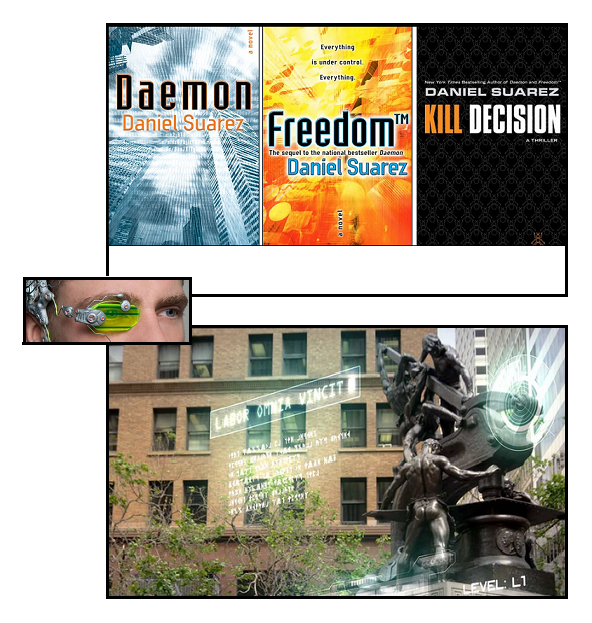
I’m about half way through Freedom(TM), the second of the books in the trilogy by Daniel Suarez which began with Daemon and (I believe) ends with Kill Decision — I’d have finished all three pretty much as fast as I could lay my hands on them if I wasn’t trying to write quite so much myself. As those who have read or are reading the books know, there’s a lot in there about the difference in perspective between those who have and don’t have “augmented reality” glasses.
Since I tend to like to have at least two lenses through which to view things — and am interested in general in what William Blake called “fourfold vision” — the topic itself is of interest me, quite aside from its potential to illuminate some pretty obscure corners of near future possibilities.
Likewise, I’d like to have some roughly parallel universe with which to compare the one Suarez is providing me with — and this video introducing a game called Ingress looks like a suitable “second lens” to set up a stereoscopic inquiry and arrive at a measure of depth:
.
I’m not looking to make a qualitative comparison between the books and the game here, just to ask if anyone with access to both would like to discuss what we can learn from juxtaposing them?
**
Because juxtaposition is key. Because, as Iain McGilchrist says in his speech The Divided Brain and the Courage to Think Differently:
There’s an oddity about the brain, which is that it makes all its everything that happens — the multifarious beauty of the world — come out of connections. It exists only to make connections.
Because, as he also says:
Relations matter more than things.
So that a marvelous counterpoint to Suarez’ fast-paced action-oriented techno-thriller imagination is McGilchrist’s slow-paced psycho-stiller contemplative approach:
.
I hope you’ll find time to appreciate them both.
[ by Charles Cameron — an intriguing resemblance, is all ]
.
.
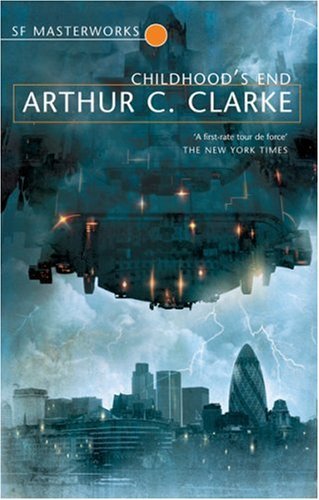
The upper image is a photoshopped (fake, fictive) image of Hurricane Sandy over New York — an image which apparently went a little viral on the web a day or two ago — while the lower one is from the cover illustration of an edition of Arthur C Clarke‘s science fiction novel, Childhood’s End, in which the aliens arrive to hover (and lord it, somewhat benignly) over us — in this case, over London.
Simply that: two images, quite different, yet curiously similar.
First, I enjoyed the book. Kill Decision is a tense, fast-moving, page-turner. As I tend to read books at night before bed, Kill Decision kept me up later than I should have been and I was reluctant to put it down. I fully agree with Shloky that this book is a movie waiting to happen.
Secondly, the plot is all too plausible. While there is some of the normal deus ex machina in action-thriller novels of this kind, readers who are knowledgeable about the defense and intel worlds will have the uncomfortable feeling that while the first lethal autonomous drones would not operate on exactly the clever and disturbing premises outlined by Suarez , they will be within shouting distance. And with all the same dangerous societal implications.
Third, likeWilliam Gibson, Daniel Suarez excels as a conceptual novelist – the writer as futurist ( a near-term futurist in the latter case) with his labor of love going into theme, setting and plot. Suarez creates dynamic hooks for his books. Unlike Gibson, character development is still a weakness for Suarez. Of all the characters in Kill Decision, only Odin, the SOF covert operative, projects real depth and motivational development; he is the Sun around which the other, mostly one-dimensional characters, orbit – including the book’s nominal protagonist. The good news is that you’ll be so wrapped up in the flow of the story that you won’t much care. I can also commend Suarez for having a George R.R. Martin kind of willingness to ruthlessly terminate his characters with extreme prejudice because it kept me wondering until the very end as to who would survive.
Kill Decision by Daniel Suarez is strongly recommended.
Zenpundit is a blog dedicated to exploring the intersections of foreign policy, history, military theory, national security,strategic thinking, futurism, cognition and a number of other esoteric pursuits.