zenpundit.com » Doublequotes

Archive for the ‘Doublequotes’ Category

Quietly now, a possibility

Monday, August 7th, 2017

[ by Charles Cameron — a comment by Hegghammer, possibly echoing Bukhari re the Khawarij ]
.

Ritual practice with greater intensity..

Very much a book to read..

  • Thomas Hegghammer, Jihadi Culture: The Art and Social Practices of Militant Islamists
  • ISIS in alliance with AQ? Taliban?

    Monday, August 7th, 2017

    [ by Charles Cameron — waiting for the wave function to collapse ]
    .

    Hm.

    **

    Sources:

  • Newsweek, Is an ISIS / al-Qaeda merger in the cards?
  • NYT, Joint Taliban-ISIS Attack Kills Dozens, Afghan Officials Say
  • Transfiguration, Tabernacles, and Yom Kippur

    Sunday, August 6th, 2017

    [ By Charles Cameron — responding to Scott, Jewish & Christian holy days ]
    .

    J Scott Shipman today sent some Zenpundit friends a post concerning The Feast of Tabernacles (Sukkot), viewed through a “Messianic Jewish” (ie Judaism-observant Christian) lens:

    As the last feast on the Sabbatical calendar, representing the final ingathering of the great harvest and the joyful celebration that will follow, the number seven is imprinted in this feast. The feast was in the seventh month, lasted for seven days, and the number of sacrifices, of which there were more than for any other festival, were divisible by seven. Little wonder that it was also called the “Feast of the Lord”.

    Following closely after Yom Kippur (the Day of Atonement), it was a particularly joyous celebration, representing the joy of those who have been reconciled to God through the forgiveness of sin. One of the names applied to this feast was “the season of our joy.”

    According to Jewish tradition the pillar of cloud and the pillar of fire which was given to guide the Israelites day and night first appeared to Israel on the 15th of Tishri, the first day of the feast. Moreover, Moses is said to have come down from the mountain and announced to the people that the tabernacle of God would be pitched in the midst of their tabernacles on this same day.

    **

    By way of response, I’d like to offer Scott and company the following post, The Transfiguration and Jewish feast days, from a liturgically traditionalist Catholic site:

    I thought it might be helpful to look at today’s feast day in the light of two Jewish feasts. Many years ago, I was bowled over by Fr Jean Galot’s observation concerning St Peter’s profession of faith. He argued that if, as many scholars accepted, the transfiguration occurred during the feast of tabernacles, then the “after six days” of Matthew 17.1 would mean that the profession of faith of St Peter in Matthew 16.16 would have taken place on the Day of Atonement. This is highly significant because the Day of Atonement was the one day in the year on which the high priest solemnly pronounced the holy name YHWH in the holy of holies in the Temple. St Peter, by his confession of faith fulfils the work of the high priests, and Our Lord in His own person is the living presence the Most High.

    There’s more at each site, naturally, and both Jewish and Christian traditions have their symbolisms as well as their festivals.

    Greetings to all.

    Sunday surprise, from dogs & muffins to Stop! & 45mph limit

    Sunday, August 6th, 2017

    [ by Charles Cameron — better eat a muffin than a dog, stop at a stop sign than blow through it at 45, oh well ]
    .

    **

    It’s cute, sorta, that AIs can’t easily distinguish dogs from muffins:

    But STOP!

    **

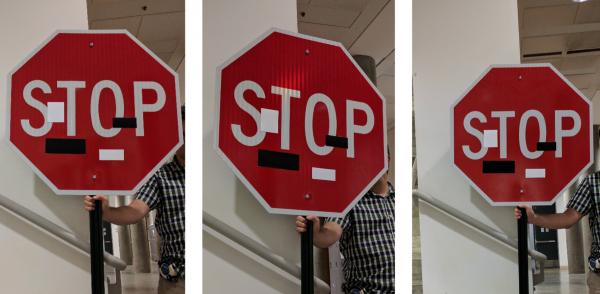
    What’s not so funny is that the AI in many autonomous vehicles misreads a treated STOP sign —

    — as a sign for a 45 mph speed limit. As Ivan Evtimov and colleagues indicate in Robust Physical-World Attacks on Machine Learning Models, “Physically realizing such an attack for road signs can raise concern in human observers.”

    I’ll say.

    Grab the wheel, conscious entity!

    **

    Readings:

  • Becoming Human: AI, Why are Marketers All Talking about AI Now?
  • Wired, Simple Pictures that State-of-the-Art AI Still Can’t Recognize
  • Car & Driver, Researchers Find a Malicious Way to Meddle with Autonomous Cars
  • Arxiv, Robust Physical-World Attacks on Machine Learning Models
  • HipBone implications of the second shoe dropping for intel analysis

    Sunday, August 6th, 2017

    [ by Charles Cameron — also, the role of the True Name in intel analysis & Ursula Le Guin’s Earthsea ]
    .

    You may know that I value the documentary film Manhunt for its lucid presentation of the process by which the finest intelligence analysts “leap” to their quarry — in which Cindy Storer notes, “not the analysts doing it, but other people who didn’t have that talent referred to it as magic”.

    In my post The process of associative memory I decribe this process, which I consider the root process of true creativity:

    There’s the present moment .. And there’s the memory it elicits.

    Compare Michael Hayden in Manhunt, at 1.19.18:

    The way it works is, information come in, you catalog it, your organize it – that little nugget there could sit fallow on your shelves for four or five years until something else comes in that’s suddenly very illuminating about something that you may have had for a very long period of time. That actually happened in the work we did to hunt for Osama bin Laden by trying to track his courier.

    By way of confirmation, here is Robert Frost:

    The artist must value himself as he snatches a thing from some previous order in time and space into a new order with not so much as a ligature clinging to it of the old place where it was organic.

    And here’s Jeff Jones on piecing together puzzles —

    Some pieces produce remarkable epiphanies. You grab the next piece, which appears to be just some chunk of grass – obviously no big deal. But wait … you discover this innocuous piece connects the windmill scene to the alligator scene! This innocent little new piece turned out to be the glue.

    **

    My point here is that the board in my “game” of DoubleQuotes provides a matrix for eliciting and annotating such leaps between fact and memory — that’s its purpose, and that’s why I believe the practice and “playing” of DoubleQuotes is, in itself, an ideal training for the analytic mind in that otherwise elusive aptitude which Ms Storer says seenms like magic to those who do not possess it..

    I believe my DoubleQuotes would be an invaluable tool for analysts in training.

    **

    Note, however, that Jose Rodriguez, speaking immediately after Michael Hayden at 1.19.55, adds a reference to the “True Name” — accompanying screencaps included — something to which as a theologian I am naturally drawn:

    It took years for the agency to recruit the human source that eventually gave us the true name. That’s why we were in the business the of condensing human intelligence because, in many cases, all these fancy gadgets and everything else won’t give you the information that you really need. A true name.

    And we finally got his true name, which is whatever it is. Whatever. Arabic name, you know. But the true name – we were able to find out a lot about him. From then on, you know, the agency was able to do what it does so well. Track the guy and find him.

    That too elicits memories, though in this case providing cultural context rather than actionable intelligence. It’s interesting to compare Rodriguez’ quote with the passages in which Ursula Le Guin describes the nature of magic in her book, Wizard of Earthsea:

    He who would be Seamaster must know the true name of every drop of water in the sea.

    and:

    He saw that in this dusty and fathomless matter of learning the true name of every place, thing, and being, the power he wanted lay like a jewel at the bottom of a dry well. For magic consists in this, the true naming of a thing.

    **

    See also:

  • Gaming the Connections: from Sherlock H to Nada B
  • Jeff Jonas, Nada Bakos, Cindy Storer and Puzzles
  • FWIW, there’s an appendix on the central spiritual significance of remembrance of the True Name in Judaism (HaShem), Christianity (Jesus Prayer), Islam (dhikr), Hinduism (nama-rupa), Buddhism (nembutsu) etc at the back of Frithjof Schuon‘s little book, The Transcendent Unity of Religions.

    On which frankly mystical note, here’s a third para from Le Guin to carry you towards Lao Tzu‘s observation that “The name that can be named is not the eternal Name” —

    It is no secret. All power is one in source and end, I think. Years and distances, stars and candles, water and wind and wizardry, the craft in a man’s hand and the wisdom in a tree’s root: they all arise together. My name, and yours, and the true name of the sun, or a spring of water, or an unborn child, all are syllables of the great word that is very slowly spoken by the shining of the stars. There is no other power. No other name.

    Switch to our mobile site