zenpundit.com » Israel

Archive for the ‘Israel’ Category

Haaretz on the Temple Mount, pt II: axis mundi

Sunday, October 7th, 2012

[ by Charles Cameron — Jerusalem, and the Temple Mount in particular, as the still point in the turning world — Midrash, Haaretz, a map from 1581, M Eliade, TS Eliot, Navaho Night Way ]
.

There is tremendous poetic force to the notion of the axis mundi, the mythic center around which all else revolves.


.

In an earlier post, I quoted this saying, which exemplifies the power of the “center of the world” motif as applied to Israel and the Temple Mount:

As the navel is set in the centre of the human body,
so is the land of Israel the navel of the world…
situated in the centre of the world,
and Jerusalem in the centre of the land of Israel,
and the sanctuary in the centre of Jerusalem,
and the holy place in the centre of the sanctuary,
and the ark in the centre of the holy place,
and the foundation stone before the holy place,
because from it the world was founded.

– Midrash Tanchuma, Qedoshim.

**

Let’s give that room to breathe.

**

There are those who will dismiss all such images and words as irrelevant, impractical, foolish, irrational — Jerusalem is not the center of the earth any more than the earth is the center of the solar system — but to a poet they are words in a familiar language, not of fact but of imagination and love. They are poetry.

Sadly, in my view, the members of the various movements to rebuild the Jerusalem Temple on or near the sites of the Al-Aqsa Mosque and Dome of the Rock on the Noble Sanctuary / Temple Mount take the poetry of the Mount as axis mundi literally and all too politically — as happens not infrequently with authentic poetry.

Phrased as political prose, the idea just isn’t the same, as these words from Shany Littman‘s Haaretz article addressed in the prequel to this post will demonstrate:

Rivka reminded us that over and above the sheer experience and the historical tales, the visit had a purpose: to understand the essence of the Jewish home through the Temple, as the visit revolved around a bride on her wedding day. Holding up a page containing what looks like a satellite image of planet Earth, she showed how, from a certain angle, the Land of Israel and Jerusalem appear to be at the center of the world, in its innermost circle. “I give lessons to women about modesty,” she said. “I show them this image and replace the word ‘modesty’ with the word ‘inwardness.’ The innermost circle, the most hidden, is the Land of Israel, Jerusalem, the Temple, the Holy of Holies. What is modesty, what is a modest, inward place? It is hidden, the place least visible to the eye.”

But the bride was contentious: “You could take that photograph from a different angle and then Jerusalem will not be in the center.” “True,” Rivka replied, “but here we see that the State of Israel is at the heart of the world. If the world knew how much it would gain from us building the Temple, they would heap good stones on us, because they will profit from it. The most prosperous countries in the world are the Western ones; China, Africa and Asia are poor.”

A questioning eyebrow was raised. “Don’t look at the industry,” Rivka said. “Look at the miserable people, who are not allowed to have more than one child and don’t have proper housing and suffer from tsunamis and earthquakes. Look at the suffering they are undergoing. And why? Because the Jewish people resides close to the Temple, the world on this side gains; where we do not reside [i.e., the East] the world loses. This is the place that coordinates and pinpoints all the prayers and the connection with the Master of the Universe. If we are not here, they lose. And we lose, too.”

and, in the words of Prof. Weiss from the same article:

I want to take the movements to a place that is more sensible: a Temple-based state, where the state’s entire content revolves around the Temple.”

**

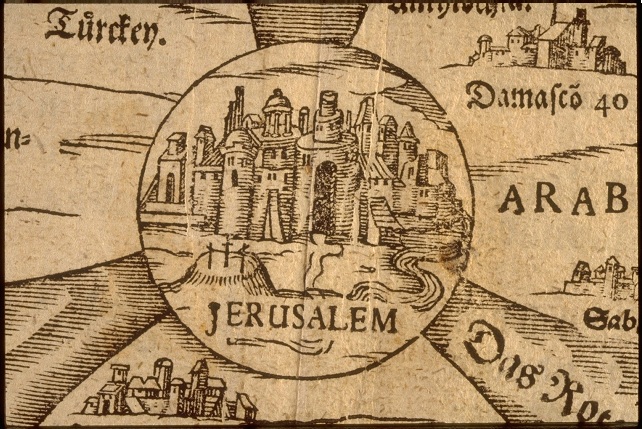
Map (above) by Heinrich Bunting from a copy of Itinerarium Sacrae Scripturae (1581) in the Jerusalem as the center of the world exhibition at the University of Southern Maine’s Osher Map Library, detail below:
**

For more on the symbolism of the axis mundi, see Mircea Eliade‘s essay Symbolism of the Centre in his book Images and Symbols — or consider these lines from TS Eliot‘s poem-series, Four Quartets:

At the still point of the turning world. Neither flesh nor fleshless;
Neither from nor towards; at the still point, there the dance is,
But neither arrest nor movement. And do not call it fixity,
Where past and future are gathered. Neither movement from nor towards,
Neither ascent nor decline. Except for the point, the still point,
There would be no dance, and there is only the dance.
I can only say, there we have been: but I cannot say where.
And I cannot say, how long, for that is to place it in time.
The inner freedom from the practical desire,
The release from action and suffering, release from the inner
And the outer compulsion, yet surrounded
By a grace of sense, a white light still and moving…

**

In many ways, both Eliot’s words and those of the Midrash remind me of the beauty found in the prayers of the Navaho Night Chant:

In beauty may I walk.
All day long may I walk.
Through the returning seasons may I walk.
On the trail marked with pollen may I walk.
With grasshoppers about my feet may I walk.
With dew about my feet may I walk.
With beauty may I walk.
With beauty before me, may I walk.
With beauty behind me, may I walk.
With beauty above me, may I walk.
With beauty below me, may I walk.
With beauty all around me, may I walk.
In old age wandering on a trail of beauty, lively, may I walk.
In old age wandering on a trail of beauty, living again, may I walk.
It is finished in beauty.

To my reading eye as a poet, these are all expressions of the same kind — invocations of the human spirit by rhythm and imagery — true poems, visions. They offer us a form of nourishment and insight not easily found today — nourishment and insight which shrivel and die when reduced to politics or prose.

**

For more on the Navaho chantways, and the balance called “sa’a naghai bik’e hózhó” which this prayer embodies, see John Farella, The Main Stalk: A Synthesis of Navajo Philosophy.

Three from Haaretz on the Temple Mount

Sunday, October 7th, 2012

[ by Charles Cameron — growth and mainstreaming of Rebuild the Temple movements in Israel, parallels with perceived slights against the Prophet of Islam, volatility of the situation ]
.

You saw the New York Times headline, New Clashes at Site in Jerusalem Holy to Both Muslims and Jews? That was just a taste, here’s more of the story:
.


.

Haaretz has posted three pieces in the last couple of days about the movement to build a Third Temple on the Temple Mount / Noble Sanctuary in Jerusalem. I’ll give you the title, link and brief summaries of for the two shorter pieces, and some significant quotes from the Longer one.

**

I’d also like to suggest considering the issues here as analogues of those in the recent “blasphemy” incidents.

We might think in terms of freedom of speech being akin to freedom of worship — but we should also consider the dangers inherent in what would likely be perceived as a huge provocation, in what may be the most volatile hot-spot on earth.

Consider: building the Third Temple might involve the destruction of the Al-Aqsa Mosque, whether by an act of God or by human intervention. Whether it would or not is in dispute, as we shall see — but as we shall also see, attempts to destroy it have already been made…

Bearing that in mind..

**

1: Temple Mount Faithful: From the fringes to the mainstream

Once consigned to messianic extremist fringes, movements fighting the ban on Jewish
prayers on Temple Mount are now endorsed by moderate rabbis. Even the Education Ministry has taken sides by encouraging pupils to visit the site.

If that’s accurate, it’s a significant shift in relation to what my American-Israeli journalist friend Gershom Gorenberg called in his book about the Mount, The End of Days, “the most contested piece of real-estate on earth” — for a quick overview of the importance of the site, see my piece of that name from July of this year.

**

2: Jerusalem Magistrate’s Court: Jews should be allowed to pray on Temple Mount

Police currently enforce the Muslim ban on Jewish prayer at the site, citing security concerns.

Put those two pieces together, and you have a sense of momentum gathering for an epic clash, one which would have immense apocalyptic significance in terms of those eagerly awaiting a Coming One in each of the three Abrahamic traditions

**

3: Following the dream of a Third Temple in Jerusalem

More than 90 percent of Israel’s religious public wants to be allowed to pray at the Temple Mount in Jerusalem. Some groups, though, wish to go even further and build a Third Temple in place of the Al-Aqsa Mosque. What fuels the dreams of these Jewish extremists?

Shany Littman, the author of this impressive magazine-length piece which is behind a paywall on the Haaretz site but has been reposted here, expresses through the voices of a diverse group of people she met and talked with, the deep-seated longing behind the movement —

I pray for it three times a day and I wanted to take seriously what I say. I say, ‘Next year in rebuilt Jerusalem.’

and the theological logic behind that —

It is the heart of Judaism. Numerically, one-third of the 613 commandments are not fulfilled today because of the absence of a Temple. The Temple is the Jewish public sphere that we lost. I want a transnational Judaism, which will encompass all the commandments.

the sacred politics —

I want to take the movements to a place that is more sensible: a Temple-based state, where the state’s entire content revolves around the Temple.

the somewhat archaic-sounding motivations involved —

the fulfillment of the three commandments the Israelite nation was given in anticipation of its imminent entry into the Land of Israel: to appoint their king and establish his kingdom, to wipe out the seed of Amalek and to build their Holy Temple.

the progress that has already been made in terms of preparation —

only two vessels that are not yet ready are the Ark of the Covenant, which cannot be reconstructed because it contained the stone tablets from Mount Sinai, and the huge external altar, on which the sacrifices were performed.

and recent trends on the part of Israeli police and politicians that seem to show an increasing willingness to allow Jews to pray in what is, after all, their holiest of holy places.

**

I have been pondering these things, and I think we can helpfully, if carefully, draw a parallel between the extreme caution with which the Israelis have approached the issue of the potential for Jewish behavior — up to and including the possible removal of the Al-Aqsa Mosque and or Dome of the Rock — enraging not just Jerusalem’s Palestinians but the Islamic world, and the far smaller provocations of Charlie Hebdo, the puerile video, and the Qur’an-burning Revd. Jones.

Consider the rules and regulations invoked by the Israeli poloice on Jewish visitors to the Mount (compare also the rabbinic decree in the “traffic sign” at the top of this post):

Because this was the month of Ramadan, no food or drink was to be brought. Also forbidden were praying, bowing, kneeling, singing and anything that might disturb the public order. And have a good day.

Prayer is banned — have I heard that phrase somewhere before?

Prayer is banned because it would be blasphemous — the ironies, the echoes, the resonances and paradoxes here are endless.

**

To understand the depth of feeling here — and remember, we are only examining the Judaic side of the issue here, and there are other perspectives in play — let’s peer a little deeper into the sacred / sacral motivation:

Sacrifice, not a very “contemporary” word but one with strong, archaic / archetypal meaning, is the heart of the Temple’s purpose:

Animal sacrifice was the primary ritual activity in the Temple. Rivka spoke of the practice yearningly. “Today it is hard to understand what sacrifice is,” she said. “When a person errs, makes a mistake, sins ? instead of bringing himself, he brings a substitute; he brings either an offering or an animal whose blood atones for his soul. This is something we have lost today. The media always talks about korbanot [the Hebrew word “korban” means both “sacrifice” and “victim”] ? victims of traffic accidents, victims of the peace process, victims of terrorism. And I say to myself, despairingly, that there is a place for korbanot ? and it is here. And what is the root of the word ‘korban’? It is from lehitkarev, to draw closer. To draw closer to Hashem.

Indeed, the sacrifice of a red heifer is widely believed to be necessary to purify those who would enter the Temple grounds — note in this next paragraph the reference to the return of the Messiah:

According to religious belief, until the ashes of a red heifer are obtained, access to the courtyard of the Temple is prohibited for Jews (see Numbers 19:1-22 and Mishna tractate Parah). Water mixed with the ashes of a red heifer can cleanse people of the impurity of the dead, which clings to everyone. Tradition holds that there have been only nine ritually suitable red heifers, and that the 10th will appear upon the advent of the Messiah. The absence of the ashes of a red heifer, with the concomitant inability to become ritually clean, is one of the reasons that many Jews are unwilling to visit the Temple Mount. However, the Temple movement activists claim this is only an excuse, and that there is no problem obtaining a red heifer today.

**

Now back to “on the ground” realities — and risks, including the risks of terrorism and war.

This situation of contesting claims to one of the world’s most sacred sites the has been simmering for quite some time, and I think the gist of the three Haaretz articles could be read as “the stew’s beginning the bubble”.

For another glimpse of the potential volatility of the situation, we can turn to a decade-old piece by Jeffrey Goldberg in the NYT — though if the situation is as significant as I take it to be, you’d also be well-advised to read Gershom Gorenberg’s book The End of Days.

Back in 1999, Goldberg wrote a piece which carried the sub-head:

There are Jews who want to seize the Temple Mount by any means necessary. And Christians who want to see the Jewish Temple rebuilt — and destroyed to bring on Armageddon. And Muslims who will never give up the Dome of the Rock. Will the peace process be stalled by the apocalypse?

It’s a long magazine piece, and like Littman’s piece for Haaretz, well worth pondering. Here I’ll just pull a couple of excerpts that touch on how Temple movement participants view the possible repercussions of their actions. Gershon Salomon is the leader of one such movement, and not infrequently raises funds addressing Christian audiences.

“The mountain is within reach,” Salomon told me. “God is waiting for us to move the mosques and rebuild. The Jews may not be ready, but the Christians are.”

In Casselbery, I saw Salomon work the Christian congregants into a flag-waving — Israeli flag waving — frenzy. After, as the congregants lined up to give Salomon checks and even their jewelry to pay for rebuilding the Temple, I asked him, “Do you think these people believe that God will remove the Dome of the Rock, or that man must remove it?”
He smiled beatifically.
“They know that God will make this miracle happen.”
By the hand of man?
“Only God knows.”

[ … ]

I ask him how he would feel if someone blew up the Dome of the Rock.
“The question is, Why did they build their mosque on our holy mountain, anyway? Who gave them permission? God didn’t.”
Would you be saddened if the destruction of the Dome of the Rock led to war?
“I don’t think it will come to that. The Muslims know in their heart that this belongs to us.”
“But what if it did lead to war?”
Salomon smiled. “The Temple will be a reality. God has promised it.”
But what about war?
“O.K.,” he said impatiently, “so we’ll have a war.”

Returning to the Haaretz magazine piece, we can perhaps temper that last remark with a word of moderation.

Journalist Arnon Segal is the activist son of a member of the Jewish Underground of the 1980s — one of whose leaders, Yehuda Etzion, plotted to blow up the Dome of the Rock. His views are accordingly of considerable interest.

Contrary to the usual image of those who are involved with the Temple, they are a great deal more soul-searching and hesitant than people think. People did not want to join with Yehuda Etzion, who was the one who raised the idea [of blowing up the mosque].

“I think it is nonsensical to blow up [Al-Aqsa Mosque]. We would not have achieved anything by doing that. That is not how to solve issues. The Arabs are against the Jewish presence on the Temple Mount as such. If the State of Israel were to permit sacrifices to be made, that would already be enough to make me jump for joy. Obviously my inspiration is from home, but not from a fanatic place. I was not brought up to hate Arabs. But an as-yet unattained Jewish national purpose and the concept of the Temple Mount? those are definitely notions I got at home.”

Segal insists that the debate over the Temple Mount is basically an internal Jewish issue and is not related to the conflict with the Arabs. “I am not an enemy of the Arabs. I do not say that I don’t want Arabs on the Mount. Even Rabbi Dov Lior said that all nations are permitted to pray on the Mount. We will not tell others not to pray to God on the Mount, even though the Muslims do not respect our right to pray there. I am ready to leave them Al-Aqsa. But Al-Aqsa is not the whole Mount.”

And here is Segal’s pragmatic evaluation of the risk:

I don’t think the Arab states are lovers of Zion, even now; if they could destroy us, they would already have done it. The Temple Mount will not irk them more than other things.

Would you want to test that hypothesis in “real life”?

Let not thy left hand know what thy right hand doeth

Tuesday, October 2nd, 2012

[ by Charles Cameron — this post is about comparisons — what you make of them, and what they make of you, death calculus, and Handel ]
.


.

Scraped from my morning read, these two quotes — a tweeted headline from Breitbart and a gobbit of the Jerusalem Post — neatly illustrate a paradox I’ve been wrestling with, the way more profound souls wrestle with angels [link is to Rilke].

It’s the paradox of comparison.

**

On the one hand, I can barely imagine what it would be like to build — with, say, enough funds for a latter-day Manhattan Project — a Department whose job it was to monitor all activities and ensure even-handedness in the allocation of resources.

So that not ever would a Presidential aide on vacation receive a security detail until each and every ambassador had an equivalent force of marines around them at any given moment, in embassy or out.

I mean, what about consuls, or CIA heads of station — are they ambassadorial enough? Members of the cabinet on vacation? Members of the National Security Council? How far do we need to go with our even-handedness? Is Benghazi different from London? Londonistan?

How would one possibly assure oneself that no “hand” of government, left, right, center, upper, lower, or oblique to all of the above, ever arranged things in a way that compared foolishly with the way some other “hand” of government had arranged something more or less similar?

**

Let’s go to what my friend Bryan Alexander calls the death calculus. Since we’re interested in terrorism here, I’ll pull quotes from a couple of pieces that you can read in full if this topic interests you. Two paras from TomDispatch:

In 2008, 14,180 Americans were murdered, according to the FBI. In that year, there were 34,017 fatal vehicle crashes in the U.S. and, so the U.S. Fire Administration tells us, 3,320 deaths by fire. More than 11,000 Americans died of the swine flu between April and mid-December 2009, according to the Centers for Disease Control and Prevention; on average, a staggering 443,600 Americans die yearly of illnesses related to tobacco use, reports the American Cancer Society;5,000 Americans die annually from food-borne diseases; an estimated 1,760children died from abuse or neglect in 2007; and the next year, 560 Americans died of weather-related conditions, according to the National Weather Service, including 126 from tornadoes, 67 from rip tides, 58 from flash floods, 27 from lightning, 27 from avalanches, and 1 from a dust devil.

and:

The now-infamous Northwest Airlines Flight 253, carrying Umar Farouk Abdulmutallab and his bomb-laden underwear toward Detroit on Christmas Day 2009, had 290 passengers and crew, all of whom survived. Had the inept Abdulmutallab actually succeeded, the death toll would not have equaled the 324 traffic fatalities in Nevada in 2008; while the destruction of four Flight 253s from terrorism would not have equaled New York State’s 2008 traffic death toll of1,231, 341 of whom, or 51 more than those on Flight 253, were classified as “alcohol-impaired fatalities.”

Two paras from a Salon piece [copied here sans links and emphases]:

“The number of people worldwide who are killed by Muslim-type terrorists, Al Qaeda wannabes, is maybe a few hundred outside of war zones. It’s basically the same number of people who die drowning in the bathtub each year,” said John Mueller, an Ohio State University professor who has written extensively about the balance between threat and expenditures in fighting terrorism.

Last year, McClatchy characterized this threat in similar terms: “undoubtedly more American citizens died overseas from traffic accidents or intestinal illnesses than from terrorism.” The March, 2011, Harper’s Index expressed the point this way: “Number of American civilians who died worldwide in terrorist attacks last year: 8 — Minimum number who died after being struck by lightning: 29.” That’s the threat in the name of which a vast domestic Security State is constructed, wars and other attacks are and continue to be launched, and trillions of dollars are transferred to the private security and defense contracting industry at exactly the time that Americans — even as they face massive wealth inequality — are told that they must sacrifice basic economic security because of budgetary constraints.

**

My points?

On the one hand, that the world is far too complex to avoid disparities that can draw mockery down on the heads of those one might wish to mock.

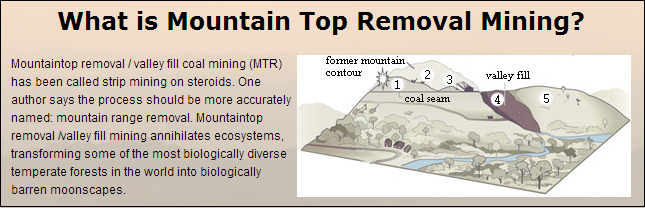
And on the other, that comparisons also have an invaluable role to play in giving us a sense of the relative peaks and valleys of the terrain we live in — and may be literally or metaphorically mountaintop removal / valley fill coal mining in preparation for our children’s children…

**

Here’s a “DoubleQuote” for you:

Or for the musically inclined:

Now there’s a fascinating comparison (between the mining and the music) that doesn’t tell you much. Or does it?

**

Onwards to the issue of that sacred plateau in Jerusalem, featured as my second “reading for the day” at the top of this post.

It appears that you can be arrested for carrying a concealed knife on the Noble Sanctuary — or tallit or tefillin on Temple Mount — same place, different perspective.

That’s the sort of comparison that makes me catch my breath with wonder.

As the Famous Thinkers School might ask, giving you a pencil and a blank sheet of paper: can you draw this conclusion?

**

The full text of Matthew 6.3 reads in the KJV:

But when thou doest alms, let not thy left hand know what thy right hand doeth:

Marangolo P and associates uses a significant variant of that verse in the title of a learned paper: Let not thy left hand know what thy right hand knoweth. The case of a patient with an infarct involving the callosal pathways.

Brain malfunctions (and brain surgeries) can provide windows of considerable interest on our human condition, as the writings of Oliver Sacks so eloquently demonstrate.

Graphic matches?

Thursday, September 27th, 2012

[ by Charles Cameron — Netanyahu’s UN speech, Jyllands-Posten cartoon, a nifty film technique, and is there an echo there? ]
.

**

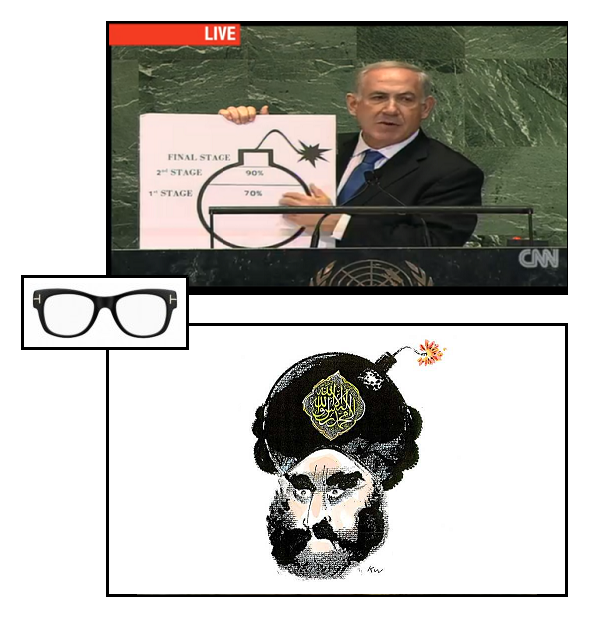
A fair number of people have commented on Israeli PM Netanyahu‘s displaying a cartoonish bomb graphic in the course of his UN address today, and some have complained, fairly IMO, at the choice of photo used to depict Netanyahu during his speech by eg Fox News:

I think it’s important to read graphic messages closely for the cues they contain.

**

Sometimes, as with images of the Virgin Mary seen in grilled cheese sandwiches or oil slicks, the correspondences don’t really mean much more than that the brain is designed for pattern recognition, and a little “imagination” without critical appraisal can get things wrong: the terms commonly used for this are apophenia, patternicity and pareidola.

My own favorite example of this phenomenon is of the wall-stain in a school in the East Bay that was recognized as the Virgin Mary by Catholics and the bodhisattva Kuan-Yin by Buddhists

Nonetheless, I’m reluctant to ridicule such modes of perception without also recognizing the utility of Rorschach blots in psychology and the even more creative uses to which Leonardo put them.

**

Perceived visual similarities, in short, can be the result of creative or merely overheated imagination, but in the visually sophisticated they become much more.

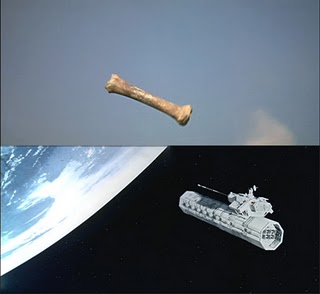
Film-makers, in particular, have several names for the kind of skillful editing by which one scene segues into another via a well-chosen visual similarity: match cut and graphic match.

My personal favorite example is that of Apocalypse Now, where the rotors of the fan in that claustrophobic hotel room in Saigon morph into the rotors of the helicopter coming to take Captain Willard out and away on his mission up river…

Perhaps even more celebrated, though, is Kubrick’s match between the bone tumbling through the air and the space station tumbling through space, in 2001: A Space Odyssey:

**

To get back to Netanyahu, then — is his hand held out a little above vertical, palm down, really a Hitler salute? I think not.

And does his image of a bomb carry any resonance from the Jyllands-Posten cartoon? I have to admit I’m almost undecided on that one.

And if there’s just a hint of a correspondence, would it be conscious or unconscious?

**

The thing is, politicians have to be extremely careful about tossing graphic matches onto dry kindling.

To my own way of thinking, both Netanyahu’s “cartoonish bomb” graphic and his “mid-heil” salute are potential fodder for incautious speculation — but neither one is even remotely as far-fetched as Jerome Corsi‘s claim in a recent WND that a recent Obama campaign use of the Stars and Stripes (above, upper panel) — in admittedly terrible taste — suggests that Obama in any way favored the decease of Ambassador Christopher Stevens in Benghazi (lower panel).

**

My point here, as so often, lies not in any political content or conclusion, so much as in a general purpose invitation to persons of intelligence (and a fortiori, intel) to watch out for possible graphic matches, to make close and cautious readings of visual as well as textual data — in short, to take a closer look

Lang, Francona et socii on an Israeli strike

Sunday, September 23rd, 2012

[ by Charles Cameron — a quick recap of Col. Lang & Lt. Col. Francona on the realities of an Israeli strike on Iranian facilities, 2006-2012 — and the recent WaPo trilogy ]
.

Nuclear and missile sites, 2008, credit: Stratfor

.
I posted here a while ago about what happens when “religious leaders talk of wiping nations off the map” — quoting the Iranian Ayatollah Khamenei and the Shas Rabbi Ovaida Yosef — and unobtrusively included the question:

Do the logistics back the rhetoric up?

Or so I thought.

**

Srikanth R of the Takshashila Cyber Strategy Studies team picked up on that supposedly unobtrusive question, though, so maybe it wasn’t so unobtrusive.

The thing is, it’s a solid, material, practical, down to earth realist’s question… and behind it, behind my dropping it into that post, is a memory of Col. Pat Lang, the blogger at Sic Semper Tyrannis, pointing his readers to that question quite a while back, in the form of a post by his one-time DIA deputy, Rick Francona back in 2006. Any “intelligence” in my question is strictly theirs.

I thought then, and I think now, that logistical considerations are as important as potential messianic-mahdist echo-chambers or statements by Israeli intelligence figures or American Chairman of the Joint Chiefs to bear in mind when considering the potential for an Israeli attack on Iran.

This is not an area that I consider myself informed about, so I thought I’d check back and see what Lang and Francona have had to say on the issue over the intervening years…

**

Rick Francona: flight routes, 2006

**

Here are a bunch of other places where Lang, Francona et socii discuss such matters, in what I believe is a sequence by date:

http://francona.blogspot.com/2006/03/iran-israels-air-strike-options.html
http://francona.blogspot.com/2008/06/iran-israels-air-strike-options-update.html
http://turcopolier.typepad.com/sic_semper_tyrannis/2008/06/overflight-clea.html
http://turcopolier.typepad.com/sic_semper_tyrannis/2008/09/ask-the-iraqi-g.html
http://turcopolier.typepad.com/sic_semper_tyrannis/2009/05/sounds-like-a-plan-iranisrael.html
http://turcopolier.typepad.com/sic_semper_tyrannis/2009/05/haaretz-article-on-iranian-realities.html
http://turcopolier.typepad.com/sic_semper_tyrannis/2010/11/israeli-planning-considerations-harper.html
http://turcopolier.typepad.com/sic_semper_tyrannis/2012/02/can_israel_stri.html
http://turcopolier.typepad.com/sic_semper_tyrannis/2012/04/an-israeli-iran-war-what-would-it-look-like-by-richard-sale.html
http://turcopolier.typepad.com/sic_semper_tyrannis/2012/08/yaalon.html

**

From that last URL, here’s the most recent map in the series:

**

And is that all?

Over the last few days the Washington Post has published a three-part “essay” on an Israeli strike on Iranian nuclear facilities. I’ve already quoted from David Ignatius‘ contribution in a comment on ZP, but that was about a different aspect of the thing. Here are links to the three parts:

Azadeh Moaveni, What if Israel bombed Iran? The view from Tehran
Anat Berko, If Israel bombed Iran, what would life in Tel Aviv be like?
David Ignatius, Lessons from an Iranian war game

**

Again, let me emphasize that I don’t know about logistics, but that I suspect Col. Lang does. You might think three points of view was enough to get a decent overview of the situation. You might believe that a war game conducted by a cluster of intelligent specialists would be enough…

Just for the record, Col. Lang obviously still thinks we’re missing the point. This is from his Sic Semper Tyrannis blog, today:

A general defect of the thing is the complete ignorance reflected of the actual limitations of distances, weapons, numbers of aircraft and missiles, Iranian air defenses, the lack of any recovery air fields between Israeli bases and the targets or SAR capability for the attacking Israeli force. Basic military knowledge of the situation is ignored in the manner common in politico-military strategic war games. In these “games” any reference to actual limitations are airily waved off as not germane. In this essay it is suggested that one option is for the US to “shoot down’ the attacking Israeli force before it passes beyond Iraq. The Joe Biden character angrily says that this is not an option. He is correct but not for the reason implied. In fact, since the completion of the US withdrawal from Iraq the US has no ability to do such a thing and neither do the Iraqis. The nearest USAF assets are in the Gulf or Turkey and the nearest US Navy assets are where the carriers may be. Look at the distances.

**

Comments?


Switch to our mobile site