zenpundit.com » graphical thinking

Archive for the ‘graphical thinking’ Category

Of the arm, fist and rifle

Thursday, July 25th, 2013

[ by Charles Cameron — product from a neat, brief convo with Ibn Siqilli aka Chris Anzalone ]
.

I found the upper image in the same Visual References post from Chris Anzalone that I recommended recently in two comments here [figs 2, 3, 3B] and here. If you look closely — or is just my poor eyesight? — you’ll see the arm, fist and rifle to the left of the black banner in the upper half of the upper image.

Black banner? Did I just say black banner?

That upper image is the “logo of the Brigade of the Awaited Savior (Katibat al-Mahdi al-Muntazar)” according to Chris, and the text below reads, “O’ One Who Arises (al-Qa’im) [from] the family of Muhammad.”

So there you have Mahdism (the titles al-Muntazar and al-Qa’im are both indicators of the same returning great one as the term al-Mahdi itself) along with the well-known banner…

**

What follows I have taken from a post on the Lebanese Expatriate blog, with some minor format changes to give the contents better graphical integration with the rest of the post:

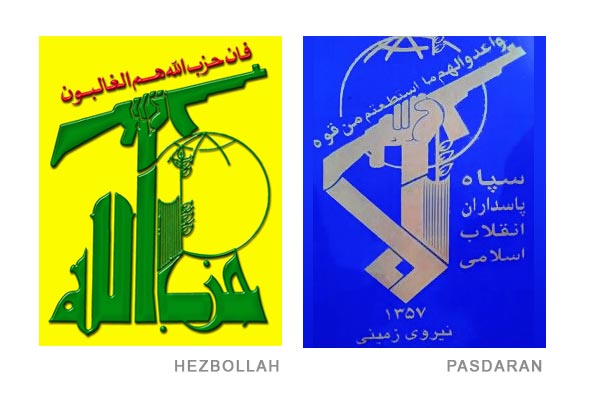
For those with the slightest knowledge about Hezbollah and the Middle East, I am not sharing with you something new, but for those who receive this information as a revelation, check out the resemblance between the emblem of Hezbollah and that of the Pasdaran, a.k.a Army of the Guardians of the Islamic Revolution.

.

— Hezbollah emblem to the left in yellow. Pasdaran emblem to the right in blue.
.

So what’s new? Why am I shedding light on what is already obvious? Why target Hezbollah today, out of all the parties that have been selling Lebanon?

Today, more than ever, Hezbollah and Iran owe Lebanon an explanation. Take a look at the 10 Riyal postage stamp that is circulated in Iran.


Iranian 10 Riyal postage stamp showing the emblem of Hezbollah covering the whole map of Lebanon. A clear symbol of the hidden intentions and a direct breach for the sovereignty of Lebanon’s independence as a nation.

The stamp commemorates the martyrs of Hezbollah in Lebanon. Isn’t this an obvious breach of Lebanon’s sovereignty as a nation? I understand the bff relationship between Iran and Hezbollah, but why does Iran need to have Hezbollah’s emblem covering the Lebanese territories instead of the Lebanese flag? Why does Iran need to commemorate the Lebanese martyrs in the first place?

What does Hezbollah have to say about this in the first place? How can Hezbollah justify such a demeaning document? What can its big-bellied, tie-less MPs and representatives say to logically justify this? Will they even attempt to justify it, or consider it normal and not even worth concealing with the whole world’s knowledge of its non-matrimonial marriage to Iran.

As a Lebanese, I ask my government (which is controlled by Hezbollah) to question the Iranian ambassador about the motives of this stamp and ban its circulation.

As a Lebanese, I ask Hezbollah to denounce the usage and circulation of this stamp in Iran and ask the Iranian state for an apology to the Lebanese people and its government.
That’s taken from a post made in January, but I think it is no less relevant today, and adds to the general picture I’m painting.

**

I put this post together as the result of an exchange with Chris in which I asked him whether a raised arm with slanted rifle was now a characteristic motif across many or all Shi’a jihadist movements, to which he responded:

Those groups influenced by Hizbullah &, by extension, Iranian Gov’t, seem to favor it, likely b/c it’s used by the Pasdaran.

I then asked whether he’d say Hizbollah got the motif from the Pasdaran or vice versa, to which he replied:

The former.

I stumbled across the DoubleQuote image and accompanying Lebanese Expatriate post myself, searching for the best image of a Pasdaran flag or logo while following up on Chris’ pointer to the Pasdaran — and that gave me yet another use of DoubleQuotes in the wild!

Hat-tip, #FF and thanks, Chris!

**

Quiet note to self: compare the arm, fist and rifle motif here with the name of the Covenant, Sword, and Arm of the Lord group in 1970s Arkansas. Most interesting, the way we display value systems in titles and images…

From the Comments section: jihadist use of DoubleQuotes

Thursday, July 25th, 2013

[ by Charles Cameron — comments on two posts by Chris Anzalone aka Ibn Siqilli ]
.

I’m bringing across two comments of mine from DoubleQuotes in the wild and making a separate post out of them — to give them more exposure, to emphasize the importance / interest of the two posts by Chris Anzalone that they are based on — and to be able to reference them in a post I’m currently working on. Both graphics are drawn from Chris Anzalone‘s Visual References post from last month, which gives essential visual support to his article, Zaynab’s Guardians: The Emergence of Shi`a Militias in Syria in the CTC Sentinel, just out.

Here’s the first, with Chris’ comment below:

Nasrallah & Bashar with the Qur'an (Poster)
.
An Internet poster showing Hizbullah’s secretary-general Hasan Nasrallah (right) and Syrian president Bashar al-Asad. The photograph of Nasrallah was taken after the 2006 Hizbullah-Israel war and has clearly been edited to show light emanating from the book (presumably the Qur’an). The same is true of the posed image of al-Asad. Both are shown by the designer as pious (thus, presumably, deserving of support).

This pair ties the piety of the politician with the piety of the cleric, making a conceptual bridge between both Lebanon & Syria on the one hand, and politics & religion on the other. Not terribly surprising, but still, cleverly done.

**

The use of “doubling” in the double cannibalism images presented below some from a little further into the same Visual References post, but serve a different function, making an association in time rather than one linking two contemporaries… They are designed to suggest that present Sunni brutalities have historical precedent — with tremendous spiritual and emotional resonance. Again, Chris’ own comment contextualizes the images:

1, Hind & Abu Sakkar the Syrian Rebel Heart-eater
.
Internet poster comparing Abu Sakkar, commander of a Syrian rebel group, (right), who committed a politically symbolic act of cannibalism on video with an organ (said to have been the liver or heart) from a slain Syrian government soldier in May 2013, and Hind bint ‘Utba (left), one of the Prophet Muhammad’s most virulent enemies before his conquest of Mecca in 630 C.E. In some Islamic historical sources, she is said to have taken a bite of the liver of the Prophet’s uncle, Hamza bin ‘Abd al-Muttalib, who was also one of his greatest warriors, after the Muslims’ defeat at the Battle of Uhud near the city of Madina. The text at the bottom reads: “Some stick to their habits and traditions!!,” referring to Sunni Muslims. The image of Hind and Hamza is a still from Syrian film director Moustapha Akkad’s famous 1977 film The Message about the beginnings of the prophetic career of Muhammad, the founder of Islam. Akkad was one of those killed in a bombings of hotels in ‘Amman, Jordan carried out by Al-Qa’ida in the Land of the Two Rivers/Iraq, then led by Abu Mus’ab al-Zarqawi.

Taken together, the two “doublets” linked to above can add rich spoils to our understanding of Shi’a contributions to what Chris calls “the increasing sectarianization of Syria’s civil war”.

Redux: I’d like to game an idea entering a mind

Tuesday, July 9th, 2013

[ by Charles Cameron — another angle on the whole idea of qualitative node-&-edge graphs for concept mapping ]
.

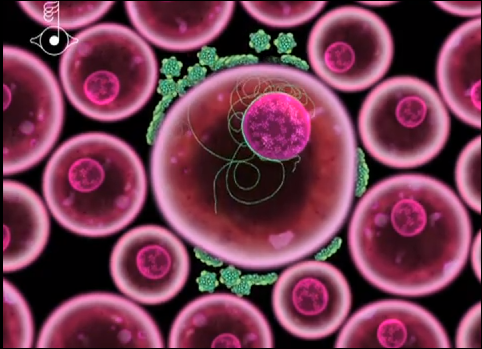
Image of a virus letting its DNA loose in a cell, from the Bjork app-game-song

The other day I found myself re-reading a comment I’d made on Zen’s post The Games People Play back in January 2008, which I’d been searching for in the back of my mind for months — too attic-like and cobwebbed, probably not the best place to look for it. In any case, now I’ve found it I’ve dusted it off and offer it here for your consideration:

**

Ideas can be infectious.  We know this, and thus we can explore the spread of ideas using models drawn from epidemiology, an approach which Malcolm Gladwell takes in his book Tipping Point. Ideas can also be viewed as existing in an ecosystem, and thus what we know of genetics can be applied to them, as Dawkins suggested in coining the term "meme". Having said that, I’d still like to game an idea entering a mind.

Specifically, I would like to game the way in which the idea that constitutes "martyrdom" (shahada) in an al-Qaida mind enters a mind that’s primed with the ideas of Tablighi Jamaat, for instance, and once it’s "in," conforms the idea of "obligation" (fard) that’s already present in TJ’s non-violent and apolitical version into the al-Q sense of the word — that "to kill the Americans and their allies — civilians and military — is an individual duty (fard ‘ayn) for every Muslim who can do it in any country in which it is possible to do it"… I’m thinking of something along the lines of the kind of research that allows someone to write, describing the John Cunningham virus (JCV):

the JC virus enters the central nervous system by fastening itself to the 5HT2AR receptor for serotonin, which is found on the surface of glial cells.  When this receptor for serotonin is triggered, it opens the pathway that allows the virus to enter the cell.

The thing is, we can manage a very brief verbal sketch of how an idea enters a mind and becomes part of a person’s "thinking" — and we can model in some detail the way that an idea spreads through a population — but we’re not very good at modeling, or gaming, thought processes.  And from my POV, that’s the most fascinating challenge of all.

My question is: what kind of game should this be, how do we set up the board, what markers shall we have for ideas or parts of ideas and for views or congregations of ideas, what rules do we need to use in combining them, etc — how do we get as close to a mental conversation as humanly possible?

I happen to think that meditators will have quite a bit to teach us here, that the Tibetans may have a better vantage point than we as a culture do… because they’ve been watching the mind, and in particular watching its various coiled springs uncoil, and putting the process into words, for longer than we have. But it will take a whole new series of aha!s to really figure this out.

**

The result wouldn’t look like the image at the top of this post — it might look more like a PERT chart, but with sequences of ideas rather than actions. And it would be based on narratives, not theories. Above all, it would be multi-voiced, polyphonic, fluid — like that diagram from Edward Tufte about the Ocean of Stories:

That’s it — what say you all?

The Bjork Virus video can be found here, the Virus app-game-song can apparently be downloaded here.

Videos, the counter-nasheed and some dancing girls

Sunday, June 30th, 2013

[ by Charles Cameron — further notes from the frayed edges of what’s significant ]
.

Okay, you all know I’m interested in the graphics of terrorism and their symbolism, and only a day or two ago I posted Of dualities, contradictions and the nonduality on the two into one phenomenon — well, here’s an addendum:

**

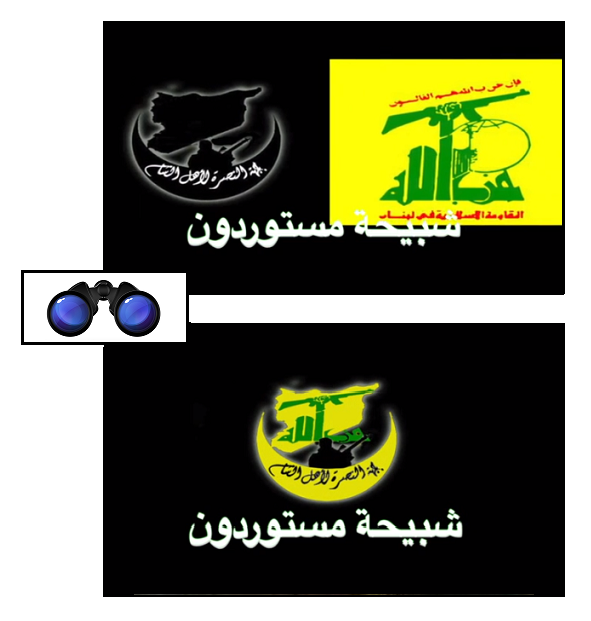
The upper image, showing the Jabha al-Nusra logo — Sunni, left — alongside the Hezbollah insignia — Shi’a, right — morphs into the single image in the lower panel, thereby resolving the sectarian conflict in Syria by filmic means.

The video from which these two shots were taken, alas, was the work product of the US Government, as part of an effort of outreach by the little-known Digital Outreach Team at the State Department, who at the time of writing appear to have 193 videos uploaded.

The BBC notes:

According to the Associated Press news agency, the 50-member Digital Outreach Team tweets, posts Facebook updates and uploads video to YouTube in Arabic, Punjabi, Somali and Urdu, in a bid to counter the radical jihadist message. It seems it’s even had exchanges with terror suspects such as US-born militant Omar Hammami, a former member of Somalia’s al-Shabab.

The two images above were taken from a video titled Secret meeting between Hassan Nasrallah and al-Zawahiri, but the Beeb’s article focused on what it termed a “spoof Al-Qaeda video”, which I’ll call Pharaoh Ayman speaks to the dancing girls for want of a better name:

The team’s al-Zawahiri spoof opens with a notice that “fizzy drinks should be consumed while watching this production” – a twist on the usual message at the beginning of al-Qaeda videos saying “it is not permitted to add music to this production … Taking the classic preaching-to-camera format, the three-minute clip features a voiceover in which the Egyptian-born militant repeatedly bungles his speech by saying things like: “The butchers, ahem, sorry, I mean the mujahideen”. In the video – issued by the US State Department’s Digital Outreach Team – al-Zawahiri is backed by punkah-wallahs. The clip then cuts to a shot, as though from behind the speaker, to reveal a troupe of dancers performing in front of him.”

But see for yourselves, punkah-wallas and all:

For your further Sundance consideration, and from the same studios, you might also like the lowest and slowest nasheed ever recorded.

**

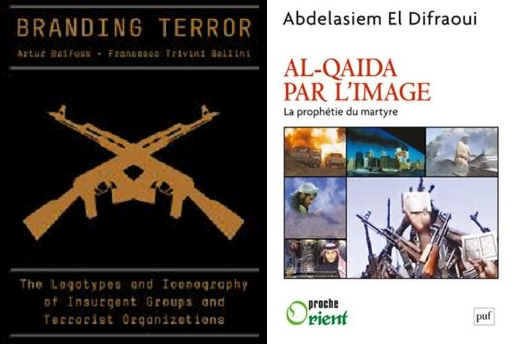
Speaking of graphics — coming up on ZP when I have had a chance to read a little more of El Difraoui, reviews of:

  • Beifuss and Bellini, Branding Terror
  • Abdelasiem El Difraoui, Al-Qaida par l’image. La prophétie du martyre
  • Pilgrim visas, the Hajj, and MERS-CoV

    Tuesday, June 11th, 2013

    [ by Charles Cameron — it’s all a matter of concentric circles and the integration of the vertical — ibn Arabi ]
    .


    .

    The concentric circles around the Kaaba ripple out across our world. This means we should be watchful at the intersection of three overlapping regions in a Venn diagram: pilgrim visas, MERS-CoV epidemiology, and pilgrim dispersal.

    John Burgess of Crossroads Arabia is the only one I know focusing on the conjunction, see his Saudis Restrict Pilgrim Visas.

    The point I’d like to be hinting at here is that whereas MERS-CoV epidemiology is a scientific monitoring and interpretive matter using Science Rules, and visa issues are mostly matters of bureaucracy, the Hajj itself is a matter of the most passionate devotional concern, and a “purely rational” understanding will hardly scratch its surface.

    **

    Those with a mixture of poetry and scholarship in their souls may wish to read Love Letters to the Ka’ba: a presentation of Ibn ‘Arabi’s Tâj al-Rasâ’il to glimpse the Kaaba as seen by the al-Sheikh al-Akbar, Muhyiddin ibn Arabi:

    Charles-Andre Gilis has pointed out that in the Islamic tradition the Ka’ba symbolises the centre of every state of Being, as is demonstrated by the tradition recorded by Ibn ‘Abbas according to which there exists a Ka’ba, similar to the one belonging to our world, in each of the seven heavens and seven earths (cf. La Doctrine Initiatique du Pélerinage, Paris, 1982, pp. 45-6). In the introduction to the Tâj, Ibn ‘Arabi refers to the Visited House (al-bayt al-ma’mûr), situated in the seventh heaven, the celestial prototype of the Ka’ba (p. 557).

    As Gilis also observes, the Ka’ba is perceived by Ibn ‘Arabi as a manifestation of the divine Essence (Tâjallî dhâtî). However, he situates it, due to its mineral nature, in the lowest level of Being. But it is precisely the inferior character of its external aspect that allows it to sustain the ladder of beings and to identify itself on each level. It is thus described as “celestial constitution, angelic reality, young girl with formed breasts, level of the perceptible realm, and Meccan dignity (at the same time this constitutes an excellent example of the assonances of his rhymed prose: nash’a falakiyya wa haqîqa malakiyya wa jâriya falkiyya wa martaba mulkiyya wa rutba makkiyya) (p. 555).” Ibn ‘Arabi himself is astonished at the number of contradictory aspects that this being is able to bring together: “Oh marvel: divine constitution, simil (mithliyya), angelic, human, superior and inferior in which we find validity and deficiency, multiplicity and scarcity.” (p. 556)

    The devotional aspect of the Hajj is orthogonal to the realism of bureaucracies and epidemiology — but not on that account any the less powerful!


    Switch to our mobile site