zenpundit.com » graphical thinking

Archive for the ‘graphical thinking’ Category

A feast of form in my twitter-stream today

Sunday, June 2nd, 2013

[ by Charles Cameron — forms & patterns, pattern recognition & creative leaps, creative leaps & connecting dots, connecting dots & node-and-edge mapping — node-and-edge mapping, link charts and Sembl-HipBone games ]
.
.

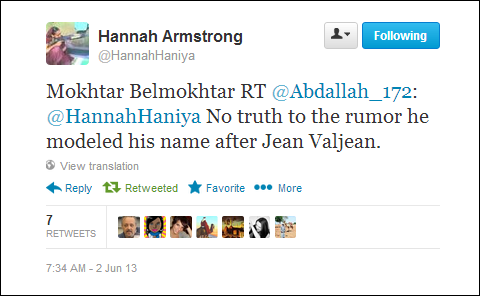
There’s no “actionable intelligence” in that tweet, but it recognizes a pattern, it makes a fine creative leap. And given the chance, that’s something bright minds do naturally, and enjoy doing, and is away more important than we think.

Yestedrday I was watching Manhunt pretty closely for an upcoming Zenpundit review, and noticed that some of the most significant quotes in the film were absent from CNN’s transcript. One gap I noticed had to do with the descriptions of the analytic process, and in particular some of the things Cindy Storer said. I’ll quote this one, which goes to the heart of the matter, but there’s plenty more left for me to chew over with you later. Here she goes:

Even in the analytical community there’s a relatively smaller percentage of people who are really good at making sense of information that doesn’t appear to be connected. So that’s what we call pattern analysis, trying to figure out what things look like. And those people, you really need those people to work on an issue like terrorism, counternarcotic, international arms trafficking, because you’ve got bits and pieces of scattered information from all over the place, and you have to try to make some sense of it. … That takes this talent, which is also a skill, and people would refer to it as magic — not the analysts doing it, but other people who didn’t have that talent referred to it as magic.

That’s a pretty exact description of what the Sembl game will eventually teach people, once it comes out of the museum prototype and onto the web — but let’s back it up with a quick quote from Wittgenstein:

A surveyable representation produces precisely that kind of understanding which consists in ‘seeing connections’ [Zusammenhänge sehen]. Hence the importance of finding and inventing connecting links. Hence the importance of finding and inventing intermediate links.

That’s from Philosophical Investigations, 122, and it’s a higher altitude / more abstract view — but it’s also the very heart of network thinking, seeing processes not just in terms of isolated nodes but of the connections between them.

**

Seeing connections — connecting the dots — happens in lines and leaps. That is to say, it can happen according to the usual linear way of thinking, the dogged 99% of perspiration that people talk about — or according to the far less common lateral move or creative leap, which moves by analogy, which is to say by pattern recognition, by the perception of similarities of form.

That’s the 1% we call inspiration. That’s the magic.

**

So a whole lot of patterning was going on in my twitter-stream today, and I thought I’d show you.

First, there was the parallel between the names Mokhtar Belmokhtar and Jean Valjean (above). If you’re hunting either fellow, the parallelism isn’t going to yield a useful clue — but the mode of recognition is what matters, and the reason its such a rare mode is precisely because it’s playful. It plays with forms — in this case, the forms of the two names — without regard for practicality.

And yet this playful spirit is what brought us Weil‘s conjecture and Pierre Deligne‘s Abel Prize, and the Taniyama-Shimura conjecture and Wiles‘ proof of Fermat’s Last Theorem.

Serious playfulness is key… to serious, magical breakthroughs. In any and all domains.

*

With that in mind, here are the rest of the patterns I recognized in todays feed.

Let’s start with self-reference, which can hardly get more succinct than the hackers hacked:

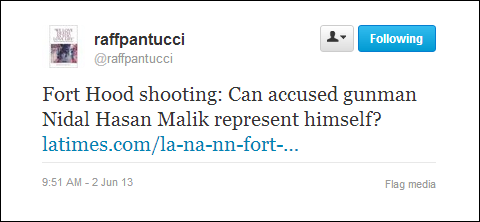
There’s also a self-referential paradox at work in the question of a defendant appearing in his own defense — something that gives judges pause, because they see how tightly the serpent is chasing its own tail. Defendant defends self, From Raff Pantucci:
The saddest self-reference of the morning’s tweets was this one, which could be encapsulated as storm-chaser chased by storm:
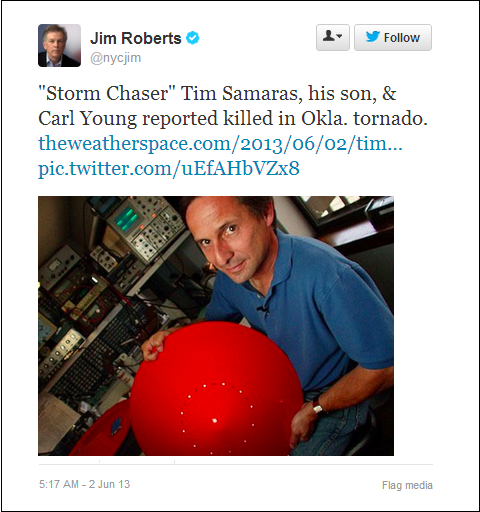
Even tragedy can take self-referential form.

**

But lets move on to Turkey, which provided a rich dividend:

There was this problem:
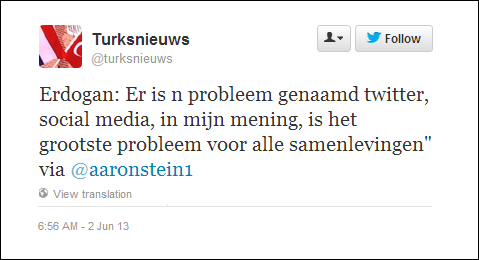
Turkish I couldn’t read, Dutch I can more or less make out — but for an English tweet making the same point let’s go to Zeynep Tufekci, who has expertise in both matters Turkish and matters Internet, and tweets about Erdogan disapproving of tweeting:

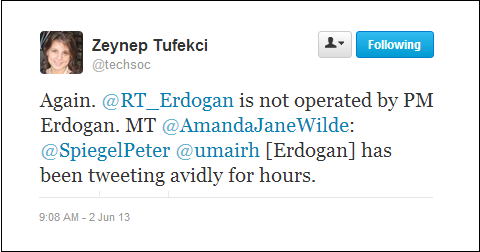
Tufekci again, this time catching an even neater self-reference which doesn’t quite pan out — because, as she says, PM Erdogan is not the same as @RT_Erdogan:
**

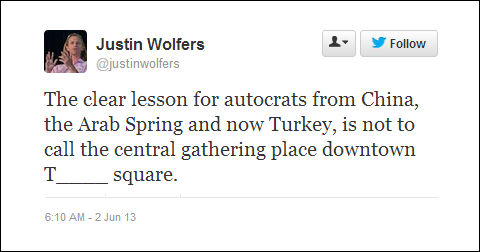
While we’re on Turkey, this tweet about Tienanmen, Tahrir and Taksim Squares gave us another example of a bright mind catching a hint of pattern…
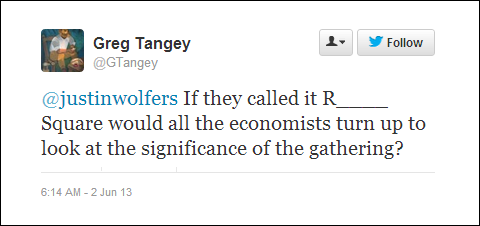
And what a neat rejoinder!
All of the above is quite useless, entirely playful — and of deep interest if creativity and insight matter

**

Finally, I’d like to go someplace quiet and bathe in peace. This tweet, featuring a poem by a Korean zen master, does the trick nicely:
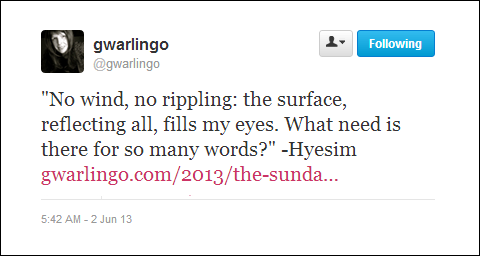
AN appreciative bow to Gwarlingo for that one…

Of images and likenesses

Thursday, May 30th, 2013

[ by Charles Cameron — a storm in a tea-kettle, various resemblances to Hitler, how Pudovkin perceived and practiced montage, what happened when the talkies came along, and four faces of Christ ]
.

It begins with something as innocent ad a tea kettle:

Does this otherwise innocuous tea kettle resemble Hitler? Does it look enough like Hitler to merit JC Penney withdrawing it from sale?

**

Let’s take a look at a couple of other “resemblances to Hitler”:

Who most resembles Hitler — Chaplin, or Stalin?

On the face of it, that’s an easy question. If I were to just ask you the question “who is most like Hitler” in words, you might very well say Stalin, or Pol Pot perhaps — or, I suppose, if you were very focused on World War II and the Axis leaders, Mussolini.

And if I asked you “who looks most like Hitler?” you might well say Charlie Chaplin — but you’d be “thinking visually” in terms of appearances, rather than “verbally” in terms of meanings.

So there are at least two different ways someone can resemble Hitler — in terms of appearance, and in terms of behavior.

**

We don’t notice our own noses most of the time, even though they’re within our field of vision — and it’s a bit like that with likeness. We don’t have a grammar of resemblance, and that’s part of what I want to explore here, in drawing your attention to these two ways (at least) in which we can think of someone resembling Hitler.

Placing two pictures side by side — Charlie Chaplin and Hitler, Hitler and Joseph Stalin — gets us to think a bit about the parallelisms and oppositions. And that’s a large part of what my DoubleQuotes format is good for. I am interested in what the mind does with juxtapositions, and I’m interested in getting us able to hold two contrasting thoughts in mind at the same time. As F Scott Fitzgerald said:

The test of a first-rate intelligence is the ability to hold two opposed ideas in mind at the same time and still retain the ability to function.

I’m in two minds as to whether he’s right, of course.

**

So montage. So the beginnings of Russian cinema, and the great directors of the silent era in film, Vsevolod Pudovkin and Sergei Eisenstein.

Pudovkin wrote quite a bit about montage, about what he called relational editing, telling us:

editing is not merely a method of the junction of separate scenes or pieces, but is a method that controls the “psychological guidance” of the spectator.

He talked about five modes of editing, getting close to the foundations of a grammar of resemblance of the kind I mentioned above — contrast, paralleliem, symbolism, simultaneity and leit-motif. He said, for instance:

Suppose it be our task to tell of the miserable situation of a starving man; the story will impress the more vividly if associated with mention of the senseless gluttony of a well-to-do man.

and went on:

it is possible not only to relate the starving sequence to the gluttony sequence, but also to relate separate scenes and even separate shots of the scenes to one another, thus, as it were, forcing the spectator to compare the two actions all the time, one strengthening the other.

Under the heading of Symbolism, he noted:

In the final scenes of the film Strike the shooting down of workmen is punctuated by shots of the slaughter of a bull in a stockyard. The scenarist, as it were, desires to say: just as a butcher fells a bull with the swing of a pole-axe, so, cruelly and in cold blood, were shot down the workers.

I don’t suppose I’m alone in thinking here of the ending of Coppola‘s Apocalypse Now — and I doubt Coppola would have been unaware of the tribute he was paying to one of the early masters of cinematography, either. And what doe Pudovkin say about the symbolic editing together of the shooting of workmen punctuated by the slaughter of a bull?

This method is especially interesting because, by means of editing, it introduces an abstract concept into the consciousness of the spectator without use of a title.

**

All this, of course, during the silent era. And when the talkies begin…

After the advent of the talking pictures, Eisenstein, Pudovkin, Alexandrov and Vertov issue a statement, attempting to salvage the emotional impact of montage which is in danger of being capsized by the oh so new and glittery charm of verbals — of people talking:

Only a contrapuntal use of sound in relation to the visual montage piece will afford a new potentiality of montage development and perfection.

The first experimental work with sound must be directed along the line of its distinct nonsynchronization with the visual images. And only such an attack will give the necessary palpability which will later lead to the creation- of an orchestral counterpoint of visual and aural images

You see what’s going on here? Eisenstein, Pudovkin, Vertov want the mind to be working on two tracks of ideation at once — a visual track, full of emotional impact, and a verbal track, in counterpoint to the visual.

They want us to be able “to hold two opposed ideas in mind at the same time” — not in synchrony but in counterpoint.

So this business of juxtaposition, of contrapuntal thinking, goes quite deep, and it’s my contention that it’s a skill we need both to develop and to understand — hence my interest in building a grammar of resemblance, of rhyme, of fugue, of graphic match, of equation.

**

One final example. If the “likeness of Hitler” example confronted us with the “nature of likeness” as between facial resemblance and similarities of behavior, this next instance will deal more with “evidence of likeness”:

Here’s the question: are these “real” likenesses?

**

The two likenesses above are both of interest as possible “likenesses of Christ” — the top one taken from the Shroud of Turin, the lower one allegedly photographed in the snow, perhaps in China. The image on the Shroud might be a sort of “photographic negative” of the actual face of man a crucified two thousand years ago — and scientific techniques may or may not offer us evidence as to that likelihood. The other image — supposedly of the face of the same Christ, this time seen and recognized by a photographer in shadows on snow — how does one check the provenance of an image like that?

We don’t have a photographic record of what Christ looked like to compare our own images with — unless the Shroud turns out to offer us just that — so it’s likely we’re back at the distinction first drawn by theologians over a century ago, between “the Jesus of History” and “the Christ of Faith”.

Consider the two images below, neither one perhaps what a camera might have seen if a photographer could time-travel back two thousand years, but each suited to the people for whom it was produced — in China, in Africa:

The Christs these two images evoke come from a different mode of seeing to the images captured in biometric scans and on ID cards — yet they are well-suited for devotion and inspiration…

Love, Death, and Jihad by Pen and Sword

Wednesday, May 29th, 2013

[ by Charles Cameron — with Wagner and Abu Dujana as examples, the cognitive sting here is in the tail — the power of a double image to engage both emotion and insight ]
.

Love and death.

**

The human mind thinks in parallelisms and oppositions.

My lords, if you would hear a high tale of love and of death, here is that of Tristan and Queen Iseult; how to their full joy, but to their sorrow also, they loved each other, and how at last they died of that love together upon one day; she by him and he by her.

Thus begins Bédier‘s version of The Romance of Tristan & Iseult as Hilaire Belloc presents it in its classic English form. The parallel there, between love and death, is found also in Freud’s binary opposition of Eros and Thanatos, which he suggests in Civilization and Its Discontents:

The name libido can again be used to denote the manifestations of the power of Eros in contradistinction to the energy of the death instinct.

and in Wagner’s Liebestod — by way of returning to Tristan and Iseult:

**

Likewise, there’s a parallelism between jihad by pen (jihad bil qalam) and by sword (jihad bil saif) — shown in Abu Dujana al-Khurasani‘s move from writing on the forums to martyrdom in Khost — which al-Awlaki phrases in terms of ink and blood in eulogizing Sayyid Qutb in Constants on the Path of Jihad:

We see that in our contemporary times with people like Syed Qutb. He wrote with ink and his own blood. People like Shaykh Abdullah Azzam and Shaykh Yusuf al ‘Uyayree. They wrote amazing books, and after they died it was as if Allah made their soul enter their words to make it alive; it gives their words a new life

and which appears, contrariwise, in the hadith — considered weak by some and cherished by others:

The ink of the scholar is more sacred than the blood of a martyr

**

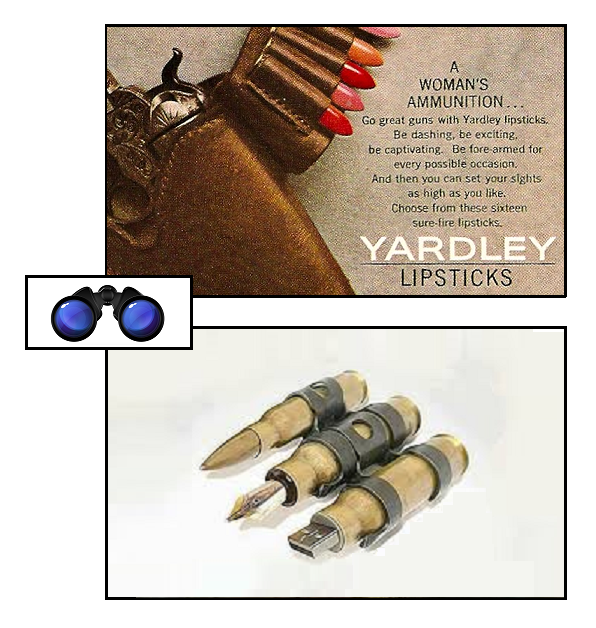
Which brings me to my own parallelism of the day — a parallelism between two uses of graphical similarities, to convey powerful messages:

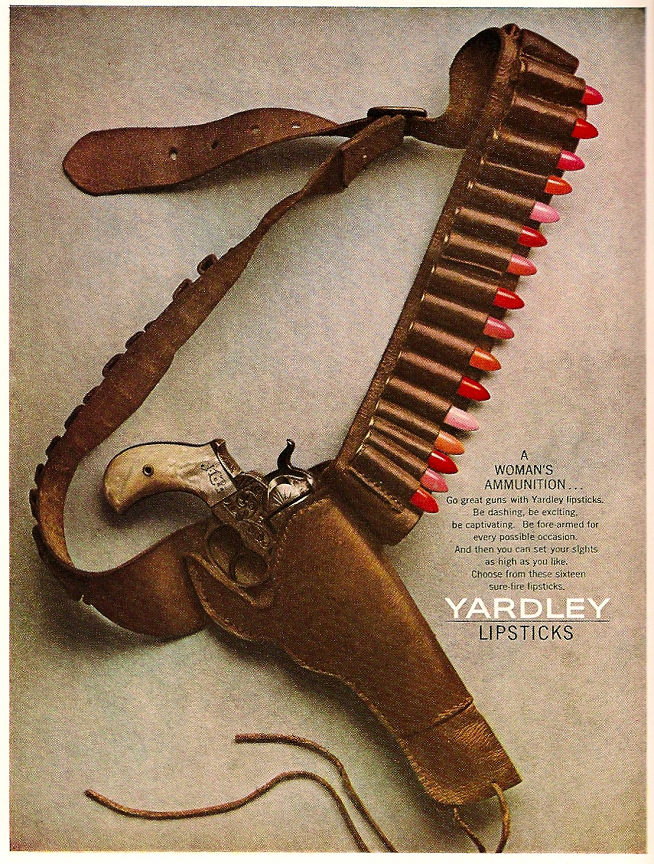
The upper panel shows a Yardley‘s lipstick ad that I must have seen forty years ago on the London Underground — it stunned me then, and it stuns me today to have rediscovered it on the net — which I have long thought of as a brilliant illustration of “rhyme” in images.

And the lower panel? It’s the parallelism between jihad bil qalam with jihad bil saif, extended into the cyber realm. Again, a powerful image, because when two items “rhyme” in some way that’a apparent to us, there’s an instinctive summoning of all that they mean to us close to the surface of consciousness, and other aspects of their relatedness can then become clear to us in a flash of insight.

**

Here’s the full Yardley’s ad, still very much as I remember it from so long ago:

Hezbollah and related graphics

Sunday, May 26th, 2013

[ by Charles Cameron — insights into symbolism on both sides of the Syrian conflict, including Nasrallah as Dajjal and Pinocchio, Star Trek darkness, more ]
.

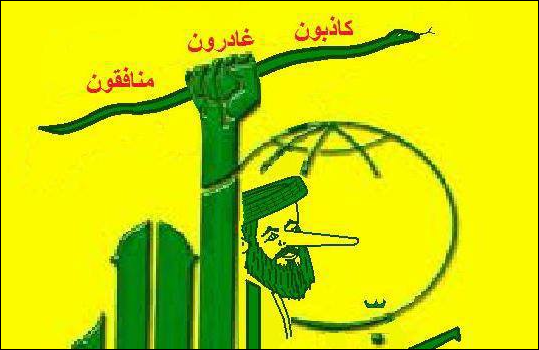
I thought it might be instructive to compare the Hezbollah flag:

with a couple of variants seen recently:

The version on the left is captioned Syrian opposition activists re-imagining Hezbollah’s logo after absorbing heavy losses in Qusayr. The one on the right is from another image mocking Hezbollah, this one picturing Nasrollah as the Dajjal.

Note that in the second image, the gun is pointing down — in a sort of “shoot your own foot” gesture, perhaps?

**

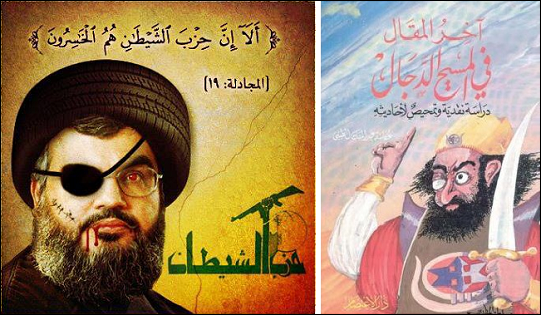
That second image, with the gun reversed, comes from a portrayal of Nasrallah as the Dajjal (below, left) — the one-eyed figure in Muslim apocalyptic serving roughly the same function as the Antichrist in Christian eschatology (depicted in a popular book cover,found by J-P Filiu, below, right):

Not also the tire substituting for Nasrallah’s black turban.

This image of Nasrallah is itself a variant on this one, also portraying him as the Dajjal:

but without the vampiric attributes and tire-turban of the other version.

**

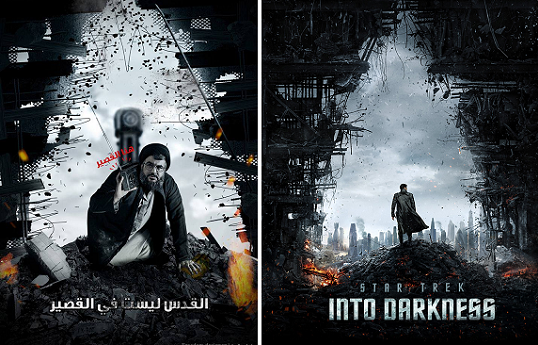
These guys are quick, incidentally — see how fast Nasrallah appeared in StarTrek guise

**

Here are a couple more variants on the Hezbollah flag:

I’m intrigued by the Pinocchio image, which — if I’m not mistaken — features the tire-turban once again:

It was lying that made Pinocchio’s nose extend itself, and just as the Devil in Christianity is “the Father of Lies” (John 8.44), so in Islam the term al-Dajjal means “the Deceiver”. And see how the gun has turned into a Serpent, complete with forked tongue?

**

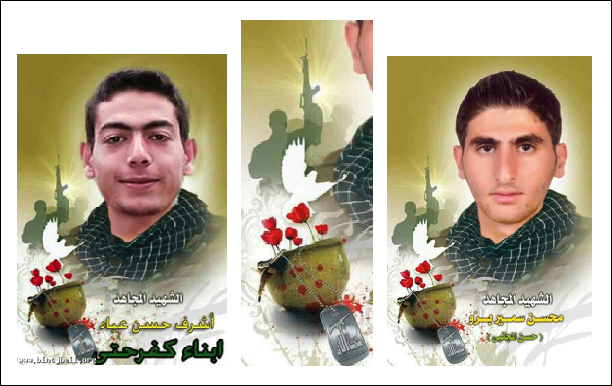
Finally, Phillip Smyth has been posting a series titled Hizballah Cavalcade at Aaron Zelin‘s Jihadology blog, and a couple of details caught my eye in what Smyth terms the “official Hizballah martyrdom posters” for Ashraf Hasan ‘Ayyad and Musen Samir Birro.

As you can see, each of these posters features the Hezbollah emblem on dog-tags, a soldier’s helmet with poppies growing from it, the outline of a white dove, silhouette of a soldier with rifle raised, and the glint of the sun behind it.

If anyone has a detailed exegesis of this cluster of images to offer, I’d be most interested.

**

Hat tips to Mr Orange for pointing me to the Nasrallah Dajjal graphics, and to Aaron Zelin for Jihadology…

GMTA: Temple Grandin

Friday, May 24th, 2013

[ by Charles Cameron — here’s today’s windfall apple from the tree of creative delight ]
.

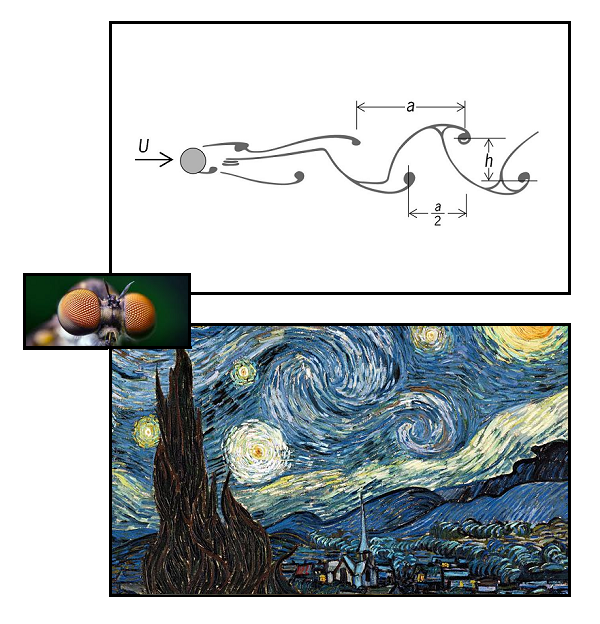
On March 31st, 2012 (or very likely the evening of the day before, because the clock this blog runs on is always way ahead of me) I posted a graphic here:

The upper image illustrates Theodore von Kármán‘s mathematics of turbulent flow, the lower image Vincent van Gogh‘s view of the night sky, and I juxtaposed them using my “DoubleQuotes” format to illustrate the underlying unity of the arts and sciences, and the breathtaking beauty and insight we can derive when we recognize a “semblance” — a rich commonality that transcends our usual division of concepts into separate and un-mutually-communicative “disciplines” and “silos”.

Apparently, this kind of cognition — the basis of every DoubleQuote, and of every move in one of the Hipbone / Sembl games — has now been termed “pattern thinking”.

**

According to Amazon, Temple Grandin and Richard Panek‘s book The Autistic Brain: Thinking Across the Spectrum was released April 30, 2013 although books are often available a couple of weeks ahead of release date, and galleys and proofs earlier still).

I read about it for the first time today, in Grandin & Panek’s piece, How an Entirely New, Autistic Way of Thinking Powers Silicon Valley in Wired. That article begins with a pull-quote from Grandin’s book:

I’ve given a great deal of thought to the topic of different ways of thinking. In fact, my pursuit of this topic has led me to propose a new category of thinker in addition to the traditional visual and verbal: pattern thinkers.

Obviously, that’s something i’d want to find out more about, so I read on into the article, expecting good things. Imagine my surprise when I read this paragraph, though:

Vincent van Gogh’s later paintings had all sorts of swirling, churning patterns in the sky — clouds and stars that he painted as if they were whirlpools of air and light. And, it turns out, that’s what they were! In 2006, physicists compared van Gogh’s patterns of turbulence with the mathematical formula for turbulence in liquids. The paintings date to the 1880s. The mathematical formula dates to the 1930s. Yet van Gogh’s turbulence in the sky provided an almost identical match for turbulence in liquid.

Boom!

**

Okay, I just received my review copy of Hofstadter and Sander, Surfaces and Essences: Analogy as the Fuel and Fire of Thinking — I guess I’ll have to review Grandin and Panke here, too.


Switch to our mobile site