zenpundit.com » Libya

Archive for the ‘Libya’ Category

Quick update / pointer: GR & AZ on prisoner release

Friday, October 12th, 2012

[ by Charles Cameron — prisoner releases in Arab springtime, abu Musab and Dr Fadl; Daveed G-R and Aaron Z; two major rules of expertise: detail and humility ]
.

video edit-bay photo credit http://www.cdmastercopy.com

.

When you watch a well edited movie, the experience is seamless — despite the fact that the film itself was made with hundreds of cuts and splices. Film critics, mavens and the director’s fellow auteurs who make close readings and detailed studies of the film will see and appreciate the juxtapositions and graphic matches, the fine-tuned timing of the edits and the rhythm they give the film — but for the regular viewer, one continuous fabric of story unspools from opening to final credits. The editor’s skill lies in getting the splices right to a degree beyond the perceptual acuity of the audience.

Similarly, a fine carpenter will often want to make joints that are imperceptible to the client, seeking a sensitivity to changes in height that is an order of magnitude greater than that required for the quick, cheap performance of the same task.

True expertise is at least one order of magnitude deeper and more self-critical than it needs to be to satisfy a cursory examination.

**

Thus when Daveed Gartenstein-Ross and Aaron Zelin tackle the important — and easily overlooked — question of How the Arab Spring’s Prisoner Releases Have Helped the Jihadi Cause in the Atlantic, they offer us both far more than we knew we needed to know, and yet less than they themselves know about the topic, let alone the broader current of jihadist movements of which this particular topic is a single strand.

It’s a significant topic, though, as their opening paragraphs neatly show:

The investigation of the devastating Sept. 11 attack on the U.S. consulate in Benghazi, Libya, that killed American ambassador Christopher Stevens — limited as it is by security concerns that hampered the FBI’s access to the site –has begun to focus on a Libya-based Egyptian, Muhammad Jamal (a.k.a. Abu Ahmad al Masri). As a detailed Wall Street Journal report explains, Jamal is notable not only for having fighters under his command and operating militant training camps in the Libyan desert, but also for having recently gotten out of Egyptian prison.

This latter fact makes Jamal part of a trend that has gone largely unremarked upon in the public sphere since the beginning of the “Arab Spring” uprisings: prisons in affected countries have been emptied, inmates scattering after being released or breaking free. In many cases, it is a good thing that prisoners have gone free: the Arab dictatorships were notorious for unjustly incarcerating political prisoners, and abusing them in captivity. But jihadists have also been part of this wave of releases, and we are now beginning to see the fruits of the talent pool that is back on the streets.

I recommend it highly, as does at least one other more knowledgeable than I.

**

A short piece in the Atlantic is just right for an overview, but not the place to lay out the next level of detail, though — and there are three people in particular whose names I am always on the lookout for, names of people who vanished from public view into some form of imprisonment, and who are of considerable interest to me personally — primarily for their theological significance.

The first of these is the Imam Musa al-Sadr, whose “disappearance” in Gaddafi’s Libya at the age of 50 in 1978 deprived the Lebanon of an inspiring leader — in a manner that eerily paralleled the ghayba or “occultation” of the Twelfth Imam of the Ithna ‘ashariyah.

The second would be Sayyed Imam Al-Sharif, aka Dr. Fadl, whose book The Essentials was one of the major works of AQ ideology and the #2 jihadist manual downloaded from the net according to the CTC Atlas (p.10), and who recanted it from Egyptian prison, writing his Rationalizing Jihad in Egypt and the World which so severely critiqued AQ-style jihad that al-Zawahiri felt obliged to pen a 200-page counter-argument. In Dr Fadl’s case, the interest would be to see what he would say if liberated now.

And my third “person of interest”? That would be Mustafa Setmariam Nasar aka Abu Musab al-Suri, whose massive Call to Global Islamic Resistance is a key document that chides bin Laden for “leading them to the abyss”, says “Al Qaeda is not an organization, it is not a group, nor do we want it to be. It is a call, a reference, a methodology”, and calls for “terrorism created by individuals or small autonomous groups (see Lawrence Wright, The Master Plan). Abu Musab, who may have been released from prison in Syria recently, is of interest to others as potentially the jihadi’s foremost strategist — and to me chiefly because of his use of apocalyptic forecasting in his Call.

**

Since their Atlantic piece was a short context-setter rather than a longer analytic paper, I asked Gartenstein-Ross and Zelin — Daveed and Aaron — net acquaintance and friendship is a funny thing, we haven’t worked out the etiquette as yet — about Dr Fadl and Abu Musab, not mentioned in the piece itself but surely not far from their thoughts.

Twitter, of course, is even more drastically reduced than a piece in the Atlantic, so you can think of their tweeted responses as something along the lines of snapshots of footnotes. Nevertheless, they give me, as an inquiring mind, a quick glimpse of what a couple of those at least an order of magnitude deeper into these things know or conjecture about two people whose names and potential activities we should all keep stashed quietly away on some easily accessible mental shelf.

Three things emerge from these tweets — how little we actually know, how important what we don’t know may be, and how honest the best analysts are about the limits of their knowledge. I’d tweeted, congratulating them on their piece and saying:

hipbonegamer: i note no mention of Musab a-S – any idea what’s up with Dr Fadl? Dead? Released? Still held?

And they responded:

Aaron Y. Zelin: Details still too murky on Abu Mus’ab and no info on Dr. Fadl.

D. Gartenstein-Ross: However, I think the question “where is Dr. Fadl, and why haven’t we heard from him?” is important for many reasons.

D. Gartenstein-Ross: But Aaron is right: I haven’t seen any open source info that speaks to his fate.

That’s two things at once: not very much, and a great deal.

**

So if lesson #1 of this post is that True expertise is at least one order of magnitude deeper and more self-critical than it needs to be to satisfy a cursory examination, lesson #2 must be…

True expertise never claims knowledge that is one order of magnitude deeper or more exact than is actually known.

Putting that in other terms: having an accurate mapping of one’s archipelago of knowledges within one’s oceanic ignorance is a highly significant form of meta-knowledge, lacking which one’s knowledges have blurred edges and little definitional value.

And that in turns means — especially in terms of human intelligence — humility.

**

It’s Follow Friday (#FF) on Twitter: @DaveedGR and @azelin are two folks you can follow and trust.
Waco in Pakistan

Monday, September 24th, 2012

[ by Charles Cameron — on the way not listening sometimes leads to trouble, the importance of ultimate concerns, and a remarkable remark by M. Morsi ]
.

It’s happening again, this time in Pakistan.

Nicholas Kristof‘s NYR op-ed a day or two ago, Exploiting the Prophet, included one particularly interesting little quote that set me thinking – and my friend Bryan Alexander noted it too. Kristof was talking about how people in Muslim countries with little or no tradition of free speech sometimes “have an addled view of how the United States handles blasphemy” and commented, almost as an aside:

A Pakistani imam, Abdul Wahid Qasmi, once told me that President Bill Clinton burned to death scores of Americans for criticizing Jesus. If America can execute blasphemers, he said, why can’t Pakistan?

I challenged him, and he plucked an Urdu-language book off his shelf, thumbed through it, and began reading triumphantly about the 1993 raid on David Koresh’s cult in Waco, Tex.

That’s absurd, preposterous. Perfectly understandable. And dangerous.

**

Here’s a description of how Americans listened to al-Qaida, drawn from Benjamin and Simon’s book, The Age of Sacred Terror, p. 159:

So much of what was heard from al-Qaeda after the attacks sounded to Americans like gibberish that many chords of the apocalypse were missed.

According, that is, to two senior members of President Clinton‘s National Security Council charged with counterterrorism, jihadist “chords of the apocalypse” were missed because they sounded like “gibberish”.

When I read that, I couldn’t help but recall the label given by FBI field agents to attempts by David Koresh to engage them in a discussion of the Book of Revelation, which for him was a roadmap of the very events he was living through — the FBI’s siege of Mount Carmel in Waco, TX.

Here’s a quote from the abstract of Robert Agne and Karen Tracy‘s analysis, ‘Bible Babble’: Naming the Interactional Trouble at Waco, published in Discourse Studies (v 3 # 3, 269-294):

A frustrating yet persistent aspect for the FBI negotiators was the Davidians’ talk about the Bible and their religious beliefs, what agents dismissively described as ‘Bible babble’.

So:

Does it matter if one group of people persists in misunderstanding the religious positions of another in high-tension disputes?

In the case of Waco, it may indeed have contributed to the tragic outcome.

In this study, we analyze several exchanges between Koresh and one of the FBI agents. The analysis shows how the FBI’s identifying their problem as ‘Bible babble’ contributed to the negotiation failure.

**

There are other parallels that can be drawn between the Branch Davidians and their worldview, and al-Qaida and theirs — parallels that may have significance wherever there is a clash in which the “irrational” religious discourse of an (often apocalyptically inclined) “other” is easily brushed off by our own “more rational” mindset.

According to conflict resolution scholar Jayne Seminaire Docherty, writing in Learning Lessons from Waco (p. 99):

During the Waco negotiations, the Mount Carmel residents invited the FBI negotiators to choose God’s law over man’s law.

Compare al-Qaida, as seen in two excerpts from Michael Scheuer‘s Al-Qaeda’s Completed Warning Cycle – Ready to attack? published by the Jamestown Foundation in Terrorism Focus (v 2 #5, 2005):

After 9/11, bin Laden received sharp criticisms from Islamist scholars that dealt with the al-Qaeda chief’s failure to satisfy several religious requirements pertinent to waging war. The critique focused on three items: (1) insufficient warning; (2) failure to offer Americans a chance to convert to Islam; and (3) inadequate religious authorization to kill so many people. Bin Laden accepted these criticisms and in mid-2002 began a series of speeches and actions to remedy the shortcomings and satisfy his Islamist critics before again attacking in the United States.

Parallel to the warnings, bin Laden on two occasions since 2002 asked Americans to convert to Islam as the means of terminating the war al-Qaeda is waging against the United States. “We call you to Islam,” bin Laden said on both occasions, addressing himself to President Bush – as the leader of the American people – and asking him to lead his countrymen to Islam. He also offered to serve as guide and teacher for the American people, urging them to “follow the right path” to Islam. “I am an honest adviser to you.” bin Laden concluded, “I urge you to seek the joy of life and the after life…. I urge you to become Muslims….” (Al-Jazeera 6 Oct 02; Waaqiah.com, 26 Oct 02)

**

The Davidian invitation to the FBI interlocutors to talk Revelation — like the AQ invitation to President Bush and all America to convert to Islam — may seem a foredoomed invitation, but it’s one that at the very least situates one side of the conflict in the territory of “ultimate concerns”. Thus Docherty continues:

The negotiators resisted these invitations as situationally inappropriate conversion efforts. The Branch Davidians, they said, were disrupting the “real” negotiations with their proselytizing. However, for the Mount Carmel residents, proselytizing was the truly important business at hand. With the Second Coming looming on the horizon, all else was trivial by comparison, even the task of peacefully resolving the barricade standoff.

What is ultimate and what is, strictly by comparison, trivial?

One of the most significant answers to that question was given by Muhammad Morsi when he said recently:

To God, the attack on a person to Allah is bigger an attack on the Kaaba.

I still have a post or two in me concerning the ugly video clip and the far uglier riots it triggered, and in one of them I’d like to explore that remarkable remark of Morsi’s — deploring the killing of Ambassador Stevens — and supporting texts from the Qur’an, hadith and the writings of the late Egyptian cleric Sheikh Ghazali.

The symmetry: Charlie Hebdo

Saturday, September 22nd, 2012

[ by Charles Cameron — my apologies for an earlier incomplete draft, quickly withdrawn — first of two, on loose cannonry and mirror imagery — second will deal with recent events in Benghazi ]
.


.

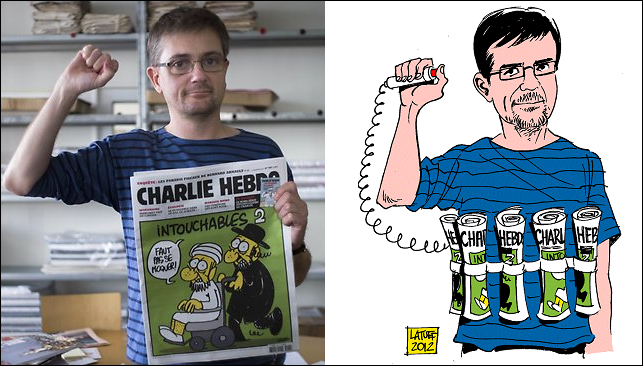
Charlie Hebdo recently published some cartoons featuring the prophet…

Okay, I’m always on about symmetry.

I posted a piece titled Messianic symmetries on ZP a while back, noting that both Ahmadinejad and Netanyahu can be viewed as exercising “leadership that makes decisions out of messianic feelings” — the quote comes from an unimpressed ex-Shin Beth director describing Bibi; Ahmadinejad makes the case for his own Mahdist leabings quite well himself.

Symmetry seems like an important analytic category to me, either because it’s there in the build of the world, or because it’s there in the build of the mind. Either way, I think we should take careful notice of symmetries.

Asymmetries I’ll talk about in my next post.

**

What about the cartoon above, right? It’s clearly based on the photo above, left, which shows Stéphane Charbonnier, the editor of Charlie Hebdo, holding his magazine with its offensive cartoons / vindication of free speech. And the suggestion is clear that he’s some kind of suicide bomber.

But who is he blowing up, exactly? Himself, and perhaps his staff and anyone else who happens to be within a few yards of his office at the time? France, Europe, the western world — the world itself? And how much irony should we read into the cartoon portrait?

They may have learned the technique from the Tamil Tigers, but these days, in the immediate wake of widespread rioting over the video clip and in the context of someone publishing cartoons that satirize the prophet, it’s clearly Islamist suicide bombers who provide the model for the cartoon of the cartoonist above.

Tit for tat? An eye for an eye? You’re just setting yourself up for a fatwa like Salman Rushdie?

**

Incendiary rhetoric on one side leads to incendiary behavior on the other, validating the incendiary rhetoric and making the escalation to incendiary behavior all the more probable.

Some of the incendiary rhetoric has its origin in holy books, which also preach peace.

There are Coptic Christians utterly blindsided by the virulence of the video, attributed to one of their number. There are Libyan Muslims utterly blindsided by the virulence of the attack on the US Embassy, attributed to some of their own.

**

I want to focus not on the specifics of the topic, but on the symmetry.

One writer, observing the partition of India and Pakistan, wrote:

The rioters brought the train to a stop. Those who belonged to the other religion were methodically picked out and slaughtered. After it was all over, those who remained were treated to a feast of milk, custard pies and fresh fruit.

Before the train moved off, the leader of the assassins made a small farewell speech: “Dear brothers and sisters, since we were not sure about the time of your train’s arrival, regretfully we were not able to offer you anything better than this most modest hospitality. We would have liked to have done more.”

Commenting on this paragraph, Ali Sethi wrote recently in the New Yorker:

That is all there is: murder—methodical and quick—followed by a feast and an ingratiating speech. Note the withholding of tags: we don’t know the location of the massacre or the religion of the killers. All we have is a spurt of base instincts.

The point here is that whenever you see a symmetry of opposites, it’s worth considering that symmetry in the abstract, as well as weighing the particular issues that drive your own side or the other.

That, I’d suggest, is one of the implications of that Paul van Riper remark I’m fond of quoting:

What we tend to do is look toward the enemy. We’re only looking one way: from us to them. But the good commanders take two other views. They mentally move forward and look back to themselves. They look from the enemy back to the friendly, and they try to imagine how the enemy might attack them. The third is to get a bird’s-eye view, a top-down view, where you take the whole scene in. The amateur looks one way; the professional looks at least three different ways.

**

I am concerned about hatred, simmering here, boiling over there. I am concerned about what sparks hatred, and what fans it. What I want to draw your attention to here, though, is the process by which one hatred fuels abother, the process of mirror imaging.

Mark Juergensmeyer, a terrific scholar of religion who has published on topics ranging from Gandhi‘s nonviolence to the violence of religionists who consider themselves sanctioned by the scriptures of various religions, makes the point in a recent Religion Dispatches post thus:

The US-based Islamophobes behind the insulting and amateurish video “The Innocence of Muslims,” and those behind the violent protests it allegedly caused around the Muslim world, are kindred hatemongers. Both are extremists with a political agenda, and both want to use this incident to discredit the legitimacy of the moderate governments in power in their respective countries. There is a symbiotic relationship between the strident protesters and the bigoted filmmakers; each needs the other.

We are in a hall of incendiary mirrors, with plenty of kindling: in my view, we should avoid playing with matches.

**

Thank God, there are also asymmetries.

In a companion post, I’ll take a look at recent, very promising events in Benghazi (h/t to Pundita for a pointer to this particular article), the not particularly unsurprising but unwelcome attitude of a Pakistani minister, and the imbalances that go along with the dangerous balances I’ve discussed in this post.

**

Oh, and let me digress…

I won the Divinity essay prize back in my schooldays at Wellington College, and received my chosen prize book, the Liber Usualis with its glorious collection of Gregorian Chants, from the then Minister of Defence, John Profumo, MP. Not long thereafter, it was discovered that he pillow talked with one Christine Keeler, a night lady of class, who also pillow talked with the Russian defence attaché. And the story was broken, week by glorious week, by the British satirical magazine, Private Eye.

Which I consequently have an affection for, after all these years. And I tell you this, because Charlie Hebdo, or Weekly Chuck as we might call it over here is, I’d suggest, a plausible latter-day French rough equivalent of Private Eye.

I don’t really like our guys posting inflammatory materials, you see, but I also have an affection for freedom of speech — and for magazines with a satirical bite, too…

So sue me, I contain multitudes.

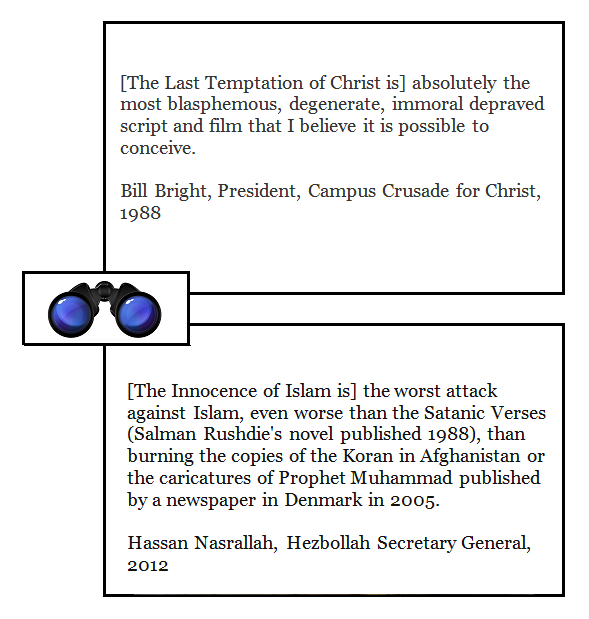
Of films, riots and hatred III: Scorsese and Verhoeven

Monday, September 17th, 2012

[ by Charles Cameron — The Last Temptation of Christ troubles, an early warning re the upcoming Jesus of Nazareth movie — the blood libel and more ]
.

American and European Christians, too, can react violently to films they perceive as blasphemous, and this too we should remember as we weigh our own responses to the rioting in Cairo and elsewhere.

Martin Scorsese‘s Last Temptation of Christ gives us a sense of how modern American and European Christians can react to perceived blasphemy, while the forthcoming Paul Verhoeven movie of his own book Jesus of Nazareth will test the degree to which we’ve learned the lessons of a quarter century ago — and of this last week.


.

**

Martin Scorsese’s The Last Temptation of Christ: stirred strong feelings when it opened. I was in LA at the time, and was following the controversy fairly closely having attended an early screening, and having both literary and theological interests.

The short video clip below is a little choppy, it doesn’t make it particularly clear that the clips you see are from the film Martin Scorsese made of a novel — written by the Nobel laureate Nikos Kazantzakis — which makes no attempt nor pretense to be a historical or religiously orthodox portrayal of Christ. IMO, it is worth watching for the glimpse it gives of just how strong the undercurrents of emotion aroused by Scorsese’s film were at the time:

**

I’m bringing this subject up and attending to it in some detail because NBC World News mentioned Martin Scorsese’s movie on the 13th of this month, in an explanation as to Why films and cartoons of Muhammad spark violence, but without gwetting the picture quite right:

Director Martin Scorsese’s adaptation of a book by the same name showed Jesus struggling with lust, depression and doubt, and engaging in sex — in his imaginings — before snapping back to reality and dying on the cross. That movie was seen as blasphemy by some Christians, who — though not violent — were vocal enough to prevent the film from being shown in many parts of the United States.

There may have been no violence done to humans in the US — but there as certainly damage to property, and some vicious threats made, as The Encyclopedia of Religion and Film records:

At the Cineplex Odeon Showcase Theater in New York City, vandals slashed seats and spray-painted threats aimed at the chairman of MCA: “Lew Wasserman: If you release ‘The Last Temptation of Christ,’ we will wait years and decimate all Universal property. This message is for your insurance company.”

In parts of Europe, the violence was more intense:

Overseas, at the September 28 opening in Paris, demonstrators who had gathered for a prayer vigil threw tear gas canisters at the theater’s entrance. Catholic clergy led rock-throwing and fire-bombing assaults on theaters in many French municipalities. A thousand rioters in Athens trashed the Opera cinema, ripping apart the screen and destroying the projection equipment.

In Paris, specifically, the violence severely injured some human targets. From Wikipedia (with their footnotes removed — you can track the various quotes from the original page):

On October 22, 1988, a French Christian fundamentalist group launched Molotov cocktails inside the Parisian Saint Michel movie theater while it was showing the film. This attack injured thirteen people, four of whom were severely burned. The Saint Michel theater was heavily damaged, and reopened 3 years later after restoration. Following the attack, a representative of the film’s distributor, United International Pictures, said, “The opponents of the film have largely won. They have massacred the film’s success, and they have scared the public.” Jack Lang, France’s Minister of Culture, went to the St.-Michel theater after the fire, and said, “Freedom of speech is threatened, and we must not be intimidated by such acts.”

The Catholic response — from the Cardinal Archbishop of Paris among others — reproved both the blasphemy and the rioting:

The Archbishop of Paris, Jean-Marie Cardinal Lustiger, said “One doesn’t have the right to shock the sensibilities of millions of people for whom Jesus is more important than their father or mother.” After the fire he condemned the attack, saying, “You don’t behave as Christians but as enemies of Christ. From the Christian point of view, one doesn’t defend Christ with arms. Christ himself forbade it.” The leader of Christian Solidarity, a Roman Catholic group that had promised to stop the film from being shown, said, “We will not hesitate to go to prison if it is necessary.”

There was apparently a connection with French far-right politics, too:

The attack was subsequently blamed on a Christian fundamentalist group linked to Bernard Antony, a representative of the far-right National Front to the European Parliament in Strasbourg, and the excommunicated followers of Archbishop Marcel Lefebvre. Lefebvre had been excommunicated from the Catholic Church on July 2, 1988. Similar attacks against theatres included graffiti, setting off tear-gas canisters and stink bombs, and assaulting filmgoers.

There were legal proceedings following the Saint Michel incident, and it’s notable that Fr. Gérard Calvet OSB, founder and Prior of the Benedictine Abbaye Sainte-Madeleine du Barroux, testified at the tribunal on behalf of the convicted youths, describing their motives if not their mode of expression as “noble”. Would that term be equally applicable to protesters of blasphemies against other faiths? We now live in a dense-packed world where such comparisons are easily made.

Let’s pause for a minute over the twinned remarks of the late (and widely respected) Cardinal Lustiger concerning Last Temptation

Jean-Marie Cardinal Lustiger, said “One doesn’t have the right to shock the sensibilities of millions of people for whom Jesus is more important than their father or mother.” After the fire he condemned the attack, saying, “You don’t behave as Christians but as enemies of Christ. From the Christian point of view, one doesn’t defend Christ with arms. Christ himself forbade it.”

and compare the remarks of a similarly authoritative religious figure in Libya to the Innocence of Muslims video:

Libya’s Grand Mufti, Sheikh Sadeq Al-Ghariani, has issued a fatwa condemning Tuesday’s killing of US Ambassador Chris Stevens along with three other American diplomatic staff and a number of Libya security guards. He said those involved were criminals who were damned by their action.

He also condemned the production of any film, picture or article insulting the Prophet Mohammad or any of the prophets by “extreme fanatics” in the US or elsewhere. The Prophet Muhammad, Ghariani said, had specifically forbidden the killing of ambassadors and envoys.

**

Almost a quarter century has passed since Scorsese’s movie opened, but as I said above, we will soon have an opportunity to show what we have learned from those lamentable events in Paris and the more recent tragedies in Benghazi, Cairo and elsewhere.

Paul Verhoeven — the director of such blockbusters as RoboCop, the original Total Recall, and Basic Instinct — has raised the financing for his upcoming movie Jesus of Nazareth, based on his book of the same name, and scripted by Roger Avary, who shared an Oscar with Quentin Tarrentino for their Pulp Fiction screenplay.

Verhoeven, be it noted, is not only a writer and movie director, but also a member of the Jesus Seminar — a group of scholars which, as Wikipedia nicely puts it, “treats the canonical gospels as historical sources that represent Jesus’ actual words and deeds as well as elaborations of the early Christian community and of the gospel authors” and prepares color-coded editions of the gospels suggesting which sayings of Jesus should be considered original, and which are better understood as later additions.

Here, to give you an idea of what may be on the horizon, is an excerpt from a quick and informal take on the upcoming movie by an admirer of Verhoeven:

Deadline reports that the legendary Paul Verhoeven — a guy who, amazingly, only directed three movies in the past fifteen years — has received financing to adapt his own book, Jesus of Nazareth, which discounts every mythical story surrounding Christ and, instead, opts to present him as a simple human figure with a message powerful enough to radiate throughout time. Roger Avary (Tarantino‘s story partner on Pulp Fiction) will write the film, while Muse Productions are doing the proper backing.

Almost any work going against the long-held Biblical grain will get groups up in arms — no, I don’t even need to provide examples — but the claims of Nazareth are, even in this context, still mighty contentious. Most notable is the idea that Jesus is not the son of God, but was actually the product of Mary being raped by a Roman soldier; so, right off the bat, you’re discounting the entire foundation of his story.

I am pointing this out because right now would be a good time for the various churches to begin a general conversation about the film-maker’s right to hold an opinion, write a book and make a movie, the hurt that may be felt by believers, and the importance of responding without hatred or violence when offended.

**

In our concern with matters of Christian and Muslim issues, let us not lose sight of the fact that Jews too have movies made about them that may not only hurt feelings but also represent real threats against them, reminiscent of Nazi and earlier Russian antisemitic propaganda fabrications.

From the copious “blood libel” entry in Wikipedia:

In 2003 a private Syrian film company created a 29-part television series Ash-Shatat (“The Diaspora”). This series originally aired in Lebanon in late 2003 and was broadcast by Al-Manar, a satellite television network owned by Hezbollah. This TV series, based on the antisemitic forgery The Protocols of the Learned Elders of Zion, shows the Jewish people as engaging in a conspiracy to rule the world, and presents Jews as people who murder Christian children, drain their blood and use this blood to bake matzah.

MEMRI has a report with further details, and a MEMRI clip of the scene in which a Christian child is killed by Jews has been posted on YouTube, with the comment:

Al-Shatat: Jews Murder A Christian Child and Use His Blood for Passover Matzos. anti Semite Arab propaganda against Jews, Judaism and Israel.

The following is a scene from the Syrian-produced TV series Al-Shatat. Al-Shatat was first aired on Hizbullah’s Al-Manar TV during the month of Ramadan 2003, and then on two Iranian channels during Ramadan 2004. Al-Mamnou’ TV, a new Jordanian channel, is airing Al-Shatat during Ramadan 2005.

It is worth recalling, too, that Mel Gibson‘s film, The Passion of the Christ, was perceived by many Jews, Christians and others as anti-Semitic — and that nonetheless the Orthodox Jew and conservative movie critic Michael Medved wrote:

The possibility of anti-Jewish violence in response to the film has been irresponsibly emphasized and has become, self-fulfilling prophecy. In parts of Europe and the Islamic world, anti-Semitic vandalism and violence occur daily, and hardly need a film by a Hollywood superstar to encourage them. In this context, Jewish denunciations of the movie only increase the likelihood that those who hate us will seize on the movie as an excuse for more of hatred.

**

I trust it is not too late to wish our Jewish readers l’shana tova: may your apples be dipped in honey and all our days bathed in peace.

Syria, Iran and the Risks of Tactical Geopolitics

Monday, February 13th, 2012


Mr. Nyet 

World affairs are much more like spider’s web than the neat little drawers of an apothecary’s cabinet. In the latter,  the contents of each drawer are cleanly isolated and conveniently compartmentalized. What you do with the contents of one drawer today has no bearing on what you do next week with those of another. By contrast, with a spider’s web, when you touch a web at any point, not only do you find it to be sticky in a fragile sort of way, but your touch sends vibrations through every centimeter of the lattice.

Which alerts the spiders.

The great foreign policy panjandrums of the United States and the Western allies – with assorted Middle-Eastern clients who have real skin in the game-  are attempting to muddle through two overlapping but different crises with Syria and Iran through the medium of international diplomatic organizations. In the case of Syria, whose Baathist-Alawite dictatorship of Bashar Assad is trying to crush a widespread uprising by pacing the body count of their atrocities to what CNN viewers can tolerate, the effort by SECSTATE Clinton and Ambassador Rice to rally the UN Security Council to issue a forceful resolution against Syria was itself forcefully rebuffed by the double-veto of Russia and China. A highly predictable event that left Ambassador Rice “disgusted” but we hope, not surprised.

The case of Iran, which incidentally is one of Syria’s few allies, involves the long-running dispute over Iran’s complex and semi-clandestine nuclear activities which, in violation of the NPT and IAEA agreements, appear designed to pressure the West by giving Iran, at a minimum, a “breakout” capacity to make some nuclear weapons.  This decade long “crisis” has recently escalated, with the EU and United States applying punishing new economic sanctions while an unknown party that everyone knows to be Israel is engaging in a campaign of  sabotage and assassination against Iran’s IRGC-run nuclear establishment. Iran for it’s part has taken hostages, blustered about closing the straits of Hormuz and threatened unspecified new breakthroughs in nuclear activities.

To say that Russia and China have been less than helpful in halting Iranian nuclear weapons-related activity is like saying Pakistan’s ISI might be involved with assisting the Taliban.  Another situation the American foreign policy establishment consistently has trouble puzzling out.

The problem with current US policy or it’s advocates is not target selection. Syria, Iran, Libya and various other states have nasty, disruptive and anti-Western regimes. Giving them the heave-ho, in the abstract, makes sense if advancing American interests  (or basic decency in governance) is the objective. However, unlike the aforementioned apothecary cabinet drawers, states and their regimes do not exist in the abstract, moving according to arid principles of conduct, but in the real world with a society of states which constantly are evaluating and re-evaluating each other’s conduct in light of interest. Which means, as with many things, in foreign policy, timing matters.

The West recently dispatched over the objections of two great powers, Colonel Gaddafi, a ruler who was also an unpopular and violent lunatic with a long pedigree of terrorism and cruelty.  That in itself was tolerable and comprehensible, if not welcome, to Moscow and Beijing, but we rubbed salt in the wound in two ways. First, simply stomping on the Realpolitik economic interests of Russia and China in Libya, as Walter Russell Meade eloquently put it:

….Russia has some specific grievances connected to Libya.  What seems to really enrage the Russians is less the overthrow of the Great Loon than the cancellation of his many contracts with Russia and the refusal of the new government to give Russia a slice of the Libyan pie.  Russia always thought the west’s democratic agenda in Libya was a laugh — and the antics of the thuggish new regime and the array of torturers and thieves now running rampant in that country has done little to dispel that view. (Again, the Putin/KGB worldview would suggest that the hard realists at the core of Washington’s power structure released the ninnies to dance themselves into a frenzy of humanitarian and democratic ecstasy while the cold purposes of the DC machine were advanced.)

But what Russia thought it expected and deserved in return for its abstention on the Libya vote was due consideration for its commercial interests in Libya.  France, Britain and Qatar seem to be dividing that pie enthusiastically among themselves and nobody is thinking about Russia’s share and Russia’s price.

Secondly, was icing Gaddafi under the moral banner of R2P, which would seem – in theory of course – to be applicable to governments very much like those run by the allies of….Moscow and Beijing. To say nothing of , Moscow and Beijing themselves, which already see the “color revolutions” as subversive Western elite sock puppets with a democracy stage show kit.  To be frank, Russian and Chinese leaders see R2P as a doctrine or policy that potentially can be used not only against their nation’s interests, but their own hold on power, which they view, accurately, as a violation of sovereignty.

So it can hardly be reassuring to Moscow or Beijing that when the dust has yet to settle in Libya, that the United States and it’s NATO allies are now pressing for new UN resolutions designed to justify military intervention in Syria to overthrow Bashar Assad. Like the late and unlamented Colonel Gaddafi, Bashar Assad is a cold-blooded murderer, but unlike the crazy Colonel, Assad is a client of Russia and close Syrian ties to Moscow go way back to the earliest days of his father’s dictatorship. There’s no way, in such a short amount of time, that an American effort to topple Assad – however justified morally – that Vladimir Putin and to be truthful, many ordinary Russians, would not view that as a Western attempt to humiliate Russia. And R2P would indicate still more humiliations to come! As Dan Trombly wrote:

….that is precisely why the United States should drop even lip service to the Responsibility to Protect. Honestly stayed, the doctrine requires intervention after intervention, and its strategic advantage to the United States relies on consistency, because without consistency the supposed normative benefits it creates quickly evaporates. Yet R2P, far from strengthening the international order, actually demands continually more resources and, each time it is employed or contemplated, calls into question the rest of the international order the United States promulgates. If the goal is to “expand and strengthen an effective international order,” why would increasing the visibility of Responsibility to Protect, a doctrine that divides the United States and Western Europe from Central Europe, the rising democracies of Brazil, South Africa, and India – not to mention, of course, the major powers China and Russia and exhausts an already overburdened and shrinking Western military capability? 

In that context, the idea that Russia and China would support a UNSC resolution to intervene in Syria and depose Assad borders on the bizarre.  Advocates of R2P, like Anne-Marie Slaughter, would counter here, arguing that both Russia and China previously accepted R2P, so their cooperation in support of a UNSC resolution on Syria should have been a manageable enterprise. It wasn’t, largely because the Russians do not seem to give R2P much weight as a part of international law, the Russian Defense Ministry being even more blunt than their diplomatic counterparts:

….Russia’s Defense Ministry on Thursday reiterated its position stated earlier by the Foreign Ministry: Russia will do its best to avoid military intervention in Syria.

 “As for Syria, we see that harsh discussions are going on in New York and we are just giving backup to our colleagues from the Foreign Ministry who are tackling these problems. Of course, we think it is necessary to prevent military intervention in Syria,” Deputy Defense Minister Anatoly Antonov told Vesti 24 TV channel.

 Russia has firmly supported Syrian President Bashar al-Assad during the uprising against his regime. Russia and China vetoed a UN Security Council resolution on Syria, backed by the Arab League and Western nations, to prevent a repetition of “the Libyan scenario.

Joshua Foust, writing in The Atlantic, addressed the situation with admirable clarity:

….A big reason for Russia and China’s intransigence is the NATO coalition that led the intervention, which badly overstepped the range of permissible actions stipulated in the UN Security Council Resolution that authorized intervention. Russia was an early critic of such actions as France’s weapons shipments to the rebels — criticism that could have been accounted for (Moscow never made any secret of its concerns) but which seemed to be ignored in the rush to intervene. President Obama made a rapid transition from saying “regime change is not on the table” last March (part of the bargain to get Russian abstention from the UNSC vote) to publicly calling for his ouster. France and the UK used similar language, ignoring the politics of getting UN approval for intervention.

….Many states, none of whom are free, worry that the West’s renewed love of intervention might one day be focused upon them. This is a critical consequence of rejecting sovereignty and declaring governments unfit to rule through a mixture of expediency and opportunity. Powerful states with poor human rights records — Russia and China included — look at what happened in Libya and see disaster, not freedom. And they are taking steps to avoid it.

The problem is not  intervention per se but an otherworldly posture of Western policy makers that embraces tactical geopolitics – i.e.  each intervention (Libya, Syria, Afghanistan, Iraq), undertaken whenever chance arises somehow exists on it’s own terms, in splendid isolation. It doesn’t, except in NATO capitols. Any nation not seeing itself as safe and impregnable is constantly calculating their opportunities and dangers based on our actions. If we continue to pursue intervention at the current tempo, blind to the perspectives and interests of others, we will get pushback on a more strategic level. And we will rue it.

NATO has been around so long, it is so enshrouded in hazy nostalgia and circumlocational love of diplomatic process, that we forget it was originally a radical departure for Americans and Europeans alike. Soviet postwar behavior under Stalin was so menacing, so intransigent, so relentlessly pressuring that the US set aside it’s traditional isolationism and the French and British their justified loathing of the defeated Germans, to make common cause against Soviet Communism. The West, on the defensive and backed into corner after corner in one tactical scenario after another by Moscow – Poland, Czechoslovakia, Greece, Iran, Berlin – took the conflict with the Kremlin to the next level by forming an enduring supranational, nuclear-armed, military alliance that ensured the next war in Europe meant WWIII.

That turned out to be more conflict than Uncle Joe Stalin was eager to buy.

We are now the ones backing others into corners. Iran, North Korea, Syria, Zimbabwe and other states ruled by kleptocrats and monsters act as buffers for China and Russia. Aside from the benefits these failed states can bring as customers for military hardware or sellers of raw materials, the attention of Western statesmen and human rights activists are diverted by the cause du jour in these hellholes, rather than being focused on what Beijing and Moscow might be up to at home or abroad.  Every dismantling of an anti-Western dictatorship, from their perspective, is a step closer to their direct confrontation with the West’s hyperactive, erratic, morally hypocritical, meddling, ruling elite who will be no more able to ignore “grave injustices” in Wuhai or Kazan than they could in Aleppo or Benghazi.

This is not an argument that we should not press our claims, or not try to keep nukes out of the hands of religious fanatics or refrain from crushing states that attack us with terrorist proxies; we can and should do all of these things with vigor. But when possible, much is to be gained by pursuing our interests in a manner that permits other great powers to at least save face. Destroying Iran’s government because of it’s nuclear activities, for example, is not a strategic “win” if  the way we do it convinces China and Russia to form a military alliance against the United States.

There is no need to forge ahead stupidly just because it is faster not to think matters through to their logical conclusions. America is heading down a road, led by an insular foreign policy clique of lawyers, activists and ex-academics, that eschews the need for maps because all that matters is that we drive well enough to take every short-cut.


Switch to our mobile site