Alice’s Wonderland Battlespace
Tuesday, August 23rd, 2011[ by Charles Cameron — terrain, IDF, inverse geometry, Necker cube, apocalyptic signs ]
.
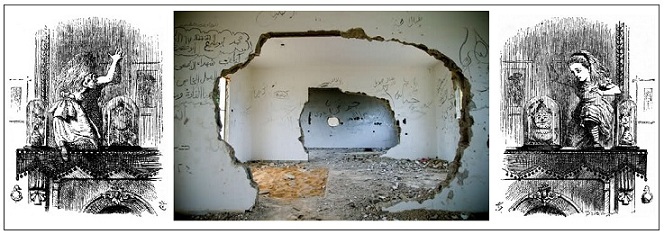
I’ve just read one of those astounding paragraphs that leaves the mind reeling. Some of you will no doubt already be aware of the work of Israeli architect Eyal Weizman, but for me, his paper Lethal Territory is new ground:
The maneuver conducted by units of the Israeli Defense Forces (IDF) in Nablus in April 2002 was described by its commander, Brigadier General Aviv Kokhavi, as inverse geometry, the reorganization of the urban syntax by means of a series of microtactical actions. During the battle, soldiers moved within the city across hundred-meter-long “overground-tunnels” carved through a dense and contiguous urban fabric. Although several thousand soldiers and several hundred Palestinian guerrilla fighters were maneuvering simultaneously in the city, they were so “saturated” within its fabric that very few would have been visible from an aerial perspective at any given moment. Furthermore, soldiers used none of the streets, roads, alleys, or courtyards that constitute the syntax of the city, and none of the external doors, internal stairwells, and windows that constitute the order of buildings, but rather moved horizontally through party walls, and vertically through holes blasted in ceilings and floors. This form of movement, described by the military as “infestation”, sought to redefine inside as outside, and domestic interiors as thoroughfares. Rather than submit to the authority of conventional spatial boundaries and logic, movement became constitutive of space. The three-dimensional progression through walls, ceilings, and floors across the urban balk reinterpreted, short-circuited, and recomposed both architectural and urban syntax. The IDF’s strategy of “walking through walls” involved a conception of the city as not just the site, but the very medium of warfare — a flexible, almost liquid medium that is forever contingent and in flux.
Where do I begin?
* * *
1. For sheer creativity, this reversal of our normal understanding of space is both audacious and brilliant.
2. In terms of the way the humans living in that space experience the tactic, it must have been – must be – extraordinary – shock and awe on the scale of the individual family and its dwelling. Weizman quotes a Palestinian woman’s response:
Imagine it – you’re sitting in your living room, which you know so well; this is the room where the family watches television together after the evening meal. .. And, suddenly, that wall disappears with a deafening roar, the room fills with dust and debris, and through the wall pours one soldier after the other, screaming orders. You have no idea if they’re after you, if they’ve come to take over your home, or if your house just lies on their route to somewhere else. The children are screaming, panicking. . Is it possible to even begin to imagine the horror experienced by a five-year-old child as four, six, eight, twelve soldiers, their faces painted black, submachine guns pointed everywhere, antennas protruding from their backpacks, making them look like giant alien bugs, blast their way through that wall?
3. It has a past, there’s nothing entirely new under the sun:
Similarly, the strategy of walking through walls, as Israeli architect Sharon Rotbard reminds us, is reinvented for every urban battle in response to local conditions. It was first described in Marshal Thomas Bugeaud’s 1849 draft of La Guerre des Rues et des Maisons, in the context of anti-insurgency tactics used in the class-based urban battles of 19th-century Paris. Instead of storming the barricades from the front, Bugeaud recommended entering the barricaded block at a different location and “mouse-holing” along “over-ground tunnels” that cut across party walls, then taking the barricade by surprise from the flank. On the other side of the barricades and a decade later, Louis-August Blanqui wrote this microtactical maneuver into his Instructions pour une prise d’armes.
* * *
4. Quite apart from the notion of “inverse geometry” there’s a thread here that concerns mapping and deserves investigation. First, there’s this quote in Weizman’s essay from Walter Benjamin:
I have long, indeed for years, played with the idea of setting out the sphere of life — bios — graphically on a map. First I envisaged an ordinary map, but now I would incline to a general staff’s map of a city center, if such a thing existed. Doubtless it does not, because of the ignorance of the theatre of future wars.
Then, in a paper on forming a “coherent mental map of the Israeli-Palestinian conflict”, Weizman writes
A new understanding of territory had to be developed to govern the West Bank. The Occupied Territories were no longer seen as a two-dimensional surface, but as a large three-dimensional volume, layered with strategic, religious and political strata.
Later in the same piece, we can find Weizman’s description of a “politics of verticality” along with its vivid quote from Benveniste:
New and intricate frontiers were invented, like the temporary borders later drawn up in the Oslo Interim Accord, under which the Palestinian Authority was given control over isolated territorial ‘islands’, but Israel retained control over the airspace above them and the sub-terrain beneath.
This process might be described as the ‘politics of verticality’. It began as a set of ideas, policies, projects and regulations proposed by Israeli state-technocrats, generals, archaeologists, planners and road engineers since the occupation of the West Bank, severing the territory into different, discontinuous layers.
The writer Meron Benvenisti described the process as crashing “three-dimensional space into six dimensions – three Jewish and three Arab”. Former US president Bill Clinton sincerely believed in a vertical solution to the problem of partitioning the Temple Mount. Settlement Masterplanners like Matityahu Drobless aimed to generate control from high points.
* * *
Upside down, inside out, and topsy-turvy? Apart from Alice, of course — what does this remind me of?
Why, religion, naturally.
Take the Gospel of Thomas, logion 22 (Barnstone & Meyer, p. 51):
Yeshua said to them,
When you make the two into one,
and when you make the inner like the outer
and the outer like the inner
and the upper like the lower,
and when you make male and female into a single one,
so that the male will not be male nor female be female,
when you make eyes in place of an eye,
a hand in place of a hand,
a foot in place of a foot,
an image in place of an image,
then you will enter the kingdom.
Similar sayings are found in the poetry of Kabir, the great Indian mystic-poet, and described thus by Linda Hess (The Bijak of Kabir, p.135):
A particularly intriguing category of Kabir’s poems is the type known as ulatbamsi, poems in “upside down language”. They intrigue because they are absurd, paradoxical, crazy, impenetrable, and yet they purport to be meaningful.
In Japan, they might be given the name of koan — Hess quotes (p. 145) an early Mahayana sutra describing the world as “like a desert mirage, a celestial city, a mirror-reflection, a stone made from water hardened by a whirlwind”.
.
Here is one of the signs of the end times quote in Islamic sources:
After the night of three nights, the following morning the sun will rise in the west. People’s repentance will not be accepted after this incident.
* * *
And so perhaps the saying with which Eihei Dogen described Master Dogo‘s friend in his Shinji Shobogenzo best encapsulates both the state of mind that a sudden reality-reversal accomplishes in those who are not prepared for it — and paradoxically, the state of mind in which it can be accepted as part of the natural order of things:
He does not have a roof above his head, nor any ground under him.