[ by Charles Cameron — on a brief random walk through YouTube, an ambulation for a sedentary soul — nothing serious, I promise ]
.
Back when I was a wee lad at Oxford there was another wee lad, also of a poetic disposition, named Heathcote Williams. For some reason, the other evening I stumbled on a clip of Heathcote performing the role of a psychiatrist in a movie I haven’t seen, but will probably keep an eye out for.
Here’s that (somewhat ob)scene:
Well, I’m the nomadic type, and my eye somehow strayed from there to this:
Okay? I get the sense I’m on a roll here, Salma Hayek is compellingly beautiful, and so I compulsively gamble away a few more minutes of my precious time, and find… You’ll forgive me, I hope, and see this clip through to the end, because in its own light-hearted way it’s about miracles.
And as you know, I have theological interests:
**
So that was my evening’s delectation a couple of days ago, delivered here today for yours.
If, however, you are willing to take a grander leap into anti-monarchical, pro-poetic, anti-theological polemic, you might take a look at Heathcote’s fiery account of Shelley, his volatile predecessor at Oxford, in seven parts beginning on YouTube here: Shelley at Oxford.
Heathcote takes the liberty of speaking his mind, and consequently several of my own sacred cows get scorched to steak along the way — you have been warned.
[ by Charles Cameron — squeezed between the space of astronomers and the paradise of the believers, is there yet room for the dancing play of poetry, music and imagination? ]
.
My first question for you today would be — do you believe in Alice?
And further to that, do you believe in the Red Queen?
‘I declare it’s marked out just like a large chessboard!’ Alice said at last. ‘There ought to be some men moving about somewhere–and so there are!’ she added in a tone of delight, and her heart began to beat quick with excitement as she went on. ‘It’s a great huge game of chess that’s being played–all over the world -– if this is the world at all, you know. Oh, what fun it is!’
I can’t really ignore Lewis Carroll when he crops up in my morning feed like that: he’s a Christ Church man and a poet, as I am, and it would be rude of me to ignore him. And besides, what he’s on about here is the world-as-game concept, which is never far from my mind — hence my inclusion of that question about the Red Queen.
**
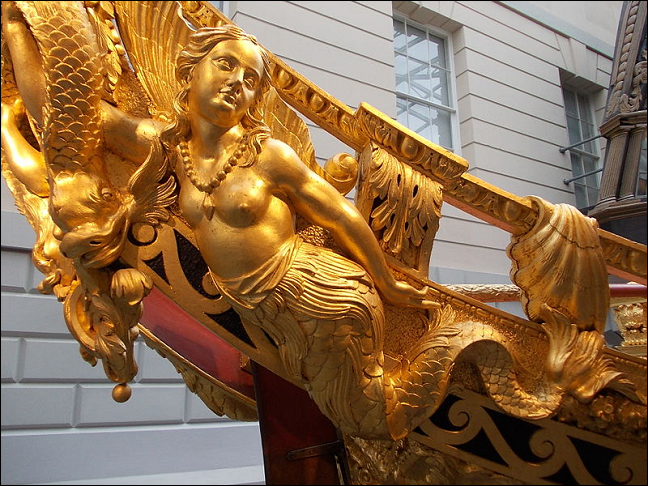
And second, mermaids.
.
It gets more interesting, you see. Because what collided with that first question was a conversation @khanserai aka Humera Khan was having with @mujaahid4life aka Abdallah via Twitter, in which the Harry Potter books were discussed and the topic of unimaginative clerical fatwas on games and works of fiction came up. At which point, Abdallah pointed us all to this now-archived fatwa regarding the permissibility of eating mermaid flesh:
Ruling on eating mermaids
A mermaid is a creature that lives in water and looks like a human. As to whether it really exists or it is a mythical being, that is subject to further discussion.
It says in a footnote in al-Mawsoo’ah al-Fiqhiyyah (5/129): From the modern academic resources that are available to us, it may be understood that the mermaid, which is called Sirène in French, is a mythical creature that is described in fairy tales as having an upper body like a woman and a lower half like a fish.
See the French Larousse encyclopédique on the word Sirène.
The encyclopaedia goes on to say: The widespread notion in ancient times was that the wonders and animals of the sea were more and greater than the wonders of dry land, and that there was no kind of animal in the sea that did not have a counterpart on land. This was confirmed by Prof. Muhammad Fareed Wajdi in his encyclopaedia, quoting from modern academic sources. See: Daa’irah Ma’aarif al-Qarn al-‘Ishreen: Bahr – Hayawiyan. End quote.
Al-Dumayri said in Hayaat al-Haywaan al-Kubra: Mermaid: it resembles a human but it has a tail. Al-Qazweeni said: Someone brought one of them in our time. End quote.
Many of the fuqaha’ mentioned mermaids and differed on the ruling concerning them. Some of them said that they are permissible (to eat) because of the general meaning of the evidence which says that whatever is in the sea is permissible. This is the view of the Shaafa’is and Hanbalis, and is the view of most of the Maalikis and of Ibn Hazm and others. And some of them regarded it as haraam because it is not a kind of fish. This is the view of the Hanafis and of al-Layth ibn Sa’d.
Ibn Hazm (may Allaah have mercy on him) said in al-Muhalla (6/50): As for that which lives in the water and cannot live anywhere else, it is all halaal no matter what state it is in, whether it is caught alive and then dies, or it dies in the water and then floats or does not float, whether it was killed by a sea creature or a land animal. It is all halaal to eat, whether it is the pig of the sea (i.e., a dolphin), a mermaid, or a dog of the sea (i.e., shark) and so on. It is halaal to eat, whether it was killed by an idol-worshipper, a Muslim, a kitaabi (Jew or Christian) or it was not killed by anyone.
What’s outside the box?
And it goes on… ending, mercifully:
And Allaah knows best.
Sometimes I think those might be my favorite words evvah!
**
Are mermaids real enough for religious scholarship to address them?
Many Zen koans contain references to myths and folktales of ancient India, China, and Japan. Since Westerners generally are not familiar with these stories, koan study without extensive background information is often a frustrating and exasperating process.
In this dharma discourse, Abbot John Daido Loori fashions a koan, complete with pointer and capping verse, from a classic of children’s literature, Lewis Carroll’s Alice in Wonderland. The koan revolves around Alice’s encounter with a caterpillar who explains the magical properties of a special two-sided mushroom that to Alice’s eyes appears perfectly round. Alice’s struggles with this dilemma make for a stimulating story that mirrors the conflicts and dualities we face in our everyday life.
All of which brings me to the question of the place of deep imagination in a sometimes shallow world.
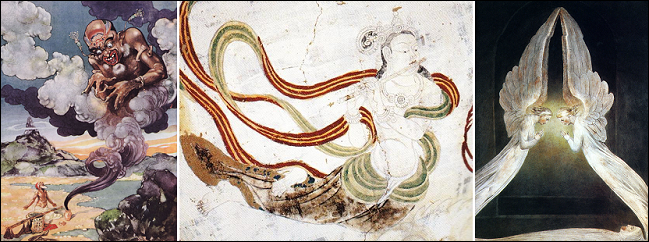
Alice, do you believe in her? Mermaids and Macbeth mean something to sailors and theater-folk, respetively. Angels? If angels, then the djinn, too? Christian scripture speaks for the existence of one, the Qur’an of both — is one more probable, more real, perhaps, than the other?
And what of the gandharvas and apsaras — middle panel — the celestial musicians and airy dancers who move to their music? Is there any poet who can claim never to have sensed them?
**
And thus we come to Robert Graves and the muse as he depicts her, in his book The White Goddess, and in many poems such as this:
In Dedication
.
Your broad, high brow is whiter than a leper’s,
Your eyes are flax-flower blue, blood-red your lips,
Your hair curls honey-colored to white hips.
All saints revile you, and all sober men
Ruled by the God Apollo’s golden mean;
Yet for me rises even in November
(Rawest of months) so cruelly new a vision,
Cerridwen, of your beatific love
I forget violence and long betrayal,
Careless of where the next bright bolt might fall.
[ by Charles Cameron — on peace in Northern Ireland, soldiers and Christ ]
.
The upper image is of the celebrated “Shroud of Turin” — in which it is thought by some that Jesus was wrapped to be buried, leaving a negative image of his features on its linen. Below it, the image of “a British soldier behind a bullet-resistant riot shield in Northern Ireland in 1973, during the Troubles” which heads an article by the novelist Colum McCann in today’s NY Times magazine, Remembering an Easter Miracle in Northern Ireland.
McCann writes:
PEACE, said W. B. Yeats, comes dropping slow.
After 15 years, the Good Friday peace agreement in Northern Ireland still occasionally quivers, sometimes abruptly, and yet it holds. It is one of the great stories of the second half of the 20th century, and by the nature of its refusal to topple, it is one of the continuing marvels of the 21st as well. While rockets fizzle across the Israeli border, and funeral chants sound along the streets of Aleppo in Syria, and drones cut coordinates in the blue over Kandahar, Afghanistan, the Irish peace process reaffirms the possibility that — despite the weight of evidence against human nature — we are all still capable of small moments of resurrection, no matter where we happen to be.
This is the Easter narrative: that the stone can be rolled away from the cave.
Hundred of years of arterial bitterness, in Ireland and elsewhere, are never easy to ignore. They cannot be whisked away with a series of signatures. It takes time and struggle to maintain even the remotest sense of calm. Peace is indeed harder than war, and its constant fragility is part of its beauty. A bullet need happen only once, but for peace to work we need to be reminded of its existence again and again and again.
In the twinned images above, we see the crucifixion and burial of Christ, commemorated on Good Friday and Holy Saturday, and their analog in the lives we ourselves live, in a world whose body is blooded with strife and buried in the many forms of forgetfulness and denial.
Here we should recall Wilfred Owen’s words — seeing in the soldier before him, Christ:
For 14 hours yesterday, I was at work-teaching Christ to lift his cross by the numbers, and how to adjust his crown; and not to imagine he thirst until after the last halt. I attended his Supper to see that there were no complaints; and inspected his feet that they should be worthy of the nails. I see to it that he is dumb, and stands before his accusers. With a piece of silver I buy him every day, and with maps I make him familiar with the topography of Golgotha.
In McCann’s piece we may find a modern type and hope of resurrection:
This is the Easter narrative: that the stone can be rolled away from the cave.
[ by Charles Cameron — finding a gem of a DoubleQuote on ChicagoBoyz ]
.
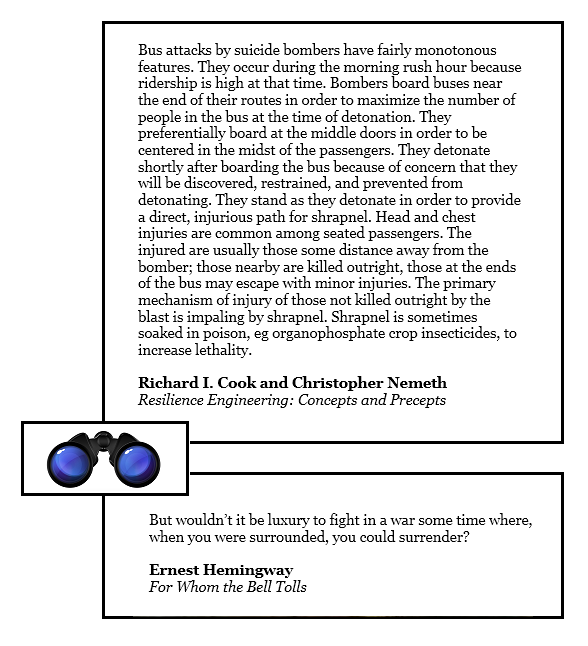
As regular readers here will see, I have varied my usual DoubleQuotes format here to make room for the two particular quotes in question.
Taken together — as I found them in a post by Jay Manifold titled Quoted Without Comment today at ChicagoBoyz — they form a powerful, moving DoubleQuote, and I thought it was worth dropping them into the DQ format, thus essentially reposting Jay’s fine post here at Zenpundit.
**
This business of “finding” DoubleQuotes in the writings of others confirms me in my suspicion that the form itself is a naturally occurring one, which can be sharpened into a powerful analytic tool once we recognize its utility and formalize it.
[ by Charles Cameron — the art of memory, with a sidelong glance at swans, typhoid and theodicy ]
.
Thomas Harris (and by extension Hannibal Lector) has been interested in memory palaces for a long time. We can begin to infer this this because Lector describes his hobby in Red Dragon (1981) and again in Silence of the Lambs (1988):
So — church collapses?
**
As you can tell from that last comment in the Silence of the Lambs quote — to my mind the most brilliant presentation of the problem of theodicy for our day — if there’s a God worth defending, it has to be a God who allows sparrows to fall, typhoid to accompany swans in the vast ecology of existence, churches to collapse on worshipers, and “bad things to happen to good people” from time to time.
And such things, specifically including collapses of religious buildings atop worshipers, do indeed happen in fact as well as fiction.
And they don’t only happen to Christians, either… Bon is the shamanistic religious tradition of Tibet, prior to — and later, somewhat assimilated by — Buddhism…
**
The thing is, when I read that Hannibal Lector collected church collapses, it not only made me start to take note of them myself, it also made me think of Simonides. As Frances Yates tells us in her book, The Art of Memory:
At a banquet given by a nobleman of Thessaly named Scopas, the poet Simonides of Ceos chanted a lyric poem in honour of his host but including a passage in praise of Castor and Pollux. Scopas meanly told the poet that he would only pay him halfthe sum agreed upon for the panegyric and that he must obtain the balance from the twin gods to whom he had devoted half the poem. A little later, a message was brought in to Simonides that two young men were waiting outside who wished to see him. He rose from the banquet and went out but could find no one. During his absence the roof of the banqueting hall fell in, crushing Scopas and all the guests to death beneath the ruins; the corpses were so mangled that the relatives who came to take them away for burial were unable to identify them. But Simonides remembered the places at which they had been sitting at the table and was therefore able to indicate to the relatives which were their dead. The invisible callers, Castor and Pollux, had handsomely paid for their share in the panegyric by drawing Simonides away from the banquet just before the crash. And this experience suggested to the poet the principles of the art of memory of which he is said to have been the inventor. Noting that it was through his memory of the places at which the guests had been sitting that he had been able to identify the bodies, he realised that orderly arrangement is essential for good memory.
And by way of reinforcing my Lector-Simonides conjecture, Lector certainly had a remarkable interest in memory, as we learn from his dialogue with Clarice Starling:
“Did you do the drawings on your walls, Doctor?”
“Do you think I called in a decorator?”
“The one over the sink is a European city?”
“It’s Florence. That’s the Palazzo Vecchio and the Duomo, seen from the Belvedere.”
“Did you do it from memory, all the detail?”
“Memory, Officer Starling, is what I have instead of a view.”
A belvedere, from the Italian, is “a structure (as a cupola or a summerhouse) designed to command a view” — and a beautiful view at that. Belvedere is also, ironically, the name of the town in Ohio where Buffalo Bill, Lector’s serial killer ex-patient, lives…
**
So it didn’t surprise me to discover that in Hannibal (1999), the book that follows Silence, this brilliant man who as we have seen collects church collapses and has an exquisite memory in place of a view, is revealed as a practitioner of Simonides’ art:
The memory palace was a mnemonic system well known to ancient scholars and much information was preserved in them through the Dark Ages while Vandals burned the books. Like scholars before him, Dr. Lecter stores an enormous amount of information keyed to objects in his thousand rooms, but unlike the ancients, Dr.Lecter has a second purpose for his palace; sometimes he lives there. He has passed years among its exquisite collections, while his body lay bound on a violent ward with screams buzzing the steel bars like hell’s own harp.
Hannibal Lecter’s palace is vast, even by medieval standards. Translated to the tangible world it would rival the Topkapi Palace in Istanbul for size and complexity.
We catch up to him as the swift slippers of his mind pass from the foyer into the Great Hall of the Seasons. The palace is built according to the rules discovered by Simonides of Ceos and elaborated by Cicero four hundred years later; it is airy, high-ceilinged, furnished with objects and tableaux that are vivid, striking, sometimes shocking and absurd, and often beautiful. The displays are well spaced and well lighted like those of a great museum. But the walls are not the neutral colors of museum walls. Like Giotto, Dr. Lecter has frescoed the walls of his mind.
Brilliant. And a delight, years later, to have my hunch connecting the church collapses and prison cell with only memory for a view with Simonides and the Art of Memory confirmed by the third book and film in the series…
You’ll note, btw, that the Lector (caveat lector) of the first two books has now become Lecter in alignment with the films starring Anthony Hopkins.
**
I love symmetries, so let’s move from the most monstrous criminal mind in literature, to the greatest detective…
Sherlock Holmes — in his latest television incarnation — builds memory palaces of a sort, though I’m not sure Simonides would recognize them.
I’m posting the clip from the series here to honor my son Emlyn, with whom I have been watching the series…
In 1596 Matteo Ricci taught the Chinese how to build a memory palace. He told them that the size of the palace would depend on how much they wanted to remember: the most ambitious construction would consist of several hundred buildings of all shapes and sizes, “the more there are the better it will be,” said Ricci, thought he added that one did not have to build on a gradiose scale right away. One coul create modest palaces, or one could build less dramatic structures such as a temple compound, a cluster of government offices, a public hostel, or a merchants’s meeting lodge. If one wished to begin on a still smaller scale, then one could erect a simple reception hall, a pavilion, or a studio. And if one wanted an intimate space one could use just the corner of a pavilion, or an altar in a temple, or even such a homely object as a wardrobe or a divan.
You’ll note that in this early example of virtual reality as an pedagogical technology, Ricci doesn’t start with the easy stuff, the single wardrobe or divan — he begins with “the most ambitious construction”…
Enough for now. When I want to talk about in a follow up post is detail… the crucial importance of detail.
Zenpundit is a blog dedicated to exploring the intersections of foreign policy, history, military theory, national security,strategic thinking, futurism, cognition and a number of other esoteric pursuits.