zenpundit.com » mathematics

Archive for the ‘mathematics’ Category

Don’t ask me — I’m a Qualit!

Friday, February 8th, 2013

[ by Charles Cameron — Christmas pudding UK circa 1950, math, banks, and moral authority ]
.


.

As I recall, the plum pudding served in our family on Christmas day was not only rich in raisins, sultanas, currants and candied peel, it not only had brandy poured over it and a flame swiftly set to it, it was not only served with brandy butter…

It also had, somewhere within it, a silver coin — I understand these were originally related to coins of healing and the Royal Touch — and one of us, my sister and I, would be the one to find it in our slice. So equality of opportunity was important, both of us wanted to have an equal chance at winning the coveted prize.

Or perhaps I should say, equantity? Because believe me, the quality in each and every slice was just fine.

All this by way of saying that yes, I understand that quantity has its uses.

**

In Recipe for Disaster: The Formula That Killed Wall Street a while back, Felix Salmon proposed the upper (and more colorful) of the two equations below, suggesting that it was the root cause of the financial failure of 2008:

Comes now Chris Arnade blogging on Scientific American for the defense, claiming that The Real—and Simple—Equation That Killed Wall Street was the lower of the two equations (the one in black on white).

**

Arnade writes of Salmon’s Wired article:

It was not the first piece that made this type of argument, but it was the most aggressive. Since then it has been a common theme in the media that mathematics, especially obscure advanced mathematics, is largely responsible for the catastrophe that doomed the world to the last five years of recession and slow growth.

This theme plays on the fallacy that danger always comes from complexity. It’s a fabrication that obscures the real causes, that makes it easier to say, “Hey, it wasn’t my fault, I was blinded by science.”

The reality is much simpler and less sexy. Wall Street killed itself in a time-honored fashion: Cheap money, excessive borrowing, and greed. And yes, there is an equation one can point to and blame. This equation, however, requires nothing more than middle school algebra to understand and is taught to every new Wall Street employee. It is leveraged return.

What is leveraged return? It’s the return on assets using borrowed money.

I am depicted as the fellow with glasses and a squint, squeezed in between the two equations. When I recover from my discombobulation, I will push my glasses up high on my brow and say, Don’t ask me — I’m a Qualit!

**

And now we Anglicans have a new Archbishop who, well, as the Guardian puts it, Archbishop of Canterbury accuses banks of hypocrisy over bonuses:

Two months ago HSBC was also fined a record £1.2bn over allegations of money laundering for Mexican drug barons. Regulators said HSBC had allowed at least $881m of drugs money through its accounts.

Taking evidence from HSBC’s two top bosses – its chief executive, Stuart Gulliver, and chairman, Douglas Flint – the archbishop said: “I’m increasingly baffled at the discussion we are having. What is it essentially about bankers that means they need skin in the game [bonuses]? We don’t give skin in the game to civil servants, to surgeons, to teachers.

“There’s a whole range of people who don’t have that. It seems to me that you are putting huge effort into a values-based organisation and yet at the end of the day, particularly for your most senior staff who are most important as regards setting values and culture, you seem to be saying the only way you can motivate them to any significant extent is with cash.”

The bankers, who said they wanted to turn HSBC into a bank of “courageous integrity”, insisted it was necessary to pay bonuses because they provided incentives that could be clawed back if mistakes were later uncovered.

Don’t you love it? Courageous integrity!

**

As Rochefoucauld said:

Hypocrisy is the homage vice pays to virtue.

It seems it is a small price to pay, quantitatively speaking — a rounding error. From a qualitative perspective however, it is a Faustian price — as Wikipedia (following Britannica) has it, it is:

a situation in which an ambitious person surrenders moral integrity in order to achieve power and success

Ooh — it’s a question of having or surrendering moral integrity about one’s own claim to integrity! A self-referential paradox if ever I saw one…

Christianity (since we’ve just been quoting an Archbishop) sets the matter sub specie aeternitatis in Mark 7.6:

He answered and said unto them, Well hath Esaias prophesied of you hypocrites, as it is written, This people honoureth me with their lips, but their heart is far from me.

A small price, or the ultimate? Quant? or Qualit? The choice is always ours.

**

So you see why I’d rather be a Qualit than a Quant.

But even so, finding that silver coin in my Christmas pudding was pretty special, from a quantish point of view. The brandy butter, more qualitish IMO, was even better.

** ** **

Sources for header:

Qualit logo
Quant logo

Sources for SPECS:

Wired‘s equation
SciAm‘s equation

Unequal equations

Friday, January 18th, 2013

[ by Charles Cameron — math, modeling and mapping, in that strange zone where beauty meets understanding ]
.

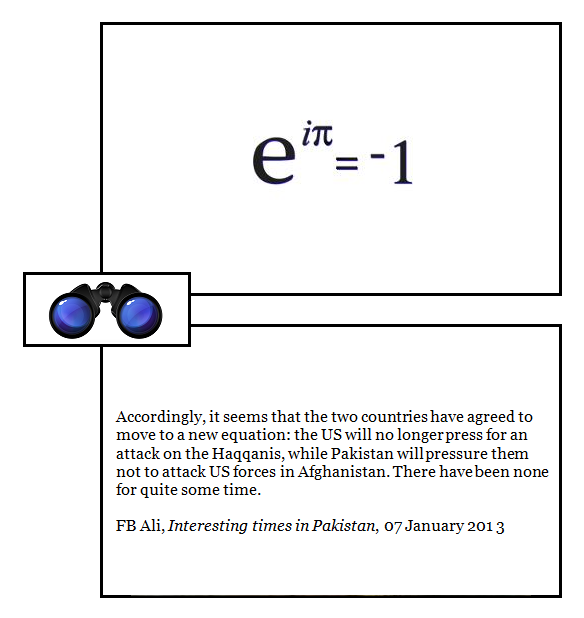
The upper equation — Euler‘s — gets as tight and definitional as one can get, yet is profound in the way the greatest haiku are… while the metaphorical “equation” mentioned in the lower panel is a very rough model indeed of the intricate and constantly shifting forces at work in and on Pakistan.

**

I’m interested in mapping these sorts of influences at a level of detail that the human mind can assimilate and comprehend — and the graphical news-map in the video below will give you an idea of what one approach to such a mapping would look like.

This particular example is drawn from a mapping of web-based news items related to President Obama over the course of 2009, but it should give you some idea of the constant flux of tensions and motion of “nodes” involved in tracking political issues, at home or abroad — the beginning is a bit slow, but from about the 23 second mark on is just amazing:

Now is that art, or technology — or a beginning of something fascinating that by its very nature melds both?

**

Sources:

  • FB Ali, Interesting times in Pakistan on Sic Semper Tyrannis
  • Recorded Future Index video
  • The War and Peace koan, episode n+1

    Wednesday, November 21st, 2012

    [ by Charles Cameron — glimpsing the Necker Cube effect, when the weapons of war meet the prayers of peace ]
    .

    Necker cube image credit -- youramazingbrain.org

    .

    A while back I co-authored a book with a physician friend, Cleaves Bennett MD, on the control of high blood pressure, and since he wanted to include the idea that humor had a role to play in reducing stress, we included a joke with each week’s exercises — and one of the jokes I suggested, and which made it into the book, was this:

    A Catholic priest, a Dominican, once walked into London’s Farm Street Jesuit Church and found one of his Jesuit friends kneeling in prayer, smoking a cigarette.

    “How do you get away with it?” the Dominican muttered. “I asked my father confessor if I could smoke while I was praying and he absolutely forbade it.”

    “No wonder,” said the Jesuit. “I inquired if I could pray while I was smoking, and my confessor said, ‘Of course, old boy, feel free. … I don’t believe you should ever stop praying.'”

    **

    This post could well be included in my “form is insight”: series, with the form in question being “the reversal”.

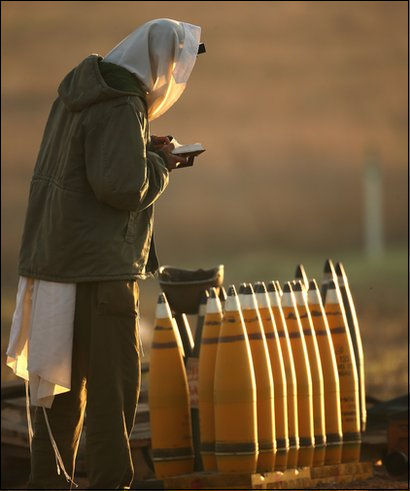
    Here’s a recent BBC picture with the tag-line “An Israeli soldier prays at dawn on Israel’s border with the Gaza Strip”:

    Some readers might look at that picture and recall Psalm 94, verses 3-5:

    Lord, how long shall the wicked, how long shall the wicked triumph? How long shall they utter and speak hard things? and all the workers of iniquity boast themselves? They break in pieces thy people, O Lord, and afflict thine heritage.

    Some might reflect on Psalm 122, verses 6-7:

    Pray for the peace of Jerusalem; may they prosper that love thee. Peace be within thy walls, and prosperity within thy palaces.

    Some might recall the Qur’an 49, verse 13:

    O mankind, We have created you male and female, and appointed you races and tribes, that you may know one another.

    Others might think of the Gharqad Tree hadith, quoted in the charter of Hamas:

    The Day of Judgement will not come about until Muslims fight the Jews (killing the Jews), when the Jew will hide behind stones and trees. The stones and trees will say O Muslims, O Abdulla, there is a Jew behind me, come and kill him. Only the Gharkad tree, would not do that because it is one of the trees of the Jews.

    And I myself have no idea what the prayers that Jewish soldier offered were all about — his own safety, that of his family and loved ones, that of his own people, that of all the world’s people — nor about the prayers of young Muslims on the other side of the wall…

    **

    I look at that photo of the soldier boy praying beside the munitions of a brutal war, and my first instinct is to feel sadness — because the essence of prayer, surely, is shalom, peace, salaam.

    And then I am reminded of the Dominican and the Jesuit in that story I told you.

    Substituting “peace” for “prayer” and “war” for “munitions” to get at the essence here — should I be more sad that here, peace is depicted in the presence of war — or more glad that here, war is depicted in the presence of peace?

    Reading a partisan cartoon: the parable of a dog’s ears and teeth

    Friday, November 16th, 2012

    [ by Charles Cameron — on the difficulties that may be posed when “reading” graphics ]
    .

    **

    The question I want to ask in this post is: how much can you safely read into a political cartoon?

    Here is the particular cartoon I have in mind:

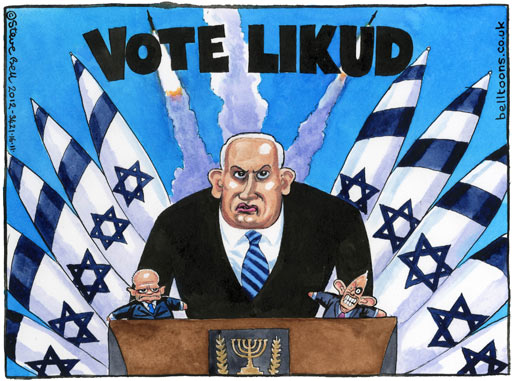
    It was published in The Guardian (UK) yesterday, and as you may be able to see, it portrays Israeli PM Benjamin Netanyahu as a puppet-master, with British politicians Tony Blair and William Hague as his puppets, and was published to illustrate the cartoonist’s view of British reaction to the Gaza situation.

    How much can we read into it?

    **

    If you are used to seeing cartoons such as these —

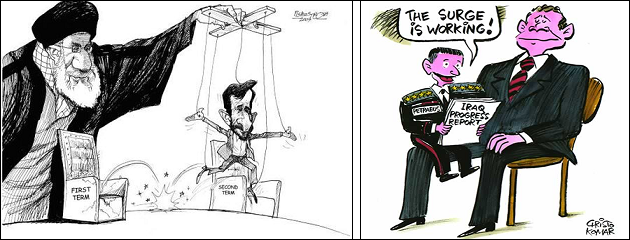
    showing Khamenei pulling Ahmadinejad‘s strings and Petraeus as a puppet of GW Bush, when you come across the Netanyahu cartoon in the Guardian, you may well view it as another in a long series of political cartoons suggesting that someone is running someone else’s show behind the scenes. It’s the old idea of the eminence grise, in other words, expressed in cartoon form.

    **

    If, on the other hand, you’ve been exposed way too often to cartoons like these —

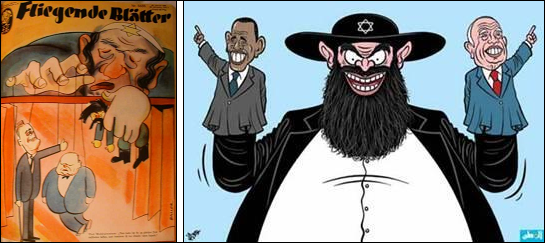
    the one portraying Churchill, FDR and Stalin as Jewish puppets, taken from a 1942 issue of the Nazi paper, Fliegende Blätter, or the one depicting McCain and Obama as Israeli puppets, taken from a 2008 issue of the Saudi paper, Al-Watan… you may well see the same cartoon in a very different — and distinctly antisemitic — light.

    **

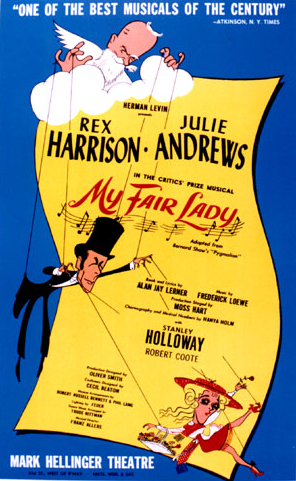
    The last two graphics, at least, are extremely offensive, and I would like to offer another graphic here — one which also uses our “puppet master” theme — as a visual equivalent of offering a glass of water to cleanse the palate:

    I’ll be addressing this My Fair Lady poster from a very different angle, in a later post in my “form is insight” series — this one on “dolls within dolls”, the “world stage which we have dotted with stages of our own devising” and “turtles all the way down”…

    **

    Having hopefully reduced the emotional freight which some of the cartoons above must surely have carried with them, I would now like to offer you some background which seems relevant to me. Characteristically, perhaps, it comes from a very different field of knowledge.

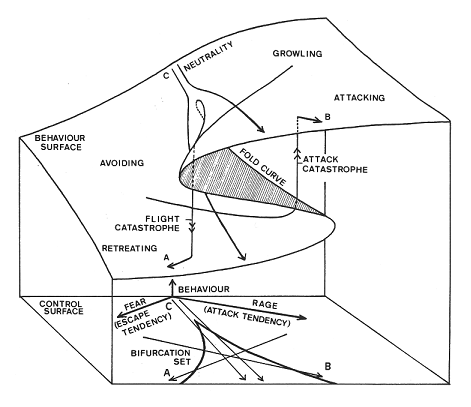
    EC Zeeman‘s April 1976 article Catastrophe Theory in the Scientific American was my introduction to the mathematician Rene Thom’s remarkable body of work, an introduction which sailed mostly over my head — but one of Zeeman’s points, which he illustrated with the graphic below, made perfect sense to me.

    The annotation to this illustration read in part:

    If an angry dog is made more fearful, its mood follow* the trajectory ‘A’ on the control surface. The corresponding path on the behaviour surface moves to the left on the top sheet until it reaches the fold curve; the top sheet then vanishes, and the path must jump abruptly to the bottom sheet. Thus the dog abandons its attack and suddenly flees. Similarly, a frightened dog that is angered followes the trajectory ‘B’. The dog remains on the bottom sheet until that sheet disappears, then as it jumps to the top sheet it stops cowering and suddenly attacks.

    My translation:

    A dog that reaches the point where its ears are fully pinned back, indicating full-on fear, and its teeth are also fully bared, indicating full on rage, will behave differently depending on whether its fear level or its rage level was the first to be raised to “full”.

    Just as a dog’s reaction to a full on mix of rage and fear may depend on which stimulus came first, so — I am suggesting — our own reaction to the cartoon in question — inherently antisemitic, or merely critical of a particular Israeli operation — may depend on our previous exposure to cartoons, politics, the Israeli-Palestinian conflict, or antisemitism.

    **

    We now have several levels of ease or difficulty in reading graphics. The Zeeman graphics are hard to read because they’re too small to be legible — but put them in the context of Zeeman’s article, and view them full size as originally published, and the only problem might be in following Zeeman’s text, itself a popularization and simplification of Rene Thom‘s work.

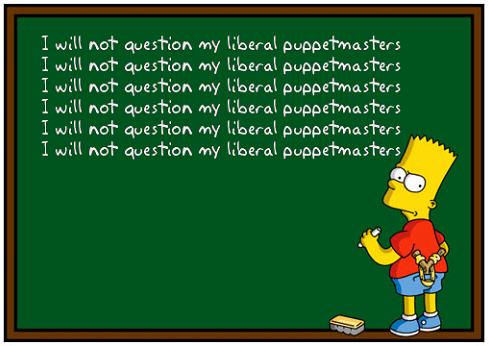
    The Bart Simpson graphic is fairly straight forward, and regular viewers of the show would “read” it in line with hundreds of similar frames in which Bart writes repeated lines on a classroom chalkboard, from Season 1 episode 2’s “I will not waste chalk” to Season 23’s “There’s no proven link between raisins and boogers”.

    And then there’s the disputed Netanyahu graphic… which can be “read” differently, depending on what previous “puppet master” associations the viewer beings to the task. Here, it seems to me, the task of interpretation can be viewed in one of two ways: (i) as an exploration of how it is likely to be read, which I’m suggesting will depend on previous association, and (ii) as an exploration of what “must have been” in the cartoonist’s heart.

    **

    Assessing the cartoon’s probable impact on segments of the public is one thing — knowing what the cartoonist intended, even though we tend to conflate the two, is quite another. Not for nothing does St Paul in I Corinthians 2.11 ask (in my own translation)

    Who knows the qualities of a man but the spirit of that man within him?

    A Qualit’s tribute to Quants

    Saturday, November 10th, 2012

    [ by Charles Cameron — now the election dust has settled, let’s hear it for Nate Silver, Megyn Kelly, Zeynep Tufekci and xkcd ]
    .


    .

    I’m about as Qualit as you can get on the Qualit vs Quant side of things, and if I had a bête grise, it might well be statistics. Why? As Albert Einstein once said, or is said to have said:

    Not everything that counts can be counted, and not everything that can be counted counts

    Look, it’s even on his blackboard:

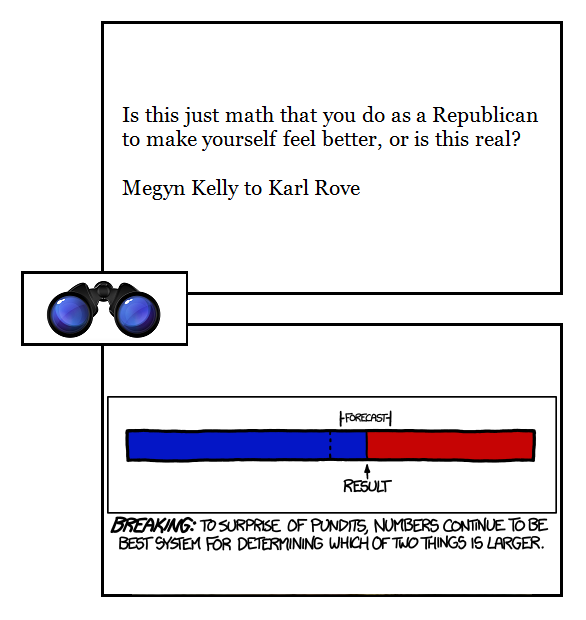
    But look: votes can be counted, and what can be counted is Quant territory. So here’s a little hommage from a Qualit to a Quant — Nate Silver, in this case — with a bow to Megyn Kelly for calling out Karl Rove like that (upper panel, above), and a tip of the hat to xkcd (lower panel) for the usual spot-on commentary from his “webcomic of romance, sarcasm, math, and language”.

    Quality work, Quants!

    **

    Ah — but then, what should we do with Colbert‘s comment?

    Math has a liberal bias

    Joking aside, one reading I’d add to Zen‘s post-election list would be Zeynep Tufekci‘s In Defense of Nate Silver, Election Pollsters, and Statistical Predictions.


    Switch to our mobile site