zenpundit.com » mathematics

Archive for the ‘mathematics’ Category

Numbers by the numbers: Twone?

Saturday, November 10th, 2012

[ by Charles Cameron — parallels and opposites, with a pinch of Shakespeare and a digression into philosophical theology ]
.

My friend Peter Feltham steered me towards an intriguing Telegraph piece about something called the Rolling Jubilee project. The accompanying image caught my eye —

because it reminded me of another image I’d seen years ago, when I took a class in movie directing at UCLA extension.

The upper image (above) illustrates the Telegraph piece, which depicts the Rolling Jubilee thus:

The Rolling Jubilee project is seeking donations to help it buy-up distressed debts, including student loans and outstanding medical bills, and then wipe the slate clean by writing them off.

The lower image is from Jean-Luc Godard‘s film, La Chinoise, which is apparently about a bunch of French Maoist radicals in the 1960s — the “wall” in the image is made of countless copies of Chairman Mao‘s Little Red Book.

And bundles of twenty dollar bills are pretty much the intellectual opposite of stacks of Little Red Books, no?

**

So what? Where do we go from here? Is there anything actionable about those two images?

Does the lower one mean the Rolling Jubilee project is Maoist? Or that capitalism has triumphed over Marxism in the 45 years since Godard’s film was produced? In China? Or in the world at large? Or (ironically?) that capitalism, like communism, is a failed system? That there’s a Hole in the Wall?

Should we be thinking of Pyramus and Thisbe, the play within a play in Shakespeare‘s Midsummer Night’s Dream?

This man, with lime and rough-cast, doth present
Wall, that vile Wall which did these lovers sunder;
And through Wall’s chink, poor souls, they are content
To whisper.

Is there idea that there’s a chink in Wall Street?

**

I’m asking all this because we can take all manner of conclusions from a juxtaposition — it naturally lends the mind to associative thinking, extrapolation, the derivation of one or more meanings. And I surely want to emphasize the “or more” here.

But also because it brings up, with force, the issue of parallels and oppositions.

We don’t say Oxford is the opposite of a Fouquieria columnaris cactus in the Huntington Gardens — they’re too disparate to be opposite. No, we think of Cambridge as the opposite of Oxford because they’re so similar, they’re almost the same — as I’ve said elsewhere on ZP, there’s even a single word for both: Oxbridge.

Opposites are similars with difference, while parallels are differents with similarities — and is that one insight, or two?

We talk about a “two-way street” — in city traffic terms, that’s just one street, but the traffic flows in two directions — and it’s probably best to keep ’em separate.

**

Zoom in, and you’ll see differences, zoom out, and you’ll see samenesses — is that true? true when applied to concepts, debates, arguments, elections, partisanship, wars? day and night? sun and moon? war and peace? life and death?

Apples and oranges?

I don’t think we’re terribly good at thinking about this sort of thing — and I also think binary thinking is both a primary and a frequently divisive factor in the human condition, so we’d best get better at it.

Sun and moon are an interesting pair, because even though they are vastly different both in size and distance from our planet, they each subtend almost exactly the same angle on the eye — thus allowing for the brilliant halo effects of full eclipses of the sun.
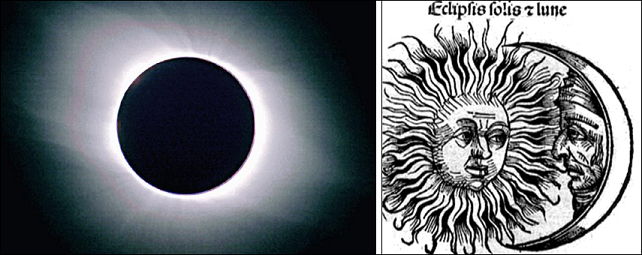
Alchemists see in that sameness a marriage of opposites or coincidentia oppositorum. But here’s my pair of questions for you:

  • is that similarity a matter of entirely random coincidence, or is it evidence of immaculate care and design?
  • and how different would the entire history of human belief be, if the moon and sun were not even close to the same as each other in (apparent) size?
  • For one thing, if the moon seemed smaller than the sun, we’d have no total solar eclipses — the impact of that alone would be interesting to consider.

    Sensitive dependence on initial conditions — & more

    Saturday, November 3rd, 2012

    [ by Charles Cameron — on human impact, with a quick glance at Pundita’s wide-angle thinking ]
    .

    The “butterfly effect” identified by meteorologist Edward Lorenz suggests that when you are dealing with highly complex systems such as weather patterns, what eventually happens may be “sensitively dependent on initial conditions”. Very small differences at one moment in such systems may result in very large differences later on. As Lorenz explains in the upper quote above, however, we’re dealing with a myriad of influences simultaneously, and it’s entirely possible that our own meteorological impact exceeds and outweighs that of the butterfly species…

    I’ve chosen to post this particular pair of quotes, in fact, because both examples point to severely deleterious effects of human impact on our home environment in the larger sense — “the world we live in” — at a level where human individuals may not feel they have much of an individual impact, but where the cumulative effect is much greater: global warming? devastating storms? loss of rain forest? — narcarchy?

    Narcarchy: hereby defined as rule by cartel — see this fascinating news piece, and note in particular the presence of a significant religious thread in the midst of the drug / crime / warfare picture.

    **

    On the question of sensitive dependence on initial conditions, this graphic paints the picture nicely and with nuance, for those who “think in pictures”:

    I found it attached to the Wikipedia entry on Lorenz’s Butterfly Effect which may also help if like me you’re a lay reader, mathematically speaking.

    **

    I also wanted to juxtapose the two quotes above because they give me a chance to talk about “wide angle views” and their virtues, and to point you to a recent Pundita post that set me thinking along those lines. The post is Then and Now: Instructive parallels between 9/11/01-Benghazi and Katrina-Sandy storms, and part of my comment read as follows:

    …you have an amazing breadth of thought going on here – especially in your paragraph:

    It’s as if a new era arrived, with its vast changes in weather patterns and attack patterns, and nobody is yet fully processing the nature of the threats. I guess such an observation is actually old news. But Sandy coming on the heels of Benghazi struck me as a kind of exclamation mark to the fact that civilizations start to fall at the point where they’re no longer able to process the cumulative effects of their past.

    Seeing parallels between Benghazi and 9/11, or between Sandy and Katrina, would be one thing – but managing to see parallel changes in both “weather patterns and attack patterns” is quite another — and even though people may want to question and qualify some of the details, the overall scope and view is breathtaking.

    We need this kind of wide-angle thinking, it seems to me, and I offer my two quotes here in much the same spirit.

    So if “sensitive dependence on initial conditions” is one analytic thought pattern I’m promoting here, “wide-angle thinking” and the capacity to zoom from significant detail to global context is surely another.

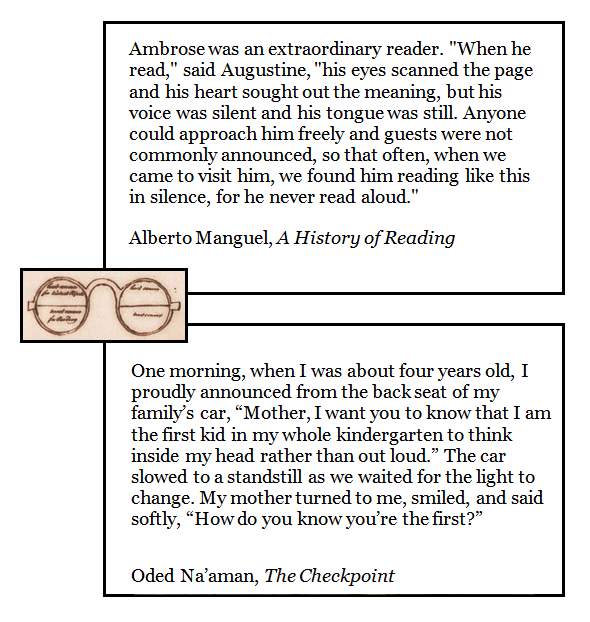
    Silent reading, silent thinking, bifocal glasses

    Thursday, July 26th, 2012

    [ by Charles Cameron — two forms of creativity: far out and close in ]
    .


    .
    Some of the most obvious things aren’t obvious at all, until you think of them. The things my friend Derek Robinson talks about as being in the beforeground. Too close to notice / right under our noses all along.
    .
    And I think that’s one of the principles of creative thinking — a lot of creative detailing takes place out on the bleeding edge, where someone pushes the limits of existing knowledge that little bit farther, and sometimes those insights can be revolutionary. But profound revelations also come from questioning the most basic assumptions — as Cambridge University Press blogged last year, celebrating the centenary of the Russell-Whitehead Principia Mathematica, vol II:

    Principia attempted to ground mathematics in logic and the authors left no stone unturned in their attempt to create the ultimate definition of mathematics. For example, they were well into volume two before they had proved that one plus one equals two! They concluded their proofs with the laconic statement: “The above proposition is occasionally useful.”

    BTW, that’s a point I also addressed in the context of my work on social entrepreneurship for the Skoll Foundation:

    IMO, we need some funding sources that understand that the next significant breakthrough, too, will be all but invisible — and who therefore look specifically for projects that are categorized by their radical rethinking of the seemingly known and obvious.

    **

    For anyone who’s curious, the bifocals pictured in the tiny “specs” section of my graphic above come from Ben Franklin‘s original letter proposing the idea of bifocal glasses, courtesy of the Library of Congress (link is to complete image).

    The Odel Na’aman story, The Checkpoint: Terror, Power, and Cruelty is up at the Boston Review site. I haven’t read it yet, just tasted the first paragraph.

    There are times when it helps to have bifocal (contrapuntal) vision…

    Numbers by the numbers: two

    Thursday, July 12th, 2012

    [ by Charles Cameron — numbers as analytic categories, two, the duel and the duet ]
    .

    Charles Darwin once said of his fellow species biologists:

    Those who make many species are the “splitters,” and those who make few are the “lumpers”.

    **

    The diagram above represents a card-game I’ve played on occasion in my mind, asking myself the question: what is the opposite of one?

    Two is the usual answer — and it’s interesting, you can get there from one two ways: by adding, or by dividing.

    **

    The human mind very often thinks in binaries, we talk about us and them, friend and foe, the Allies and the Axis Powers, and even an eye for an eye and a tooth for a tooth – our ideas of warfare, contest and justice alike are predicated on the number two.

    As I said in my intro post, one is a single data point, perhaps an anomaly: two is a duel or a duet, an opposition or a trend.

    So we don’t always have to think of us and them — we could also think about me and mine, you and yours, two heads are better than one…

    And what if you can “turn” your enemy? Then the duel turns into a duet.

    **

    The duel is all about two competing, contending, fighting, agonizing to see who shall be the one. It is arguably the most basic form of combat, the simplest, and possibly the most profound. It can be close to symmetric — “they were perfectly matched” — or the very essence of asymmetric — David and Goliath.

    The duet is about two collaborating, counterpointing, harmonizing — seeing how, together, they are one…

    War-fighting and music-making, war and peace, regiment and free form, the march and the dance…

    *****

    I am eager to know what sorts of insights you can derive from or find echoed in this series of posts.

    Numbers by the numbers: one

    Thursday, July 12th, 2012

    [ by Charles Cameron — numbers as analytic categories, one, self-reference ]
    .

    Is that a self-eating watermelon?

    Not exactly. It’s the ourobouros, the serpent in many mythologies which eats its own tail…

    **

    The thing about one is that it’s itself: as the song says, One is one and all alone, and ever more shall be so.

    One is itself, it is self-contained, sufficient — it refers only to itself.

    And so it is that all things self-referential have a special quality to them. Douglas Hofstadter recognized this specialness of the self-referential, and made it a feature of his book Godel Escher Bach. And my point in writing this post is simply to say that whenever I as an analyst recognize a self-reference, I pay special attention.

    And I am almost always rewarded, either by an aha!, a sigh, or a laugh…

    **

    So for the last two months, I’ve been quietly noting down every self-referential structure in my twitter-stream. Insights, jokes, regrets, they’re all here:

    @BryanAlexander, 120508: The trick is to have 3d printers printing 3d printers
    @BryanAlexander, 120508: 3d printers all the way down

    @tejucole, 120508: Perfectly sane except for persistent paranoia about being sent to an asylum, Miron, 20, of Elizabeth, N.J., was sent to an asylum.

    @GEsfandiari, 120509: Kafkaesque Iran where Khamenei’s Fatwa on Antifiltering is Filtered http://www.rferl.org/content/iran_filters_khamenei_fatwa_on_antifiltering_internet/24575143.html

    @emptywheel, 120514: MEK, about to be rewarded for its assassination of Iranian scientists, AKA terrorism, by being delisted as terrorists. http://goo.gl/4833u

    @carlacasilli, 120515: “By default, Brackets shows its own source code (MIND BLOWN).” How’s that for recursive?

    @imothanaYemen, 120529: Paradoxically, I can’t watch @frontlinepbs on Al-Qaeda in Yemen live because I am in Yemen :). Trying to do something about that!

    @shephardm, 120612: Think someone has new chapter…Man hitchhiking across US writing “The Kindness of America” hurt in a drive-by shooting

    @JimmySky, 120615: #ff @DaveedGR, one of the world’s foremost authorities on foremost authorities.

    @DaveedGR, 120707: Ironically, the Brown Lloyd James firm is now in need of its own Brown Lloyd James firm.

    @holysmoke, 120709: I wish sarcastic Tweeters would stay classy and STOP SAYING ‘STAY CLASSY’.

    @rwhe, 120712: Attention, comedians! How’s “How’s that workin’ out for ya?” workin’ out for ya?

    **

    Each of those very bright fellows noticed a self-reference and thought it noteworthy, worth tweeting on to their various followers. It was the shape they noticed, the form, the way what they were tweeting about turned back on itself, like that proverbial serpent eating its own tail.

    And the same shape crops up in scripture and poetry:

    Wherefore he saith, When he ascended up on high, he led captivity captive, and gave gifts unto men. Ephesians 4:8, KJV — the Vulgate has captivam duxit captivitatem.

    One short sleep past, we wake eternally,
    And death shall be no more; Death, thou shalt die! — John Donne, Holy Sonnets, X.

    **

    Self-reference is an important analytic signal: pay special attention. It doesn’t tell you what kind of attention, or why it might be important, just that there’s something worth looking at. A data point, possibly an anomaly.

    That’s the number one thing to note.

    *****

    I am eager to know what sorts of insights you can derive from or find echoed in this series of posts.


    Switch to our mobile site