zenpundit.com » Zen

Archive for the ‘Zen’ Category

The cloak, mantle and authority of the Prophet

Sunday, September 30th, 2012

[ by Charles Cameron — the symbolic importance of Mullah Omar with the cloak of the Prophet, comparative, frankly long, and IMO worth it ]
.
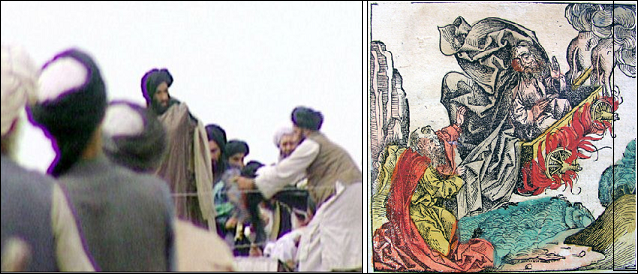
Mullah Omar in Kandahar; Elijah & Elisha from the Nuremberg Chronicle

.
I would like to give you a sense of the significance of an apparently insignificant detail, which I was reminded of today while skimming Charles Kurzman‘s The Missing Martyrs: Why There Are So Few Muslim Terrorists, page 74:

To gain legitimacy as he was taking over Afghanistan,Taliban leader Mulla Muhammad Umar literally wrapped himself in the cloak of the Prophet Muhammad, a cherished relic stored for two centuries at a shrine in Qandahar. He ordered the custodians to unlock the sanctuary, then stood on the roof of a nearby mosque and placed his hands in the cloth as a crowd of supporters chanted “Commander of the Faithful,” a title associated with the first caliphs to succeed the Prophet Muhammad.

To better grasp the significance of the situation, I will first quote from the Jewish and Buddhist scriptures to illuminate the symbolic power that can be vested — interesting word — in a cloak or robe.

**

John Daido Loori is a zen master in whose teishos or teachings I often find insight and delight. Here’s his description of the original transmission of “bowl and robe” in Buddhism, from the Buddha to his disciple Mahakashyapa:

After Buddha died, Ananda became the attendant of Mahakashyapa. One day he asked, “That time on Mount Gudhakutra, when the World-Honored One gave you the bowl and robe, and transmitted the Dharma to you, what else did he give you?” Mahakashyapa called out, “Ananda.” Ananda responded, “Yes, Master?” Mahakashyapa said, “Take down the flagpole.” At that point, Ananda finally had a realization. He realized what Mahakashyapa had realized. So it has been, down through successive generations, mind-to-mind for 2,500 years.

The Buddha’s teaching later passes from India into China, where the transmission continues. Here’s how Hui Neng, in the Platform Sutra, describes his own enlightenment and reception of the teachings:

At midnight the Fifth Patriarch called me into the hall and expounded the Diamond Sutra to me. Hearing it but once, I was immediately awakened, and that night I received the Dharma. None of the others knew anything about it. Then he transmitted to me the Dharma of Sudden Enlightenment and the robe, saying: ‘I make you the Sixth Patriarch. The robe is the proof and is to be handed down from generation to generation. My Dharma must be transmitted from mind to mind. You must make people awaken to themselves.’

**

There’s a remarkable story told in 2 Kings 2.8-15 that concerns the transmission of prophetic gifts by similar means, when the prophet Elijah is carried up into heaven:

And Elijah took his mantle, and wrapped it together, and smote the waters, and they were divided hither and thither, so that they two went over on dry ground. And it came to pass, when they were gone over, that Elijah said unto Elisha, Ask what I shall do for thee, before I be taken away from thee. And Elisha said, I pray thee, let a double portion of thy spirit be upon me. And he said, Thou hast asked a hard thing: nevertheless, if thou see me when I am taken from thee, it shall be so unto thee; but if not, it shall not be so.

And it came to pass, as they still went on, and talked, that, behold, there appeared a chariot of fire, and horses of fire, and parted them both asunder; and Elijah went up by a whirlwind into heaven. And Elisha saw it, and he cried, My father, my father, the chariot of Israel, and the horsemen thereof. And he saw him no more: and he took hold of his own clothes, and rent them in two pieces.

He took up also the mantle of Elijah that fell from him, and went back, and stood by the bank of Jordan; And he took the mantle of Elijah that fell from him, and smote the waters, and said, Where is the Lord God of Elijah? and when he also had smitten the waters, they parted hither and thither: and Elisha went over. And when the sons of the prophets which were to view at Jericho saw him, they said, The spirit of Elijah doth rest on Elisha. And they came to meet him, and bowed themselves to the ground before him.

The beauty, the power in this telling comes from the cloak’s ability to part the waters, as on an earlier occasion Moses‘ staff had done, not merely in the hands on Elijah, but also, once the transmission has been made, in the hands of Elisha. It is that double motif of the parting of the waters that demonstrates the efficacy of the prophetic transmission.

Coming fresh from the Buddha, Mahakashyapa, Hui Neng, Elijah and Elisha, we should be ready to appreciate that the mantle, cloak or robe of a sacred person is imbued with that person’s power — Matthew 14.36 describes crowds bringing the sick to Jesus:

that they might only touch the hem of his garment: and as many as touched were made perfectly whole.

**

In light of these examples, let us consider the reports of the day when Mullah Omar was proclaimed Amir of the Faithful:

There was a tremendous stir in Kandahar: we followed the crowds to a mosque in the city center. The Taliban had been holding an assembly of mullahs from all over Afghanistan. Now the results were about to be made public. Holy war was announced against the government of President Rabbani in Kabul. The head of the Taliban, Mullah Omar, was declared to be the Amir or leader of all Muslims everywhere. Because this was regarded as a key moment for the Afghan nation, Mullah Omar displayed the holy cloak of the Prophet Muhammad to the crowd. It’s kept in Kandahar and shown only in times of crisis. The last time was sixty years ago. Neither the cloak nor the ceremony has ever been filmed before, not has Mullah Omar. People in the crowd threw up their turbans to touch the cloak and be blessed by it. It was like being at some great religious ceremony in the Middle Ages.

That’s from the soundtrack of a video I sadly can’t post here, but which you can see for yourself on a BBC site under the title Mullah Omar reveals the Prophet’s cloak.

Adam Curtis, who posted the clip, describes it thus:

In the early 90s the students returned to Afghanistan and set up the Taliban – to cleanse the country of a revolution that had gone wrong, compromised by the futile idea of modernising Islam. And in April 1996 Mullah Omar went to the Shrine of the Holy Cloak. He took out the cloak for the first time in 60 years and waved it from the roof – just as Amanullah had in 1929 – and announced a jihad against the Islamist factions in Kabul.

The BBC producer Tom Giles and John Simpson were in Kandahar that day – and they captured this extraordinary moment on video.

When King Amanullah had held the cloak above his head in 1929 it symbolised the end of his dreams of creating a modern world in Afghanistan. Now – in 1996 – Omar was saying the same thing – forget the future, listen to the ghosts of your past – and follow their rules.

Let’s note in passing that Omar holds the cloak up — neither in the video clip nor in the two accounts is it suggested that he wore it — and that it had previously been held up by Amanullah Shah in 1929.

**

For the symbolic impact as reported in the West, let’s turn to Tim Weiner‘s piece, Seizing the Prophet’s Mantle: Muhammad Omar, in the NYT of December 7, 2001:

And as the country was falling to the Taliban five and a half years ago, Mullah Omar literally cloaked himself in the trappings of the Prophet Muhammad.

On April 4, 1996, as the Taliban neared total control, he was moved by zeal to unseal a shrine in Kandahar that held a cloak believed to have belonged to the prophet, the founder of Islam. The cloak had not been touched since some time in the 1930’s. He lifted it in the air as he stood on a rooftop, displaying it to a crowd of followers. The event was caught on videotape, one of the very few times that he was ever photographed. He placed the cloak, which only the Prophet was said to have worn, upon his own shoulders.

And at that moment, he declared himself the commander of the faithful, the leader of all Islam. No one had claimed that title since the Fourth Caliph, more than 1,000 years ago.

That’s impressive stuff, and “Seizing the Prophet’s Mantle” and “Omar literally cloaked himself in the trappings of the Prophet” do a decent job of capturing the marriage of literal and symbolic that’s at work here.

But “he placed the cloak … upon his own shoulders”? I’m not so sure.

**

It was a tremulous moment, evidently, even for Omar, as Norimitsu Onishi reported in the NYT a couple of weeks later on December 19, 2001, in A Tale of the Mullah and Muhammad’s Amazing Cloak:

The first time Mullah Muhammad Omar was allowed to enter the Shrine of the Cloak of the Prophet Muhammad here in Kandahar, and cast his gaze on the sacred ancient robe, he trembled. So disoriented was Mullah Omar that as he prepared to pray, he mistook the way toward Mecca.

“He turned to face toward the south,” recalled Qari Shawali, 48, the keeper of the prophet’s cloak. “So I made him change his position to turn toward Mecca.”

I suspect that here we have an indication that Omar was surprised by the event, that he was in fact acclaimed by the assembly of mullahs rather than claiming the robe and title for himself.

However, as the saying goes: Allah is the best of knowers.

**

Mujib Mashal‘s piece, The myth of Mullah Omar on al-Jazeera, 6 June 2012, gives us a few clues as to informed Afghan responses to the event, throwing in the detail that bin Laden was there at the time -– but also informing us that Omar “donned the cloak” and claiming this was the first time in 250 years that this had happened:

To formally announce his leadership in 1996, Mullah Omar, then 36 years old, brought forth the purported cloak of the Prophet Mohammed, one of Afghanistan’s most cherished Islamic relics. For the first time since the reign of Ahmad Shah Abdali more than 250 years before, Omar donned the cloak in the presence of about 1,500 religious leaders, including the late Osama bin Laden.

“Wearing the cloak was a masterstroke,” Sharifi said, adding that it linked the ex-guerrilla fighter to both Abdali and the Prophet. But Wahid Muzhda, an Afghan analyst and one-time high-ranking official in the Taliban foreign ministry, disputes that narrative. “From what I know, from sources close to Omar, and from a chat with the keeper of the shrine [where the cloak is kept], Omar did not wear the cloak.” “With great respect, he held the cloak in front of the religious leaders gathered for allegiance.”

This gesture, more than any other, was the impetus that allowed Mullah Omar, without any deep political or tribal base, to become the iron-fisted ruler of about 90 per cent of Afghanistan until the US invasion in 2001.

**

I know, you’re fatigued and I’m excited: bear with me, let’s hear the story of Ahmad Shah as told by Steve Inskeep on NPR in The Cloak of the Prophet some time in 2002:

According to the version of the legend that I heard, Ahmad Shah traveled to Bokhara — once one of the major centers of Islamic scholarship and culture, now a modern city in the former Soviet state of Uzbekistan . There he saw the sacred Cloak of the Prophet Mohammed, and decided to bring it home. He wanted Kandahar to have the artifact, so he asked to “borrow” the cloak from its keepers.

The keepers knew he might steal it, and told him he must not take the cloak from Bokhara. So Ahmad Shah pointed to a stone in the ground and made a promise. He said, “I will never take the cloak far away from this stone.”

Relieved, the keepers let him take the cloak. Ahmed Shah kept his word, in a sense. He had the stone taken up out of the ground, and had it carried back to Kandahar, along with the cloak, which he never returned. Today, the stone stands on a pedestal near the shrine.

The Cloak of the Prophet is normally hidden from public view. It is taken out only for special occasions. The last such occasion came in 1996, as the Taliban seized control of the country.

The Taliban leader, Mullah Omar, made what was considered a brilliant propaganda move. He took Mohammed’s shroud out of storage and wore it in a public rally, as a way to identify himself with the Prophet, and give himself legitimacy.

That’s an interesting tale in its own right, and reminds me of another Abrahamic treasure, the Stone of Scone, throned above which Scottish and British Kings and Queens are crowned. For your viewing delight: Stone of Destiny.

**

Fast forward to July 1928, a more recent moment when Afghanistan was in crisis.
Adam Curtis reports in The Weird World of Waziristan, 5 April 2010:

Amanullah fled to Kandahar. He knew that his attempt at modernization had failed and to save himself he tried to prove that in reality he was a traditional Islamic monarch. He did it in a final dramatic gesture.

Amanullah went to the Shrine of the Holy Cloak in the centre of Kandahar. He opened up the brass bound chest where the cloak which was reputed to have been the Prophet’s had lain for over a 100 years. Amanullah lifted it above his head and demanded of the mullahs in front of him whether Allah would allow a heretic or an apostate to perform such a sacred act.

**

And so to our most serious analytic effort on the topic, and a couple of indicators of the point I’m so often trying to make, here and in other posts on ZP. Here are Thomas H. Johnson and M. Chris Mason, writing in Terrorism, Insurgency, and Afghanistan as published by the Naval Postgraduate School, where both of them work in the Program for Culture & Conflict Studies:

Omar joined this rogues gallery of politicized insurgent Mullahs by means of a politico-religious stunt that is of enormous importance to the Taliban movement but that is considered insignificant by most Western analysts, if they are aware of it at all. In doing so, he became the epitome of the charismatic leader as described by Max Weber, who he defined as having:

… a certain quality of an individual personality, by virtue of which he is set apart from ordinary men and treated as endowed with supernatural, superhuman, or at least specifically exceptional powers or qualities. These are such as are not accessible to the ordinary person, but are regarded as of divine origin or as exemplary, and on the basis of them the individual concerned is treated as a leader.

The event in question was Omar’s removal in 1994 of a sacred garment -— believed by many Afghans to be the original cloak worn by the Prophet Mohammed -– from its sanctuary in Kandahar, and actually wearing it while standing atop a mosque in the city. Whereas Omar had been a nonentity before this piece of religious theatre, the audacious stunt catapulted him to a level of mystical power (at least among the 90 percent of Pahstuns who are illiterate) in a manner that is almost impossible for Westerners to understand, and it resulted in his being proclaimed locally the Amir-ul Momineen, the Leader of the Faithful — not just of the Afghans but of all Muslims.

I would draw your particular attention to this phrase:

a politico-religious stunt that is of enormous importance to the Taliban movement but that is considered insignificant by most Western analysts, if they are aware of it at all.

Why? Why do we continually overlook such indications of the depth of feeling that animates the Taliban? Perhaps another analogy, from closer to home, will help us here.

I’m not sure that I’d call the exposition of the Shroud of Turin a “piece of religious theatre” or an “audacious stunt” — even if Pope Benedict, famously concerned at the secularization of Europe, visited it and remarked both on the Shroud as an icon of the death and burial of Christ, and of our era’s participation in the “death of God” “after the two World Wars, the lagers and the gulags, Hiroshima and Nagasaki”:

Jesus remained in the tomb until dawn of the day after the Sabbath and the Turin Shroud presents to us an image of how his body lay in the tomb during that period which was chronologically brief (about a day and a half), but immense, infinite in its value and in its significance.

You may regard the Son of God and the Prophet of Allah as similar figures or utterly different: but to understand the emotions roused by Mullah Omar’s gesture, these correspondences drawn from other religious traditions may provide a useful place to start.

**

As for myself, I have a poet’s reverence for symbols, but I recognize that it is what they symbolize that is important — and so I’ll close as I began, with the Buddhist robe and bowl and another delighful teisho from Abbot Loori:

Ming was chasing after Hui-neng, determined to retrieve the bowl and robe of Bodhidharma from him. Finally, when he caught up to Hui-neng, the Sixth Ancestor put down the robe and bowl and said, “This robe was given to me on faith. How can it be fought for by force? I leave it for you to take it.” Ming tried to pick up the robe and bowl but couldn’t—they were as heavy as a mountain. He fell to his knees, trembling, and said, “I come for the teachings, not the robe. Please teach me, oh lay brother.” Completely open, completely receptive, completely ready, he was a man teetering on the brink of realization. Immediately, the Sixth Ancestor struck. “Think neither good nor evil,” he said. “At that very moment, what is the true self of monastic Ming?”
Numbers by the numbers: three / pt 1

Monday, September 10th, 2012

[ by Charles Cameron — I thought it might be timely to consider trinary thinking in light of Zen‘s recent post featuring Clausewitz‘ Trinity ]
.

I know, it sounds inherently ridiculous, but what would happen if we thought in threes instead of twos? I mean, we tend to see things in terms of black and white, good and bad. Let’s set up a binary of our own — US President George W Bush vs the Aymara of the Andes and Altiploano:

Two into three won’t go, as they used to say in math class when I was a kid.

Hegel thought otherwise. Hegel thought two needed to move on into three, or we’d be stuck with binaries in stasis for ever. Hegel’s dialectic is about the possibility called three — which opens the otherwise static two up to various kinds of process…

**

We tend to view conflicts in binary terms: “who goes there, friend or foe?” is the challenge I was supposed to offer Mad Mitch the Axe Man if I ran across him as a CCF trainee in the grounds of my old school, Wellington College.

What is conflict is viewed in trinary?

Here is Chris Crawford, from his justly famous 1982 Art of Computer Game Design:

The advantage of asymmetric games lies in the ability to build nontransitive or triangular relationships into the game. Transitivity is a well-defined mathematical property. In the context of games it is best illustrated with the rock-scissors-paper game. Two players play this game; each secretly selects one of the three pieces; they simultaneously announce and compare their choices. If both made the same choice the result is a draw and the game is repeated. If they make different choices, then rock breaks scissors, scissors cut paper, and paper enfolds rock. This relationship, in which each component can defeat one other and can be defeated by one other, is a nontransitive relationship; the fact that rock beats scissors and scissors beat paper does not mean that rock beats paper.

We’re back in play…

**

Here, too, is a bit from m’friend Wm. Benzon, jazz-player, blogger, polymath:

Three against two is one of the most important rhythm ‘cells’ in all of music. What do I mean, three against two? You play three evenly spaced beats in one ‘stream’ in the same period of time you play two evenly spaced beats in another ‘stream.’ It sounds simple enough but, the problem is that three and two do not have a common divisor, making the ‘evenly spaced’ part of the formula a bit tricky. The two patterns coincide on the first beat, but the second and third beats of the three-beat stream happen at different times from the second beat of the two-beat stream. And if you think that’s a lot of verbiage for something that ought to be simple, when then you’re beginning to get the idea.

Noting that the brain has a hard time moving from two to three this way, Benzon quotes old-time piano virtuoso Joseph Hoffman:

In faster motion it is far better to practise at first each hand alone and with somewhat exaggerated accents of each group until the two relative speeds are well established in the mind. Then try to play the two hands together in a sort of semi-automatic way. Frequent correct repetition of the same figure will soon change your semi-automatic state into a a conscious one, and thus train your ear to listen to and control two different rhythms or groupings at the same time.

Those readers already familiar with my insistence on many-voiced (ie polyphonic) listening will quickly grasp that Hoffman is speaking of just that kind of broadening of our mental horizons — of our thinking capacities.

**

I’d like to close part 1 of this two part post within my “Numbers by the numbers” series, with a quote from LtGen Paul Van Riper (USMC Ret.), The Foundation of Strategic Thinking at Infinity Journal:

The United States and its allies need senior civilian officials and military officers who grasp the fundamental nature of systems, are adept at building shared mental models, comprehend the significance of Clausewitz’s paradoxical trinity, understand operational art and can connect strategic thinking with tactical actions through operational design. These are the true competencies of modern defense professionals.

As in conflict, as in Clausewitz, so in conflict resolution: we need to be able to think in trinary — in trinities — and beyond.

More on that — which interested me enough that I once designed a trinary game of my own, played with great splash and delight by three kids in a swimming pool — in the second part of this post.

Book review: Kay Larson on the zen of Cage

Friday, August 10th, 2012

[ by Charles Cameron ]
.

Kay Larson, Where the Heart Beats: John Cage, Zen Buddhism, and the Inner Life of Artists, Penguin, $29.95

.

Dropping silence into a concert turns things upside down: it brings the solo performer or group of performers into the position of audience, makes listeners of them – and makes keener listeners of the audience — perhaps with a touch of unease or self-consciousness, but with an unusual attentiveness, too.

Dropping John Cage‘s piece of silent music into a book right around the beginning… well, it has a similar impact. And that’s what Kay Larson‘s book Where the Heart Beats does, on the page numbered xiii so you’ll know the book hasn’t even started properly yet. Larsen points you, without giving you the URL, to YouTube, where you can find Cage’s most shocking, and thus his most famous piece, 4’33”, performed by the London Symphony at the Barbican, in three movements, all silent as demanded by the composer’s score – with breaks in between the movements for the usual coughing and fidgeting.

And how to say this? During the silence, you could have heard a pin drop? Or you could hear, as Tom Service said on the BBC, the “very distinct high hum” of the Barbican’s electrical system, and the occasional cough too – “you could cut the atmosphere with a knife, and every cough, every tiny noise was absolutely amplified, made into a massive musical event”.

Listen:

You can tell the audience was delighted – self-satisfied perhaps, too? – from the hearty applause, and they had listened, had presumably taken onboard the idea that pauses – silences – are as much a part of music as sounds.

But what if I said that wine was just as much a part of drinking as glasses, and poured wine for my guests with no glasses to contain it?

The thing about John Cage’s 4’33” is that it straddles the line between the emperor having and not having clothes, between group assent and dissent, between “either” and “or” -– if it turns us from self-obsessed self-expressives into attentive listeners, it has reached into us musicically and carried us beyond the limits of music. And if it’s a bunch of boring minutes while an orchestra gets paid to SFU, it’s plain idiotic.

Which means that John Cage composed it right at the tipping point between the stupid and the profound.

I want to express it that way, and not tell you that Cage composes where the mind is fresh and inspiration flows, because it is stupid as well as fresh and profound.

As Hitler might have said, if he’d been asked…

And we haven’t really begun the book yet.

**

There are three stories here:

There’s the rigorous thread of western classical music, from its origins in the mist via Jewish cantillation and Gregorian chant into Polyphony and the Baroque, Classicism proper, Romanticism and the Modern. The music of Cage is the culmination, here, of this theme.

There’s the circling yet nonexistent circle, drawn as it were on glass with an ink brush dipped in water, of Zen, a “rebirth with neither beginning nor end”…

And there’s the world of the contemporary arts, centering in New York, with Cage a leading light.

They comes together when various characters have what Larson calls “life altering moments” — Larson herself, John Cage, Gary Snyder, Allen Ginsberg, Jack Kerouac in the first few pages alone, with the two Suzukis, DT Suzuki and Shunryu Suzuki Roshi and their experiences hovering in the background.

Zen is the pond, the emptiness, the silence, the stillness waiting into which like so many varied pebbles, the themes are character off the book will drop, in which their ripples will intersect…

Or to put that another way: silence, the stillness, is the pond into which Cage’s life and influence is dipped, and music and the arts the shingle on the beach from which the pebbles are dropped.

**

And Cage played in that shingle, sent notes from “prepared piano” and other instruments… formal and informal… skipping across the silence.

Cage not only invited silence into the concert hall, he also theorized it at length. I’d like to quote here a celebrated passage from his book, aptly named Silence: Lectures and Writings:

What happens to a piece of music when it is purposelessly made? What happens, for instance to silence? That is, how does the mind’s perception of it change?… Silence becomes something else — not silence at all, but sounds, the ambient sounds… Where ears are in connection with a mind that has nothing to do, that mind is free to enter into the act of listening, hearing each sound as it is, not as a phenomenon more or less approximating a preconception.

**

Zen is the simplest thing, it’s human nature. It is also the most difficult — it’s what we instinctively shy away from. And it can take all our resources, as those who “sit while going round in circles” well know — to break from the “boredom” of silence into listening, to dip into the sound stream, to hear the stillness.

Somehow, I’m hoping to nudge you into that kind of awareness, so that you can understand from within the taste of silence, the importance of Cage’s life, and of Kay Larson’s book.

Here’s another nudge, from a different angle — the Scottish poet Edwin Morgan‘s poem in homage to one of John Cage’s sayings:

Opening the Cage: 14 Variations on 14 Words
“I have nothing to say and I am saying it and that is poetry.” — John Cage

I have to say poetry and is that nothing and am I saying it
I am and I have poetry to say and is that nothing saying it
I am nothing and I have poetry to say and that is saying it
I that am saying poetry have nothing and it is I and to say
And I say that I am to have poetry and saying it is nothing
I am poetry and nothing and saying it is to say that I have
To have nothing is poetry and I am saying that and I say it
Poetry is saying I have nothing and I am to say that and it
Saying nothing I am poetry and I have to say that and it is
It is and I am and I have poetry saying say that to nothing
It is saying poetry to nothing and I say I have and am that
Poetry is saying I have it and I am nothing and to say that
And that nothing is poetry I am saying and I have to say it
Saying poetry is nothing and to that I say I am and have it

Edwin Morgan, The Second Life
Edinburgh University Press, 1968

**

In a follow up post on Monday or Tuesday, I shall describe Larson’s book in more conventional terms, and offer you some details from Cage’s intricate life and extraordinary network of friends..

For now, I just want to give you again that taste of silence from which this whole endeavor springs. Here is the pianist David Tudor, for whom the piece was written, playing 4’33”:

Buddha statues: idols or icons?

Saturday, May 19th, 2012

[ by Charles Cameron — Pat Robertson, the Taliban, Bamiyan, Buddha statues, a Zen tale, Petraeus and Pastor Jones ]
.


credits: (a) wikipedia under cc license, (b) dharmashop
.

Here, by way of context, is a story posted on the Treeleaf Zendo site, and widely discussed in the Catholic blogosphere:

On a cold winter night, a big snow storm hit the city and the temple where Dan Xia served as a Monk got snowed in. Cut off from outside traffic, the coal delivery man could not get to the Zen Monastery. Soon it ran out of heating fuel after a few days and everybody was shivering in the cold. The monks could not even cook their meals.

Dan Xia began to remove the wooden Buddha Statues from the display and put them into the fireplace.

“What are you doing?” the monks were shocked to see that the holy Buddha Statues were being burnt inside the fire place. “You are burning our holy religious artifacts! You are insulting the Buddha!”

“Are these statues alive and do they have any Buddha nature?” asked Master Dan Xia.

“Of course not,” replied the monks. “They are made of wood. They cannot have Buddha Nature.”

“OK. Then they are just pieces of firewood and therefore can be used as heating fuel,” said Master Dan Xia. “Can you pass me another piece of firewood please? I need some warmth.”

The next day, the snow storm had gone and Dan Xia went into town and brought back some replacement Buddha Statues. After putting them on the displays, he began to kneel down and burn incense sticks to them.

“Are you worshiping firewood?” ask the monks who are confused for what he was doing.

“No. I am treating these statues as holy artifacts and am honouring the Buddha.” replied Dan Xia.

*

In light of that, compare and contrast this recent video of Pat Robertson:

with this video (I don’t think you need to see all of it, just a taste perhaps?) titled The Beheading of the Buddha, posted on YouTube and “presented” by Al-Muhaajiroun:

and both of those with this third video, of Pastor Jones, discussing both his own burning of the Qur’an and GEN Petraeus‘ powerful and intelligent response…

*

I think we should discuss these matters in an open and respectful way, and hope that this post will provide an appropriately respectful and open-minded framing for such a discussion.

As to my own view – I see a consideration that whatever opens us up to compassion and clarity is an icon and a grace, and another consideration that whatever closes us off from clarity and compassion is an idol or a poison…

***

For those of a scholarly bent, here’s a downloadable fatwa on the Taliban’s destruction of the great Buddhas of Bamiyan — from which the screen-grab below is taken:

Of Quantity and Quality II: Holocaust, torture and sacrament

Thursday, April 19th, 2012

[ by Charles Cameron — Yom HaShoah, quality vs quantity, sacramental value of life, continuing from Q&Q I, long, intense ]
.

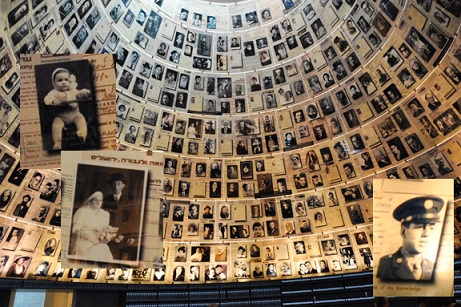
Today is Yom HaShoah, Holocaust Remembrance Day.


photo credit: Joni B Hannigan

The mind is struck dumb.

Six million individuals is too vast a gathering to contemplate. Even to think of ten people we know well if they are in the room with us requires us to move from face to face, person to person, picking up where we left off with each one, perhaps with this couple or these four colleagues from a remembered journey or project.

Six million.

Six million people is more than a crowd, it’s a blur — it is, approximately, the entire population of Arizona, of Rio or Lahore, of entire nations, El Salvador, Libya or Sierra Leone.

Today we remember those who died in the Shoah, as individuals and together.

*

I believe the Shoah to be one of those topics where we humans need to use the cognitive equivalent of a zoom lens – the capacity to hold magnitude in mind while exploring at the level of the individual, and to feel for the individual while not losing sight of the magnitude of the larger picture.

Consider the rabbinic opinion given in the Babylonian Talmud, Sanhedrin 37a:

For this reason was man created alone, to teach thee that whosoever destroys a single soul of Israel, scripture imputes [guilt] to him as though he had destroyed a complete world; and whosoever preserves a single soul of Israel, scripture ascribes [merit] to him as though he had preserved a complete world.

How do you magnify that “complete world” by six million?

*

Another such topic involving the individual and the group is torture.

Here the issue is, at best, not one of innate cruelty or hatred or disregard for values, but a considered weighing of alternatives — the brutal interrogation of a Khalid Sheikh Mohammed, say, against the chance to avoid a second 9/11. Torture, too, is a matter of the relationship of the many to the one, and I suspect people’s opinion of torture pretty much rests on each person’s understanding of when and indeed whether the need of the group ever trumps that of the individual.

Again, I think we need a cognitive zoom capability, if we are to begin to grasp the subtlety of the issue — and to be able to countenance those who see it differently from ourselves.

*

I suggest that the core question is that of the relationship of quality to quantity — which I have argued before, is essentially the same as the deep question in consciousness, that of the relationship between (subjective) mind and (objective) brain.

Can a sheer quantity of people saved from some hateful end ever really compare to the quality — radiant suchness of the Tathagata (Diamond Sutra), image and likeness of God (Genesis) — of a single willfully tortured human?

For some people this is a no-brainer. Of course: you weigh the likely impacts, and on occasions when torturing one is liable to reveal information that saves thousands of others, do it. Reuel Marc Gerecht, lately of the CIA, posed the issue this way:

… if you had been confronted on 7 September 2001 with a captured Khalid Shaykh Muhammad or Abu Zubaydah and you knew that a major, mass-casualty terrorist strike was about to go down in the United States, and you had plenipotentiary authority for the nation’s security …

For some, it is a no-brainer. Of course not: if you treat others that way, even in the heat of battle, you’ve lost already — you’ve become what you hate. John Kiriakou, lately of the CIA, wrote:

even if torture works, it cannot be tolerated – not in one case or a thousand or a million. If their efficacy becomes the measure of abhorrent acts, all sorts of unspeakable crimes somehow become acceptable. … There are things we should not do, even in the name of national security.

*


.

In the Egyptian scene above — taken from the Papyrus of Ani in the British Museum — judgment is rendered on a single human soul when it is weighed against the feather of Maat:

The goddess Maat, shown as a feather in the scale pan, is the deification of the concept of maat: truth, justice and cosmic order.

Is the heart light enough to balance justice herself?

The jackal-headed Anubis is weighing the heart of the supplicant as the ugly beast Ammit, known as “The Devourer,” “Bringer of the Second Death” — a hybrid monster, part lion, part hippopotamus, part crocodile — crouches by the scales drooling, waiting to gulp down the failed soul. The ibis-headed Thoth is poised to record the verdict on his slate. Various deities are ranged around the scene, serving as Judges or in other roles important to the ritual or the ideology that had developed over the span of many centuries. Overlooking this scene is the Ba — the winged representation of the personality of the deceased — perched and ready but not yet able to take flight as a risen being.

Even though Osiris is pictured at the far end of the Judgment scene, indicating the conclusion of the proceedings, his presence nonetheless dominates the scene, as a confirmation of the ultimate purpose of all this.

*

Mary Qualit and Martha Quant…

A number of significant thinkers have weighed in on the scales which measure human lives… basically asking if a quality can be quantified, added, multiplied.

The philosopher Wittgenstein, in a selection of his posthumous writings, says:

The whole earth cannot be in greater distress than one soul.

The writer CS Lewis concurs:

We must never make the problem of pain worse than it is by vague talk about the “unimaginable sum of human misery.” … There is no such thing as a sum of suffering, for no one suffers it. When we have reached the maximum that a single person can suffer, we have, no doubt, reached something very horrible, but we have reached all the suffering there ever can be in the universe. The addition of a million fellow-sufferers adds no more pain.

And Arne Naess, the “father” of Deep Ecology, in his Philosophy of Wolf Policies says:

We should be careful when talking about greater suffering. Referring to a consciously experienced suffering, including simple pain, we have to do with a quality admitting degrees of intensity, but in an important sense unquantifiable and nonadditive.

Strictly speaking, experienced suffering is not additive.

In my view — or perhaps I should say, with my mind — it is hard even to fully grasp what these three distinguished and diverse folk are saying. And yet I feel as if they are bringing me a truth, bringing it right to the edge of my awareness.

*

Tarek Mehanna wrote in his sentencing statement, given in court last week:

I learned about the American-led sanctions that prevented food, medicine, and medical equipment from entering Iraq, and how – according to the United Nations – over half a million children perished as a result. I remember a clip from a ’60 Minutes’ interview of Madeline Albright where she expressed her view that these dead children were “worth it.”

I can understand that, the reluctance to accept that particular policies are “worth” the loss of children. Where is Maat, to weigh such matters for us?

*

Here are four quotations having to do with the value of sparrows, one way or another:

Are not two sparrows sold for a farthing? and one of them shall not fall on the ground without your Father. But the very hairs of your head are all numbered. Fear ye not therefore, ye are of more value than many sparrows. — Matthew 10.29-31.

Whoever uselessly kills a sparrow, on the Day of Judgment, it will come and shout in front of the throne and say, “Oh my Lord, ask this person why he uselessly killed me.” — Hadith of the Prophet, quoted in Kazemi, Environmental Rights and the Teachings of Mahdism

There is a special providence in the fall of a sparrow. — Shakespeare, Hamlet, V.2

If a sparrow dies in Central Park, I feel responsible. — Mayor Fiorello La Guardia

*

There’s a streak of paradox running through the heart of Christianity, in which two values are simultaneously present: one temporal and moral, the other atemporal / eternal and transcendent. Thus Christ can say “Before Abraham was, I am” — situating himself in both eternal and temporal realms simultaneously. Thus also, he can say of himself and his betrayal by Judas, “The Son of man goeth as it is written of him: but woe unto that man by whom the Son of man is betrayed! it had been good for that man if he had not been born.”

And thus also, in a masterful paradox, St John’s Gospel recounts how the High Priest Caiaphas argued for the death of Christ:

Then gathered the chief priests and the Pharisees a council, and said, What do we? for this man doeth many miracles. If we let him thus alone, all men will believe on him: and the Romans shall come and take away both our place and nation. And one of them, named Caiaphas, being the high priest that same year, said unto them, Ye know nothing at all, Nor consider that it is expedient for us, that one man should die for the people, and that the whole nation perish not. And this spake he not of himself: but being high priest that year, he prophesied that Jesus should die for that nation; And not for that nation only, but that also he should gather together in one the children of God that were scattered abroad. Then from that day forth they took counsel together for to put him to death.

On the one hand, Caiaphas is arguing that one troublesome young rabbi’s life is expendable if it will avoid a Roman crackdown not unlike the one that did in fact occur some forty years later, with the destruction of the Temple in 70 CE. This is, in Christian terms, a vile argument, and one respondible for the death by execution of the Christ.

On the other, though — and the brilliance of the paradox lies in the way that John weaves the two perspectives together — God thinks it preferable that he himself, incarnate, should die as a once-for-all sacrifice to save his many creatures who — and here I can’t help but hear the strains of Handel’s Messiah — like sheep have gone astray…

Putting it mildly.

So, whether you’re Christian or not — and I wouldn’t claim to be, though I’m clearly influenced — the notions of sacrifice and self-sacrifice belong in here somehow.

*

I quoted the Talmudic Tractate Sanhedrin at the top of this post. The Qur’an recalls this passage in Sura 5.32:

Therefore We prescribed for the Children of Israel that whoso slays a soul not to retaliate for a soul slain, nor for corruption done in the land, shall be as if he had slain mankind altogether; and whoso gives life to a soul, shall be as if he had given life to mankind altogether.

It is my suggestion that the difference between Quantity and Quality is as profound (in Bateson’s terms, makes as great a difference as) as the difference between mind and brain, subjective and objective or inner and outer worlds — which itself revovles around the “deep problem” in consciousness.

If I’m right about this — and “right” may not be the best term in any case — then the quality / quantity issue is one facet of the great mystery at the heart of things that religion approaches and derives from, but can never fully define or express.

Morality is our attempt to work in the world with some of the insight gleaned from that mystery, and it may well be that dualistic, propositional thinking is inherently unsuited to the task.

I’d like to return at this point to a quote I’ve used here before, and find very insightful. It’s from Lin Jensen, An Ear to the Ground: Uncovering the living source of Zen ethics, and it tells us:

Judgments on right and wrong are a nearly irresistible enticement to pick sides. And that’s exactly why the old Zen masters warned against becoming a person of right and wrong. It isn’t that the masters were indifferent to questions of ethics, but for them ethical conduct went beyond simply taking the prescribed right side. For these masters, the source of ethical conduct is found in the way things are, circumstance itself: unfiltered immediate reality reveals what is needed.

*

In closing, I would like to return to the issue of torture, and to offer you another quote, this one from one of the most powerful works of theology known to me, William T Cavanaugh‘s Torture and Eucharist: Theology, Politics and the Body of Christ:

by making the seeking of important answers seem like the motive for the torture, the torturer seems able to justify his brutality. No one would think of defending the sheer physical act of torture, the merciless inflicting of pain on a helpless victim. However, once we consider the verbal aspect, the question and answer which seem of such great urgency, the moral contours of torture seem less clear, and utilitarian justifications of torture become thinkable, provided the motive for the questions is of sufficient importance.

Cavanaugh is writing about those who were “disappeared” in Pinochet‘s Chile, and his broader argument is that torture is the antithesis of the sacramental nature of human identity — and here we return full circle to the “image and likeness” of the divine in the mortal, the human.

The deeper we can penetrate into the central mystery, it seems to me, the better we will be enabled to love, to understand, and to forgive.


Switch to our mobile site