zenpundit.com » movies

Archive for the ‘movies’ Category

Techno-Mahdi?

Saturday, August 4th, 2012

[ by Charles Cameron — of no practical importance, yet curious indeed, Mahdism, Pakistani history, shamanism, magic, the Kwakiutl / Tlingit, religion ]
.
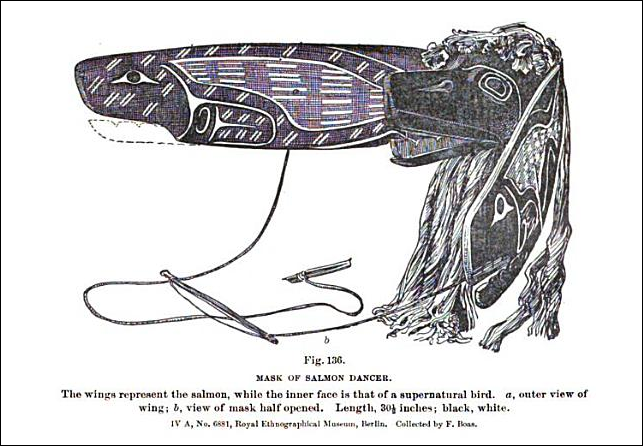
Kwakiutl Salmon Dancer's mask

.

I really don’t have much to say about this, but I’d like to note it as one more instance of Mahdism cropping up in unlikely places. And a h/t to Scott McWilliams @macengr for pointing me to the story. I can’t entirely vouch for its accuracy since I don’t have easy access to 1970s Pakistani newspapers, but I’ve seen allusions to the same story dating back a couple of years

When the Pakistani army and bureaucratic establishment realized that Mujib-ur-Rehman’s Awami League and Zulfiqar Ali Bhutto’s PPP were attracting people—with no other party able to draw even 5000 to its rallies—they imported Zohra Fona, a woman from Indonesia, pregnant with Imam Mehdi. She had visited several Islamic countries, it was propagated, where rulers had offered prayers in her Imamat [i.e. she led the prayers even if a woman is not supposed to do that].

Many Muslim intellectuals and scholars claimed through their writings and lectures that the time for Imam Mehdi’s appearance had arrived. A new Islamic world was about to emerge. During this period the Islamic parties, including Jamat-e-Islami, perpetrated violence. Members started attacking liberal and progressive professors, doctors, writers, journalists as well as their houses. They also burned many libraries and collections of books.

Zohra Fona claimed that the child in her womb recited Azaan [call for prayers] and could lead the prayers. Ulema like Maulana Okarvi and Ehtesham Ul Haque went to see Zohra Fona and listened to Azan with ears close to lady’s womb. Prayer events were arranged for her in open places as well as in the larger mosques, and the Ulema [religious scholars] were praying behind her. She would stretch her legs towards Kaaba [Mecca], directing her womb toward the pulpit. Suddenly Azaan would start coming from her womb or from another private part. The Ulema were so shameless that they were offering prayers while focusing their eyes on her private parts.

Back then the left was very organized so it was difficult to explain this farce. Finally the Pakistan Medical Association and doctors at Jinnah Hospital, Karachi decided to unearth the drama. Several lady gynecologists were asked to help; they knew that this kind of thing could not happen. But Zohra Fona was very clever. Whenever doctors were pursuing her to take a medical examination she avoided with help from the Pakistani security forces. But one day, when she was unable to escape, the doctors of Jinnah hospital, Karachi conducted an examination. The doctors recovered a small tape recorder from her womb.

Does the bit about the tape-recorder in the womb sound a bit far-fetched? Here’s another version, this one from The [International] News:

Zohra Fona, a blessed Indonesian woman, arrived in Pakistan just ahead its first general elections. She was said to be expecting a child who would be Imam Mehdi. She had visited several Islamic countries where, and it was propagated, that rulers had offered prayers in her imamat. Many ulema began to claim that the time for Imam Mehdi’s coming had arrived.

Zohra Fona claimed that the child recited Azaan. Reputed ulema like Maulana Okarvi and Ehteshamul Haque met Zohra Fona and listened to the Azaan with ears close to the lady’s stomach. She began to draw huge crowds to mosques and parks where she led prayers. Our reputed ulema would join the prayers.

Woe betide this country! Some leftist and agnostics at Karachi’s Jinnah Hospital decided to put the legend to scientific test. It was revealed that the holy woman was not even pregnant with an Azan-reciting messiah but had a recording device tied to her body. She immediately left for Indonesia once the farce was exposed.

That sounds more plausible.

**

A word of caution here.

Just as theater and film sometimes deploy “deux ex machina” interventions to immerse their audiences more deeply into their created micro-worlds, so have shamanic performances.

I’ve written about this before in an email to a religious scholars’ list, and in these days when even self-plagiarism is disdained, I am going to repeat here what I wrote then, with very minor changes:

It’s my recollection that [Tlingit / Kwakiutl winter ceremonials] were both entertainment for the long winter nights and “schooling” for the young, and I have a vivid recall of reading somewhere a shaman’s admission to an anthro of the exact nature of the dramatic means by which the shaman’s capacity to defeat death was demonstrated.

I read this in the early eighties, but searching on the web I’ve found something that comes close — Clellan Stearns Ford’s record of Charles James Nowell’s memories in _Smoke from their fires: the life of a Kwakiutl chief_. Around p 120, there are two stories, the first about a girl who “turned the wrong way” during a dance, the second about a girl who is put in a box and burned. In both cases, the nature of the trickery is described but in the version I read all those years ago, the two stories were one — the girl who was put in a box in the fire pit and “burned to death” escapes through a false bottom to the box along a tunnel into the adjoining room, and her voice then issues as if from her ashes, via a kelp tube that goes from the tunnel to the adjoining room where she’s now standing.

She describes her descent into the sea realm, where she is chastened and eventually granted a boon to return to the tribe. A canoe sets out to fetch her, but by the time the audience sees it set out, she’s already secured by rope to the far side of the boat, and at a suitable distance is hauled aboard and brought back to shore, alive.

A child seeing this would be mightily predisposed to believing the shaman had healing powers, and by the time the ruse was revealed, that underpinning of faith is already in place.

In the Nowell version, even the adults, who “know” the deception involved, are deceived: “The fire burned and the box burned, and she was still singing inside, and then the box go up in flames, and they can see her burning there in her blue blanket, and all her relatives just cry and cry. Although they know it is not real, it looks so real they can’t help it. It was all a trick. There was a hole under the box with a tunnel leading out of the house, and the woman went out of the box and put a seal in her place wrapped in a blue blanket, and then someone sang into the fire through a kelp tube, her song. Oh, it looked real!”

The Winter ceremonials of the Pacific Northwestern tribes are by turns opera, history, religion and “general education” to the children of the tribe, and “continuing education” to their elders…

Do we have anything to equal them?

Bearing such things in mind, we may want to consider trickery — a quality of the trickster gods, after all, in many mythologies — a not entirely illegitimate activity for a religious performer…

The Olympic Truce

Sunday, July 29th, 2012

[ by Charles Cameron — the Truce, great gospel music, and athletes in ads in slomo — a personal view ]
.


.

If there are two things about the Olympics I like, they would be the Olympic Truce, and athletes in slow motion.

Here’s what the IOC’s site has to say about the Truce:

The tradition of the “Truce” or “Ekecheiria” was established in ancient Greece in the 9th century BC by the signature of a treaty between three kings. During the Truce period, the athletes, artists and their families, as well as ordinary pilgrims, could travel in total safety to participate in or attend the Olympic Games and return afterwards to their respective countries

and it’s relevance today:

Taking into account the global context in which sport and the Olympic Games exist, the International Olympic Committee (IOC) decided to revive the ancient concept of the Olympic Truce with the view to protecting, as far as possible, the interests of the athletes and sport in general, and to encourage searching for peaceful and diplomatic solutions to the conflicts around the world.

Through this global and symbolic concept, the IOC aims to :

  • mobilise youth for the promotion of the Olympic ideals;
  • use sport to establish contacts between communities in conflict; and
  • offer humanitarian support in countries at war ; and more generally :
  • to create a window of opportunities for dialogue and reconciliation.

**

To be honest, I don’t care in the least what human runs fastest or jumps highest, and if I did I wouldn’t have a huge investment in what territory he or she comes from or lives in.

The Games are the Games though, they affect people’s lives, and are affected by them. I have, here in my room, a copy of the official book of the 1936 Games which I picked up in a swap meet for a dollar or two:

American Olympic Committee Report, 1936, Games of the XIth Olympiad, Berlin

Somewhere, also, I have the official English playbook for the 1934 Oberammergau Passion Play — two stark reminders of how we are sometimes suborned from the better angels of our nature by the worse…

If I have a minute of silence, then, it is for the Israeli athletes killed at the 1972 Munich Games.

**

breath,
breath

**

Again, corporate sponsorships, banking industries and advertising are not generally among my favored interests, but slow motion is — and while I care little for the athletic record-setting and patriotic rivalrous sides of the Olympics, great athletes are often beautiful, something the Greek sculptors understood, and slomo can capture that beauty for us.

Besides, I have always been a fan of Morgan Freeman, ever since I heard him play the role of the Preacher opposite Clarence Fountain in Gospel at Colonus — undoubtedly the most joyous theatrical experience of my life…

Here to give you a taste is Freeman’s opening sermon:

and perhaps the most audacious musical moment of all, the great battle of the bands as Oedipus attempts to enter Colonus:

**

breath,
breath

**

Here, then, are three VISA ads for the Games this year, accompanied by that unmistakable Freeman voice, and offered here for the beauty, sheer joy and creative excellence they present.

First, the audience speaking to the heart of the athlete — itself a remarkable insight:

Second, the way running itself runs like a thread through the life of Lopez Lomong:

And third, the difference a hundredth of a second makes — and again, the roar of the crowd:

That last clip has Morgan Freeman saying:

A hundredth of a second – it’s faster than the blink of an eye, faster than a flash of lightning – and it was the difference between Michael Phelps winning eight gold medals instead of seven – a hundredth of a second – just think of the cheers if lightning strikes twice!

I know — that’s the speed thing, not the beauty thing. And I’m an ideas man — an aesthetic man, not an athletic man.

So I take my long jumps sideways, in the mind…

**

Wikipedia tells us:

US National Park Ranger Roy Sullivan has the record for being struck by lightning the most times. Sullivan was struck seven times during his 35-year career. He lost the nail on one of his big toes, and suffered multiple injuries to the rest of his body

Again I think of the poet Randall Jarrell, whom I quoted here not so long ago as saying:

A good poet is someone who manages, in a lifetime of standing out in thunderstorms, to be struck by lightning five or six times; a dozen or two dozen times and he is great.

Only the Muse knows what damage that does to the poet’s mind.

**

breath,
breath

**

To sum up:

If I were God — and friends, that’s not in nay way a risk we need to concern ourselves about, flat out impossible — I would be watching the Olympics in slomo from a dozen angles simultaneously, without commentators.

And I’d be praying everyone world-wide would take the Truce as seriously as the Games.

The most important post about Aurora doesn’t mention Aurora

Thursday, July 26th, 2012

[ by Charles Cameron — futurism, making, printing, printable guns, time of your life, intersecting timelines ]
.


.

We only have one mouth, so we’re linear speakers, confined to speaking one thought at a time. And we only have one body, so we tend to think of our lives along a single timeline — although other people with their own uncontolled timelines are constantly crisscrossing our paths and making things better (hey, thanks!) or worse (damn it!) or just plain interesting (okaaay) or boring (unhh)… but the world itself includes the crisscrossing of all those paths in its own timeline, and what this means in practice is that linear thinking doesn’t catch the drift.

Which is why it’s interesting that the most important blog-piece on the Aurora tragedy today doesn’t mention Aurora once.

It’s by John Robb, and it’s about printing these:

And it’s important because the world-line it talks about will cross the path of the Columbine > Virginia Tech > Utøya > Aurora timeline at some point.

**

It begins like this:

Printing Weapons at Home for Fun and Mayhem

.
It’s now possible to print functional weapons at home. This is going to progress rapidly now.

Think: global file sharing of designs for servicable weapons, from pistols on up to ?, that can be printed at home. What you can print — from the materials to the size/quality of the object to the completeness (snap together construction) — is already moving forward quickly. The weapons effort will just be along for the ride.

But read the whole thing. And read Duncan Kinder and the other comments there, too.

**

That’s John Robb’s message for the day — and apart from the fact that it talks about reliable home-printed weaponry, a line of development which will I suggest will cross that Columbine > Virginia Tech > Utøya > Aurora line some time in the not too distant, there’s one unremarkable little remark in there that’s well worth remarking on. John says:

The weapons effort will just be along for the ride.

**

Along for the ride. Side effects. Adverse reactions. Serendipity. Unintended consequences. Unknown unknowns. Black swans.

We have a variety of terms we use for the things that blindside us, for better or worse. Our future is full of them, our past is littered with the results…

So it’s interesting that if a bunch of us are thinking along the broad line of maker-printables, a few will be thinking printable guns. A bunch of us will be making films, a bunch more will be going to the movies to see them. And some will have far darker thoughts in mind.

**

Crisscross your thinking. Weave your world with care for the future, please.

To be or to do

Sunday, July 22nd, 2012

[ by Charles Cameron — to be or to do: this one’s for Scott ]
.


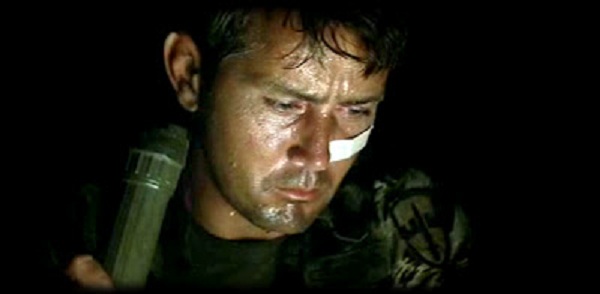
Martin Sheen as Capt. Willard in Francis Ford Coppola’s Apocalypse Now

**

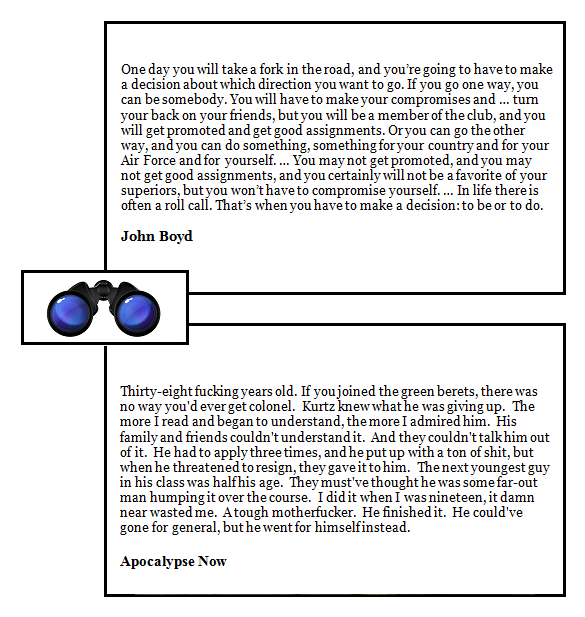
Of course, Col. Kurtz‘ end in the movie is more than a little different from Col. Boyd‘s — but one wonders whether John Milius was aware of the Boyd quote when he wrote that particular scene.

Byzantium, Constantinople, Istanbul

Sunday, July 8th, 2012

[ by Charles Cameron — different styles of online communication, main topic: Istanbul in three Islamic videos ]
.

There’s passionate and visceral communication, and there’s communication that’s more scholarly, dispassionate and calm. Let’s begin and end with calm.

**

Visceral communication is essential for getting people out of a theater on fire, but a 30% application of scholarly distance and calm may be prerequisite for avoiding panic — and scholarly communication may be important for conveying in detail the high-dimensionality of a complex topic, but a drop of visceral may ease the salient points into more general circulation.

In an earlier, text heavy post — Damascus, Dearborn, Rome, Vienna? — I belabored you with details as to just how much ambiguity and fog surrounds the use of place names in scriptural and prophetic contexts. Here I’d like to give you a visceral sense of what some prophetic voices are doing with those place names.

One of the easiest ways to move from scholarly to visceral is to switch from text quotation to video clip, so that’s what I’ll do here — but my first video clip will be relatively calm and scholarly as video clips go, the next one more visceral and exhortatory, while the third and final clip will use all the tricks of the feature movie trade to provide a Tolkien-heroic account of the Muslim siege and taking of then-Christian Constantinople in 1453.

**

First, a very short clip from Adnan Oktar, aka Harun Yahya, widely known in the Islamic world for his lavishly illustrated books, CDs and DVDs presenting an Islamic version of creationism, the Mahdist end times — which he sees as entirely peaceable — and more besides.

In this clip, he’s talking about Istanbul, and he means that very city, even if it has sometimes been called Byzantium or Constantinople — or even on occasion, Rome.
.

**

My second clip is far longer, and presents an interview with Sheikh Imran Nazar Hosein, Islamic scholar, sometime Trinidadian diplomat and sometimes fiery YouTube preacher, whom I have quoted previously in Al-Awlaki and the former and latter rains and elsewhere.

Hosein discusses the prophecies of the conquest of Constantinople by Muslim forces as part of the background for a grand sweep overview of what he terms the first and second Arab Springs — which he locates a century apart and views as both engineered by an Anglo-American alliance to advance a Zionist agenda — and contemporary events in Bahrain, Saudi, Syria, Iran, Israel, and Russia:
.

.

It’s an hour-long interview, perhaps you didn’t watch the whole way through. Hosein concludes this interview, centered in Islamic prophecy about Constantinople, with a Saudi-American alliance facing off against an Iranian-Russian alliance in service to very long term Zionist interests, making the video a window not only on the Sheikh’s own worldview but also on how widely perceptions of the world situation can diverge:

I want the viewing audience to know that a situation is evolving in the world before our eyes, and we must understand it, that the two major powers in the world are now moving in a collision course, that collision course between these two major powers, the American-led alliance and the Russian-led alliance, is going to lead to nuclear warfare of such a magnitude that there is only one word that we can look for in the vocabulary to fit it, and that’s called Armageddon, that is, millions and millions and millions are going to die, most of them probably in North America and Europe, Europe of the East and Europe of the West — and what is left of the world after that, the Zionists hope that they can cope with it, and they can somehow survive and come out on top and Israel will rule the world, the rump that is left after the two giants engage in a war of mutual destruction, That is what we are facing now…

Is that what you thought scholarly Islamists were thinking? By what paths did a highly educated and world traveled man come to that conclusion?

**

My third clip speaks for itself. It is a trailer for an upcoming motion picture about the siege of Constantinople, presented as heroic spectacle with improbable but striking feats of arms, beautiful but not excessively modestly dressed women, obligatory mass choruses of Allahu Akbar, and at least one reference to the Antichrist.
.

.

I can’t wait to see it — but I expect to do so with mixed emotions. Perhaps they will stir up a decent blog post or two.

What emotions will they stir in those who identify with the heroic Mehmet II, and how much of an echo will those emotions find in the world around us? Long shot — any Turkey-NATO impact?

**

To return to a calmer clime:


.

Byzantium, Constantinople, Istanbul. I have prayed in the Sultan Ahmed — click image above to glimpse its beauty — I have relaxed deliciously at a nearby hammam.

The history of Istanbul could be the rich study of many lifetimes, its promise — for better or worse or a little of both — may have been variously prophesied or predicted, but remains to be seen.


Switch to our mobile site