zenpundit.com » movies

Archive for the ‘movies’ Category

Sacred space and the imagination

Sunday, June 19th, 2011

[ by Charles Cameron — no mil/intel stuff — the sacred, architecture, nature, books, imagination ]

.

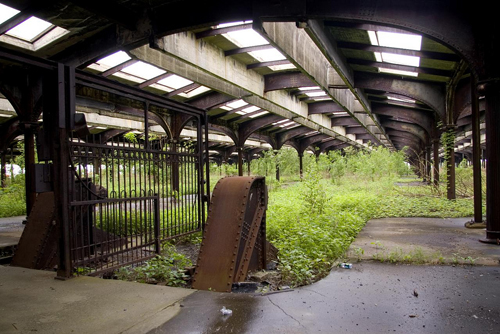
This post began with a photo my friend William Benzon took of an abandoned passenger terminal in Liberty State Park:

abandoned_passenger_terminal_libery_state_park.jpg

*

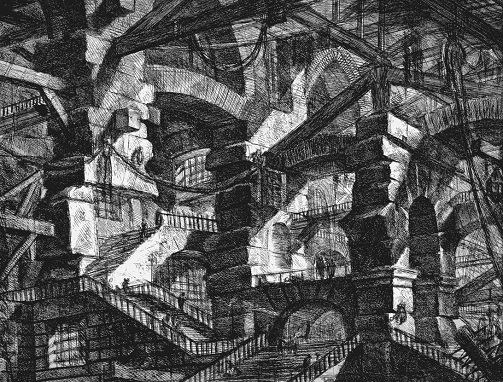
Without the greenery, I don’t think I’d feel this was “special” in quite the same way.  I might see it as prison-like, akin to those magnificent Piranesi prints in his Carceri series:

piranesi_carcere_xiv.jpg

… vast, haunted — the anti-cathedral.

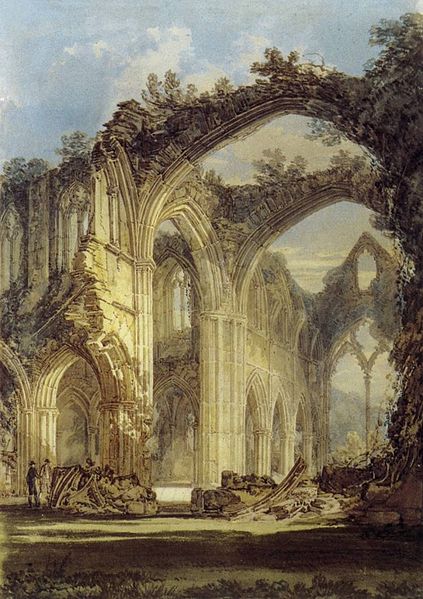
Yet the grasses and small trees are there in Benzon’s photo, green and vibrant — and in their presence, the prison becomes a cathedral… not unlike the great ruined abbeys of England, Tintern, Calder, Whitby, Walsingham, Fountains.

Here’s Tintern Abbey by JMW Turner, for a sense of how ruins were viewed in his day:

423px-turner_tintern1.jpg

Somehow, in the workings of the human mind and heart, nature’s grasses can keep a ruined space sacred…

*

But what of books?

bookstore-interior-design-in-the-former-dominican-church-by-merkxgirod-1.jpg

The effect is austere by comparison, but the hush of the library slips into the high-vaulted silence of the cloister, and when I saw Bill Benzon’s photo above, this photo of a bookstore in Holland was the first analogy to cross my mind…

The Selexyz Dominicanen bookshop is housed in an old church in the centre of Maastricht. A beautiful listed building, this former Dominican church was transformed into a bookstore by architects Merkx+Girod, resulting in an extraordinary combination of bookselling complex and church interior, preserving the unique landmark setting. It was praised by British newspaper The Guardian as ‘possibly the world’s finest bookshop’. Earlier, Selexyz Dominicanen had already received the prestigious Lensvelt Architecture Interior Award 2007 for the décor of the store.

Of course, not everyone thinks a bookstore is sacred, and a lot might depend on what books you browsed, or caught your neighbor browsing. Here’s one negative report:

When your church community gets bored of reaching out with the love of Christ and doesn’t like to meet together anymore, don’t cry over it! Build a bookstore and coffee shop out of your unwanted worship space. The chancel is great for a cappuccino… And the worship space would house a nice collection of bargain-priced books, and kitten calendars:

So next time you despair that the church has lost its way, relax and sooth your aching conscience with a steaming latte – you can even sit at the crucifix table and plug into the WiFi. There are so many uses for old churches, why bother with renewal in the Church at all?

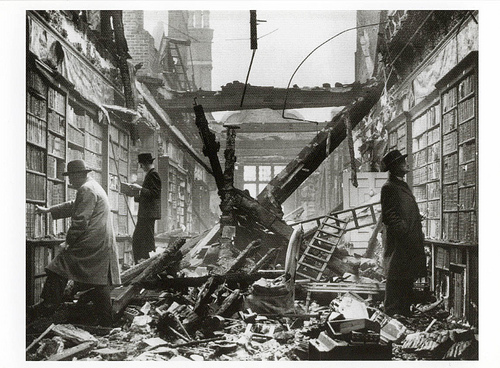
Even a ruined bookstore can have something of a sacred quality, though, as this London library photo clearly shows:

london-library-bomb-damage.jpg

Surely, that’s the last word in books — what more could one ask for?

*

Still — look.  There’s some sort of disaster, atrophy, ruin or sea-change in each of these images.  What happens when an architect — as skilled as the folks from who designed that bookstore — builds a chapel in the forest?

With all the contemporary emphasis on modern sustainable architecture, sometimes we seem to forget that environmentally friendly architecture has existed for a long time. Built in 1980, Thorncrown Chapel was created with the idea of highlighting the natural setting, which was, and still is, an attractive natural setting for tourists in the area. The owner of the site, Jim Reed, hired well known architect, Frank Lloyd Wright alumni E. Fay Jones to design and build the site which used native timber to match the setting around it, and the result was a fantastic expression of architecture that was awarded the “Twenty-Five year award” by the American Institute of Architects.

It is as lovely by winter light:

snow_fs1.jpg

as it is by light of spring and summer:

thorncrown-chapel.jpg

and yet I’d say there is something not ascetic but arid there: it has tried a great deal, but not died a little.

*

Nothing there is any which way ruined.  And it is out of ruins that our hopes grow these days, as grass at times breaks through tarmac.

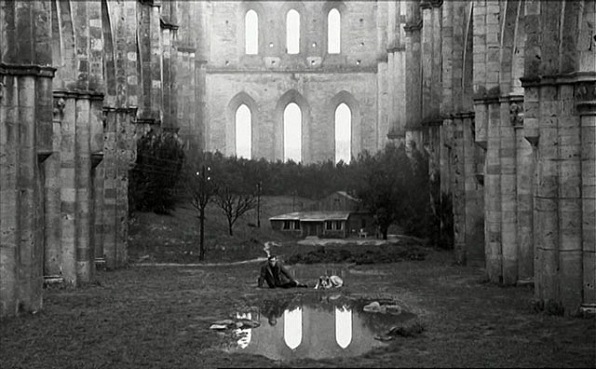
Tarkovsky’s great film Nostalghia closes with a breathtaking shot…

nostalghia11.jpg

a sacred space in pure, delivered, imagination — a single shot which to my mind, having seen the film and left the movie theater speechless, must be accounted the greatest single work of surrealism yet…

in which the protagonist, a Russian exiled in Italy, sees finally the lonely Italian abbey that has come to symbolize his loss of hearth and home, all loss, all absence — with his home nestled inside it, the little pond, himself, his dog…

Ugliness and holiness

Thursday, May 12th, 2011

[ by Charles Cameron ]

.
I’m taking a break from my usual Zenpundit fare this time around, and posting some poems about the ugliness and holiness I see most evenings.

*

When my capacity for writing about religious violence and apocalyptic fever has abated, and I want to set my mind on pause before I go to sleep, I often watch crime-thrillers: it’s a sort of meditation for me. And because it’s a sort of meditation, I find that odd things – single shots, often the ones film-makers call “establishing shots” – catch my eye and send me into poetry mode, where what I’ve seen triggers a clearer sense of what I intuit.

The secular sacred: i

In the relative darks of early darkness
a train crosses on a raised rail above the houses
where sleeping is beginning, its
windows and windows and windows lit up
with empty interiors, here and there
a person, but windows, mainly, and their
lights passing in sequence with a rhythm like
the rhythm of breathing, of the late train.

And how to get that in poetry, how to get
what the camera sees, the slightest of slightest
parts of the daily routine, entirely secular,
where plain people have transmuted
metal to transportation system? Tta-cha,
this passing of lights, lights, lights in the night.

It goes this way: the films show me something of the scope and range of human activity, and the scope – the sheer size of numerous cities – is so huge, and the range – from the heroic, the creative and even the saintly to the crazed, the dulled, the bereft and the vicious – is so great that my sense of how wide and deep the world is gets expanded way past its limits.

And the part of me that has experienced (and continues to experience) something that I can find no words for outside the religious vocabulary — “grace” and “radiance” – the part of me that is enormously thankful now and always for the privilege of human being, of sight, friends, speech, friends, books, friends, music, travel, the internet… that part of me, precious to me, somehow must come to grips with the gritty, the grimy, the “real”.

I have no theories about heaven, no belief or creed beyond a non-verbal assent, but it’s my sense that the condition of joy we call “heaven” – much like the condition of insight we call “poetry” – reaches “down” from whatever lofty spires or Himalayas we may suppose it abides in, into the dust beneath our wheels, beneath our feet… dust that my mind, at least, could easily sweep under the carpet.

And so, watching thrillers to put my mind on pause, I have to put the films on pause to write the poems…

The secular sacred: ii

How many gravestones can a camera’s eye
pass in a single sweep, and you think
God any less able to see? The sacrament
of cinema surpasses, pushes words
into admission of strange holiness way
past the tolerances of the religious,
way and away past any sense of what sacred
might mean except only the sacred itself,

felt fully in belly and brain of the city, the
splintered, splendored city. Nor, in
these needle-strewn streets, this broken
flesh and blood, is there mercy room
beyond pity of such pettiness, the
shattered dreams — so ugly, small, so holy.

After writing those two on successive nights, I made a note for some friends…

Those two, the “secular sacred” poems, are part of something I’m working towards by watching “gritty” films most nights, and triggered in particular by helicopter long-shots of freeways intercut with goings on at street level — giving me the feeling the world is far larger (and uglier) than (my) religious imagination usually reckons, with holiness in the discarded condoms.

So I’m trying to make room conceptually for a god or emergent world or mirroring pool wide and deep enough for gritty realism in these poems…

The secular sacred: iii

Now you think of it, someone must have
wanted him to walk down those steps from
the whore’s house round the corner
into the shadow and to his car, the street
laid out just the way it happens
in the film, someone put the camera
there or the street corner, setting
up a street corner is less effort than

growing a city from scratch and gives
greater freedom, so there was some intent,
some design to his coming down
those steps at that speed and time with
that look on his face, and directors
are not necessarily lacking in street smarts.

And I’m far from sure what sort of God, mirror or emergence will emerge from all this at the end, but it’s unlikely to have curls in a beard and be supremely nice, at least not just nice…

The secular sacred iv

The fact that there’s holiness in needles
glinting in the sun and discarded condoms in
the shade, and the fact there’s often
more shade than sun, and other facts I
might mention shouldn’t dissuade us from
the glint of clinics and the shade of
discarded habits, there’s holiness there
too, in the turning around of a life, and if

grass needs to break through asphalt to
prove a metaphysical point, you can be sure
some kind of holiness is reaching up
for sky and to get our attention, which,
too, is a locus of the sacred, humming in
time with the heartbeat of world and heaven.

Recommended reading — in stereo

Wednesday, May 11th, 2011

[ By Charles Cameron ]
.
quo-dark-side-of-force.jpg

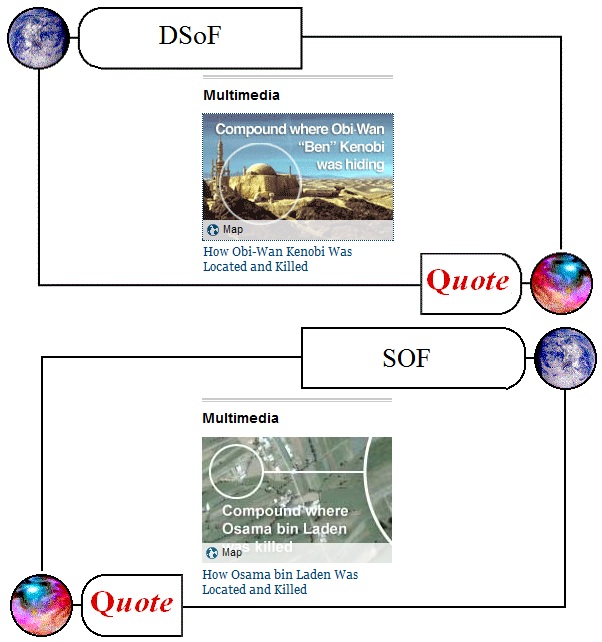
I’m always on about the power of polyphonic thinking, right? Okay, IMO, these two pieces are well worth reading in stereo:

http://www.galacticempiretimes.com/2011/05/09/galaxy/outer-rim/obi-wan-kenobi-is-killed.html
http://www.nytimes.com/2011/05/02/world/asia/osama-bin-laden-is-killed.html

h/t @abumuqawama

A two part meditation, part ii: of monks and militants

Wednesday, April 20th, 2011

[ by Charles Cameron ]
See also part I: Scenario planning the end times

*

Today I received a book in the mail from Powell’s: C Christine Fair and Sumit Ganguly‘s Treading on Hallowed Ground: Counterinsurgency operations in Sacred Spaces. That covers the spread of my interests pretty concisely. I’m reminded that Dietrich Bonhoeffer, the German theologian who was complicit in several attempts to assassinate Hitler, once said, “Only he who cries out for the Jews may sing Gregorian chants” – again, the intersection of the sacred and harsh “facts on the ground”.

I am interested in this intersection partly because my father was a warrior and my mentor a priest and peace-maker, and partly because that mentor, Fr. Trevor Huddleston CR, taught me to anchor my life in the contemplative and sacramental side of things, then reach out into world with a view to being of service – an idea that he movingly expressed in this key paragraph from his great book, Naught for your comfort:

On Maundy Thursday, in the Liturgy of the Catholic Church, when the Mass of the day is ended, the priest takes a towel and girds himself with it; he takes a basin in his hands, and kneeling in front of those who have been chosen, he washes their feet and wipes them, kissing them also one by one. So he takes, momentarily, the place of his Master. The centuries are swept away, the Upper Room in the stillness of the night is all around him: “If I, your Lord and Master, have washed your feet, ye ought also to wash one another’s feet.” I have knelt in the sanctuary of our lovely church in Rosettenville and washed the feet of African students, stooping to kiss them. In this also I have known the meaning of identification. The difficulty is to carry the truth out into Johannesberg, into South Africa, into the world.

A few days ago I saw a film that encompasses that same range – from the contemplative to the brutal – telling the story of the Cistercian (Trappist) monks of Tibhirine in the Atlas mountains of Algeria, the warmth of affection that existed between them and their Muslim neighbors, the mortal threat they came under from Muslim “rebels” whose wounded they had cared for, their individual and group decisions to stay there in Tibhirine under those threats, and their eventual deaths.

*

It is an astonishing story, and my copy of John Kiser‘s book, The Monks of Tibhirine: Faith, Love and Terror in Algeria, which also tells that story, already has more tabs in it noting phrases and whole paragraphs I’ll want to return to than any altar missal – and I’m only two-thirds of the way through it.

I don’t wish to retell the story – I’d rather you saw the film, Of Gods and Men, in the theater if possible, on DVD if not, or read the book, or both – but a few of those book-marked passages stand out for me.

First, Algeria – in the words of Albert Camus:

Algeria is land and sun. Algeria is a mother, cruel and yet adored, suffering and passionate, hard and nourishing. More than in our temperate zones, she is proof of the mix of good and evil, the inseparable dialectic of love and hate, the fusion of opposites that constitute mankind

That sets the scene – and I am inescapably reminded of that comment of Solzhenitsyn, which I quoted at the end of my first response to Abu Walid:

Gradually it was disclosed to me that the line separating good and evil passes not through states, nor between classes, nor between political parties either – but right through every human heart – and through all human hearts. This line shifts. Inside us, it oscillates with the years. And even within hearts overwhelmed by evil, one small bridgehead of good is retained. And even in the best of all hearts, there remains … an uprooted small corner of evil.

Algeria brings that separation into sharp relief – the monks of Tibhirine knew and acted on their knowledge that it passes through each and every human heart.

Next, the Qur’an. When the monks first meet the militants, their prior, Fr. Christian de Chergé, begins to quote from Sura 5, and the militant leader completes the verse:

The nearest to the faithful are those who say “We are Christians.” That is because there are priests and monks among them and because they are free of pride

The view I wish to present here in describing the monks of Tibhirine is not a view from left or right but from a contemplative perspective — and while I do not believe it the only perspective to be considered, I think we do well to heed the insights of Christian monks — a group to whom even the Muslim scriptures give praise.

Then, the Rule of St Benedict:

Just as there is the zeal of bitterness that is evil and separates us from God and leads to hell, so also there is a good zeal which removes vices and leads to God and eternal life.

This, then, was the spirit in which the monks of Tibhirine served and loved their God – and their neighbors as themselves.

And finally, the Bible, from the book of Job:

My face is flushed from weeping and on my eyelids is the shadow of death; although no violence is in my hands and my prayer is pure.

*

It was with that shadow playing on his eyelids that Fr. de Chergé penned these words of immense generosity:

Facing a GOODBYE …

If it should happen one day — and it could be today — that I become a victim of the terrorism which now seems ready to engulf all the foreigners living in Algeria, I would like my community, my Church and my family to remember that my life was GIVEN to God and to this country.

I ask them to accept the fact that the One Master of all life was not a stranger to this brutal departure.

I would ask them to pray for me: for how could I be found worthy of such an offering?

I ask them to associate this death with so many other equally violent ones which are forgotten through indifference or anonymity.

My life has no more value than any other. Nor any less value. In any case, it has not the innocence of childhood.

I have lived long enough to know that I am an accomplice in the evil which seems to prevail so terribly in the world, even in the evil which might blindly strike me down.

I should like, when the time comes, to have a moment of spiritual clarity which would allow me to beg forgiveness of God and of my fellow human beings, and at the same time forgive with all my heart the one who would strike me down.

I could not desire such a death. It seems to me important to state this.

I do not see, in fact, how I could rejoice if the people I love were indiscriminately accused of my murder.

It would be too high a price to pay for what will perhaps be called, the “grace of martyrdom” to owe it to an Algerian, whoever he might be, especially if he says he is acting in fidelity to what he believes to be Islam.

I am aware of the scorn which can be heaped on the Algerians indiscriminately.

I am also aware of the caricatures of Islam which a certain Islamism fosters.

It is too easy to soothe one’s conscience by identifying this religious way with the fundamentalist ideology of its extremists.

For me, Algeria and Islam are something different: it is a body and a soul.

I have proclaimed this often enough, I think, in the light of what I have received from it.

I so often find there that true strand of the Gospel which I learned at my mother’s knee, my very first Church, precisely in Algeria, and already inspired with respect for Muslim believers.

Obviously, my death will appear to confirm those who hastily judged me naive or idealistic:
“Let him tell us now what he thinks of his ideals!”

But these persons should know that finally my most avid curiosity will be set free.

This is what I shall be able to do, God willing: immerse my gaze in that of the Father to contemplate with him His children of Islam just as He sees them, all shining with the glory of Christ, the fruit of His Passion, filled with the Gift of the Spirit whose secret joy will always be to establish communion and restore the likeness, playing with the differences.

For this life lost, totally mine and totally theirs, I thank God, who seems to have willed it entirely for the sake of that JOY in everything and in spite of everything.

In this THANK YOU, which is said for everything in my life from now on, I certainly include you, friends of yesterday and today, and you, my friends of this place, along with my mother and father, my sisters and brothers and their families — you are the hundredfold granted as was promised!

And also you, my last-minute friend, who will not have known what you were doing:

Yes, I want this THANK YOU and this GOODBYE to be a “GOD BLESS” for you, too, because in God’s face I see yours.

May we meet again as happy thieves in Paradise, if it please God, the Father of us both.

AMEN! INCHALLAH!

Algiers, 1st December 1993
Tibhirine, 1st January 1994

Christian +

*

I note with sadness today the death of Tim Hetherington, photo-journalist and co-director of the film Restrepo, together with that of his colleague Chris Hondros, in Misrata, Libya. Their cameras, and those of others like them, brought and will bring the grimness of war home, into the living rooms of peace.
Inspire #5: between front and back covers

Thursday, March 31st, 2011

[ by Charles Cameron ]

*

Okay. When what goes into the opening paragraphs of an editor’s note at the front of a magazine corresponds pretty exactly to what’s on the back cover, you have a sort of conceptual bracket that’s “holding” the rest of the content, and it pays to pay attention.

Here are the first paras of the “Letter from the Editor” that is featured on page 5 of the latest issue of AQAP’s English language magazine, Inspire, immediately after the front cover and index pages:

The cover of this issue is about the Tsunami of change that is sweeping the Arab world. With the removal of the despots, the ummah will speak its voice, and when it does, it will chant: Here we start and in al-Aqsa we’ll meet.The biggest barrier between the mujahidin and freeing al-Aqsa were the tyrant rulers. Now that the friends of America and Israel are being mopped out one after the other, our aspirations are great that the path between us and al-Aqsa is clearing up.

There could be no freeing of Palestine with the presence of the likes of King Abdullah to the East, Hosni Mubarak to the West and al-Saud to the South. Now that Hosni is gone, we heard the Imam of the Friday prayers praying: “O Allah we ask you to allow us to meet in al-Aqsa,” and the millions in Tahrir square roared with one voice: Amin.

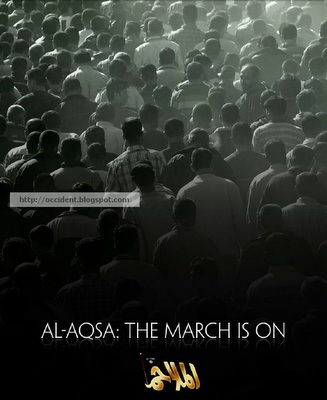
Note that this explicitly ties the front cover (“about the Tsunami of change that is sweeping the Arab world”) with the back (“Here we start and in al-Aqsa we’ll meet”), shown here:

inspire-5-al-aqsa-the-march-is-on.jpg

[ graphic courtesy of Ibn Siqilli ]

As I’ve noted before, al-Aqsa isn’t just the focal point of the Palestinian / Israeli question, nor it is only the place at which the Prophet alighted from his steed, Buraq, and ascended to receive the divine instructions for prayer in the Miraj — it is also the destination of the Mahdi‘s victorious army in the Khorasan strand of ahadith.

Indeed, it has been suggested that the Pierced Rock of the Dome of the Rock in al-Aqsa is closely related to the Black Stone of the Kaaba. Kanan Makiya, in his part-fictional part-documentary book, The Rock, quotes Charles Matthews‘ translation of Burhan al-Din ibn Firka al-Fazari‘s Kitab Ba’ith al-Nufus ila Ziyarat al-Quds al-Mahrus (The Book of Arousing Souls to Visit Jerusalem’s Holy Walls) from Matthews’ Palestine: Mohammedan Holy Land:

Verily, the Kaaba is in an equivalent position to the Frequented House in the Seventh Heaven, to which the angels of Allah make pilgrimage. And if rocks fell from it, they would have fallen on the place of the Rock of the Temple of Mecca [i.e. the Black Stone]. And indeed, Paradise is in the Seventh Heaven in an equivalent position to the Holy Temple (in Jerusalem) and the Rock; and if a rock had fallen from it, it would have fallen upon the place of the Rock there. And for this case the city is called Urushalim, and Paradise is called Dar al-Salam, the House of Peace.

Indeed, David Roxburgh mentions all these matters, writing in Salma Khadra Jayyusi et al., The city in the Islamic world, vol. 1. p 756:

This movement corresponded to other efforts — before, during, and after the Crusades — to establish “geo-theological” connections between Jerusalem and Mecca, whose preeminent sanctity was inviolable up until the end of days. Examples linking Mecca to Jerusalem include the Prophet Muhammad’s nocturnal journey from Mecca to Jerusalem (isra) and his ascension from Jerusalem to the throne of God (miraj); the underground joining of the waters of Zamzam to Silwan (var. Siloam) during the “feast of the sacrifice” (id al-adha); and the transfer of the Kaba and its black stone from Mecca to Jerusalem during the last days. these various traditions linked Jerusalem to Mecca, sometimes by sets of doubled features, in a near symmetry and in a calendar that will culminate during the end of days.

So there’s an eschatological dimension to all these parallelisms, too…

*

And if for no other reason, then because I happen to love doubled features, symmetries and analogies of all sorts (and we were already speaking of graphics and Inspire #5), let me add this:

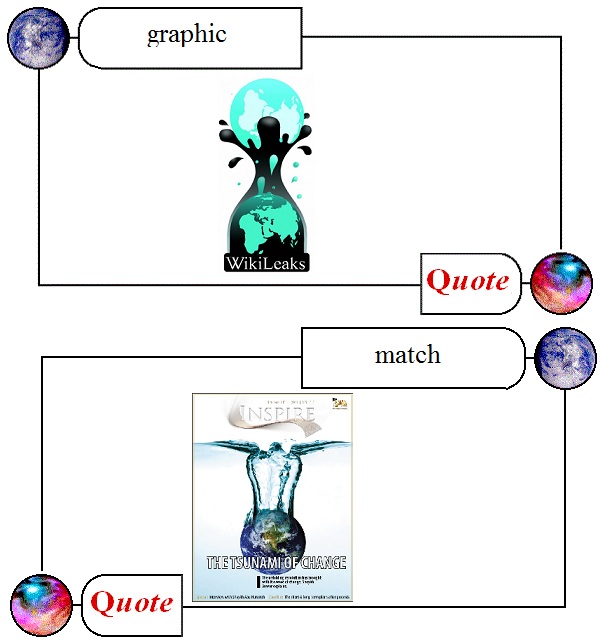
A tweet from @webradius via @azelin that I saw today noted that “the cover of Inspire 5 is remarkably similar to a wikileaks logo”.

I liked it.  And I’ve translated it here into my own DoubleQuotes format:

quographic-match.jpg

For those who are unfamiliar with the phrase, graphic match is another term for match cut — the gambit whereby one shot in a movie is directly juxtaposed to another with which it bears a close resemblance – essentially, a film director’s equivalent of rhyme.

Wikipedia gives two classic examples which are of particular interest to me because there is a “rhyme” between them, too, albeit a far more indirect one – the second being an hommage to the first.

Stanley Kubrick‘s 2001: A Space Odyssey contains a famous example of a match cut. After an ape discovers the use of bones as a tool and a weapon, there is a match cut to a spacecraft or satellite in orbit. The match cut helps draw a connection between the two objects as exemplars of primitive and advanced tools respectively.

Michael Powell and Emeric Pressburger‘s A Canterbury Tale contains the influence for the 2001: A Space Odyssey match cut in which a fourteenth century falcon cuts to a World War II aeroplane. The sense of time passing but nothing changing is emphasised by having the same actor, in different costumes, looking at both the falcon and the aeroplane.

*

Conclusion:

Parallelisms really are worth watching — always bearing in mind that one thing is never quite the same as another…


Switch to our mobile site