zenpundit.com » movies

Archive for the ‘movies’ Category

NSFW RIP — obituary for a friend, Heathcote Williams

Monday, July 3rd, 2017

[ by Charles Cameron — Sunday sadness — for Julian West and Gabi Nasemann, each of whom loved Heathcote no doubt better than I ]
.

NSFW might well have been John Henley Heathcote Williams’ initials. There were few boundaries he did not push, he taught himself fire-breathing and burned himself breathing fire to impress his then girlfriend, the model Jean (or was it Chrissie?) Shrimpton, and breathed fiery words all the livelong day. Here’s his final tweet, containing a poem you may want to watch:

**

I’ve posted this before, but do so again today because I’m old enough find it very funny, and because it piercingly reminds me of my friend:

Oh, and the beauties of his days loved his ugly mug — this I posted before, too:

**

As someone observed, Heathcote was a Ranter in the fine old tradition:

Coppe went up and down London streets ‘with his hat cockt, his teeth gnashing, his eyes fixed, charging the great ones to obey his Majesty within him.’ Clarkson as ‘Captain of the Rant’ entertained women to his lodging house but made canny financial provision simultaneously for his wife. This was the ugly face of Protestantism. It was what countless opponents of the Reformation had inveighed against since Munster: antinomianism was the logical, if perverted, conclusion of dissent. Anabaptists attracted the opprobrium in sixteenth-century Europe; Quakers inherited this legacy in later seventeenth-century England. But it was the Ranters who were the enemy of orthodoxy in England in 1650.

Myself, while I have Ranter sympathies, am also a Royalist and Cavalier.. Heathcote, no way: he’s an unabashed anti-monarchist through and through.

**

An Old Etonian and overlap-contemporary of mine at Christ Church, Oxford, Heathcote took language to the street:

Believing the world to be a common treasure house to all
I spray-painted this slogan almost everywhere,
‘USE YOUR BIRTH CERTIFICATE AS A CREDIT CARD’,
Suggesting to be born entitles you to a share.

I’d then keep an eye on the graffiti’s lifespan
And would often find myself amazed
By its lasting for years in the poorer districts
But if they were gentrified, it’d be erased.

And he meant it!

**

Heathcote, I’ve owed you a review of your book on Badshah Khan. I have been too fatigued to write it, but take it as a mark of your singular intelligence that you know, revere and celebrate the man!

Badshah Khan: Islamic Peace Warrior by Heathcote Williams

Thin Man Press is delighted to be publishing this timely and important ‘poetic investigation’ by Heathcote Williams (‘Whale nation’, ‘Falling for A Dolphin’, ‘Autogeddon’, ‘Royal Babylon’…).

With the news full of Islamic extremism, terrorism and the steady rise of the ‘Islamic State’, Heathcote Williams brings us a different story – the amazing life of Afghan Pashtun leader, Badshah Abdel Gaffar Khan, a devout Moslem, revered spiritual guide and champion of world peace who was a close friend and companion of Gandhi. Gaffar Khan spent much of his life as a political prisoner, and was tortured by the British; but he remained committed to his ‘jihad’ of peace, kindness and gentleness, which Williams relays with clarity and passion.

**

But onwards, to death.

Speaking of Van Gogh, in There has to be an afterlife, Heathcote wrote:

He believed that the heavens were our future destination
And he declared, “we take death to reach a star.”
Now that there’s stardust in every single cell of our body
More mystery is added to knowing who we are.

But in bereavement it’s a very great comfort
To those who are feeling dispossessed
To consider that those they’ve known who’ve died
Have simply changed their cosmic address.

Heathcote, are you going soft?

Or is the new address you address yourself to — and have now achieved — “among the stars, dissipated“?

I’ll miss you, until I’m dissipated, too.

Ouroboros with a twist

Wednesday, May 31st, 2017

[ by Charles Cameron — the FU President is back ]
.

Here’s a Moebius ouroboros from the fifth season of House of Cards. Francis Underwood speaks:

I’m staggered: a brilliant combination of two classic patterns. Zing!

Sunday surprise, Pikachu & more

Sunday, May 7th, 2017

[ by Charles Cameron — getting to know the Koreas North & South, also conflict resolution and a schoolgirl movie ]
.

Yoyu may have seen this viral Pikachu video from South Korea, filmed during the Pokémon World Festival:

If you didn’t know better, you might figure those were North Korean security agents hustling that sadly deflating Pikachu dancer offstage, to ensure the appearance of massed conformity to which such parades as this one have accustomed us to:

For a less regimented view of North Korea, consider this example of conflict resolution among schoolgirls:

Fortunately, you can see the whole film:

**

It is known that humans “catch and train to battle each other for sport.”

Mattis and Kim: mirrors have consequences

Friday, April 21st, 2017

[ by Charles Cameron — the current nuclear standoff, with a coda on silver beech and copper birch ]
.

**

I spend a fair amount of time suggesting that formal characteristics found in events are frequently worth special note, and mirroring is a good example. Here, in Why Mattis versus Kim Jong-Un Will End Badly for Us All, War on tnhe Rocks indicates the potential (and potent) peril of mirroring in the context of our latest Korean adventure:

Inadvertent war in Korea is more likely now than at any point in recent history. Whereas a second Korean war has always been possible, clashing U.S. and North Korean “theories of victory” — beliefs about what it takes to successfully coerce and control escalation — now make it plausible, even probable.

Patterns of bluster and brinkmanship have of course long characterized affairs on the Korean Peninsula. For “Korea watchers,” there’s a perverse comfort in the predictability of a situation that, to the uninitiated, sometimes looks anything but stable.

So on some level, the rhythm of recent saber-rattling between the Trump administration and North Korea recalls the perverse comfort of typical Korea policy. On a recent visit to South Korea, Vice President Mike Pence cited U.S. attacks in Syria and Afghanistan as indications of U.S. resolve against North Korea. This statement followed numerous officials confirming that the administration is contemplating preventive strikes against the North, and a recent policy review on North Korea yielding one overarching imperative: “maximum pressure.” North Korea’s rhetoric and posturing has been no less confrontational and no less familiar. As Pence departed Alaska for South Korea, North Korea attempted a submarine-launched ballistic missile test that failed. Upon news that a U.S. carrier group was headed to its neighborhood, North Korea responded that “a thermonuclear war may break out at any moment” and that it’s “ready to react to any mode of war desired by the U.S.”

These words and deeds themselves are more heated than usual, but unremarkable in the context of all that’s come before. North Korea routinely threatens war, often summoning images of a future mushroom cloud. The United States routinely dispatches aircraft carriers, bombers, and other strategic military assets in hopes of signaling resolve while actually registering little more than displeasure with North Korean behavior. The notion of “maximum pressure,” moreover, only differs from the approach of past U.S. presidents in the ambiguous adjective “maximum.” Pressure is the historical mean of U.S. policy toward North Korea. My concern is not with these observable dynamics to date, but rather with what lies beneath them, and what may be coming soon as a consequence.

It’s getting harder to ignore that the Pentagon, under Secretary Jim Mattis, may have a coercive theory of victory that largely mirrors that of North Korea under Kim Jong-Un. The danger is in the fundamental incompatibility of these disturbingly similar sets of strategic beliefs.

**

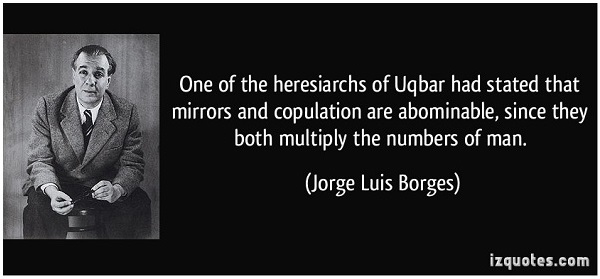
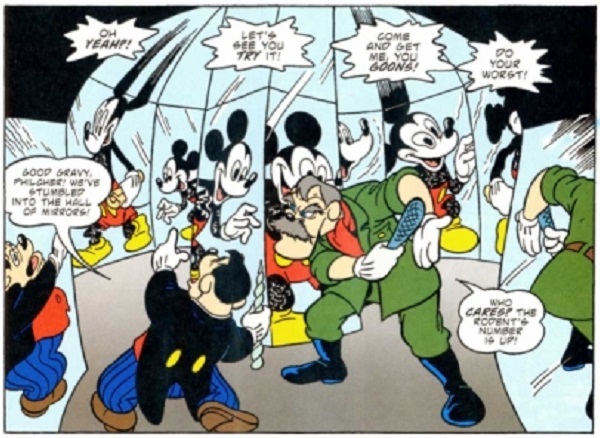
Smoke and the hall of mirrors, a digression:

An excellent place for final confrontations with heroes, the Hall Of Mirrors wins high marks for ease of use. All you have to do is lure your victim inside by dashing in yourself, and then cackle with glee as they find you reflected back not once but a thousand times… When you have had your fun, seal the exits and fill the cramped space with some kind of liquid. Plain water works as well as anything, but why not add food dye for color. Or, for a touch of whimsy, use a sickeningly sweet fruit punch.

Neil Zawacki, How to Be a Villain, in TV Tropes: Hall of Mirrors

**

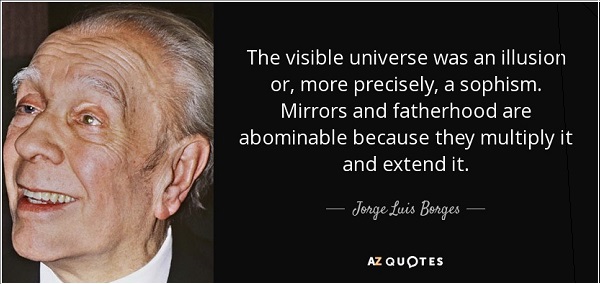
Mirroring sets up an echo chamber — consider the myth of Narcissus** — which is also a sort of ping-pong game and a feedback machine —

and hence a magnifier or an accelerator. It can allm too easily howl out of control, with — in this case — nuclear consequences.

** Narcissus sees his reflection, Echo echos his voice back to him, thus the myth encompasses a parallelism between visual and aural self-perceptions in a wonderful act of inter-media symmetry.

**

Form is the decorative act of the creative mind, adding to meaning by the use of devices of art in the way the materials of the art are deployed — as when the poet notes (specifically) beech and birch trees in a wood, delighted by the verbal felicity between the two words, or Coppola matches helicopter rotors against the blades of a hotel room fan in the beginning of Apocalypse Now.

And then the delight triples with the addition of a metallic match:

But again, I digress..

**

Talmud meets the Gridiron

Friday, April 21st, 2017

[ by Charles Cameron — they meet in the American war movie exploring the use of drones, Good Kill ]
.

A quick example of Talmud-to-movie translation:

Lest we forget:

Ha-Ba le-Horgekha Hashkem le-Horgo is a teaching of increasing popularity among Israelis. Taken from the Babylonian Talmud, Sanhedrin 72:1, its most precise translation is: ‘If someone comes to kill you, get up early to kill him first.’ It seems that every online newspaper Comment section will include this sentence when discussing Israeli aggression: the Gaza offensive? ‘Kill him first’. The Second Lebanon War? ‘Kill him fi rst’ again. A Google search for the expression ‘kill him first’ and ‘flotilla’ yields more than 4,200 Hebrew results, confi rming the centrality of this narrative. This convenient license to kill extends beyond the online community to Israeli decision makers and politicians. Following the Second Lebanon War, Ehud Yatom, a Likud MK, explained the asymmetrical death toll of 44 Israeli civilians and 1,191 Lebanese civilians with the same trump card:

‘and if someone comes to kill you, get up early to kill him fi rst.’ It has been used by Minister of Strategic Affairs Moshe Ya’alon when addressing university students about their military reserve service and by Minister of Public Security Avi Dichter when lecturing about IDF strategy. It was also the explanation provided by Minister of Minorities Avishai Braverman for the assassination of a Hamas leader in Dubai. Even Ayoub Kara, a Druze MK from Likud, has used it. When asked about the Iranian nuclear plan Kara showed little originality: ‘I think an attack on Iran will be justifi ed’, he said, ‘since if someone comes to kill you, get up early to kill him first.’

Jewish Quarterly, Kill Him First

Similarly:

Several days before the horror of September 11, 2001, Israel’s Foreign Minister Shimon Peres spoke to Conservative rabbis in an international conference call. Responding to a concern expressed about Israel’s policy of preemptive targeted killings of suspected terrorist leaders and the inevitable collateral damage, Mr. Peres defended the practice, citing an oft-quoted rabbinic legal dictum, “Im ba l’hargekha, hashkem l’hargo,” “If someone comes to kill you, rise up and kill him (first).”

American Jewish Committee, If Someone Comes to Kill You, Rise Up and Kill Him First

And further:

Our policy is guided by two main principles: the first is “if someone comes to kill you, rise up and kill him first,” and the second is “if anyone harms us, his blood is on his own hands.”

PM Netanyahu, Opening of Knesset winter session, 2011

And by way of contrast with New Testament teaching:

There is nothing righteous in turning the other cheek. We are not supposed to passively accept death, but rather to fight and survive.

Times of Israel, Torah for Today: What does the Torah say about… self-defence


Switch to our mobile site