zenpundit.com » scriptures

Archive for the ‘scriptures’ Category

The Pillar of Cloud and the Pillar of Fire

Thursday, November 15th, 2012

[ by Charles Cameron — IDF terminology and the Gaza conflict, explanations of Exodus, an IDF video, Megillah 10b and the koan “with God on our side” / “with God on all sides” ]
.
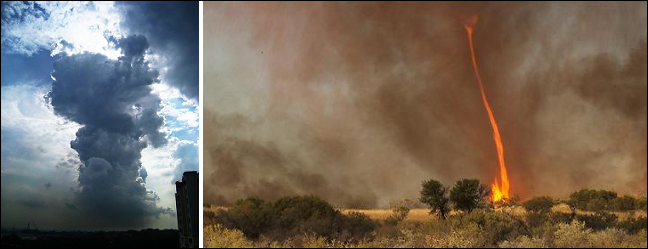
photo credits: Schristia, Cloud; Chris Tangey, Fire

.

I’m curious.

The IDF calls today’s Israeli operation in Gaza “Operation Pillar of Defense” in English, but as John Cook points out in Gawker, uses the term Hebrew term “Pillar of Cloud” in Hebrew.

There’s a great deal of interest here, apart from the difference between their use of non-Biblical terminology in English and Biblical terminology in Hebrew. One point that catches my ear, a poet being a poet, is that the phrase “Pillar of Cloud” is in fact only one half of a double reference…

Thus in Exodus 13.21-22 we read:

And the LORD went before them by day in a pillar of a cloud, to lead them the way; and by night in a pillar of fire, to give them light; to go by day and night: He took not away the pillar of the cloud by day, nor the pillar of fire by night, from before the people.

**

There are various ways of understanding the pillar of cloud and pillar of fire, but it’s pretty clear that there’s only one pillar —

And it came to pass, that in the morning watch the LORD looked unto the host of the Egyptians through the pillar of fire and of the cloud… [Exodus 14.24]

which is called a pillar of cloud by day and a pillar of fire by night, perhaps simply because we are speaking of theophany — the Divine Presence made visible — perhaps because smoke from a brazier is more visible in daylight and flames at night — perhaps because as Hans Goedicke, then chairman of the department of Near Eastern Studies at Johns Hopkins, suggested, the source of both fire and smoke was the eruption of Santorini around 1600 BCE.

The difference in worldviews behind those explanations alone is a matter of considerable interest.

**

Linguistically, however — and this is where the poet being a poet comes in — there are two pillars, and I have to wonder whether the name “Pillar of Fire” is being saved for a later and perhaps more impressive (“shock and awe”) operation, or — in line with the “by day and by night” distinction — refers to the covert side of the same op?

Not that anyone would be likely to give me that information, or that I’d have any use for it if they did.

But the Biblical phrasing is powerful, and “Pillar of Defense” doesn’t make a whole lot of sense — besides, cloud and fire go together in Hebrew in much the same way smoke and mirrors do in English.

Of the three choices, I’d have gone with “Pillar of Fire” myself.

**

An IDF spokesperson, in a response to Cook’s Gawker article, claimed:

I think that every example of Bible quotes you cited has defensive connotations, rather than “vengeful.”

One of those quotes is Exodus 14:24, which I quoted above but will now give in full, along with verse 25:

And it came to pass, that in the morning watch the LORD looked unto the host of the Egyptians through the pillar of fire and of the cloud, and troubled the host of the Egyptians, and took off their chariot wheels, that they drave them heavily: so that the Egyptians said, Let us flee from the face of Israel; for the LORD fighteth for them against the Egyptians.

I think calling that “defensive” is a bit one-sided, but on the other of the two hands in question, so is calling it “vengeful”.

The Israelites saw themselves in the larger context as escaping Egyptian oppression, the Egyptians obviously considered themselves under attack in the short term — just as surely as the people of Gaza must feel under attack by the oppressive Israelis today, while the Israelis clearly feel under attack by terroristic Hamas and its rockets. But hey, the IDF spokesman only offered his explanation that the Pillar of Cloud and Defense was “defensive” as “Just my two cents”…

FWIW, those two verses from Exodus sound just a little like Quran 33.26:

And He brought down those of the People of the Book who supported them from their fortresses and cast terror in their hearts; some you slew, some you made captive. And He bequeathed upon you their lands, their habitations, and their possessions, and a land you never trod. God is powerful over everything.

That’s an ayat that has always interested me, because of the use of the word “terror” found in a number of translations including this one, by AJ Arberry — others have “awe” or “panic”, but “terror” is interesting in the context of its contemporary usage.

**

Here’s the current strike counter strike in two tweets:

**

Okay, let’s get as close to visceral as modern technological warfare permits. After the recent truce was broken and numerous rockets fired into Israel, the IDF fired a missile that killed Hamas military leader Ahmed Jabari, and quickly put the video feed up on YouTube:

**

People are killing and getting killed. Should that be a matter for concern, or delight?

The narrative from which the IDF drew the name of their campaign in Gaza is taken from that of Israel’s escape from Egypt in Exodus, which also includes the parting of the waters and destruction of the Egyptian army:

And the angel of God, which went before the camp of Israel, removed and went behind them; and the pillar of the cloud went from before their face, and stood behind them: And it came between the camp of the Egyptians and the camp of Israel; and it was a cloud and darkness to them, but it gave light by night to these: so that the one came not near the other all the night. And Moses stretched out his hand over the sea; and the Lord caused the sea to go back by a strong east wind all that night, and made the sea dry land, and the waters were divided…. [Exodus 14.19-21]

And it came to pass, that in the morning watch the Lord looked unto the host of the Egyptians through the pillar of fire and of the cloud, and troubled the host of the Egyptians, And took off their chariot wheels, that they drave them heavily: so that the Egyptians said, Let us flee from the face of Israel; for the Lord fighteth for them against the Egyptians. And the Lord said unto Moses, Stretch out thine hand over the sea, that the waters may come again upon the Egyptians, upon their chariots, and upon their horsemen. And Moses stretched forth his hand over the sea, and the sea returned to his strength when the morning appeared; and the Egyptians fled against it; and the Lord overthrew the Egyptians in the midst of the sea. [Exodus 14.24-27]

Here again we see an instance of what I have called the two-fold logic of scriptures: In the Babylonian Talmud, Megillah 10b, R. Johanan tells us:

The ministering angels wanted to chant their hymns, but the Holy One, blessed be He, said, The work of my hands is being drowned in the sea, and shall you chant hymns?

to which R. Eleazar responds:

He himself does not rejoice, but he makes others rejoice.

**

To my mind, what we’re looking at here is a global koan: the immediate and eternal paradox of life and death.

But more on koans shortly.

An interesting peek into the PKK

Monday, November 12th, 2012

[ by Charles Cameron — the PKK and religion, my own ignorance and curiosity ]
.

Flag of the Iraqi Kurds, not a PKK flag -- but see below...

**

The PKK is important in a “first cousin once removed” kind of way, if I’m understanding Karen Kaya‘s piece in SWJ this past May correctly:

As Turkish military and government officials often say, the PKK is to Turkey what Al-Qaida is to the U.S., or that “the PKK is Turkey’s Al-Qaida.”

**

So I was trawling the web today, and the mention of religion in this paragraph from McClatchy caught my eye:

Volunteers who join the Kurdish insurgency against Turkey must abandon Islamic religious practice and must forego “emotional ties” to anyone outside the group, as well as swear words and sex, or face trial and prison, according to a Syrian-born Kurd who defected from the group to Turkey over the summer.

People who “defect” not uncommonly offer prejudiced accounts of the organizations they’ve left, so I read on to see how trustworthy this source might be:

The 21-year-old defector, who surrendered in June, brought with him not only a tale of life inside the Kurdistan Workers’ Party, known by its Kurdish initials as the PKK, but also detailed information about a planned attack inside Turkey that helped Turkish authorities beat back the PKK offensive.

McClatchy obtained a copy of a 19-page Turkish-language account of his debriefing, which was dated July 4 and was not marked classified. The debriefing contained his name, but McClatchy is identifying him only by his initials, R.S., to protect family members who might still be in territory held by the PKK’s Syrian affiliate.

It seems his military intelligence was quite accurate — so far so good. Next, my own curiosity naturally led me to wonder what the PKK’s religious stance, apart from being opposed to Islam, might be. After all, it’s called the the Kurdistan Workers’ Party and was founded on Marxist principles…

Okay, I skipped a few paragraphs, and found this:

R.S. portrayed the PKK as anti-Islamic. Performing daily prayers, fasting and reading the Quran are among the offenses that could land a recruit in prison, he told Turkish authorities. Instead, fighters were told that the religion of Kurds is Zoroastrianism, one of the world’s most ancient religions, and they should worship fire. There are said to be fewer than 200,000 Zoroastrians today, mostly in Iran and India.

Now that’s a fascinating glimpse behind the curtain.

**

For an alternate viewpoint, here’s the University of Utrecht grad student in Conflict Studies and Human Rights, Wladimir van Wilgenburg, writing for Rudaw in English and sounding knowledgeable, though his own or Rudaw’s potential biases are unknown to me:

The idea that Kurds are actually Zoroastrians is not something new. Kurdish nationalists such as the Bedirkhan brothers tried to revive Zoroastrianism and Yezidism as the original religion of the Kurds in the 1920s and 1930s. By this the Bedirkhans aimed to separate the Kurds from their Muslim neighbors and give them a glorious pre-Islamic history that had once boasted many empires.

They did not emphasize much on the Kurdish Islamic warrior Salahadin al-Ayyubi that rallied the Muslims against the crusaders in the twelfth century. Similarly, Turkish nationalists tried to promote Shamanism as the original religion of the Turks. But despite these efforts, Islam remained an important element among Kurdish nationalist movements.

It is unlikely that Yezidis are originally Zoroastrians. The Zoroastrian religion is a dualist religion (with good and evil constantly fighting each other), while the Yezidi faith revolves more around a single deity as the Satan.

Therefore it is possible that the Zoroastrians would regard the Yezidis as devil-worshippers, just as some Muslims do.

There are still many Kurds (especially in Europe) who think Kurds are originally Zoroastrians and wear Zoroastrian symbols, even though they are non-religious and do not have much knowledge about Zoroastrianism and its rituals.

The PKK was particularly influenced by the ideas of early Kurdish nationalists. Its media promoted the idea that Kurds are originally Zoroastrians. Other Kurdish political groups also came under the same influence.

But in 1991 the PKK took a positive approach about Islam and thus managed to win some sympathy. Some say the PKK tried to merge Kurdish nationalism and Islam for its own cause.

In recent years the PKK has also used Imams, Friday prayers and Islamic language as a means to compete with the ruling Justice and Development Party (AKP). In return, the Turkish government is said to have plans to recruit 1000 Kurdish Imams in its battle to win the hearts and minds of the Kurdish people.

**

That (Iraqi) Kurdistan National Flag at the top of this post has a golden sun with 21 rays as it’s central feature — but it’s from Iraq. The PKK has used a variety of flags, some of them reflecting the group’s Marxist origins, but one in particular appears to borrow from the Iraqi flag:

As noted on this Flags of the World page:

This seems to be a variant of the original PKK flag, since it has the star and the red background of the PKK original flag but also the sun disc of the Kurdish Regional Government in Iraq.

That, in brief, is why the symbolism of the Iraqi Kurdish flag may be significant in understanding symbolism associated with the PKK.

The Kurdistanica page on the Iraqi Kurdish flag is a little coy on the topic of the sun, noting:

The primary Kurdish characteristic of the flag is the golden sun emblem at the center. The sun emblem has a religious and cultural history among the Kurds, stretching into antiquity. The sun disk of the emblem has 21 rays, equal in size and shape. The number 21 holds a primary importance in the native Yazdani religious tradition of the Kurds.

The sun might also be associated with Zoroastrianism, and the number 21 with the 21 nasks of the original Zoroastrian scriptures — but the issue of Kurdish religious nationalism is another area I’m unfamiliar with…

**

The nice thing about knowing that one doesn’t know is that it makes leaping to conclusions so much more difficult.

Armistice Day, Veterans Day

Sunday, November 11th, 2012

[by Charles Cameron — for the UK, US and others, a day to remember ]
.

.
.

The Great War ended on this date a little short of a century ago, November 11th, 1918. My grandfather, Sir Henry Clayton Darlington, commanded troops at the Hellespont, so for me that war — and the Armistice which ended it — is but one degree of separation from personal memory.

Common British, Canadian, South African, and ANZAC traditions include two minutes of silence at the eleventh hour of the eleventh day of the eleventh month (11:00 am, 11 November), as that marks the time (in the United Kingdom) when armistice became effective.

Poppies grew in the fields of Flanders where so many of our soldiers died, and in the UK poppies are worn in the lapel on this day to remember them. In the words of the Laurence Binyon‘s poem For the Fallen,

At the going down of the sun and in the morning
We will remember them.

**

Small Wars Journal has a history of the various Armistice Day, Veterans Day and Remembrance Day observances.

The poppy pressed between the pages of St Luke’s gospel (image, above) was picked by one Les Forryan, who served with the UK’s Army Service Corps in France and Belgium during the Great War, and the book itself was a “Soldier’s Pocket Testament”, given to him in 1915. The field of poppies and crosses (image, below) was photographed by Brandanno1 in Cardiff, Wales, in 2007. The image of HM Queen Elizabeth II (image, inset) is from a Daily Mail report in 2008.

An army in Sham, an army in Yemen, and an army in Iraq

Thursday, November 1st, 2012

[ by Charles Cameron — uh-oh, it’s Mahdi time again.. giving a little wide-angle context, then passing along a hadith of possible current interest — also an aside about an end-times Shiite trinity ]
.

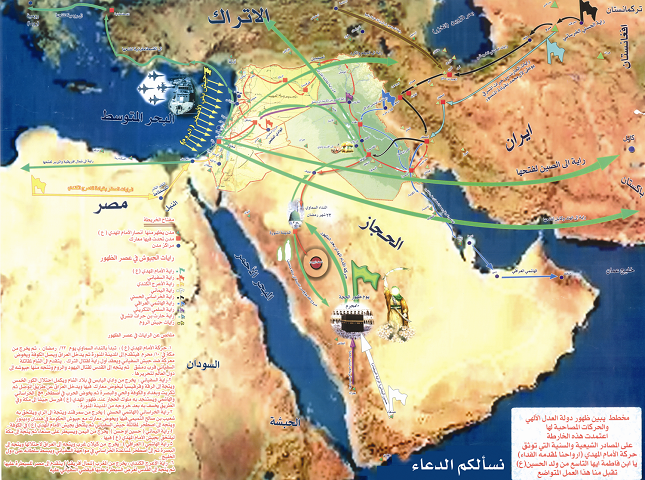
a ShiaChat map of one end times scenario: the Sufyani will attack Iran, black banners come from Khorasan

.

We live, as everyone pretty much agrees, in some place called “here” (although that shifts) at a particular moment called “now” (although that shifts too) in a medium often called “spacetime” in honor of Albert Einstein.

The Game-changing Coming Ones of many religions and sects – and even their secular variants, the Game-changing Coming Ideologies and Leaders) – are situated in another area of the same “spacetime” continuum for their respective believers: next up after “wars and rumors of wars” or “come the revolution” or “when the Mayan Calendar runs out” or “next year in Jerusalem”…
.

When:

My old friend Stephen O’Leary suggests there’s a shifting “window of opportunity” for people who preach “soon comings” – if you warn people that the world will end in a couple of thousand years, or with the heat death of the sun, or even that sea levels are liable to rise precipitously over the next few decades unless remedial action is taken, the view is long-range enough to seriously diminish your impact. Conversely, if you announce the end of the world will occur three minutes from now, nobody has time to get scared or prepared – or to propagate your message.

So “soon coming expectations” generally predict the coming is a little ways around the corner, close enough to matter but no close enough to sell all that you possess and climb Mt Ararat this week.
.

Where:

The “where” is interesting, though. We have news cameras focused 24/7 on the Mount of Olives to catch the Second Coming of Christ, although most observant Jews won’t be expecting that Christianity will be finally vindicated as the true inheritor of Judaism’s mantle there any time soon, and many Muslims expect he’ll descend at one of the minarets of the Umayyad Mosque in Damascus.

And the Mahdi? Two popular points of anticipated arrival are beside the Kaaba in Mecca, or out of the well behind the Jamkaran mosque, not too many miles from Qom.

But Islamic apocalyptic geography doesn’t end with either place – it extends, minimally, from Khorasan (Iran or Afghanistan) to Jerusalem, with a possible side-expedition to India (the Ghazwa-eh-Hind) and with possible tributaries from Africa and who knows where else… and in at least some Shia strands of apocalyptic thinking, the city of Kufa in Iraq will be the Mahdi’s seat of government.
.

And now, the hadith:

All this is simply to provide some context for a specific hadith that my friend Aaron Zelin pointed to me today, as recorded yesterday on the Kavkaz Center webpage:

Hadith about Syria, Iraq and Yemen

Publication time:
30 October 2012, 14:58

Sham – the territory of Syria, Palestine, Jordan and Lebanon

Abdullah ibn Hawalah [Allah's blessings be on him] narrated from the Messenger of Allah (pbuh) that he said:

"Matters will run their course until you become three armies: an army in Sham, an army in Yemen, and an army in Iraq".

Ibn Hawalah said:

"Choose for me, O Messenger of Allah! in case I live to see that day".

The Messenger of Allah (pbuh) said:

"You should go to Sham, for it is the best of Allah's lands, and the best of His slaves will be drawn there!

And if you refuse, then you should go to the Yemen and drink from its wells. For Allah has guaranteed me that He will look after Sham and its people!"

(Imam Ahmad 4/110, Abu Dawud 2483. Authenticated by Imam Abu Hatim, Imam ad-Diya al-Maqdisi, Sheikh al-Albani and Sheikh Shu'aib Al-Arnaut).

Department of Monitoring
Kavkaz Center

.
Further reading:

For more on this, see especially J-P Filiu‘s Apocalypse in Islam, noting in particular his account of “the revelation of Abu Musab al-Suri” (pp. 186-193), including specifically his discussion of “Sham” in a paragraph on p. 189.

*****

And an intriguing aside:

And since were talking Yemen and the greater Sham here, it may be worth noting as an aside, the presence in Islamic apocalyptic traditions of a figure known as the Yemeni — sometimes identified in Iranian Shia apocalyptic as Hezbollah’s Hasan Nasrallah. Filiu writes (p.156) of:

Shaykh Nazrallah’s transformation into the apocalyptic figure of the Yemeni, completing a very political trinity in which Ayatollah Khamenei served as the standard bearer of the Mahdi and Ahmadinejad as the commander of his armies.

Filiu’s book was published in France in 2008, but the same trinity can also be found in the fairly recent video The Coming is Upon Us attributed by Reza Kahlili to circles around Ahmadinejad. I’ve taken this account of the video and the trinity as it reports it from the Counter Jihad Report, because their version succinctly draws together the strands that most concern me here:

A little-noticed documentary titled “The Coming is Upon Us” was produced by Ahmadinejad’s office last year and it lays out the regime’s beliefs and planned path forward, much like Mein Kampf did. And it debunks the notion that the U.S.S.R. and the Iranian regime are equivalent. The film makes the case that the regime’s leaders are the incarnations of specific End Times figures foretold in Islamic eschatology.

Iran is the “nation from the East” that paves the way for the Mahdi’s appearance. Supreme Leader Khamenei is Seyed Khorasani, “the preparer” who comes from Khorasan Province with a black flag and a distinct feature in his right hand. Khamenei’s right hand is paralyzed from an assassination attempt. Khorasani’s commander-in-chief is Shoeib-Ebne Saleh, who the film says is President Ahmadinejad. Hezbollah chief Hassan Nasrallah is the incarnation of Yamani, a commander with a Yemeni ancestry who leads the Mahdi’s army into Mecca.

These three “preparers” wage war against the Antichrist and “the Imposters”-the U.S., Israel and the West’s Arab allies. The film also mentions that a figure named Sofiani will side with Islam’s enemies. Former Iranian Revolutionary Guards officer Reza Kahlili, who leaked the film, told me that the full-length version identifies him as Jordanian King Abdullah II.

The film lists various End Times prophecies that have been fulfilled to argue that the Mahdi’s appearance is near. The 1979 Islamic Revolution in Iran; the invasion of Iraq from the south and subsequent sectarian violence and death of Saddam Hussein; the Houthi rebellion in Yemen; the fall of Egyptian President Hosni Mubarak and the increasing amount of open homosexuality, cross-dressing, adultery and women taking off the hijab are correlated to specific Islamic prophecies.

As to the video’s authenticity and provenance, I can only express my ignorance and keen interest — but whatever the case, it seems likely that the split between Khamenei and Ahmadinejad, together with the latter’s “soon going” from office, renders that particular strain of prophecy moot.

Particular prophetic timelines may fail, and indeed do so repeatedly — the apparatus of apocalyptic hope simply incorporates new figures and events into its calculations, and moves its sense of urgency a little further up along the timeline…

The war and peace paradox, take 2: of wolves and music

Tuesday, October 30th, 2012

[ by Charles Cameron — second take on the paradox, this time featuring wolves, poetry, lions, honey, and Bach ]
.

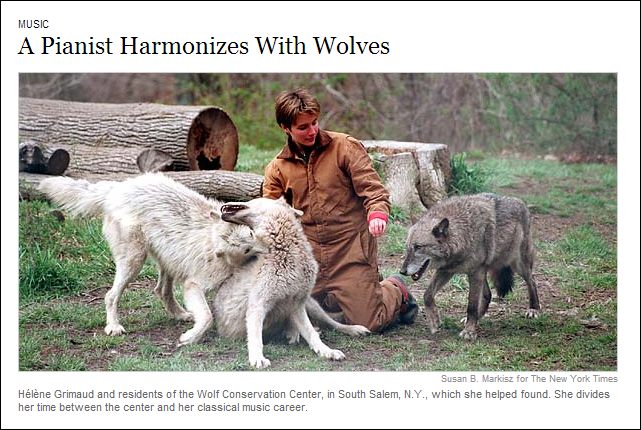
eye-catching headline & image from the New York Times, 2008

.

I’m always trying to see war and peace — violence and gentleness, if you like — in counterpoint rather than in opposition. The distinction is a subtle one, I know, but that’s the task. I tackled it from one angle a few days ago in this earlier post, and imagine I’ll return to it again from time to time.

**

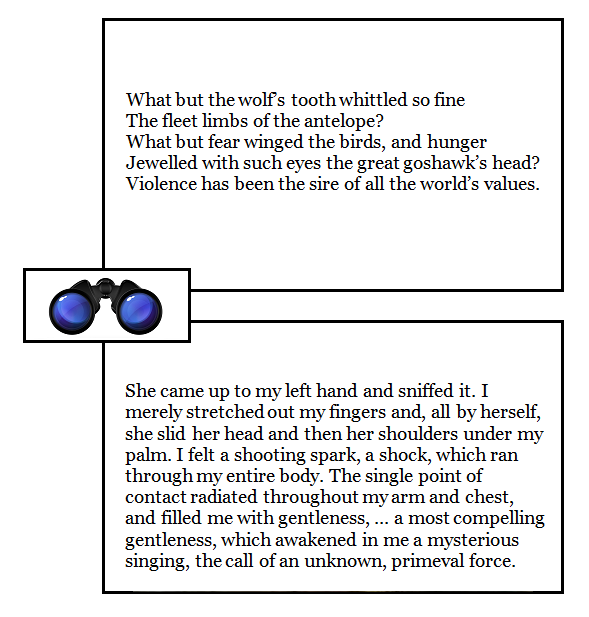
I was fascinated to run across two very different artists talking about wolves these last few days. Robinson Jeffers, in his great poem The Bloody Sire, sees the wolf’s violence (upper panel) as bringing speed and grace to the antelope:

while the extraordinary pianist Hélène Grimaud describes her first encounter with a wolf (lower panel) in terms of gentleness.

After that striking first encounter with a wolf, Grimaud went on to found the Wolf Conservation Center in upstate New York (see NYT article by clinking on image at top of this post).

**

There’s a longish and fairly erotically, religiously and violently charged story in chapter 14 of the book of Judges. Samson, so the story goes, took a liking to a woman of the Philistines, and despite his parent’s urgings went down to see her because, as he delicately put it, “she pleaseth me well.” Along the way he meet a young lion, and “rent him” — tore him apart with his bare hands — “as he would have rent a kid” — here meaning a young goat. Samson continued to like the look of the women of the Philistines, we are told, and on his next visit down to see her, “he turned aside to see the carcase of the lion: and, behold, there was a swarm of bees and honey in the carcase of the lion. And he took thereof in his hands, and went on eating, and came to his father and mother, and he gave them, and they did eat…”

Samson, it seems, was a gambling man, and he soon proposed a bet and a riddle to his bride’s companions — for somewhere around that time they had married, a fact that the story teller omits to tell us in so many words — giving them seven days to solve it:

Out of the eater came forth meat, and out of the strong came forth sweetness.

The companions, of course, could not solve the riddle, since they had not seen the lion, nor its carcase with its swarm of bees and honey… but they pleaded with his new wife so piteously that she pleaded with her new husband so piteously that he revealed the secret to her, and on the seventh day her Philistine companions won the bet and answered Samson’s riddle:

What is sweeter than honey? And what is stronger than a lion?

To which poor Samson replied:

If ye had not plowed with my heifer, ye had not found out my riddle.

The marriage didn’t last — and, we are told, “his anger was kindled…”

**

I certainly heard this story intoned in chapel at one school or another, but recognized neither the eroticism nor the violence nor the significance of the religious enmity between monotheistic Jew and pagan Philistine…

But my mother did make us pancakes on rare and wonderful occasions, and on them I lavished farm butter and Tate and Lyle‘s glorious Golden Syrup, with its image of Samson’s lion and the honey bees:

and the Tate and Lyle motto: Out of the strong came forth sweetness.

It’s that sweetness — that image of the lion and those bees more than the Biblical story itself — that I remember…

**

I am grateful to Steve Engel for bringing Robinson Jeffers’ poem to my attention this last week, and to J Scott Shipman of this blog for introducing me to Hélène Grimaud’s playing of the Bach Chaconne on YouTube:

Out of the strong came forth sweetness indeed.


Switch to our mobile site