zenpundit.com » scriptures

Archive for the ‘scriptures’ Category

The Messianic Mahdist Moebius strip — or maybe Maze?

Monday, October 29th, 2012

[ by Charles Cameron — a quick look at some confusing clashes between messianisms, with specific reference to the MUJAO — also the late Ayatollah Baqir al-Sadr sounding an ecumenical note ]
.

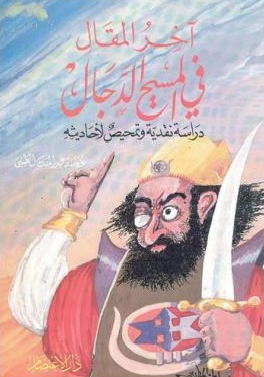
image: Dajjal, from Okasha Abdelmannan al-Tibi's The Whole Truth about the Antichrist
.

Tim Furnish opens his book Holiest Wars: Islamic Mahdis, their Jihads and Osama bin Laden, with the words:

One man’s messiah is another man’s heretic.

What he doesn’t state outright, which is also true, is that all too often that heretic is the anti-Messiah.

**

I use that term “anti-Messiah” deliberately, because in discussing Islamic end times beliefs, the term “Antichrist” is frequently used by both Christians and Muslims to refer to the Muslim “equivalent” of the Christian Antichrist — ie the “deceiving messiah” or Masih al-Dajjal, whose coming at the end of days is predicted in Islamic apocalyptic narratives in negative counterpoint to the coming of the Mahdi, in much the same way that some Christian apocalyptic narratives predict the coming of the Antichrist in negative counterpoint to the return of the Christ.

This issue was brought home to me once again today when Aaron Zelin pointed me to this tweet from Afua Hirsch [ @afuahirsch ], West Africa Correspondent for the Guardian:
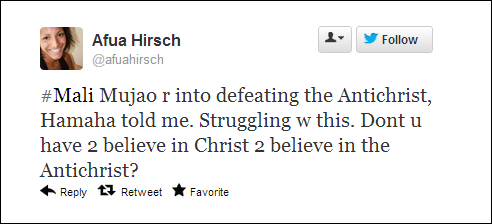
Frankly, I think that’s a very natural question to raise, and one that has an even more intriguing answer.

**

One other note, which I’ve separated out between asterisks here because I think it’s a crucial one at that:

by Afua Hirsch’s account, Mali’s Movement for Unity and Jihad in West Africa (MUJAO) has the apocalyptic fever…

**

Strange things happen when different views of the end times, as prophesied one way or another in various branches of all three Abrahamic religions, clash.

Here’s where I see the moebius strip effect, whereby apocalyptic figures are turned into their opposites by rival sets of beliefs:

Some Muslims call the Dajjal (literally, “the deceiver”) the Antichrist — here, for instance, is a video clip of Sheikh Imran Hosein, whom I have discussed on Zenpundit before, quoting a hadith or tradition of the Prophet from the Sahih Muslim collection, and using the term “Antichrist” without further comment in his translation of the term Dajjal —

While some Christians call the Mahdi the Antichrist — as does Joel Richardson in his book currently issued under the title The Islamic Antichrist: The Shocking Truth about the Real Nature of the Beast. Reviewing the book in its first edition under its earlier title, Dr David R. Reagan sums Joel’s basic points succinctly:

Joel Richardson in his book Antichrist: Islam’s Awaited Messiah argues that the Mahdi will be the Antichrist of the Bible and that the Muslim Jesus will be be the False Prophet of the Bible who serves the Antichrist and his purposes. Both will be destroyed when the true Jesus returns at the end of the Tribulation.

We were talking about the Sufyani just the other day, right? Here’s a stunner to spin your head a further 180 degrees — the Sufyani as a second (and more dangerous) Dajjal than the Dajjal:

While the great Dajjal focuses on atheism and fights Christianity, the Islam Dajjal, Sufyan, fights Islam, which is the only true religion before Allah, openly. Therefore he is regarded as more frightening.

There’s also a question of one and / or many Antichrists in Christianity, of course — see 1 John 2:18:

Little children, it is the last time: and as ye have heard that antichrist shall come, even now are there many antichrists; whereby we know that it is the last time.

And hey, bear with me, I’m not done yet: members of the Ahmadi school quote a hadith from the Sunan Ibn Majah collection which says:

There is no Mahdi but Jesus son of Mary.

Ibn Majah, however, also has a hadith in which it is stated that at the time of the Mahdi’s advent he will invite the returning Jesus to lead the evening dawn prayer [as quoted here]:

…while their Imaam will have advanced to pray the Fajr prayer with them, Eesa, the son of Mary will descend [at the time of the Fajr prayer]. The Imaam will draw backward so that ‘Eesa would go forward and lead the people in prayer. However, ‘Eesa would put his hand between his shoulders and say to him: “Go forward and pray, as it is for you that the call for the prayer was called, so their Imaam would lead them in prayer.”

**

Confusing?

I think so, unless you are paying close attention.

My own recommendation would be that the phrase “the Islamic Antichrist” should be replaced by “the Islamic equivalent of an Antichrist” when referring to the Dajjal, and “the Mahdi viewed as Antichrist” when referring to the Mahdi.

I know, I know — the chances of changing people’s verbal habits across the board are pretty slender.

But have I made things seem complicated enough?

**

This whose business naturally gets just a tad more complicated once one adds in the Sunni concept — I am not sure how widespread it is, but it would make a fascinating topic for research for someone with the requisite language skills — that the Mahdi of the Shiites will be the Dajjal of the Sunni… as shown in this screen cap of a YouTube video.
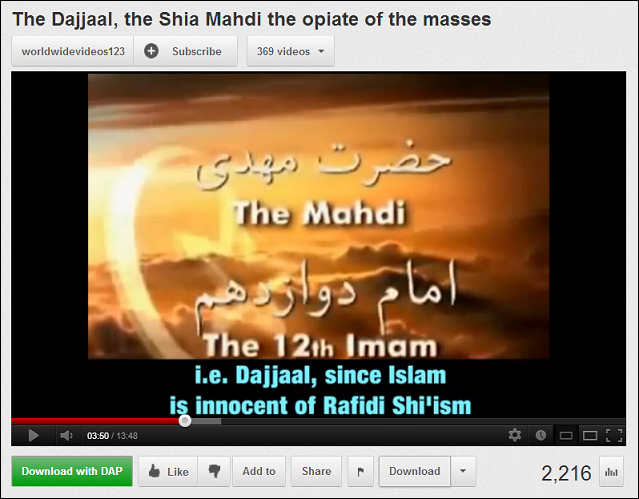
[Rafidi means one who has deserted the truth, and is a derogatory term, in this case used by Sunnis to disparage the Shiites.]

Or this one — with its equation of the Shiites with the Jews:

Of course, Christianity too has its share of internecine apocalyptic mud-slinging: Rev. Ian Paisley (long-time leader of the Ulster Unionists and Moderator of the Free Presbyterian Church of Ulster) interrupted Pope John Paul II‘s speech at the European Parliament to denounce him as the Antichrist — while Rev. JD Manning gives Oprah Winfrey that title

**

Everything I have described above is dualistic in nature and sectarian in its specifics. It comes as something of a surprise, then, to find the late Ayatollah Muhammad Baqir al-Sadr quoted as writing:

The Mahdi is not an embodiment of the Islamic belief but he is also the symbol of an aspiration cherished by mankind irrespective of its divergent religious doctrines. He is also the crystallization of an instructive inspiration through which all people, regardless of their religious affiliations, have learnt to await a day when heavenly missions, with all their implications, will achieve their final goal and the tiring march of humanity across history will culminate satisfactory in peace and tranquility. This consciousness of the expected future has not been confined to those who believe in the supernatural phenomenon but has also been reflected in the ideologies and cult which totally deny the existence of what is imperceptible. For example, the dialectical materialism which interprets history on the basis of contradiction believes that a day will come when all contradictions will disappear and complete peace and tranquility will prevail.

The point is made even more clearly in a speech given by the Iranian scholar Muhammad Ali Shumali:

So, our own camp comprises of people who have this understanding: First of all, they are the people who believe in the Ahl al-Bayt. Yet, in our camp it is possible for there to be people who work for the Ahl al-Bayt without knowing the Ahl al-Bayt. This is also something very important. You may have a non-Shia who works for the Ahl al-Bayt better than many Shias. Indeed, you have some Shias that work against the Ahl al-Bayt. You may even have non-Muslims who are working for Imam Mahdi—for the cause of Imam Mahdi, for justice, for many things—and they may not even know who Imam Mahdi is. So it is not that whoever is not a Shia is not in our camp.

and:

I believe that the majority of the people of the world are not against us; it is just our failure to present our ideas and to convince them that what we have is for all mankind. I think in particular, in the case of Imam Mahdi, we must do the same thing: we must not present Imam Mahdi as a saviour for the Shias. Imam Mahdi is not a saviour for [just] the Shias. Imam Mahdi is a saviour for all mankind…

**

And then you see what you yourself see, and believe what you yourself believe.
Apocalypse Revisited, not for the last time

Tuesday, October 9th, 2012

[ by Charles Cameron — Tim Tebow and 666, Charlie Fuqua and stoning disobedient children — addenda to two recent posts ]
.

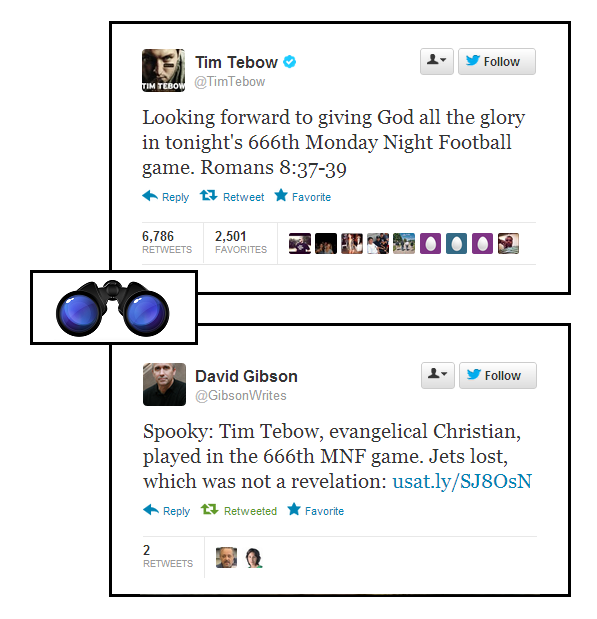
First, the more lighthearted news. Yesterday I featured three footballers prayingTim Tebow was one of them. Today: when prophecy fails on Twitter:

Just look at the retweets for Tebow: his tweet may have been half-tweet, half prediction, half-prayer, all in one forty characters, and his fans were behind it — yet the Jets lost.

At the time of writing, Tebow hasn’t tweeted for 24 hrs.

Permit me an aside, by way of clarification — as someone raised in the UK, I don’t know what “the Jets lost” means, to be honest. My Welsh ex once understood American Football while she was watching a game on hospital TV during a delivery — until the epidural wore off, at which point it went back to being incomprehensible. So that’s as close as I’ve come to understanding it myself — although I played both soccer and rugby in my schooldays.

**

Now onto more serious things. In a comment on another recent post, I mentioned Charlie Fuqua, a Republican candidate for the Arkansas House. I am beginning to think we should have a category to put after the names of such people, as in “candidate Charlie Fuqua (R-Ex)”, to indicate that many on their own team disavow their more extreme pronouncements.

In a post on his Running Chicken blog headed Today in inexplicable religious zealotry, Prof. Ari Kohen quotes the Arkansas Times on Charlie Fuqua, a Republican-side candidate for the Arkansas legislature:

Here’s the key passage from Fuqua’s 2012 book, “God’s Law: The Only Political Solution“:

The maintenance of civil order in society rests on the foundation of family discipline. Therefore, a child who disrespects his parents must be permanently removed from society in a way that gives an example to all other children of the importance of respect for parents. The death penalty for rebellious children is not something to be taken lightly. The guidelines for administering the death penalty to rebellious children are given in Deut 21:18-21:

Deuteronomy 21.18-21 reads:

If a man have a stubborn and rebellious son, which will not obey the voice of his father, or the voice of his mother, and that, when they have chastened him, will not hearken unto them: Then shall his father and his mother lay hold on him, and bring him out unto the elders of his city, and unto the gate of his place; And they shall say unto the elders of his city, This our son is stubborn and rebellious, he will not obey our voice; he is a glutton, and a drunkard. And all the men of his city shall stone him with stones, that he die: so shalt thou put evil away from among you; and all Israel shall hear, and fear.

The Arkansas Times continues:

Fuqua helpfully notes that “This passage does not give parents blanket authority to kill their children.” Rather, parents would have to “follow the proper procedure in order to have the death penalty executed against their children.” Fuqua assures the reader that, in his view, the procedure would “rarely be used.” The threat of death would, however, “be a tremendous incentive for children to give proper respect to their parents.”

**

Here’s where Prof. Kohen, Schlesinger Associate Professor of Political Science and Director of the Forsythe Family Program on Human Rights and Humanitarian Affairs at the University of Nebraska—Lincoln, adds his own informed scholarly input:

The trouble for Fuqua — and anyone else who thinks the Hebrew Bible provides a good template to follow in cases like these — is that he doesn’t actually have any idea what Jewish scholars and religious authorities have been thinking and writing about this particular passage for centuries:

In defining the extent and limitations of the laws of the ben sorer u-moreh, the Talmud (Sanhedrin 71a) states that the child is not considered liable until he has stolen his father’s property in order to acquire a tartimar of meat to eat, and a log of Italian wine to drink. The Halakha places further restrictions upon the ben sorer u-moreh so as to make the application of the law extremely unlikely, if not impossible. The rules only apply with the first three months after the child has reached halakhic manhood; both parents must be living and willing to press charges; neither parent can be deaf, lame, nor missing a limb; they must speak with the same voice and have the same appearance; the boy must steal the meat and wine from his father’s house, yet consume them elsewhere in the company of worthless individuals, in order for him to be convicted. According to the Tosefta Negaim, this law is not in effect in Yerushalayim. (The Meshekh Chokhma suggests that this is due to the continuous eating of so many sacrifices and offerings, as well as ma’aser sheni – the second tithe – within Jerusalem; consumption within the city, since it is performed for mitzva purposes, cannot be considered gluttony.) These are only a few of the numerous restrictions and limitations that apply before a boy can be judged as a ben sorer u-moreh, ensuring that the actual application of the law was extremely rare.

Several Talmudic opinions (Sanhedrin 71), having studied the above limitations, conclude that the case of the ben sorer u-moreh “never occurred and never will occur.” According to them, the sole purpose of having this section in the Torah is to learn the laws and provide a reward for those who do so.

So, in brief, here is my plea to people like Charlie Fuqua:

Stop cherry-picking the Torah to justify all of the terrible things you want people to do to one another; Jews don’t believe that things like this are mandated by the Torah and it’s our book.

**

I very much appreciate Prof. Kohen’s comments, which open a lively window not only on Judaic scripture, interpretation and practice, but also on how scriptures, their literal interpretations by outsiders, and the more skillful and adaptive interpretations of scholars within the traditions can function in the actual shaping of human lives…

When considering the scriptures of any religious tradition, we should bear such examples strongly in mind.

**

Indeed, I have only one qualification to make regarding Prof. Kohen’s post, and offer it as a small gift of thanks.

The one thing I can say that Fuqua is very likely not doing is cherry picking.

It is far more likely that he is a follower of the late RJ Rushdoony, whose massive work The Institutes of Christian Law advocates for the application of what he terms Biblical Law – in its entirety — to American society, and whose Chalcedon Institute published an article in its January 1999 issue on precisely this topic: Rev. William Einwechter‘s Stoning Disobedient Children?:

Deuteronomy 21:18-21 contains what is, perhaps, the most vilified law of the Old Testament. It is widely believed that this law authorizes the stoning of children who disobey their parents. … When this case law, which applies the moral law of the Fifth Commandment to a specific circumstance, is understood it will prove to be “holy, just, and good,” a delight to the heart of God’s true people (Rom. 7:12, 22).

This piece created a bit of a stir, and it was followed shortly thereafter by another Einwechter piece: Stoning Disobedient Children? Revisited.

Both articles seem to have proven unpopular enough that they have been removed from their respective original sites, so I am grateful that the Archive still has them as linked above. I recommend an acquaintance with Rushdoony’s work, and with essays such as these, to anyone interested in the influence of “Biblical Law” on contemporary politics.

**

By way of comparison, the Qur’an, like the Torah, stresses the importance of honoring one’s parents in close conjunction with that of having no god but God. Thus Qur’an 17:23 in the Shakir translation reads:

And your Lord has commanded that you shall not serve (any) but Him, and goodness to your parents. If either or both of them reach old age with you, say not to them (so much as) “Ugh” nor chide them, and speak to them a generous word.

— compare Exodus 20.3-5, 12 — while the hadith reported in Sahih Bukhari, Bk 48, Witness, #822 tells us:

Narrated Abu Bakra:

The Prophet said thrice, “Should I inform you out the greatest of the great sins?” They said, “Yes, O Allah’s Apostle!” He said, “To join others in worship with Allah and to be undutiful to one’s parents.” The Prophet then sat up after he had been reclining (on a pillow) and said, “And I warn you against giving a false witness, and he kept on saying that warning till we thought he would not stop.

To my knowledge, no specific (hudud) punishment for disobedient children is prescribed in the Qur’an.

Haaretz on the Temple Mount, pt II: axis mundi

Sunday, October 7th, 2012

[ by Charles Cameron — Jerusalem, and the Temple Mount in particular, as the still point in the turning world — Midrash, Haaretz, a map from 1581, M Eliade, TS Eliot, Navaho Night Way ]
.

There is tremendous poetic force to the notion of the axis mundi, the mythic center around which all else revolves.


.

In an earlier post, I quoted this saying, which exemplifies the power of the “center of the world” motif as applied to Israel and the Temple Mount:

As the navel is set in the centre of the human body,
so is the land of Israel the navel of the world…
situated in the centre of the world,
and Jerusalem in the centre of the land of Israel,
and the sanctuary in the centre of Jerusalem,
and the holy place in the centre of the sanctuary,
and the ark in the centre of the holy place,
and the foundation stone before the holy place,
because from it the world was founded.

– Midrash Tanchuma, Qedoshim.

**

Let’s give that room to breathe.

**

There are those who will dismiss all such images and words as irrelevant, impractical, foolish, irrational — Jerusalem is not the center of the earth any more than the earth is the center of the solar system — but to a poet they are words in a familiar language, not of fact but of imagination and love. They are poetry.

Sadly, in my view, the members of the various movements to rebuild the Jerusalem Temple on or near the sites of the Al-Aqsa Mosque and Dome of the Rock on the Noble Sanctuary / Temple Mount take the poetry of the Mount as axis mundi literally and all too politically — as happens not infrequently with authentic poetry.

Phrased as political prose, the idea just isn’t the same, as these words from Shany Littman‘s Haaretz article addressed in the prequel to this post will demonstrate:

Rivka reminded us that over and above the sheer experience and the historical tales, the visit had a purpose: to understand the essence of the Jewish home through the Temple, as the visit revolved around a bride on her wedding day. Holding up a page containing what looks like a satellite image of planet Earth, she showed how, from a certain angle, the Land of Israel and Jerusalem appear to be at the center of the world, in its innermost circle. “I give lessons to women about modesty,” she said. “I show them this image and replace the word ‘modesty’ with the word ‘inwardness.’ The innermost circle, the most hidden, is the Land of Israel, Jerusalem, the Temple, the Holy of Holies. What is modesty, what is a modest, inward place? It is hidden, the place least visible to the eye.”

But the bride was contentious: “You could take that photograph from a different angle and then Jerusalem will not be in the center.” “True,” Rivka replied, “but here we see that the State of Israel is at the heart of the world. If the world knew how much it would gain from us building the Temple, they would heap good stones on us, because they will profit from it. The most prosperous countries in the world are the Western ones; China, Africa and Asia are poor.”

A questioning eyebrow was raised. “Don’t look at the industry,” Rivka said. “Look at the miserable people, who are not allowed to have more than one child and don’t have proper housing and suffer from tsunamis and earthquakes. Look at the suffering they are undergoing. And why? Because the Jewish people resides close to the Temple, the world on this side gains; where we do not reside [i.e., the East] the world loses. This is the place that coordinates and pinpoints all the prayers and the connection with the Master of the Universe. If we are not here, they lose. And we lose, too.”

and, in the words of Prof. Weiss from the same article:

I want to take the movements to a place that is more sensible: a Temple-based state, where the state’s entire content revolves around the Temple.”

**

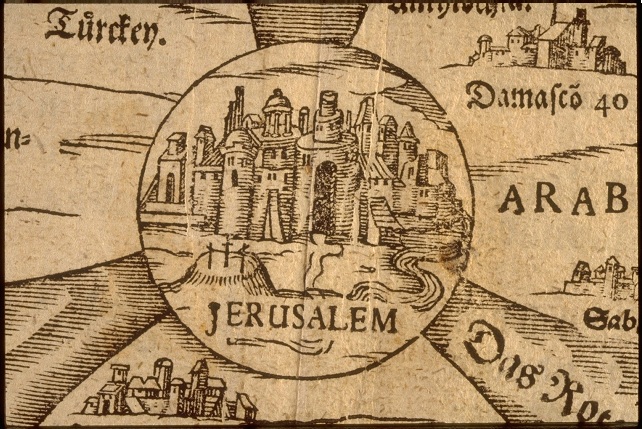
Map (above) by Heinrich Bunting from a copy of Itinerarium Sacrae Scripturae (1581) in the Jerusalem as the center of the world exhibition at the University of Southern Maine’s Osher Map Library, detail below:

**

For more on the symbolism of the axis mundi, see Mircea Eliade‘s essay Symbolism of the Centre in his book Images and Symbols — or consider these lines from TS Eliot‘s poem-series, Four Quartets:

At the still point of the turning world. Neither flesh nor fleshless;
Neither from nor towards; at the still point, there the dance is,
But neither arrest nor movement. And do not call it fixity,
Where past and future are gathered. Neither movement from nor towards,
Neither ascent nor decline. Except for the point, the still point,
There would be no dance, and there is only the dance.
I can only say, there we have been: but I cannot say where.
And I cannot say, how long, for that is to place it in time.
The inner freedom from the practical desire,
The release from action and suffering, release from the inner
And the outer compulsion, yet surrounded
By a grace of sense, a white light still and moving…

**

In many ways, both Eliot’s words and those of the Midrash remind me of the beauty found in the prayers of the Navaho Night Chant:

In beauty may I walk.
All day long may I walk.
Through the returning seasons may I walk.
On the trail marked with pollen may I walk.
With grasshoppers about my feet may I walk.
With dew about my feet may I walk.
With beauty may I walk.
With beauty before me, may I walk.
With beauty behind me, may I walk.
With beauty above me, may I walk.
With beauty below me, may I walk.
With beauty all around me, may I walk.
In old age wandering on a trail of beauty, lively, may I walk.
In old age wandering on a trail of beauty, living again, may I walk.
It is finished in beauty.

To my reading eye as a poet, these are all expressions of the same kind — invocations of the human spirit by rhythm and imagery — true poems, visions. They offer us a form of nourishment and insight not easily found today — nourishment and insight which shrivel and die when reduced to politics or prose.

**

For more on the Navaho chantways, and the balance called “sa’a naghai bik’e hózhó” which this prayer embodies, see John Farella, The Main Stalk: A Synthesis of Navajo Philosophy.

Three from Haaretz on the Temple Mount

Sunday, October 7th, 2012

[ by Charles Cameron — growth and mainstreaming of Rebuild the Temple movements in Israel, parallels with perceived slights against the Prophet of Islam, volatility of the situation ]
.

You saw the New York Times headline, New Clashes at Site in Jerusalem Holy to Both Muslims and Jews? That was just a taste, here’s more of the story:
.


.

Haaretz has posted three pieces in the last couple of days about the movement to build a Third Temple on the Temple Mount / Noble Sanctuary in Jerusalem. I’ll give you the title, link and brief summaries of for the two shorter pieces, and some significant quotes from the Longer one.

**

I’d also like to suggest considering the issues here as analogues of those in the recent “blasphemy” incidents.

We might think in terms of freedom of speech being akin to freedom of worship — but we should also consider the dangers inherent in what would likely be perceived as a huge provocation, in what may be the most volatile hot-spot on earth.

Consider: building the Third Temple might involve the destruction of the Al-Aqsa Mosque, whether by an act of God or by human intervention. Whether it would or not is in dispute, as we shall see — but as we shall also see, attempts to destroy it have already been made…

Bearing that in mind..

**

1: Temple Mount Faithful: From the fringes to the mainstream

Once consigned to messianic extremist fringes, movements fighting the ban on Jewish
prayers on Temple Mount are now endorsed by moderate rabbis. Even the Education Ministry has taken sides by encouraging pupils to visit the site.

If that’s accurate, it’s a significant shift in relation to what my American-Israeli journalist friend Gershom Gorenberg called in his book about the Mount, The End of Days, “the most contested piece of real-estate on earth” — for a quick overview of the importance of the site, see my piece of that name from July of this year.

**

2: Jerusalem Magistrate’s Court: Jews should be allowed to pray on Temple Mount

Police currently enforce the Muslim ban on Jewish prayer at the site, citing security concerns.

Put those two pieces together, and you have a sense of momentum gathering for an epic clash, one which would have immense apocalyptic significance in terms of those eagerly awaiting a Coming One in each of the three Abrahamic traditions

**

3: Following the dream of a Third Temple in Jerusalem

More than 90 percent of Israel’s religious public wants to be allowed to pray at the Temple Mount in Jerusalem. Some groups, though, wish to go even further and build a Third Temple in place of the Al-Aqsa Mosque. What fuels the dreams of these Jewish extremists?

Shany Littman, the author of this impressive magazine-length piece which is behind a paywall on the Haaretz site but has been reposted here, expresses through the voices of a diverse group of people she met and talked with, the deep-seated longing behind the movement —

I pray for it three times a day and I wanted to take seriously what I say. I say, ‘Next year in rebuilt Jerusalem.’

and the theological logic behind that —

It is the heart of Judaism. Numerically, one-third of the 613 commandments are not fulfilled today because of the absence of a Temple. The Temple is the Jewish public sphere that we lost. I want a transnational Judaism, which will encompass all the commandments.

the sacred politics —

I want to take the movements to a place that is more sensible: a Temple-based state, where the state’s entire content revolves around the Temple.

the somewhat archaic-sounding motivations involved —

the fulfillment of the three commandments the Israelite nation was given in anticipation of its imminent entry into the Land of Israel: to appoint their king and establish his kingdom, to wipe out the seed of Amalek and to build their Holy Temple.

the progress that has already been made in terms of preparation —

only two vessels that are not yet ready are the Ark of the Covenant, which cannot be reconstructed because it contained the stone tablets from Mount Sinai, and the huge external altar, on which the sacrifices were performed.

and recent trends on the part of Israeli police and politicians that seem to show an increasing willingness to allow Jews to pray in what is, after all, their holiest of holy places.

**

I have been pondering these things, and I think we can helpfully, if carefully, draw a parallel between the extreme caution with which the Israelis have approached the issue of the potential for Jewish behavior — up to and including the possible removal of the Al-Aqsa Mosque and or Dome of the Rock — enraging not just Jerusalem’s Palestinians but the Islamic world, and the far smaller provocations of Charlie Hebdo, the puerile video, and the Qur’an-burning Revd. Jones.

Consider the rules and regulations invoked by the Israeli poloice on Jewish visitors to the Mount (compare also the rabbinic decree in the “traffic sign” at the top of this post):

Because this was the month of Ramadan, no food or drink was to be brought. Also forbidden were praying, bowing, kneeling, singing and anything that might disturb the public order. And have a good day.

Prayer is banned — have I heard that phrase somewhere before?

Prayer is banned because it would be blasphemous — the ironies, the echoes, the resonances and paradoxes here are endless.

**

To understand the depth of feeling here — and remember, we are only examining the Judaic side of the issue here, and there are other perspectives in play — let’s peer a little deeper into the sacred / sacral motivation:

Sacrifice, not a very “contemporary” word but one with strong, archaic / archetypal meaning, is the heart of the Temple’s purpose:

Animal sacrifice was the primary ritual activity in the Temple. Rivka spoke of the practice yearningly. “Today it is hard to understand what sacrifice is,” she said. “When a person errs, makes a mistake, sins ? instead of bringing himself, he brings a substitute; he brings either an offering or an animal whose blood atones for his soul. This is something we have lost today. The media always talks about korbanot [the Hebrew word “korban” means both “sacrifice” and “victim”] ? victims of traffic accidents, victims of the peace process, victims of terrorism. And I say to myself, despairingly, that there is a place for korbanot ? and it is here. And what is the root of the word ‘korban’? It is from lehitkarev, to draw closer. To draw closer to Hashem.

Indeed, the sacrifice of a red heifer is widely believed to be necessary to purify those who would enter the Temple grounds — note in this next paragraph the reference to the return of the Messiah:

According to religious belief, until the ashes of a red heifer are obtained, access to the courtyard of the Temple is prohibited for Jews (see Numbers 19:1-22 and Mishna tractate Parah). Water mixed with the ashes of a red heifer can cleanse people of the impurity of the dead, which clings to everyone. Tradition holds that there have been only nine ritually suitable red heifers, and that the 10th will appear upon the advent of the Messiah. The absence of the ashes of a red heifer, with the concomitant inability to become ritually clean, is one of the reasons that many Jews are unwilling to visit the Temple Mount. However, the Temple movement activists claim this is only an excuse, and that there is no problem obtaining a red heifer today.

**

Now back to “on the ground” realities — and risks, including the risks of terrorism and war.

This situation of contesting claims to one of the world’s most sacred sites the has been simmering for quite some time, and I think the gist of the three Haaretz articles could be read as “the stew’s beginning the bubble”.

For another glimpse of the potential volatility of the situation, we can turn to a decade-old piece by Jeffrey Goldberg in the NYT — though if the situation is as significant as I take it to be, you’d also be well-advised to read Gershom Gorenberg’s book The End of Days.

Back in 1999, Goldberg wrote a piece which carried the sub-head:

There are Jews who want to seize the Temple Mount by any means necessary. And Christians who want to see the Jewish Temple rebuilt — and destroyed to bring on Armageddon. And Muslims who will never give up the Dome of the Rock. Will the peace process be stalled by the apocalypse?

It’s a long magazine piece, and like Littman’s piece for Haaretz, well worth pondering. Here I’ll just pull a couple of excerpts that touch on how Temple movement participants view the possible repercussions of their actions. Gershon Salomon is the leader of one such movement, and not infrequently raises funds addressing Christian audiences.

“The mountain is within reach,” Salomon told me. “God is waiting for us to move the mosques and rebuild. The Jews may not be ready, but the Christians are.”

In Casselbery, I saw Salomon work the Christian congregants into a flag-waving — Israeli flag waving — frenzy. After, as the congregants lined up to give Salomon checks and even their jewelry to pay for rebuilding the Temple, I asked him, “Do you think these people believe that God will remove the Dome of the Rock, or that man must remove it?”
He smiled beatifically.
“They know that God will make this miracle happen.”
By the hand of man?
“Only God knows.”

[ … ]

I ask him how he would feel if someone blew up the Dome of the Rock.
“The question is, Why did they build their mosque on our holy mountain, anyway? Who gave them permission? God didn’t.”
Would you be saddened if the destruction of the Dome of the Rock led to war?
“I don’t think it will come to that. The Muslims know in their heart that this belongs to us.”
“But what if it did lead to war?”
Salomon smiled. “The Temple will be a reality. God has promised it.”
But what about war?
“O.K.,” he said impatiently, “so we’ll have a war.”

Returning to the Haaretz magazine piece, we can perhaps temper that last remark with a word of moderation.

Journalist Arnon Segal is the activist son of a member of the Jewish Underground of the 1980s — one of whose leaders, Yehuda Etzion, plotted to blow up the Dome of the Rock. His views are accordingly of considerable interest.

Contrary to the usual image of those who are involved with the Temple, they are a great deal more soul-searching and hesitant than people think. People did not want to join with Yehuda Etzion, who was the one who raised the idea [of blowing up the mosque].

“I think it is nonsensical to blow up [Al-Aqsa Mosque]. We would not have achieved anything by doing that. That is not how to solve issues. The Arabs are against the Jewish presence on the Temple Mount as such. If the State of Israel were to permit sacrifices to be made, that would already be enough to make me jump for joy. Obviously my inspiration is from home, but not from a fanatic place. I was not brought up to hate Arabs. But an as-yet unattained Jewish national purpose and the concept of the Temple Mount? those are definitely notions I got at home.”

Segal insists that the debate over the Temple Mount is basically an internal Jewish issue and is not related to the conflict with the Arabs. “I am not an enemy of the Arabs. I do not say that I don’t want Arabs on the Mount. Even Rabbi Dov Lior said that all nations are permitted to pray on the Mount. We will not tell others not to pray to God on the Mount, even though the Muslims do not respect our right to pray there. I am ready to leave them Al-Aqsa. But Al-Aqsa is not the whole Mount.”

And here is Segal’s pragmatic evaluation of the risk:

I don’t think the Arab states are lovers of Zion, even now; if they could destroy us, they would already have done it. The Temple Mount will not irk them more than other things.

Would you want to test that hypothesis in “real life”?

The Person / Position Paradox: once more, with avatars

Saturday, October 6th, 2012

[ by Charles Cameron — a follow up to my previous post — and it’s not religion that’s the alternate reality this time, but games ]
.


.

I just posted a long and potentially contentious post about what I called a person / position paradox: that of the member of the US House Committee on Science, Space and Technology and chairman of the US House Science Subcommittee on Investigations and Oversight, Rep. Paul Broun MD (R-GA), who said recently:

that stuff I was taught about evolution and embryology and the Big Bang Theory, all that is lies straight from the pit of Hell…

And he meant it.

**

Well, while I was writing that post, this little gem (above) crossed my bows (ht Paxsims) — so perhaps you’ll permit me to poke a little fun at a member of the other US political party.

It seems that Colleen Lachowicz, Democratic candidate for the Maine State Semnate, is also Santiaga, Orc Assassination Rogue in the game-world, World of Warcraft.

Questions arising:

Does that make her more representative or less?
what about the fact that she plays at level 68?
is that a representative level to play at?
and an Orc Assassination Rogue? really?
or is she just a candidate who happens to be a gamer?

The image above comes from the Maine GOP, btw.

**

To look at this minor contretemps from another angle: how far are we from religion, here in the land of Orcs?

The great literary critic Northrop Frye in his Anatomy of Criticism writes of:

great art using popular forms, as Shakespeare does in his last period, or as the Bible does when it ends with a fairy tale about a damsel in distress, a hero killing dragons, a wicked witch, and a wonderful city glittering with jewels.

Frye is not knocking Revelation here, though one might at first think he is: he’s assigning it to a literary genre, as one might assign the Psalms to poetry, Kings and Chronicles to history, or the Gospels and Acts of the Apostles to biography. The Epistles, after all, are already classified as epistolary works. And — give the man a break — he’s also placing it in the same realm of great art as Shakespeare.

How far, then, do you suppose CS LewisNarnia — or Tolkien‘s Middle Earth, with its Elven folk Firstborn of the Children of Ilúvatar — might be from the World where Colleen is an Orc?

**

How much room can we concede to imagination in our “real world”?

And Dante‘s voyage took him through the three realms of Inferno, Purgatorio and Paradiso, didn’t it, and according to the Apostles Creed, Christ’s Harrowing of Hell took place between his death and resurrection.

So my next question would be:

When will we build and play the games of Paradise?


Switch to our mobile site