zenpundit.com » scriptures

Archive for the ‘scriptures’ Category

Introducing the Person / Position Paradox

Saturday, October 6th, 2012

[ by Charles Cameron — ye olde war of science vs religion embodied in Rep. Paul Broun, with sundry comparisons to human rights, UN, dominionism, JFK, creeping shariah etc ]
.

.

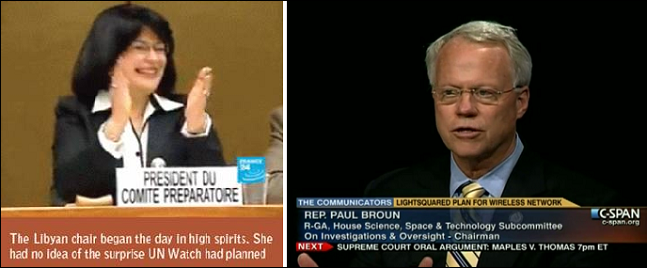
Lest we forget, Muammar Gaddafi‘s Libya, in the person of Ms. Najat Al-Hajjaji (above, left), was elected to preside over the United Nations Commission on Human Rights in 2003:

The Commission on Human Rights — meeting this morning under a new procedure two months in advance of its annual six-week session — elected Najat Al-Hajjaji of the Libyan Arab Jamahiriya as Chairperson for 2003, along with three Vice-Chairpersons and a Rapporteur.

And as recently as May 2010, still under Col. Gaddafi’s rule, Libya was elected a member of the UN Human Rights Council, and only suspended in February 2011.

Might we call this an instance of a Person / Position Paradox?

**

You know I like what I term “forms” as analytic tools — this would be another one to keep an eye out for, a particularly intriguing sub-type of the self-referential paradoxes I discussed in an earlier post.

It isn’t, of course, an analytical breakthrough for me to recognize the paradox inherent in a brutal dictatorship gaining the chair of the international Human Rights Commission at this late date: the United States protested Libya’s nomination at the time, which is why there had to be a secret ballot in the first place.

Let’s look at some of the accompanying language. Here’s Ms. Al-Hajjaji herself:

In an address following the ballot, Ms. Al-Hajjaji said among other things that the Commission must send a message that it would deal with human rights in all countries, and not just some of them; that it would take into account in its activities the world’s many different religious, cultural and historical backgrounds; and that among its tasks was to affirm the universality, indivisibility, and complementarity of human rights

Who could complain about that? And here’s the UN High Commissioner, praising the system that got her elected for its wisdom:

High Commissioner for Human Rights Sergio Vieira de Mello, also speaking briefly, reviewed his recent mission to the Democratic Republic of the Congo and to Angola, lauded the Commission’s new procedure for early election of a Bureau, and said it was important for the Commission to demonstrate that it could manage with wisdom, speed and restraint its procedural business so as to create the best possible spirit and conditions for addressing and resolving the many substantive issues on its agenda.

The lesson I learn here?

Paradoxes of this kind lead to a divergence of words from truths — in line with de la Rochefoucauld‘s maxim:

Hypocrisy is the homage vice pays to virtue.

**

Now comes the potentially contentious part.

Rep. Paul Broun MD (R-GA) (top, right), member of the US House Committee on Science, Space and Technology and chairman of the US House Science Subcommittee on Investigations and Oversight, told the Liberty Baptist Church of Hartwell, Georgia’s Sportsman’s Banquet last month:

God’s word is true. I’ve come to understand that. All that stuff I was taught about evolution and embryology and the Big Bang Theory, all that is lies straight from the pit of Hell. And it’s lies to try to keep me and all the folks who were taught that from understanding that they need a savior. You see, there are a lot of scientific data that I’ve found out as a scientist that actually show that this is really a young Earth. I don’t believe that the Earth’s but about 9,000 years old. I believe it was created in six days as we know them. That’s what the Bible says.

As a student of religions, I don’t find that statement particularly surprising: while the original 1611 edition of the King James Version of the Bible doesn’t include Archbishop Ussher‘s dating of the creation to 4004 BC, many versions of the KJV since 1701 have done so, the wildly popular “dispensationalist” Scofield Reference Bible, first published in 1909, does so… and Broun is being somewhat generous in allowing for the passage of 9,000 years since creation, where others might see the earth as entering the seventh (Sabbath) day (or millennium) about now…

As a religious belief, then, this is one of many attempts to fit chronology to scripture. I recall from my days studying the religious impact of millennial rollover (“Y2K”) concerns that one Rabbi Pinchas Winston claimed the year 2,000 (5760 in the Jewish calendar) would be a year of purification:

The secret regarding this is that, at the end of the year 5760 from creation, the verse, ‘I [God] will remove the impure spirit from the land’ (Zechariah 13.2) will be fulfilled.

For my source and further millennial date issues in Islam, Hinduism etc, see my chapter, Y2KO to Y2OK in Cathy Gutierrez and Hillel Schwartz, eds., The End that Does: Art, Science and Millennial Accomplishment, Equinox, 2006.

Politics, though — and the politics of science and science funding at that? Here’s more of Rep. Broun’s talk, explaining how Broun’s theology affects his politics:

And what I’ve come to learn is that it’s the manufacturer’s handbook, is what I call it. It teaches us how to run our lives individually, how to run our families, how to run our churches. But it teaches us how to run all of public policy and everything in society. And that’s the reason as your congressman I hold the Holy Bible as being the major directions to me of how I vote in Washington, D.C., and I’ll continue to do that.

**

I’m afraid this reminds me all too clearly of RJ Rushdoony‘s Institutes of Biblical Law, which opens with the following words:

When Wyclif wrote of his English Bible that “This Bible is for the government of the people, by the people, and for the people,” his statement attracted no attention insofar as his emphasis on the centrality of Biblical law was concerned. That law should be God’s law was held by all…

Those are the opening words of Rushdoony’s Introduction to his magnum opus. And I know, I know, I’m cherry-picking from its 850-page first volume, but on p. 251 he writes:

The law here is humane and also unsentimental. It recognizes that some people are by nature slaves and will always be so. It both requires that they be dealt with in a godly manner and also that the slave recognize his position and accept it with grace.

Is this all just another version of “creeping” theocracy?

Compare John Hubbard, Arkansas State Rep, whose book Letters to the Editor: Confessions of a Frustrated Conservative (not on Amazon) apparently includes this choice morsel:

… the institution of slavery that the black race has long believed to be an abomination upon its people may actually have been a blessing in disguise …

**

Some possible parallels that may be worth pondering, coming at similar issues from a diversity of angles — hopefully with enough different implications to generate some questioning of easy assumptions:

Can a Catholic be POTUS (JFK, eg) without serving the every whim of a foreign Head of State? Can a Mormon be POTUS without serving the wishes of a living prophet, seer and revelator? Can a person who aspires to the highest post in a “government of the people, by the people, for the people” be relied upon if he says things like this?

There are 47 percent of the people who will vote for the president no matter what. All right, there are 47 percent who are with him, who are dependent upon government, who believe that they are victims, who believe that government has a responsibility to care for them, who believe that they are entitled to health care, to food, to housing, to you name it. … And so my job is not to worry about those people — I’ll never convince them that they should take personal responsibility and care for their lives.

And what if he then admits he was in error?

In this case, I said something that’s just completely wrong.

Is that hypocrisy (see above) — or humility? And come to that: in politics, is honesty a vice?

**

But I’m sliding from religion into politics here, unless you take the Gettysburg Address as one of the central documents — akin to a scripture — of American civil religion. Or remember it was the Bible translator John Wyclif who said those words about government of, by, and for the people first…

Religion, not politics, is my concern and my “beat” — but right now, the “Warfare of Science With Theology” (to quote the apt title of Andrew Dickson White’s celebrated 1895 book) is once again in full swing, so the question of whether Rep. Broun’s positions as a a member of the US House Committee on Science, Space and Technology and chairman of the US House Science Subcommittee on Investigations and Oversight, given his views on voting according to his reading of the Bible, is also an instance of the Person / Position Paradox?

**

It seems to me that questions such as these are of vital to many of us. The question is: are they vital to our democratic principles — or to our salvation?

Joseph Smith and Kabbalah: Neibaur, Owens, Hamblin, Haaretz, Idel

Friday, October 5th, 2012

[ by Charles Cameron — controversy and scholarship re Joseph Smith’s King Follett Discourse and Kabbalah of considerable interest to students of comparative religion ]
.

A scholarly Jospeh Smith translating the Bible, and the title page of Portae Lucis, Augsburg, 1516

.

With Latter-day Saints more than a little in the news, Ha’aretz yesterday posted an article titled How kabbala shaped Mormon faith which you can also read here, and as it’s a topic I’ve been interested in for a while, I thought I’d point you to the article Lance Owens, a friend of a friend, wrote some years back, in which he describes the library of Alexander Neibaur, a Jewish convert to Mormonism and friend and Hebrew teacher to the Prophet, along with quite a bit of context.

There are two forms of Owens’ article on line, the original, quite long one [parts 1, 2, 3] and a shorter version [4] for those who’d like the details but not the details of the details.

I have to say that I find Owens’ work on Neibaur’s library, and the conclusion he draws about Joseph’s King Follett Discourse – one of the Prophet’s last sermons, and a fascinating work in its own right – pretty compelling.

**

The great magister of studies in Kabbalah Moshe Idel probably catches the situation well when he writes in his as yet untranslated book, The Angelic World: Apotheosis and Theophany (Olam Ha’malakhim):

See for now the controversial article by Owens, Joseph Smith and Kabbalah, pg. 117-194, which also contains a list of Kabbalistic sources which supposedly were in the library of Joseph Smith’s teacher. The connection between Enoch-Metatron in Jewish tradition and Mormonism was first noted by Harold Bloom, in his book The American Religion, pg. 99, 105. I can’t go into the details of the controversies created by Owens’ article and the doubts about Smith’s relationship to the Kabbalah. It seems that the matter of kabbalistic connections is more complicated and interesting than what can be learned from the currently published documents. (Pg. 156)

**

For a Mormon response to Owens’ article, and pending the comments our Mormon and other interested readers will hopefully provide, might I suggest William Hamblin‘s review of Owens’ piece, which indicates how seriously Hamblin takes the issues involved when it opens with these two sentences:

The Mormon History Association recently awarded Lance S. Owens’s “Joseph Smith and Kabbalah: The Occult Connection” its Best Article Award for 1995. With such an imprimatur the article deserves a closer critical evaluation than it has apparently heretofore received.

Hamblin’s review runs to 74 pages and 186 footnotes – together with Owens’ original 77 pages and 161 footnotes, that would make a book-sized volume of interesting reading. And as Moshe Idel notes, what we don’t know may be “more complicated and interesting” yet…

Of the importance of form in intelligence: I

Wednesday, October 3rd, 2012

[ by Charles Cameron — form as pattern recognition, the form of suicide / martyrdom ops, a format for analysts, first in a series on form in intelligence, and maybe the beginnings of an eccentric thinking manual for analysts ]
.

Bear with me for a paragraph or two, while I try to sort something out.

Form is to content as algebra is to arithmetic: does that work for you? Form is one degree more abstract than content: how about that? I don’t think either of these expressions quite captures what I want to say about form and content, but they may help us think about form. Here’s a form:

It’s pretty clearly a diagram of connections of some sort, but exactly what those connections are is unclear as long as the various boxes in the diagram remain empty.

I could fill it with the names of members of a hippie commune that practiced a flexxible approach to free love over a decade or two, from when the founder bought the farm (in the literal sense of real estate) to the point where the last surviving member bought the farm (metaphorically speaking — the farm in the sky).

Or with the names of elements in the human digestive and energetic system…

I mention the latter, because I came across this particular (empty) diagram on a blog post by a certain Jacques Chester about how people get fat, where it was preceded by the words:

A better diagram for bodyweight control will resemble a great big mess

I won’t tell you where I got the other idea from, if you want to know you’ll just have to fantasize, as I did.

**

At least in this case, form means pattern. The diagram above is a pattern, fill it with appropriate verbal or other content and you’ll give it meaning — which can then be disputed or accepted. But the form, the patterning, is somehow antecedent to any particular content.

Take the last words of each line of Shakespeare‘s Sonnet XCVII and you’ll get:

been, year, seen, everywhere, time, increase, prime, decease, me, fruit, thee, mute, cheer, near.

The rhyme scheme is pretty clear: ABAB CDCD EFEF GG.

That’s a form, and all of Shakespeare’s sonnets follow it. Petrarch‘s sonnets by contrast follow the rhyme scheme ABBA ABBA CDECDE.

**

In my practice of thinking, as a poet and as a practitioner of the open source analysis of scriptural sanctions for religious violence, I find the recognition of forms — pattern recognition — to be my central process.

I think what first really brought this home to me was the similarity of form between two reports of terrorist training activities — each in its own way illustrating the idea that the activity to be performed will begin quite naturally on earth, where training is required, but end quite supernaturally in paradise, where it isn’t:

That one’s pretty obvious, right? I mean, if you’ve seen the first instance you would be pretty likely to remember it if you ran across the second…

And what the form means is pretty clear too — martyrdom ops, suicide ops.

But what if you had a note-pad on your desk — or better, a game format on your computer — that gave you those two boxes, free of specific data, and any time you found a weird or anomalous data-point or image you could scribble it or drag-n-drop it into that form, give it a name for easy retrieval, and keep your eyes peeled for parallels, opposites, similars?

I call that format SPECS, by the way, because it allows you to see two similar ideas stereoscopically, so to speak, and thus gain an extra dimension — neat trick, eh?

What if collecting SPECS was part of your training as an analyst, and you practiced the form a few hundred times and kept 150 mind-blowing examples — as Shakespeare did with his ABAB CDCD EFEF GG sonnets?

**

Why, you’d be training yourself in pattern recognition — formal thinking — horizontal thinking — lateral thinking — analogy — thinking by leaps and bounds.

Inteligence happens in the Intelligence Community, and in the human population as well. I can’t speak to the ways in which animal and plant mimicry, or the artistry of birdsong, correspond to pattern recognition, although that would be a fascinating topic for another post.

What I can say is that analogical, horizontal, cross-disciplinary thinking is in its own away more powerful than logical, rational, vertical, silo-bound thinking.

**

In terms of Intelligence and intelligence, the strategies of linear / vertical thinking are like your fingers: it’s your skill at lateral / horizontal thinking that gives your mind an opposable thumb.

Let not thy left hand know what thy right hand doeth

Tuesday, October 2nd, 2012

[ by Charles Cameron — this post is about comparisons — what you make of them, and what they make of you, death calculus, and Handel ]
.


.

Scraped from my morning read, these two quotes — a tweeted headline from Breitbart and a gobbit of the Jerusalem Post — neatly illustrate a paradox I’ve been wrestling with, the way more profound souls wrestle with angels [link is to Rilke].

It’s the paradox of comparison.

**

On the one hand, I can barely imagine what it would be like to build — with, say, enough funds for a latter-day Manhattan Project — a Department whose job it was to monitor all activities and ensure even-handedness in the allocation of resources.

So that not ever would a Presidential aide on vacation receive a security detail until each and every ambassador had an equivalent force of marines around them at any given moment, in embassy or out.

I mean, what about consuls, or CIA heads of station — are they ambassadorial enough? Members of the cabinet on vacation? Members of the National Security Council? How far do we need to go with our even-handedness? Is Benghazi different from London? Londonistan?

How would one possibly assure oneself that no “hand” of government, left, right, center, upper, lower, or oblique to all of the above, ever arranged things in a way that compared foolishly with the way some other “hand” of government had arranged something more or less similar?

**

Let’s go to what my friend Bryan Alexander calls the death calculus. Since we’re interested in terrorism here, I’ll pull quotes from a couple of pieces that you can read in full if this topic interests you. Two paras from TomDispatch:

In 2008, 14,180 Americans were murdered, according to the FBI. In that year, there were 34,017 fatal vehicle crashes in the U.S. and, so the U.S. Fire Administration tells us, 3,320 deaths by fire. More than 11,000 Americans died of the swine flu between April and mid-December 2009, according to the Centers for Disease Control and Prevention; on average, a staggering 443,600 Americans die yearly of illnesses related to tobacco use, reports the American Cancer Society;5,000 Americans die annually from food-borne diseases; an estimated 1,760children died from abuse or neglect in 2007; and the next year, 560 Americans died of weather-related conditions, according to the National Weather Service, including 126 from tornadoes, 67 from rip tides, 58 from flash floods, 27 from lightning, 27 from avalanches, and 1 from a dust devil.

and:

The now-infamous Northwest Airlines Flight 253, carrying Umar Farouk Abdulmutallab and his bomb-laden underwear toward Detroit on Christmas Day 2009, had 290 passengers and crew, all of whom survived. Had the inept Abdulmutallab actually succeeded, the death toll would not have equaled the 324 traffic fatalities in Nevada in 2008; while the destruction of four Flight 253s from terrorism would not have equaled New York State’s 2008 traffic death toll of1,231, 341 of whom, or 51 more than those on Flight 253, were classified as “alcohol-impaired fatalities.”

Two paras from a Salon piece [copied here sans links and emphases]:

“The number of people worldwide who are killed by Muslim-type terrorists, Al Qaeda wannabes, is maybe a few hundred outside of war zones. It’s basically the same number of people who die drowning in the bathtub each year,” said John Mueller, an Ohio State University professor who has written extensively about the balance between threat and expenditures in fighting terrorism.

Last year, McClatchy characterized this threat in similar terms: “undoubtedly more American citizens died overseas from traffic accidents or intestinal illnesses than from terrorism.” The March, 2011, Harper’s Index expressed the point this way: “Number of American civilians who died worldwide in terrorist attacks last year: 8 — Minimum number who died after being struck by lightning: 29.” That’s the threat in the name of which a vast domestic Security State is constructed, wars and other attacks are and continue to be launched, and trillions of dollars are transferred to the private security and defense contracting industry at exactly the time that Americans — even as they face massive wealth inequality — are told that they must sacrifice basic economic security because of budgetary constraints.

**

My points?

On the one hand, that the world is far too complex to avoid disparities that can draw mockery down on the heads of those one might wish to mock.

And on the other, that comparisons also have an invaluable role to play in giving us a sense of the relative peaks and valleys of the terrain we live in — and may be literally or metaphorically mountaintop removal / valley fill coal mining in preparation for our children’s children…

**

Here’s a “DoubleQuote” for you:

Or for the musically inclined:

Now there’s a fascinating comparison (between the mining and the music) that doesn’t tell you much. Or does it?

**

Onwards to the issue of that sacred plateau in Jerusalem, featured as my second “reading for the day” at the top of this post.

It appears that you can be arrested for carrying a concealed knife on the Noble Sanctuary — or tallit or tefillin on Temple Mount — same place, different perspective.

That’s the sort of comparison that makes me catch my breath with wonder.

As the Famous Thinkers School might ask, giving you a pencil and a blank sheet of paper: can you draw this conclusion?

**

The full text of Matthew 6.3 reads in the KJV:

But when thou doest alms, let not thy left hand know what thy right hand doeth:

Marangolo P and associates uses a significant variant of that verse in the title of a learned paper: Let not thy left hand know what thy right hand knoweth. The case of a patient with an infarct involving the callosal pathways.

Brain malfunctions (and brain surgeries) can provide windows of considerable interest on our human condition, as the writings of Oliver Sacks so eloquently demonstrate.

Waco in Pakistan

Monday, September 24th, 2012

[ by Charles Cameron — on the way not listening sometimes leads to trouble, the importance of ultimate concerns, and a remarkable remark by M. Morsi ]
.

It’s happening again, this time in Pakistan.

Nicholas Kristof‘s NYR op-ed a day or two ago, Exploiting the Prophet, included one particularly interesting little quote that set me thinking – and my friend Bryan Alexander noted it too. Kristof was talking about how people in Muslim countries with little or no tradition of free speech sometimes “have an addled view of how the United States handles blasphemy” and commented, almost as an aside:

A Pakistani imam, Abdul Wahid Qasmi, once told me that President Bill Clinton burned to death scores of Americans for criticizing Jesus. If America can execute blasphemers, he said, why can’t Pakistan?

I challenged him, and he plucked an Urdu-language book off his shelf, thumbed through it, and began reading triumphantly about the 1993 raid on David Koresh’s cult in Waco, Tex.

That’s absurd, preposterous. Perfectly understandable. And dangerous.

**

Here’s a description of how Americans listened to al-Qaida, drawn from Benjamin and Simon’s book, The Age of Sacred Terror, p. 159:

So much of what was heard from al-Qaeda after the attacks sounded to Americans like gibberish that many chords of the apocalypse were missed.

According, that is, to two senior members of President Clinton‘s National Security Council charged with counterterrorism, jihadist “chords of the apocalypse” were missed because they sounded like “gibberish”.

When I read that, I couldn’t help but recall the label given by FBI field agents to attempts by David Koresh to engage them in a discussion of the Book of Revelation, which for him was a roadmap of the very events he was living through — the FBI’s siege of Mount Carmel in Waco, TX.

Here’s a quote from the abstract of Robert Agne and Karen Tracy‘s analysis, ‘Bible Babble’: Naming the Interactional Trouble at Waco, published in Discourse Studies (v 3 # 3, 269-294):

A frustrating yet persistent aspect for the FBI negotiators was the Davidians’ talk about the Bible and their religious beliefs, what agents dismissively described as ‘Bible babble’.

So:

Does it matter if one group of people persists in misunderstanding the religious positions of another in high-tension disputes?

In the case of Waco, it may indeed have contributed to the tragic outcome.

In this study, we analyze several exchanges between Koresh and one of the FBI agents. The analysis shows how the FBI’s identifying their problem as ‘Bible babble’ contributed to the negotiation failure.

**

There are other parallels that can be drawn between the Branch Davidians and their worldview, and al-Qaida and theirs — parallels that may have significance wherever there is a clash in which the “irrational” religious discourse of an (often apocalyptically inclined) “other” is easily brushed off by our own “more rational” mindset.

According to conflict resolution scholar Jayne Seminaire Docherty, writing in Learning Lessons from Waco (p. 99):

During the Waco negotiations, the Mount Carmel residents invited the FBI negotiators to choose God’s law over man’s law.

Compare al-Qaida, as seen in two excerpts from Michael Scheuer‘s Al-Qaeda’s Completed Warning Cycle – Ready to attack? published by the Jamestown Foundation in Terrorism Focus (v 2 #5, 2005):

After 9/11, bin Laden received sharp criticisms from Islamist scholars that dealt with the al-Qaeda chief’s failure to satisfy several religious requirements pertinent to waging war. The critique focused on three items: (1) insufficient warning; (2) failure to offer Americans a chance to convert to Islam; and (3) inadequate religious authorization to kill so many people. Bin Laden accepted these criticisms and in mid-2002 began a series of speeches and actions to remedy the shortcomings and satisfy his Islamist critics before again attacking in the United States.

Parallel to the warnings, bin Laden on two occasions since 2002 asked Americans to convert to Islam as the means of terminating the war al-Qaeda is waging against the United States. “We call you to Islam,” bin Laden said on both occasions, addressing himself to President Bush – as the leader of the American people – and asking him to lead his countrymen to Islam. He also offered to serve as guide and teacher for the American people, urging them to “follow the right path” to Islam. “I am an honest adviser to you.” bin Laden concluded, “I urge you to seek the joy of life and the after life…. I urge you to become Muslims….” (Al-Jazeera 6 Oct 02; Waaqiah.com, 26 Oct 02)

**

The Davidian invitation to the FBI interlocutors to talk Revelation — like the AQ invitation to President Bush and all America to convert to Islam — may seem a foredoomed invitation, but it’s one that at the very least situates one side of the conflict in the territory of “ultimate concerns”. Thus Docherty continues:

The negotiators resisted these invitations as situationally inappropriate conversion efforts. The Branch Davidians, they said, were disrupting the “real” negotiations with their proselytizing. However, for the Mount Carmel residents, proselytizing was the truly important business at hand. With the Second Coming looming on the horizon, all else was trivial by comparison, even the task of peacefully resolving the barricade standoff.

What is ultimate and what is, strictly by comparison, trivial?

One of the most significant answers to that question was given by Muhammad Morsi when he said recently:

To God, the attack on a person to Allah is bigger an attack on the Kaaba.

I still have a post or two in me concerning the ugly video clip and the far uglier riots it triggered, and in one of them I’d like to explore that remarkable remark of Morsi’s — deploring the killing of Ambassador Stevens — and supporting texts from the Qur’an, hadith and the writings of the late Egyptian cleric Sheikh Ghazali.


Switch to our mobile site