zenpundit.com » scriptures

Archive for the ‘scriptures’ Category

Going five rounds and then some with those Egyptian Crucifixions…

Sunday, September 2nd, 2012

[ by Charles Cameron — news, debate, credibility, Muslim brotherhood, Egypt, Ansar al-Shariah, Yemen, capital punishment, scriptures, USA, progress? ]
.

There’s plenty of food for thought here — quite a Smörgåsbord in fact — with rumor outstripping fact, images and facts too grisly for the squeamish, biases and bias-confirmation, subtlety in the details, scriptural sanctions and shifts in emphasis, capital punishment… and human progress, to paraphrase William Gibson, more or less evenly distributed.

Round One:

.
On the 17th of August, Michael Carl wrote a piece, Arab Spring run amok: ‘Brotherhood’ starts Crucifixions in WorldNetDaily:

The Arab Spring takeover of Egypt by the Muslim Brotherhood has run amok, with reports from several different media agencies that the radical Muslims have begun crucifying opponents of newly installed President Mohammed Morsi.

Middle East media confirm that during a recent rampage, Muslim Brotherhood operatives “crucified those opposing Egyptian President Muhammad Morsi naked on trees in front of the presidential palace while abusing others.”

The run amok is stated as fact, the crucifixions are described in terms of reports.

Also worth noting:

Carl quoted in his support Raymond Ibrahim — a Fellow with the Middle East Forum and the Investigative Project on Terrorism — in support. It is worth noting that Ibrahim, who authored The Al Qaeda Reader — a book I admire for its pointed insistance of the religious current in AQ documents — is himself an American of Egyptian Coptic Christian parentage, whose views of the Brotherhood can be gleaned from a recent post of his titled Egypt: Islamists vs. Copts — An Animosity That Seeks Any Excuse to Attack

Round Two:

.
On the 22nd, Jonathan Kay responded to Carl’s piece in the [Candadian] National Post, Egypt’s “crucifixion” hoax becomes an instant Internet myth:

Have you heard the one about how Christians are being nailed up on crucifixes and left to die in front of the Egyptian presidential place?

It’s a story worth dissecting — not because it’s true (it isn’t), but because it is a textbook example of how the Internet, once thought to be the perfect medium of truth-seeking, has been co-opted by culture warriors as a weapon to fire up the naïve masses with lies and urban legends.

Kay then offered his somewhat nuanced critique:

It is, of course, theoretically possible that Muslim radicals truly have “crucified” someone, somewhere, sometime, in Egypt. Islamist mobs have staged countless murderous attacks on Copt “infidels” in recent years — and a crucifixion would hardly be a more barbarous tactic than truck bombs and beheadings.

But the story doesn’t just allege that a crucifixion has taken place somewhere in Egypt: It alleges that multiple crucifixions have taken place in front of the presidential palace. That would be the equivalent of, say, mass lynchings taking place in front of the White House, or a giant gang rape taking place in front of Ottawa’s Centennial Flame fountain.

Kay then goes into some detail about his attempts to find a single photograph — or an eyewitness account — of a crucifixion outside Egypt’s Presidential Palace, and his inability to find either one, coupled with his research into the murky origins of the story…

His overall sense of things?

Why do so many people believe this made up story? For the same reason that people believe all urban legends — because they play to some deeply held narrative that resides in our deepest fears. In this case, the narrative is that the Arab Spring is part of an orchestrated Islamist plot to destroy Western civilization (beginning with Israel).

Round Three:

.
Carl quickly responded with Video Report confirms Egyptian Crucificions.

The problem here: Kay had written “That’s because there is no Sky report on the subject” — he had, he write that, and Carl quoted him, pointing out that Sky had in fact carried a report, as if that dismissed Kay’s point. What Carl didn’t quote was the following paragraphs, in which Kay said:

Yesterday I contacted the management of Sky News Arabic, and asked them about the crucifixions. According to Fares Ghneim, a Sky communications official, the crucifixion claim “began on social media. It started getting pick-up from there and eventually reached us.”

“Our reporters came across reports of the alleged crucifixions and a story very briefly appeared on the Sky News Arabia website,” he added. “The story — which was taken down within minutes — was based on third-party reports and I am not aware that any of our reporters said or confirmed anything along the lines of what is quoted…

So: Kay somewhat foolishly overstated his case with his summary “there is no Sky report” but made it immediately clear that there was in fact a report, “taken down within minutes”. Carl then quotes the inaccurate summary and shows it to be inaccurate, while ignoring the more detailed (and accurate) version.

Round Four:

.
Jonathan Kay came back on the 24th with More on the debunked Egyptian ‘crucifixion’ hoax (and its 2009 precedent). He made the point I’ve just made above, and then mentioned a Carnegie Endowment report describing “an internet rumor circulated in late 2008 to the effect that Hamas was ‘celebrating’ Christmas by crucifying Gaza’s non-Muslims”:

And amazingly, it wasn’t just the conspiracy theorists at WND who got sucked into this one. According to Brown, it was featured in blogs connected to such respectable publications as The New Republic, National Review and Commentary. Even the Simon Wiesenthal Center was pushing the story.

Voices that agree with you are easier to hear (and believe) than voices that don’t.

Round Five:

.
Carl came back again with Shocking video evidence of Islamic Crucifixion on the 29th:

WND recently confirmed a Sky News Arabia report of the crucifixion of dissidents in Egypt.

According to a report by Lebanon Today translated into English, the Yemeni jihadist group Ansar al-Shariah took control of the Azzan area of Yemen and imposed Islamic law, or Shariah.

In the process, the group crucified three men, accusing them of being agents for the U.S. The executions reportedly took place several months ago.

See that?

We’ve been discussing crucifixions allegedly taking place right outside the Presidential Palace in Egypt, and although the headline here doesn’t specify Egypt, the Egypt story is again mentioned — at which point we switch from Egypt to Yemen, and from the Muslim Brotherhood to the AQAO-related Ansar al Shariah!

Funny thing, that.

And then some:

.
The Carnegie report:

Here’s another quick quote from the Carnegie Endowment’s piece to which Kay referred, Pointers for the Obama Administration in the Middle East: Avoiding Myths and Vain Hopes from January 2009:

Myth 4: Hamas decided to celebrate Christmas by crucifying people.

Didn’t hear this one?

It is an odd story and one that is not central to diplomatic efforts. But it can illustrate the treacheries of finding one’s way in the conflict.

Different versions of this story has spread around the world—propounded most recently by a member of the Australian Senate.

If you have not read about it, that is because of what you choose to read. If you rely on the New York Times, the story would be news to you. If you choose the Washington Post, you may remember it popping up in Charles Krauthammer’s column. It turned up at least twice in the Washington Times. In the UK, it was asserted by a columnist for the Times but by none in the Guardian. Aficionados of English-language Israeli press would have read it a couple times in the Jerusalem Post but never in Ha‘aretz. It was featured in blogs connected to the New Republic, the National Review, and Commentary, but not the Nation or Mother Jones. It was pushed by the Simon Wiesenthal Center but not pursued by other mainstream Jewish organizations.

Oh, and by the way — it’s not true.

So the credibility of various media is at issue here, eh?
.

WND:

As Kay observed in his first piece, WorldNetDaily does have a history of making dubious conspiracist claims, such as:

most of the medical (not socio-spiritual) blame for today’s rise in homosexuality must fall upon the rise in soy formula and other soy products

Medical authorities with a wide range of approaches have refuted this claim, from Dr Andrew Weil (“the premier resource for timely, trustworthy information on natural health and wellness“):

When you consider that millions of men in China, Japan and other Asian countries have had soy foods in their daily diets from earliest childhood, you can appreciate that the plant estrogens they contain have no discernible effect on male sexual development, and no feminizing effects at all.

to the National Center for Biotechnology Information at the National Institutes for Health, which hosts the Fertility and Sterility (2010 May 1; 93(7): 2095-104) article Soybean isoflavone exposure does not have feminizing effects on men: a critical examination of the clinical evidence.
.

Meanwhile in Yemen…

I usually like to have an intriguing graphic at the head of my posts, but the appropriate graphic for this one is striking enough that I thought it better to present it here, well into the body of the post. It comes from MEMRI TV:

It depicts that crucifixion in Yemen. And I’d say it represents a man who has been hung on a cross to die in the excruciating heat, rather than someone crucified in the Roman manner. Either way, the death would be a horrible one — and such things happen.

It appears there was indeed a crucifixion — indeed, there may have been three — in Yemen.
.

Nota Bene:

But note well: this is not the Muslim Brotherhood, this is not Egypt, this is not anything happening directly in front of Morsi’s Presidential Palace. This is Yemen, and this is allegedly the work of Ansar al-Shariah.

Gregory Johnsen described the relationship between Al Qaeda in the Arabian Peninsula (AQAP) and Ansar al-Shariah a few months ago in this Frontline piece:

We know that Nasir al-Wuhayshi heads both AQAP and Ansar al-Sharia. We know that the different emirs for Ansar al-Sharia accept the bay‘a or oath of allegiance on behalf of Wuhayshi. And we know that members claimed by Ansar al-Sharia are also claimed by AQAP. … What we don’t know is whether everyone who self-identifies as Ansar al-Sharia would also identify as a member of AQAP.

Okay, the exact, appropriate use of the term Al-Qaeda and the relations of AQAP and Ansar are topic of discussion among scholars. But whether you think, Brotherhood, Al-Qaeda, they’re all the same, or Brotherhood, Al-Qaeda, so very different, likely depends on how much you know about the respective organizations and their history.

Here’s a fairly nuanced assessment from CFR:

Since 9/11, prominent members of the Brotherhood have renounced violence publicly and tried to distance themselves from al-Qaeda’s violent practices. The Brotherhood’s foray into electoral politics has also widened the schism between them and groups like al-Qaeda. Zawahiri had been openly critical of the Brotherhood’s participation in the 2005 parliamentary elections.

But like other mass social movements, Egypt’s Muslim Brotherhood is hardly a monolith; it comprises hardliners, reformers, and centrists, notes terrorism expert Lydia Khalil. And some hardline leaders have voiced support for al-Qaeda or use of violent jihad…

By way of religious context:

The Qur’an endorses crucifixion as a penalty at 5.33-4:T

Those who wage war against God and His Messenger and strive to spread corruption in the land should be punished by death, crucifixion, the amputation of an alternate hand and foot or banishment from the land: a disgrace for them in this world, and then a terrible punishment in the Hereafter, unless they repent before you overpower them: in that case bear in mind that God is forgiving and merciful.

Similarly, the Torah in Deuteronomy 21.18-21 endorses death by stoning for disobedient sons:

If a man have a stubborn and rebellious son, which will not obey the voice of his father, or the voice of his mother, and that, when they have chastened him, will not hearken unto them: Then shall his father and his mother lay hold on him, and bring him out unto the elders of his city, and unto the gate of his place; And they shall say unto the elders of his city, This our son is stubborn and rebellious, he will not obey our voice; he is a glutton, and a drunkard. And all the men of his city shall stone him with stones, that he die: so shalt thou put evil away from among you; and all Israel shall hear, and fear.

Jesus in the Gospel of John 8.7 comments on the punishment by stoning of an adulteress with a clever rabbinic shift of emphasis — not denying earlier scripture (Deuteronomy 17.7) which called for the first stone to be cast by a witness, but rendering the punishment itself effectively impossible to carry out:

He that is without sin among you, let him first cast a stone at her.

Finally:

From stoning, crucifixion and beheading, we the human race have by and large progressed in our use of capital punishment to such more recent devices as the guillotine, gas chamber, electric chair, and lethal injection.

Someone named Starling Carlton was executed in South Carolina in 1859 for aiding a runaway slave.

According to the Innocence Project:

Seventeen people have been proven innocent and exonerated by DNA testing in the United States after serving time on death row.

And so the wheel turns.

Twinned tweets: al Shabaab

Sunday, August 19th, 2012

[ by Charles Cameron — zeal ]
.

Zeal.

Pew II: Prevalence of belief in the Jinn

Monday, August 13th, 2012

[ by Charles Cameron — Corbin on Queen Bilqis, Qur’an and hadith regarding jinn, Pew statistics on belief in jinn — with some earlier Natsec implications & a non-serious suggestion from contemporary physics ]
.

La Jinn the Mystical Genie of the Lamp
from the Yu-Gi-Oh card game

.

I’ve been “fond” of the jinn (djenoun) since first encountering them in the brilliant short stories of Paul Bowles, and notably his A Hundred Camels in the Courtyard.

But that’s a literary fondness, neither science nor belief-based on my part. In my view, that’s only right and proper, since djenoun belong in the realm of imagination — or better said, the Imaginal, as Henry Corbin terms it — see note 16, p, 326. of his Creative Imagination in the Sufism of Ibn ‘Arabi, where he speaks of the Sheikh’s Bilqis Queen of Saba in his poetry as a being “born from a jinn and a woman” — it’s a fascinating passage, connecting Bilqis with Jesus in terms of the (unorthodox) angelology that Corbin envisioned uniting the Abrahamic faiths at a visionary level.

**

Here are two of the mentions of jinn in the Qur’an:

And the Jinn race We had created before from the fire of a scorching wind. [Sura 15, 27]

Say: It has been revealed to me that a company of Jinns listened (to the Qur’an). They say ‘We have really heard a wonderful Recital! It gives guidance to the Right and we have believed therein: We shall not join (in worship) any (gods) with our Lord. And exalted is the Majesty of our Lord: He has taken neither a wife nor a son.’ [Sura 72, 1-3]

And here is a tale of the Prophet and a jinn, as narrated by the Companion Malik ibn Anas:

The Prophet said to the jinni: “This is the stride of a jinni, as well as the tone of his voice!” The jinni replied: “My name is Hamah ibn Laqqis ibn Iblis.” The Prophet said: “Only two generations seperate you from him [Iblis].” He replied: “True.” The Prophet asked: “How long have you lived?” The jinni replied: “Almost all of time. I was a small boy when Abel was killed. I believed in Noah and repented at his hands after I stubbornly refused to submit to his call, until he wept and wept. I am indeed a repentant — God keep me from being among the ignorant! I met the prophet Hud and believed in his call. I met Abraham, and I was with him when he was thrown in the fire. I was with Joseph, too, when his brothers hurled him into the well—I preceded him to its bottom. I met the prophet Shu’ayb, and Moses and Jesus the son of Mary, who told me: ‘If you meet Muhammad, tell him Jesus salutes thee!’ Now I’ve delivered his message to you, and I believe in you.” The Prophet said: “What is your desire, 0 Hamah?” He said: “Moses taught me the Torah, Jesus the Gospels, can you teach me the Qur’an?” So the Prophet taught him the Qur’an.

The Tasneem Project

**

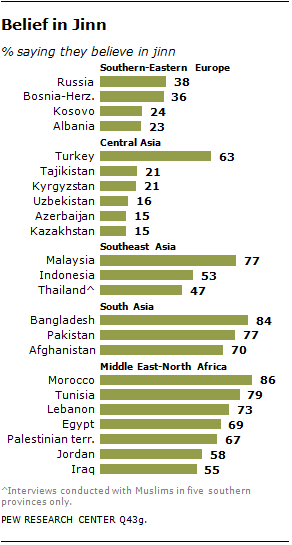
Literal vs metaphorical, let alone imaginal belief is not something the interviewers who conducted the Pew poll had the leisure to distinguish — but for the record, here are their findings as to the Muslim belief in jinns:

According to the Quran, God created jinn as well as angels and humans. Belief in jinn is relatively widespread – in 13 of 23 countries where the question was asked, more than half of Muslims believe in these supernatural beings.

In the South Asian countries surveyed, at least seven-in-ten Muslims affirm that jinn exist, including 84% in Bangladesh. In Southeast Asia, a similar proportion of Malaysian Muslims (77%) believe in jinn, while fewer in Indonesia (53%) and Thailand (47%) share this belief.

Across the Middle Eastern and North African nations surveyed, belief in jinn ranges from 86% in Morocco to 55% in Iraq.

Overall, Muslims in Central Asia and across Southern and Eastern Europe (Russia and the Balkans) are least likely to say that jinn are real. In Central Asia, Turkey is the only country where a majority (63%) of Muslims believe in jinn. Elsewhere in Central Asia, about a fifth or fewer Muslims accept the existence of jinn. In Southern and Eastern Europe, fewer than four-in-ten in any country surveyed believe in these supernatural beings.

In general, Muslims who pray several times a day are more likely to believe in jinn. For example, in Russia, 62% of those who pray more than once a day say that jinn exist, compared with 24% of those who pray less often. A similar gap also appears in Lebanon (+25 percentage points), Malaysia (+24) and Afghanistan (+21).

The survey also asked if respondents had ever seen jinn. In 21 of the 23 countries where the question was asked, fewer than one-in-ten report having seen jinn, while the proportion is 12% in Bangladesh and 10% in Lebanon.

**

Two markers concerning National Security concerns regarding Pakistan, nuclear weapons and those who believe (literally, energetically) in jinns — from the early 2000s, but dating back by implication to the era of Zia ul-Haq:

Just after the September 2001 terrorist attacks in the U.S., Pakistan’s intelligence service detained two retired nuclear scientists who had met with senior members of al Qaeda, including Mr. bin Laden, during charity work in Afghanistan. One, Sultan Bashiruddin Mahmood, was a former director at the Pakistan Atomic Energy Commission and a controversial Islamic scholar who had postulated that energy could be harnessed from fiery spirits called djinns.

WSJ, Inside Pakistan’s Drive To Guard Its A-Bombs

But as a subscriber to a brand of what is known to practitioners as “Islamic science,” which holds that the Koran is a fount of scientific knowledge, Mr. Bashiruddin Mahmood has published papers concerning djinni, which are described in the Koran as beings made of fire. He has proposed that these entities could be tapped to solve the energy crisis, and he has written on how to understand the mechanics of life after death.

NY Times, Pakistani Atomic Expert, Arrested Last Week, Had Strong Pro-Taliban Views

— together with a Pakistani critique:

If a scientist is European or Hindu he will be restricted in his vision by reason. A Muslim scientist has unlimited scope; he will relate his science to miracles, mostly performed by himself. Sultan Bashiruddin, our top enrichment expert, believed he could draw electricity from a captured jinn. (For Pakistan’s needs just one jinn would suffice.)

Khaled Ahmed, Scientists, our kind

There are times when beliefs have, or might just have, consequences.

**

Jinn are significant not only for their own sakes, so to speak, but also for their etymological implications. To quote again from the Tasneem Project:

One saying of the Prophet (aws) mentions that, “God divided the jinn and the humans into ten parts. One part makes up the human race, and the other nine parts is made up of the jinn.” The invisible is everywhere. The Arabic language itself bears witness to how the invisible realm insinuates itself on everyday life. In Arabic, each time the two letters jeem and nun occur together, as in jinn, they convey the meaning of invisible or hidden. Thus, paradise is jannah because paradise is hidden from the human sight; janin is the foetus in the womb; the expression ajannahu al-layl means the night covered him.

The jinn, like paradise itself, are among the hidden secrets…

**

And how large is the universe, that it might encompass the angels and jinn? Hugh Everett III quite brilliantly argued for what has come to be known as the “many worlds” hypothesis in quantum measurement while still a grad student:

Hugh Everett III was a student in his mid-twenties in 1957 when he presented his revolutionary formulation of quantum mechanics in his PhD thesis. Everett himself called his theory variously; pure wave mechanics, the relative-state formulation of quantum mechanics, and the theory of the universal wave function. His theory, however, came to be popularly known as the many-worlds interpretation, because it predicts that everything that might happen, does in fact happen. As the physicist Bryce DeWitt later described it, Everett’s theory predicts that our universe is composed of countless parallel universes that are each constantly splitting into yet further copies, and in the process, creating copies of each observer, each of which subsequently observes a different quantum universe and splits into further copies.

While a science fiction fan might embrace such a theory simply by dint of how cool it would be if something like that were true, one might naturally wonder what good scientific reason one might have for believing that our universe is in fact composed of countless parallel splitting universes.

**

The whole article from which that quote was taken, The Quantum Measurement Problem and the Everett Interpretation, is indeed worth reading. But whereas physicists and (most) science fiction writers might confine their “many worlds” to physical, “materialist” universes, students of the imaginal are under no such restriction, as the same Tasneem Project article suggests:

The Muslim universe has always been made up of multiple worlds – the Qur’an itself refers to “universes” in the plural, in its open chapter al-fatihah. According to prophetic tradition, the cosmos consists of 18000 universes. …

So the jinn when summoned might come — somewhat unexpectedly — from one of Everett’s more hidden “many worlds”, perhaps?

Pew on the prevalence of Mahdism — take heed!

Sunday, August 12th, 2012

[ by Charles “told you so” Cameron — Pew figures for Mahdist expectation, also the Second Coming, Israel, and the potential influence of apocalyptic ideation on foreign policy ]
.

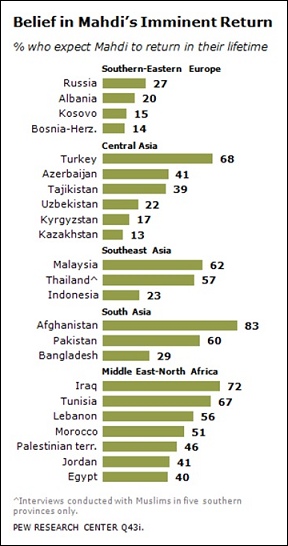
The World’s Muslims: Unity and Diversity, p. 65

.

I am Qualit, not Quant by nature, really much more interested in the workings of the imagination that in the aggregates of poll responses, so it’s a bit like pulling teeth for me to report on a Pew report — but in this case I can legitimately say “I told you so”, which massively outweighs the reluctance I might otherwise feel…

**

Recently, Pew has been including questions about the expectation of the Mahdi in some of its reports, and even Tim Furnish — who wrote the book on Mahdist movements and has long been saying we neglect them at our peril — even Tim was surprised at how widespread Mahdist expectation is, as reported in their just released The World’s Muslims: Unity and Diversity. In a post aptly titled Don’t Leave a Live (or Occulted) Mahdi Out of Your Calculations, Tim says the report contains “The most notable — indeed, strikingly important — news” in the form of “fascinating — and disturbing — data on belief in the Mahdi’s imminent (in one’s lifetime) return.”

See graphic above.

I recommend you read Tim’s analysis for the full range of his points — I won’t, for instance, be touching on what he says about Turkey — here I am going to select a couple of his key issues, and make just a point or two of my own.

**

Furnish:

Of the 23 countries whose Muslim citizens were polled, nine have majorities which expect the Mahdi in their lifetimes, with the overall average percentage at 41.8% … it is safe to extrapolate this percentage to Islam as a whole; ergo, 42% of 1.6 billion = 672 million Muslims who believe in the Mahdi’s imminent return! This is FAR greater than I had supposed.

Furnish also notes that Iran, the world’s most intensely Shi’ite nation and the one whose President has been speaking openly of Mahdist expectation, is not even included among the 23 countries Pew sampled.

Simply put, we have been blind to a very real phenomenon, and now we have a statistical alarm call to wake us up.

More subtly: there’s a difference between answering yes to the question “do you expect the Coming of X in your lifetime” and being on the edge of your seat, viewing every week as threshhold. Damian Thompson is very good on this in his book, Waiting for the Antichrist, and Stephen O’Leary in Arguing the Apocalypse suggests there’s an optimal “arousal” period — if you believe the Coming is too far away, you won’t be motivated to prepare for it quite yet, and if it’s too close it may be too late for you to do much to spread the word…

So, Pew — next time, ask a question with the opinions “in the next five to ten years” and “in my lifetime” — okay? The distinction is important, and a shift towards the shorter time-span would be highly significant.

**

Furnish again:

Despite the conventional wisdom (repeated even by Pew, in the face of their own data) that Mahdism is primarily the province of Shi`is, note that three of the four countries with the highest percentage expecting the Mahdi are majority-Sunni ones: Afghanistan (83%), Turkey (68%) and Tunisia (67%). This has ramifications, respectively, for: US policy in a country we are currently occupying; the only NATO Muslim-majority nation; and the vanguard state of the “Arab Spring.”

In his Conclusions, Furnish says:

The usual State/Defense departments’ “rational actor” approach to international relations might be quite simply irrelevant, if almost half the world’s Muslims expect the imminent return of their eschatological deliverer.

So there you have it. I discussed the “rational actor” versus Scott Atran‘s “devoted actor” in a recent post. And yes indeed, there are “ramifications for U.S. policy”…

Notably with regard to Afghanistan …

**

Here’s Furnish again:

Afghanistan is so rife with Islamic messianism because the 80% of the population that is Sunni and the 20% that is Shi`i (albeit Sevener/Isma’ili, as well as Twelver) both are in the middle of a war and occupation by a “Christian” power — which tends to ratchet up such expectations …

And again, in his Conclusions:

Afghanistan is a lost cause: over eight in ten of its people expect the Mahdi in their lifetime, and no amount of roads and clinics and girls’ schools built by the infidels will change that.

I don’t want to argue that second point in detail, although I think there’s a great deal more to life that Mahdist expectation for many who would answer “yes” to Pew’s question about expecting the Mahdi in one’s lifetime — see my comment on Damian’s book above. But how can I put it? A background Mahdist expectation can become a passionate involvement in a Mahdist movement if the right trigger comes along.

But what I find most striking here is that Afghanistan should be the country with the strongest Mahdist current out of all those Pew selected. And I’m struck not because Afghanistan has been a battlefield for so much of recent history — indeed, for so much of its history, period. I am struck because, in Al-Qaida’s recruitment narrative, supported by a number of ahadith, Afghanistan as Khorasan is the very locus from which the Mahdi’s victorious army will sweep out to conquer (finally) Jerusalem. And this too I have been posting about, eg in my discussions of Ali Soufan‘s The Black Banners and Syed Saleem Shahzad‘s Inside Al-Qaeda and the Taliban.

So the highest level of Mahdist expectation also happens to be found in an area with a potentially major role to play in an end times scenario…

**

There’s at least one earlier report in which Pew raised the question of Mahdist expectation — this time tied in with both the expectation of the Caliphate, and Christian hope of the Second Coming — their 2010 report Tolerance and Tension: Islam and Christianity in Sub-Saharan Africa.

Here, for instance, we learn:

Both Christians and Muslims believe they are living in a time that will undergo momentous religious events. For example, at least half of Christians in every country with large enough samples of Christians to analyze believe that Jesus will return to earth during their lifetime, including nearly seven-in-ten Christians in the Democratic Republic of the Congo (69%).

And at least half of Muslims in 10 of the 15 countries with large enough Muslim populations to analyze say they believe that the caliphate, the golden era of Islamic rule, will be re-established in their lifetime; this belief is most common among respondents in Mozambique (69%). And in 12 of these 15 countries, roughly six-in-ten or more Muslims believe in the return of the Mahdi, the guided one who will initiate the final period before the day of resurrection and judgment, though the survey did not ask respondents whether they expect this to occur during their lifetime.

And here is the relevant data on sub-Saharan Mahdist belief. In Q51 of this poll, Muslims were asked whether they believe “in the return of the Mahdi, the guided one who will initiate the final period before the Day of Resurrection and Judgment? Here’s the table of responses:

Given the “religious fault line” of mixed conflict and amicable coexistence between Christians and Muslims running across Africa from (so to speak) Nigeria to Somalia, with Boko Haram and Al-Shabaab among the less delightful participants, keeping an eye out for signs of Mahdist “semiotic arousal” would be important here, too.

**

And “semiotic arousal” — that reminds me. Richard Landes, who coined the term, has the definitive, encyclopedic book out about all the many forms of apocalyptic, and why they’re important: Heaven on Earth: The Varieties of the Millennial Experience Essential reading, if you ask me, on a hugely neglected and no less critically important subject.

**

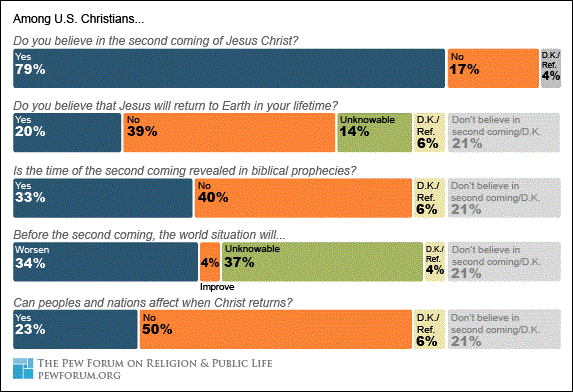
Finally, here’s yet another Pew graphic

— to be viewed in conjunction with this one, illustrating the ways in which belief in the Second Coming of Christ correlate with opinions about scriptures and the State of Israel:

**

Prophecy has impact, both on public opinion and on believing leaders. Jews with an expectation of the Messianic era, Christians expecting the soon Coming of Christ, and Muslims with Mahdist expectations each have their own apocalyptic scenarios, and in each case those scenarios exert some influence on policies relating to the Middle East and the Israeli-Palestinian situation in particular.

The bottom line?

Scriptural interpretation — and prophetic eschatology in particular — can no longer be assumed to be a quiet backwater topic for rabbinic students, seminarians and future mullahs to study, each in terms of their own tradition. It is now a series of conflicting drivers of current affairs — of war and peace.

Recommended Reading: dessert

Sunday, July 22nd, 2012

[ by Charles Cameron — of the Naked Breasts of Justice and the Verse of the Sword ]
.

Two more quick notes on the Gunpowder & Lead / Bernard Finel discussion:

The first concerns similarities between a figure — not in this case, Rick Santorum — on the American Christian right and his Iranian counterparts:

These two instances — which if I recall correctly, were reported within a month of one another between Dec 2001 and Feb 2002 — can be used as indicators to illuminate both the similarity and the difference between religiously-influenced thinking as between two nations and two religions. The similarity — a common Puritanism, to give it a name — is immediately apparent: but the difference — that the Christian Ashcroft merely veils the statue, whereas the Iranians grind off the figure’s breasts — surely speaks to a deeper intensity on the part of the Iranian authorities.

**

My second point is by way of counterpoint to my discussion of RJ Rushdoony in Recommended Reading: salad.

A recent COMOPS paper, How Islamic Extremists Quote the Qur’an [.pdf], explores a substantial body of jihadist materials:

Islamist extremists make heavy use of the Qur’an (Islam’s most sacred text) in their strategic communication. This study analyzed the most frequently cited or quoted verses in the Center for Strategic Communication’s database of over 2,000 extremist texts. The texts date from the years 1998 to 2011, and originate primarily from the Middle East and North Africa. Taking this data as a starting point, we provide a qualitative analysis of the historical contexts and core narrative components of the cited passages.

and notes:

The most surprising is the near absence of the well-known “Verse of the Sword” (9:5) from the extremist texts. Widely regarded as the most militant or violent passage of the Qur’an, it is treated as a divine call for offensive warfare on a global scale. It is also regarded as a verse which supersedes over one hundred other verses of the Qur’an that counsel patience, tolerance, and forgiveness.

We conclude that verses extremists cite from the Qur’an do not suggest an aggressive offensive foe seeking domination and conquest of unbelievers, as is commonly assumed. Instead they deal with themes of victimization, dishonor, and retribution. This shows close integration with the rhetorical vision of Islamist extremists.

Based on this analysis we recommend that the West abandon claims that Islamist extremists seek world domination, focus on counteracting or addressing claims of victimage, emphasize alternative means of deliverance, and work to undermine the “champion” image sought by extremists.

That’s a significant insight to chew on. And since we are still in “recommended reading” mode, let me also point you to the COMOPS Qur’an Verses Study: A Response to Our Critics. Different people — as the discussion between Mark Jacobsen and Tim Mathews illustrates — will have different reasons for and levels of interest in these documents, but it is good to have serious scholarship challenging some of our easy (and dubious) assumptions.


Switch to our mobile site