zenpundit.com » scriptures

Archive for the ‘scriptures’ Category

Of games IV: the apocalyptic touch

Tuesday, June 19th, 2012

[ by Charles Cameron — some recent game references with seriously playful intent ]
.

Two things, really.

If you read the Jerusalem Post, you’ll likely have seen that:

Iran, Russia, China and Syria will hold the Middle East’s largest ever war game, Iranian news outlets reported quoting unnamed sources.

According to the report, 90,000 troops, 400 warplanes and 1,000 tanks from the four countries will take part in land and sea exercises. The war games will feature Russian atomic submarines, according to Iranian media, as well as warships, aircraft carriers and mine-clearing destroyers. Semi-official Iranian FARS news agency stated that the exercise was being planned in coordination with Egypt, which recently acceded to grant the passage of 12 Chinese warships through the Suez Canal. The report stated that the Chinese naval convoy is due to dock in Syrian harbors within the next two weeks.

That’s pretty much on the materiel side of things, IMO.

*

On the other hand, if you read Joel Rosenberg, you’ll have seen all that and more — and then this:

The story is particularly intriguing — and disturbing — in light of Bible prophecies in Ezekiel 38-39 that indicate a Russian-Iranian military alliance will develop in the “last days” to attack the nation of Israel. In my first nonfiction book, Epicenter, and in my novel, The Ezekiel Option, I describe these prophecies in detail. While it remains too early to know for certain if the “War of Gog and Magog” prophecies are going to be fulfilled in the near future, geopolitical trends in recent years and even in recent months have been curiously consistent with the ancient Biblical text. A militaristic Czar — Vladimir Putin — has risen to power in Russia. Putin is the only Russian leader in history to visit Israel (7 years ago), and is preparing to visit again on June 25, trying to make the Israelis feel comfortable with him. Yet Russia has been selling billions of dollars in arms to Iran and other nations described in the prophecies. Russia is currently sending naval ships and forces to Syria. Israelis are living more securely in the land, and are more prosperous, than ever in their modern history, also consistent with the prophecies.

Followed without a paragraph break by:

To learn more about the prophecies of Ezekiel 38-39, please click here.

And the headline?

That’s more morale than materiel, I’d say!

*

So that’s Thing One, as Dr Seuss might put it. But what about Thing Two?

The big, apocalyptic war games are for big fellows like Gog, Magog and Putin, guys who can afford to wear the big-boy pants.

What about the little guys and gals?

That, YNet tells us, is where a spot tourism might come in handy…

Gush Etzion has become a hot destination in recent months for tourists seeking an Israeli experience like no other: The opportunity to pretend-shoot a terror operative. Residents of the nearby settlements, who run the site, offer day-trippers a chance to hear stories from the battleground, watch a simulated assassination of terrorists by guards, and fire weapons at the range.

The fact that the tourist attraction is located beyond the Green Line only intensifies the thrill for the visitors, who often appear disappointed when told by their guides that they are not in any danger.

That strikes me as just a tad messianic, too… in a very post-modern sort of way.

Cute pic from that YNet article, photo credit Alex Kolomoisky:

To judge by the surrounding text, that young lady’s from Miami. She’s five.

Omar Hammami and the rightness of Marisa Urgo

Saturday, June 2nd, 2012

[ by Charles Cameron — Hammami, Awlaki, RAND, Marisa Urgo and a theology of risk ]
.

Omar Hammami, also known as Abu Mansoor Al-Amriki, is a young American from Alabama who joined Al-Shabaab in Somalia around 2007. Blogfriend JM Berger of Intelwire recently commented:

Omar Hammami would like you to think he’s the next Anwar Awlaki.

Among the reasons Berger gives: Hammami, like al-Awlaki, seems to like quoting RAND analyses of jihadist thinking. Case in point: in his most recent video, Hammami quotes the RAND report, Beyond al-Qaeda: Part 1, The Global Jihadist Movement MG-429.

I want to take a look at what Hammami chooses to quote, what he has to say about it, and what conclusions we may derive.
.

Hammami quotes RAND:

Hammami goes directly to the Conclusion: New Approaches to Combating the Global Jihadist Movement, which begins on page 159, and zeroes straight in:

From the analysis in this report, it is clear that ideology is the center of gravity of the global jihadist phenomenon.

Hammami’s primary concern is with this idea, which he specifically couples with the “decapitation” of those who can propagate the ideology — bin Laden and al-Awlaki are his examples here. Having made this point, and spoken briefly about the connection between global and local jihads, he continues with his RAND quotation, again focusing on the centrality of ideology:

The war on terror at its most fundamental level goes to the war of ideas. The goal is to deny extremists the high ground of Islamic politico-religious discourse, which has been adroitly exploited by al-Qaeda to further the appeal of its own radical and absolutist rhetoric.

He goes on to quote:

Although it is inherently difficult for outsiders to attack an ideology, the ideological approach has weaknesses that are susceptible to exploitation.

And again — I’ve skipped some more detail — he quotes:

Some analysts also note that the jihadist movement is sensitive to religious ideology to the point of vulnerability. Combatants are replaceable, but theologically trained sheikhs are not. Decapitation strategies should be expanded from operational leaders to ideologues. These ideologues are often asked to provide sanction for terrorist operations and are therefore a key part of terrorists’ decision making process. Preventing al-Qaeda’s ideological mentors from continuing to provide theological justification for terrorism could expedite the movement’s ideological deterioration.

Okay, those are the parts of the RAND analysis that Hammami wants to emphasize, and to sum up, he’s concerned with the centrality of the AQ “ideology” (RAND’s term) and with the “theologically trained sheikhs” who are its irreplaceable transmitters.
.

Hammami comments:

Hammami’s own comments deserve some notice, too — he clearly thinks the RAND authors are onto some key points, and his endorsement adds to the credibility of the RAND analysis.

He says:

I believe that these kuffar, despite being from amongst the most misguided of creation, have actually put their finger on something that is extremely beneficial for us to ponder. This important idea that I am referring to here is found in the beginning of the long quote I just read to you all … The authors of this RAND research stated that the ideology of al-Qaida is in reality its center of gravity…

He goes on to say:

Now from my perspective, I’d like to say that irrespective of what these kuffar have to say, from my own personal deductions, I believe that this conclusion is absolutely correct. … Let me just restate that conclusion in my own words, to make things clear. As Muslims, I think it’s pretty much a no-brainer that the most important element which brings about the cohesion and thereby the strength of our entire Muslim ummah is no other than our aqeeda and our manhaj, i.e. our methodology for how we propose to bring about productive changes. Now, I’m fairly certain after using these native terms from our religion, that no-one will disagree with the fore-stated conclusion…

And from there he goes on to discuss the significance of Islam as he sees it:

The pinnacle of our religion is not merely to establish the individual rights of Islam within the sphere of our personal, everyday lives, but rather, worshiping Allah is much bigger than that. The reality of worship actually extends to all ways in which we please Allah (swt) and make his word uppermost in this earth. The true pinnacle of our religion is to establish tawhid in the earth and to eradicate shirk — and this must be done collectively, as an ummah.

This aim, he concludes, can only be achieved under the leadership of a renewed Caliphate,
.

Worship:

All this — the preaching and practice of jihad — is an act of worship.
.

What counts?

It was apparently a namesake of mine, William Bruce Cameron, whose 1963 book Informal Sociology: A Casual Introduction to Sociological Thinking included a quote now frequently attributed to Albert Einstein:

It would be nice if all of the data which sociologists require could be enumerated because then we could run them through IBM machines and draw charts as the economists do. However, not everything that can be counted counts, and not everything that counts can be counted.

Einstein is usually credited with the second sentence there, but it’s a pleasure to read the context in which the quote in question was originally uttered.

It is, for instance, easier to count guns, or even “all military-age males in a strike zone“, than it is to account for zeal, religious and otherwise. As a result, we devote far more intellectual firepower (think about that metaphor for a moment) to tracking people and materiel than we do to tracking ideas and passions. And when we do try to think about ideas, we often leave out the passions that empower them.

Which is why I’m grateful for the notion that Al-Qaida has an “ideology”, but don’t think it quite cuts it.

An ideology is propositional. It refers to a system of ideas, but says nothing about the fervor with which those ideas are held and acted upon. Specifically, it doesn’t address worship.

Which is where I think Marisa Urgo gets things right.
.

Marisa gets it right:

Marisa Urgo gets it right, I’d suggest, when she says:

there’s a gap in our understanding that simply can’t be described using the discourse of psychological dysfunction or earthly geopolitical ends.

That quote is from a recent post in which Marisa is commenting on Ayman al-Zawahiri‘s Knights Under the Banner of the Prophet (2d ed).

And that — in a nutshell — is why Hammami “translated” from RAND’s use of the word “ideology” to the “native terms” of his religion, aqeeda and our manhaj. That’s why he mentioned worship.

For Hammami, as for al-Zawahiri, jihad is sacramental. It is an act of worship.

In his book The Qur’anic Concept of War, the Pakistani Brigadier SK Malik writes, with emphasis:

In war, our main objective is the opponent’s heart or soul, our main weapon of offence against this objective is the strength of our own souls…

I’d like to take that one step further.

We speak of our own troops being “in harm’s way” in war — and this is no less true of those who are targeted by drone strikes. War is a risky business for all concerned. But how much risk are jihadists taking — and how much risk do they perceive themselves to be taking?

Al-Zawahiri and bin Laden, Omar Hammami and other jihadists take risks, but they calculate their risk-taking in terms of the soul — and in this way their risk-assessment notably diverges from our assessment of their risk. We in the West tend to take the Napoleonic position that “God is on the side of the big battalions” — but the jihadists prefer to believe that invisible, which is also to say, unaccountable, help may be at hand, in line with Qur’an 8.9:

When ye sought help of your Lord and He answered you (saying): I will help you with a thousand of the angels, rank on rank.

.

A theology of risk:

Back to Marisa, who raises an interesting point in this regard: She suggests, specifically with respect to Zawahiri, but with application to all those for whom jihad is a sacramental act, that the jihadists are essentially calculating according to a theology of risk:

What may be at work here is what some theologians call a personal theology of risk. It’s an idea common enough in Christian traditions; however, I’m uncertain of its presence in Islam. It would be interesting to find out if such an idea exists, because few, if any, analyst have attempted to interpret al-Qaeda’s decision-making as a function of theologically-informed risk. And yet given his life choices, theologically-informed risk-taking makes more sense than any realpolitik explanation for Zawahiri’s decision-making.

If Zawahiri has a theology of risk, it would require bold moves at the worst times, constantly pushing the envelope in order to see for a moment (without worldly obstructions) God’ will. It’s the very essence of counter-intuitive, because, to put it bluntly, God’s wisdom is not man’s, and a person guided by a theology of risk will take seemingly irrational risks at incredibly inopportune times in order to seek out that personal knowledge of Godly wisdom.

For “a person guided by a theology of risk” in Islam, in fact, the only risk is a lack of trust in God. As al-Awlaki notes, for many westernized Muslims, “the concept of Jihad is one in where it is ‘dangerous’ to practice. Their trust in Allah is not there…”

For he who entrusts himself to God in jihad, there are only two outcomes, frequently described as such: martyrdom — or victory.

From the jihadist’s point of view, it’s a win-win situation.

We do our job, He does His.

Wednesday, May 30th, 2012

[ by Charles Cameron — today’s NYT, just war, Brennan, Obama ]
.

1.

Today’s New York Times piece by Jo Becker and Scott Shane, Secret ‘Kill List’ Proves a Test of Obama’s Principles and Will, refers to just war theory while comparing John Brennan, counterterrorism advisor to the President, not once but twice to a priest:

Beside the president at every step is his counterterrorism adviser, John O. Brennan, who is variously compared by colleagues to a dogged police detective, tracking terrorists from his cavelike office in the White House basement, or a priest whose blessing has become indispensable to Mr. Obama, echoing the president’s attempt to apply the “just war” theories of Christian philosophers to a brutal modern conflict.

As regular readers here know, I can’t resist a hint of theology…

2.

The President does in fact speak of “just war” in his Nobel Prize acceptance speech:

War, in one form or another, appeared with the first man. At the dawn of history, its morality was not questioned; it was simply a fact, like drought or disease — the manner in which tribes and then civilizations sought power and settled their differences.

And over time, as codes of law sought to control violence within groups, so did philosophers and clerics and statesmen seek to regulate the destructive power of war. The concept of a “just war” emerged, suggesting that war is justified only when certain conditions were met: if it is waged as a last resort or in self-defense; if the force used is proportional; and if, whenever possible, civilians are spared from violence.

Of course, we know that for most of history, this concept of “just war” was rarely observed. The capacity of human beings to think up new ways to kill one another proved inexhaustible, as did our capacity to exempt from mercy those who look different or pray to a different God. Wars between armies gave way to wars between nations — total wars in which the distinction between combatant and civilian became blurred.

That quote about “our capacity to exempt from mercy those who look different or pray to a different God” seems particularly poignant.

3.

But let’s return to the priestcraft of John Brennan, as Harold Koh offers it to the NYT:

“If John Brennan is the last guy in the room with the president, I’m comfortable, because Brennan is a person of genuine moral rectitude,” Mr. Koh said. “It’s as though you had a priest with extremely strong moral values who was suddenly charged with leading a war.”

That’s (arguably) good.

4.

But then consider this observation from the same article:

… Mr. Obama embraced a disputed method for counting civilian casualties that did little to box him in. It in effect counts all military-age males in a strike zone as combatants, according to several administration officials, unless there is explicit intelligence posthumously proving them innocent.

On the face of it, John Brennan doesn’t seem to be guiding his pupil into the ways of “genuine moral rectitude” with great success, particularly regarding that bit about the just war requiring that “whenever possible, civilians are spared from violence”.

5.

Perhaps, though, that’s okay. After all, Arnaud-Amaury, the Abbot of Cîteaux who led the siege of Béziers in which 20,000 heretics — heretics, mind you — were slaughtered, is reported to have said:

Caedite eos! Novit enim Dominus qui sunt eius

In plain English, that’s “Kill them! The Lord knows his own”.

6.

A similar sentiment may be found in other theologies:

According to an old, old, so old it’s Archived piece in the Wall Street Journal written by Amir Taheri — whose reputation for accuracy in quotation has been questioned — the late Ayatollah Sadeq Khalkhali wrote a fatwa in which he said:

Among those we seize hostage or kill, some may be innocent. In that case, Allah will take them to his paradise. We do our job, He does His.

Which in turn gives me the title for this post.

7.

But this isn’t only a Shi’ite opinion: in the same article, Taheri quotes the distinctly Sunni Abu Anas al-Shami, “the self-styled ‘mufti’ of al Qaeda”:

“There are times when Mujahedeen cannot waste time finding out who is who in the battlefield,” he wrote. “There are times when we have to assume that whoever is not on our side is the enemy.”

… which reminds me of another remark made by a recent US President …

8.

… which in turn reminds me of the apparent paradox presented by Luke 11:23, “He that is not with me is against me: and he that gathereth not with me scattereth” — when set beside Luke 9:50, “And Jesus said unto him, Forbid him not: for he that is not against us is for us”.

Conceptual blending

Monday, May 28th, 2012

[ by Charles Cameron — cross posted from Sembl — creativity as the blending of ideas ]
.

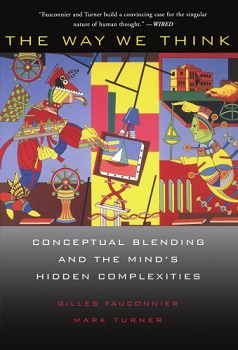
Gilles Fauconnier and Mark Turner‘s The Way We Think: Conceptual Blending and the Mind’s Hidden Complexities gives us a fascinating look at the way the human mind weaves a world out of seemingly disparate elements — in a very similar manner to that in which the creative mind weaves an aha! out of seemingly disparate ideas. The book deals with the formation of perceptions as well as ideas, but it was a specifically conceptual blend that intrigued me the other day.

First, they note that when we use expressions like “I had reached the boiling point. I was fuming. He exploded.” we are making a metaphorical mapping in which “a heated container maps to an angry individual, heat maps to anger, smoke and steam (signs of heat) map to signs of anger, explosion maps to uncontrolled rage.” Then they add in the “folk theory of physiological effects of anger” including ” increased body heat, blood pressure, agitation, redness of face” – and thus we have a threefold scheme, in which physiology, emotions and the physics of heat are intricately cross-correlated, so that we can say without much thought “He was so mad I could see smoke coming out of his ears”.

Here Fauconnier and Turner describe the mechanics of this remarkable conceptual blending process – which can yield such a seemingly unremarkable phrase:

In addition to the metaphoric mapping between Heat and Emotions and the vital-relation connection between Emotions and Body, there is a third partial mapping between Heat and Body. In this mapping, steam as vapor that comes from a container connects to perspiration as liquid that comes from a container, the heat of a physical object connects to body heat, and the shaking of the container connects to the body’s trembling.

The three partial mappings set the stage for a conventional multiple blend in which the counterparts in the inputs are fused, yielding, for example, a single element that is heat, anger, and body heat and a different single element that is exploding, reaching extreme anger, and beginning to shake. Once we have this blend, we can run it to develop further emergent structure and we can recruit other information to the inputs to facilitate its development.

*

What interests me here is the phrase:

the inputs are fused, yielding, for example, a single element that is heat, anger, and body heat

and what it reminds me of is CS Lewis writing in The Allegory of Love:

It must always be remembered … that the various senses we take out of an ancient word by analysis existed in it as a unity.

Thus the King James Version of the Bible, John 3.8, reads:

The wind bloweth where it listeth, and thou hearest the sound thereof, but canst not tell whence it cometh, and whither it goeth: so is every one that is born of the Spirit.

In the Greek, the word here translated wind is pneuma, and the sentence accordingly means “the pneuma blows where it wills, and you hear its sound but can’t tell where it comes from or is going: and so it is with all those born of pneuma“…

Recalling Lewis’ remark about the “various senses we take out of an ancient word”, this in turn means simultaneously and without separation:

the wind blows where it wills, and you hear its sound but can’t tell where it comes from or is going: and so it is with all those born of wind…

the breath blows where it wills, and you hear its sound but can’t tell where it comes from or is going: and so it is with all those born of breath…

and:

spirit blows where it wills, and you hear its sound but can’t tell where it comes from or is going: and so it is with all those born of spirit…

Take this a step further, realize that spirit can be defined as what inspires us, and we have:

inspiration blows where it wills, and you hear its sound but can’t tell where it comes from or is going: and so it is with all those born of inspiration…

Four meanings, all making good sense, and all present simultaneously and inseparably in the one gospel phrase…

*

Now consider that Fauconnier and Turner are speaking of how “three partial mappings set the stage for a conventional multiple blend in which the counterparts in the inputs are fused, yielding, for example, a single element that is heat, anger, and body heat” and compare it with Lewis’ “unity” from which we take out “the various senses” by “analysis”, as applied to the “ancient word” pneuma, with its meaning encompassing wind, breath, spirit… inspiration.

Are wind, breath and spirit or inspiration in fact three “primitives” that conceptual mapping in ancient Greek thought has brought together? What do we gain, and what do we lose if we view them this way?

And what do we lose, what do we gain if we view them as a single rich concept, now reduced to three or four separate — and separately less complexly interesting — ideas?

Updating the Apocalypse

Tuesday, May 15th, 2012

[ by Charles Cameron — four shifts in apocalyptic thinking, us & them, sacred and secular ]
.


.

Every time something significant happens in Europe or the Middle East, those who have worked out their apocalyptic timelines ahead of time have to make appropriate adjustments.

1.

Today, the Christian apocalyptic writer Joel Richardson took note of recent events in Europe in a piece entitled The Collapse of the Euro = The Collapse of the Euro-Centered End-Time Perspective? and asked:

as the collapse of the Euro monetary unity appears to loom over all of us, how will such an global earthquake affect the popular, but equally collapsing Euro-centered perspective on the end times?

Joel may be onto something, we may be on the verge of a major shift in Christian end times emphasis — away from Europe and towards Joel’s Islamic Antichrist theory, as explored in his book The Islamic Antichrist: The Shocking Truth about the Real Nature of the Beast and his forthcoming Mideast Beast: The Scriptural Case For an Islamic Antichrist.

2.

I’ve put a screen shot at the top of this post from an end times video featuring Europe as the evil empire and the Pope as Antichrist – it’s a brilliant graphic pairing that illustrates the older theory visually and viscerally, and should you so wish, you can watch the whole thing here. Note also the comment from SyriacBoy10 below the video:

In the Bible and the Quran, it is said that the Antichrist will come from Europe which is expected to be in this generation due to the signs and global disasters.

Just what place names in scriptures might refer to just what places or entities in modern or far future times is always a matter of interpretation — as Joel himself neatly demonstrated with a variety of “biblical” maps in his Prophezine post Where is Magog, Meshech and Tubal?

And for that matter, is our Coptic friend speaking of the Antichrist in the Qur’an, or the Dajjal? The two are commonly inflated, which gets a bit confusing after a while…

3.

And here’s Joel on failed predictions of the EU as the pivotal demonic empire of the last days in prophecy:

Nearly 20 years ago, I intently watched as a very popular Christian television prophecy teacher declared, “The present formation of the European Union is literally the fulfillment of Bible prophecy right before our eyes!”

According to this teacher, the creation of the European Union represented a biblically prophesied revived Roman Empire. Because the last-days empire of the Antichrist, as described in the books of Daniel and Revelation, is portrayed as a 10-nation alliance, this teacher confidently declared that when the number of EU member states reached 10, this would signal the imminent return of Jesus Christ.

Soon, the number of EU member states reached the magic number 10, just as this teacher had predicted. Then the number reached 11, and then 12. Soon there were 20. Today there are 27 member states. The teacher’s very confident predictions failed.

4.

As it happens, I correspond with Joel on occasion and like the man, despite our holding very different theological opinions. In particular, I like to quote this passage from his description of an interview he gave on NPR:

I explained to my host that unless a supernatural man bursts forth from the sky in glory, there is absolutely nothing that the world needs to worry about with regard to Christian end-time beliefs. Christians are called to passively await their defender. They are not attempting to usher in His return. Muslims, on the other hand, are actively pursuing the day when their militaristic leader comes to lead them on into victory. Many believe that they can usher in his coming.

I’d be interested to know what GEN Boykin would make of that…

5.

All in all, I see four trends in apocalyptic thinking at the present time.

First, there’s a trend, suggested by Joel Richardson in his articles linked above, away from an earlier Eurocentric focus of end times interpretation, and towards his own view of Islam – and of the Mahdi (awaited by many Muslims) as Antichrist.

Second, there’s a trend noted by another occasional correspondent of mine, Julie Ingersoll, in one of her two recent articles on Kirk Cameron in Religion Dispatches – more precisely, a theological shift:

from the larger premillennialist evangelical world that he depicted in Left Behind to the postmillennialist dominion theology of the Reconstructionists.

Third, It seems to me that there’s a trend away from the “soon expectation” of the Mahdi of President Ahmadinejad in Iran, as the Supreme Jurisprudent, Khamenei, withdraws his support from his President and Ahmadinejad enters his lame duck phase…

And finally, there are mild signs that apocalyptic itself and religious motives more generally are slowly entering the discourse of the strategically minded, including those whose secular worldviews have hitherto all too often led them to dismiss both religious and apocalyptic drivers as irrational and unserious.

Columbia’s upcoming Hertog Global Strategy Initiative with its focus this year on Religious Violence and Apocalyptic Movements, which I mentioned recently, is one such sign – another is the attention paid to Khorasan — a name with strong Mahdist associations — in a post at the Long Wars Journal today.

6.

Luckily, we have Richard Landes‘ massive, brilliant Heaven on Earth: The Varieties of the Millennial Experience to educate us in the bewildering profusion of forms, both secular and sacred, that millennial hopes and fears can take.

And with Israel’s departing Shin Beth chief calling PM Netanyahu “messianic” – using the same term Netanyahu used for Ahmedinajad – it’s about time, too.


Switch to our mobile site