zenpundit.com » Sembl

Archive for the ‘Sembl’ Category

The future lies with those individuals who can see connections

Thursday, April 5th, 2012

[ by Charles Cameron — gaming the future, rethinking thinking, NPS essay contest, mixing drinks ]
.

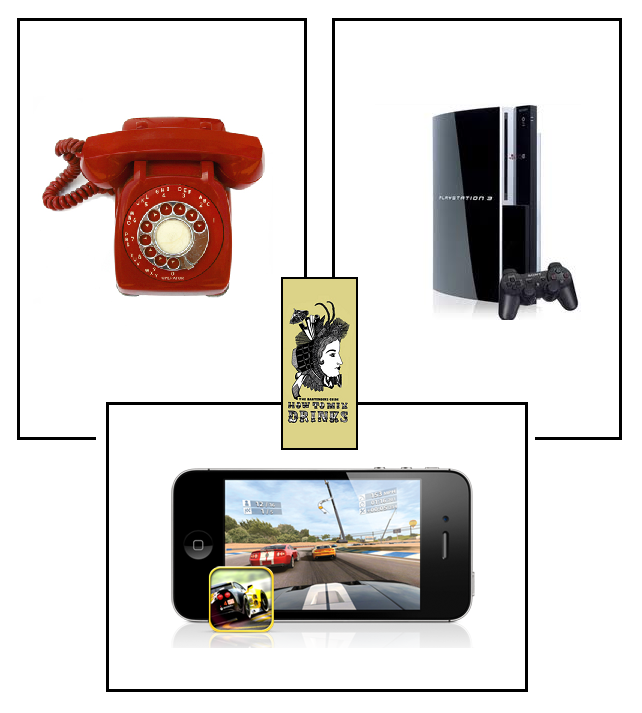
I’d like to introduce what may be a new format for my DoubleQuotes and SPECS. It features two ideas — in this case, the telephone and the game console — which merge into one via some overlap between them — here, the iPhone.

You want the neurosciwence behind all this? Try Fauconnier and Turner‘s The Way We Think: Conceptual Blending and The Mind’s Hidden Complexities.

It was a piece by Benjamin Kohlmann in today’s Small Wars Journal titled The Military Needs More Disruptive Thinkers that triggered this post.

*

Listen up:

The future lies with those individuals who can see connections across a myriad of professions and intellectual pursuits.  The mind that can see that a phone and entertainment device can be intertwined into something like, say, an iPhone.  Or, an intellect that recognizes how secondary and tertiary networks are often more valuable than first-order relationships, thus creating something like LinkedIn.  Or the strategist who understands that crowdsourced, horizontally structured non-state actors pose a greater threat to our security than Nation states.

That’s from today’s Small Wars Journal piece — and when I read that paragraph, I was way too excited to read the rest, because:

1. That’s what my series of posts [1, 2, 3, 4, 5] on Arthur Koestler‘s notion of intersecting concepts has been all about, and…

2. I’ve been working on a family of games that will train people — pleasurably — in precisely this kind of “overlap” thinking for at least fifteen years now. Don Oldenberg of the Washington Post described one of my games as an “on-line match of ricocheting intellects” back in 1996.

But you’ll be hearing more on #2 in the not too distant, once our team has all its ducks in a row — and black swans permitting.

*

Hey, this kind of thinking can get you noticed — it’s what last year’s Naval Postgraduate School Center for Homeland Defense and Security essay contest [link opens .pdf] boiled down to:

*

If you’ll permit me a quick detour:

Not only that, it’s also the basis for cocktail hour!

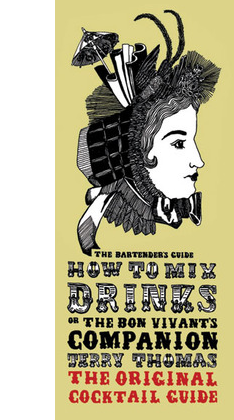
It appears that the Bartender’s Guide was first published in 1862, so bartenders have been doing this — mixing ideas, mixing drinks — for at least a century and a half. Maybe the fact that they work with liquor has something to do with it.

*

In any case, isn’t it time for the rest of us to catch up?

The future lies with those individuals who can see connections across a myriad of professions and intellectual pursuits.

Iconic: compare and contrast

Thursday, December 22nd, 2011

[ by Charles Cameron — iconic images, riot police, compare and contrast, repetition with variation ]
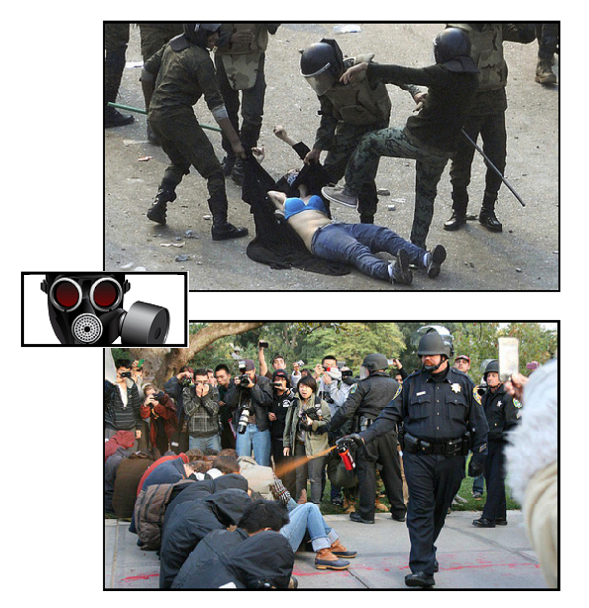
First, let’s be clear that both these images have been widely considered iconic.

Thus NPR reported of the first photo:

There have been countless accounts of violence recorded during the uprisings in Egypt but the image that perhaps has captured the most attention is the most recent. The image has been widely referred to as the “girl in the blue bra.”

While Real Clear Politics quotes Michael Moore on the second:

“The images have resonated around the world in the same way that the lone man standing in front of the tanks at Tiananmen Square resonated. It is an iconic movement in Occupy Wall Street history,” Michael Moore declared on MSNBC’s “Last Word” program.

Moore was referring to police pepper spraying students at an “Occupy” protest at UC Davis.

So we have two similarities between the two images: they both show police in riot gear taking action against demonstrators, and they have both caught the public eye as somehow being representations that can “stand in” for the events they seek to portray.

Beyond that, it’s all compare and contrast territory — or variations on a theme, perhaps — and different people will find different reasons to attack or defend the demonstrators or the police in one, the other, or both cases.

1.

These are, for many of us, “home” and “away” incidents, to borrow from sports terminology, and some of our reactions may reflect our opinions in general of what’s going on in Egypt, or in the United States.

We may or may not know the rules of engagement in effect in either case, on either side.

In a way, then, what the photos tell us about those two events, in Tahrir Square and on the UC Davis campus, may tell us much about ourselves and our inclinations, too.

2.

As I’ve indicated before, I am very interested in the process of comparison and contrast that the juxtaposition of two images — or two quotes — seems to generate. And I’ve quoted my friend Cath Styles, too:

A general principle can be distilled from this. Perhaps: In the very moment we identify a similarity between two objects, we recognise their difference. In other words, the process of drawing two things together creates an equal opposite force that draws attention to their natural distance. So the act of seeking resemblance – consistency, or patterns – simultaneously renders visible the inconsistencies, the structures and textures of our social world. And the greater the conceptual distance between the two likened objects, the more interesting the likening – and the greater the understanding to be found.

I’d like to examine these two particular photographs, then, not as images of behaviors we approve or disapprove of, but as examples of juxtaposition, of similarity and difference — and see what we might learn from reading them in a “neutral” light.

3.

What I am really trying to see is whether we can use analogy — a very powerful mental tool — with something of the same rigor we customarily apply to questions of causality and proof, and thus turn it into a method of insight that draws on our aha! pattern recognition and analogy-finding intuitions, rather than the application of inductive and deductive reason.

And that requires that we should know more about how the mind perceives likenesses — a topic that is often obscured by our strong emotional responses — you’re making a false moral equivalence there! or look, one’s as bad as the oither, and it’s sheer hypocrisy to suggest otherwise!

So among other things, we’re up against the phenomenon I call “sibling pea rivalry” — where two things, places, institutions, whatever, that are about as similar as two peas in a pod, have intense antagonism between them, real or playful — Oxford and Cambridge, say, and I’m thinking here of the Boat Race, or West Point and Annapolis in the US, and the Army-Navy game.

Oxford is far more “like” Cambridge than it is “like” a mechanic’s wrench, more like Cambridge than it is a Volkswagen or even a high school, more like it even than Harvard, Yale, Princeton or Stanford — more like it than any of the so-called “redbrick universities” in the UK — so like it, in fact, that the term “Oxbridge” has been coined to refer to the two of them together, in contrast to any other schools or colleges.

And yet on the day of the Boat Race, feelings run high — and the two places couldn’t seem more different. Or let me put that another way — an individual might be ill-advised to walk into a pub overflowing with partisans of the “dark blue” of Oxford wearing the “light blue” of Cambridge, or vice versa.  Not quite at the level of the Zetas and the Gulf Cartel, perhaps, but getting there…

4.

So one of the things I’ve thought a bunch about is the kind of analogy that says a : A :: b : B.

As in: Egyptian cop is to Egyptian protester as UC Davis cop is to UC Davis protester.

Which you may think is absolutely right — or cause for impeachment — or just plain old kufr!

And I’ve figured out that the reason people often have different “takes” on that kind of analogy — takes so different that they can get extremely steamed about it, and whistle like kettles and bubble over like pots — has to do with the perceptual phenomenon of parallax, whereby some distances get foreshortened in a way that others don’t.

5.

So my thought experiment sets up a sunken garden — always a pleasure, with two video cameras observing it, as in this diagram:
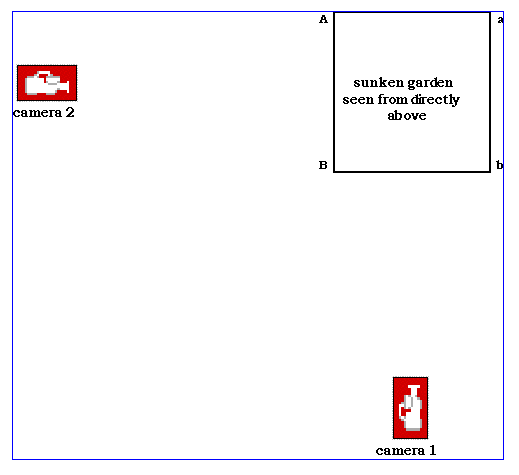
And from the two cameras, the respective views look like this:
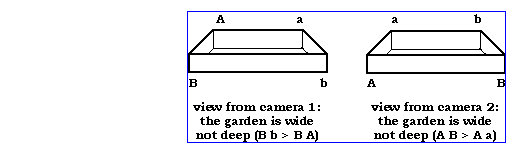
In this scheme of things, Aa (Oxford) seems very close to Bb (Cambridge) seen from the viewpoint of camera 1 — but from camera 2’s standpoint, Aa (Oxford) and Bb (Cambridge) are at opposite ends of the garden, and simply couldn’t be father apart.

6.

Now, my thinking here is either so obvious and simple as to be a platitude verging on tautology — or one of those subtle places where the closer examination of what looks tautological and obvious leads to the emergence of a new insight, a new “difference that makes a difference” in Bateson’s classic phrase.

And clearly, I hope that the latter will prove to be the case here.

7.

What can we learn from juxtapositions? What can we learn from our agreements about specific juxtapositions — and what can we learn from our specific disagreements?

Because it’s my sense that samenesses and differences both jump out at us, as Cath Styles suggested — and that both have a part to play in understanding a given juxtaposition or proposed likeness.

Each juxtaposition will, in my view, suggest both a “sameness” and a “difference” — in much the same way that an arithmetic division of integers, a = qd + r, gives both quotient and dividend.

And then we have two or more observers of the juxtaposition, who may bring their own parallax to the situation, and have their own differences.

8.

Tahrir is to Tienanmen as Qutb is to Mao?

Or is pepper spray just a food additive?

And how do icons become iconic anyway? Are they always juxtapositions, cops against college kids, girl vs napalm, man against line of tanks?  Even in the iconic photo of Kennedy from the Zapruder film, the sudden eruption of violence into the stateliness of a presidential parade is there — a morality play in miniature.

Any thoughts?
Tea Party and / or Occupy?

Sunday, October 9th, 2011

[ by Charles Cameron — parallels, opppositions, analysis, games, coincidentia oppositorum ]

.

labelling-bodies1.jpg

My friend Cath Styles, who has been developing an iPad playable version of my HipBone Games under the name Sembl for the National Museum of Australia, made a point I’ve been trying to make for a while now, with sweet lucidity, in a recent blog post:

A general principle can be distilled from this. Perhaps: In the very moment we identify a similarity between two objects, we recognise their difference. In other words, the process of drawing two things together creates an equal opposite force that draws attention to their natural distance. So the act of seeking resemblance – consistency, or patterns – simultaneously renders visible the inconsistencies, the structures and textures of our social world. And the greater the conceptual distance between the two likened objects, the more interesting the likening – and the greater the understanding to be found.

That’s absolutely right, and it gets to the heart of my games and analytic practice — to see and acknowledge both parallelisms and differences, oppositions…

Oxford is the polar opposite of Cambridge as anyone at the annual boat race between them will tell you — yet they’re so similar that the term Oxbridge exists to distinguish them as a dyad from all else the wide world round…

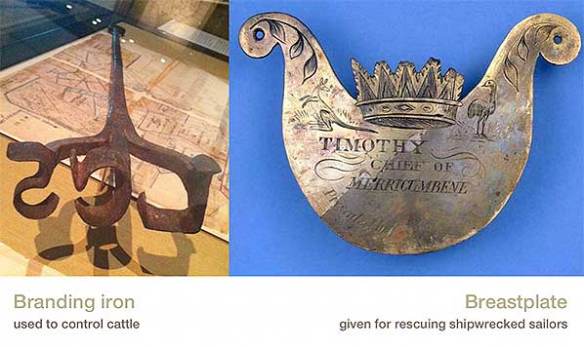
Similarly, in the example illustrated above, Cath shows two items from the Museum collection that were juxtaposed by players of an early version of her game, and writes:

the Sembl players who linked the above branding iron to the breastplate – because both are tools for labeling bodies – cast new light on the colonial practice of giving metal breastplates to Aboriginal people.

* *

Since the essence of my own analytic style (and that of HipBone and Sembl games) is the recognition of parallelisms and oppositions, I was particularly interested to see one group of early Tea Party folk reaching out to the emerging Occupy movement. Here, then, are two posts in which we can see the beginnings of recognition that there may be a kinship between the two…

Occupy Wall Street: Another View:

You know what the “Occupy Wall Street” movement is?
.
It is all the things that were in the original Tea Party, but were steadily ignored as the TP became a Republican booster club.

That comes from a post on FedUpUSA, a site with the Gadsden flag as its web-logo that was [as “Market
Ticker”], one of the founding orgs behind the TP. It’s from someone who identified as a Libertarian Party activist.

Here’s another post from FedUpUSA, not so identified:

An Open Letter From FedUpUSA To Occupy Wall Street Protestors All Over The Country:

This is a letter to OWS from FedUpUSA, one of the original Tea Parties:
.
We support you in exercising your First Amendment Right. We are outraged that any peaceful demonstrator would be assaulted or abused by any authorities.
.
If you are protesting because there are no jobs— We stand with you.
.
We are for a free economy and recognize that what we have now is NOT a free economy; it is not capitalism what we have is a fascist state or crony-capitalism. There is nothing free about doing business with Countries that manipulate their currencies to attract cheap labor. We agree that these jobs need to come back to America.
.
If you are protesting because no one has gone to jail— We stand with you.
.
Regardless of what is being said from the white house and media, we know that there are many in the financial district and the banks that have committed fraud and outright theft and we too want to see them prosecuted. We support the stop looting and start prosecuting.
.
If you are protesting because everything costs more— We stand with you.
.
We see prices rise in our food, gas, clothes yet our wages have stayed the same or have decreased. The Federal Reserve has bailed everyone out but us and not only are we going to have to pay for that, those bailouts make the price of everything else go up because it devalues our currency. We support monetary reform.
.
If you are protesting because you are tired of our bought and paid for government on both sides— We stand with you.
.
We are also against the banks and big corporations buying our politicians and writing laws that favor their special interests. We understand that our economy is broken BECAUSE of this and that all of our other issues will never be addressed as long as the financial elite control OUR government.
.
We understand that these issues cross party lines and ideologies and effect each and every one of us. We also understand that these issues will never get fixed as long as we continue to let the media, the elite, and members of the government separate us by our differing ideologies.
.
Only Together, can we Implement Change
.
It is time, We Americans, put our ideologies in our back pocket and not let them separate us so that we can work together for this ONE COMMON GOAL: to get the special interest money and elite out of OUR Government and return it to US — the people.
.
As long as the banks, largest corporations, and wealthy elite control our government, we will never have a representative republic and laws will continue to be passed that only benefit the few 1% at the expense of us 99
.
Demand that NOT ONE MORE LAW gets passed until they pass:
.
Lobby reform:
.
It is a Federal Offense punishable by a minimum 5 years in prison to:

.
Lobby any member of the US Congress outside of the district you live, work, or own a business.
Lobby a member of congress while they are physically outside the district they represent.
.
Campaign Reform:
.
It is a Federal Offense punishable by a minimum 5 years in prison to:
.
For any one person, corporation, enterprise, group, union or the like, to donate more than $2,000 to any one candidate during one campaign period.
For any member of the media to deny equal access to competing candidates.
.
These two laws will cut the control the Financial elite have on our government by leveling the playing field. You will have just as big as a voice with your representative as the big box retailer that resides in your town. Simply, it will end the Crony-Capitalism that is strangling our economy.
.
I encourage all my fellow Tea Partiers to join Occupy Wall Street protesters in their non-violent, peaceful protests and together demand that the Government be returned to the people. After all, this is precisely what the Tea Party was intended to be before it was taken over and marginalized by the establishment politicians.

.
FedUpUSA.org

* *

And we’re deep into John Robb territory…

What do you think? Do the parallelisms strike you, or the oppositions — or, perhaps, both?

FWIW, Cath’s Sembl version of my game looks like it is going to be a beautiful steampunk affair…


Switch to our mobile site