zenpundit.com » #FAIL

Archive for the ‘#FAIL’ Category

Bomb Syria?

Thursday, August 29th, 2013


[by Mark Safranski a.k.a. “zen“]

There is much ado about a prospective Western (i.e. American) aerial campaign to bomb the Iranian allied Alawite-Baathist dictatorship Syria over use of chemical weapons against primarily al Qaida allied Sunni Islamist extremist rebels.

To what end or how that end will be brought about by a surgical use of American air power, aided by token French and British contributions, well, no one is quite sure.

The driving insider force behind this astrategic call to arms are Susan Rice, Samantha Power and Anne-Marie Slaughter, the three Furies of R2P.  Slaughter writes on military intervention in Syria with her usual combination of moral certainty and operational magical thinking here. Rice angrily pontificates here while an unusually muted UN Ambassador Samantha Power just tweeted about it while on vacation from the emergency UN Security Council meeting on, uh, Syria.

The strategic argument about Syria is not about the normative qualities of the Assad regime, which is anti-American, brutal, terrorist supporting and fascistic. Or that the regime is committing atrocities. It is. It is about what political objective, if any, the use of military force against Syria can accomplish at what cost and with what probable outcomes. At a grand strategic level, there are also questions about how military intervention in Syria will impact great power relations and the shaping of international law.

I suspect many R2P advocates like Slaughter, Rice and Power are attracted to the idea of bombing Syria partly to garner a precedent to support doing similar things in the future, whether or not it has any positive effect on the Syrian civil war. That however, if true, is an extremely poor reason for military intervention anywhere. If bombing had some hope of changing the behavior of the Syrian regime or replacing it with something better, I would warm to the prospect but where is the evidence that is a likely outcome? Consider:

The Syrian rebels include armed groups as violent, lawless and squalid as the Assad regime. You know, the Beheading community of the third jihad international, with fringe support from the occasional cannibal commandos. If these Islamist lunatics come to power in Damascus they will cheerfully engage in ghastly pogroms of mass murder and torture that will make Assad’s goons look like the British Raj at tea time.

The Assad regime and the Alawite minority from whence it originates have their backs to the wall in a conflict that determines if they continue to rule Syria or are exterminated. Having no margin for maneuver or concession, America bombing them is irrelevant to whether in their calculus they can stop fighting their local enemies. The whole point of combining the threat of force with diplomacy – allegedly the reason given for bombing Syria – is to be able to make Assad an offer that he can’t refuse and not a threat that the Alawites can’t accept. Then, while blustering loudly and ominously we undercut our own bellicose posturing and announce that regime change was off the table. WTF?  Really?

The President should fire this unholy crew of incompetents and intellectual poseurs and hire some real foreign policy advisers with at least an undergraduate level grasp of how diplomacy, strategy and war have worked for the past 2000 years.

Failing that, a few poker players who can bluff without showing the entire table their cards.

Rasputin’s Apocalypse

Friday, August 23rd, 2013

[ by Charles Cameron — most likely a “foolish virgin” (Matthew 25) — I had no idea today was the day until today ]
.

.

According to Pravda, which I believe means Truth:

August 23, 2013 is the day, for which the infamous Grigory Rasputin predicted the end of the world in the beginning of the last century. Rasputin predicted a “terrible storm” in which fire would swallow all life on land, and then life would die on the whole planet. He also said that Jesus Christ would come down to Earth to comfort people in distress.

I would be remiss if I did not attempt to warn you…

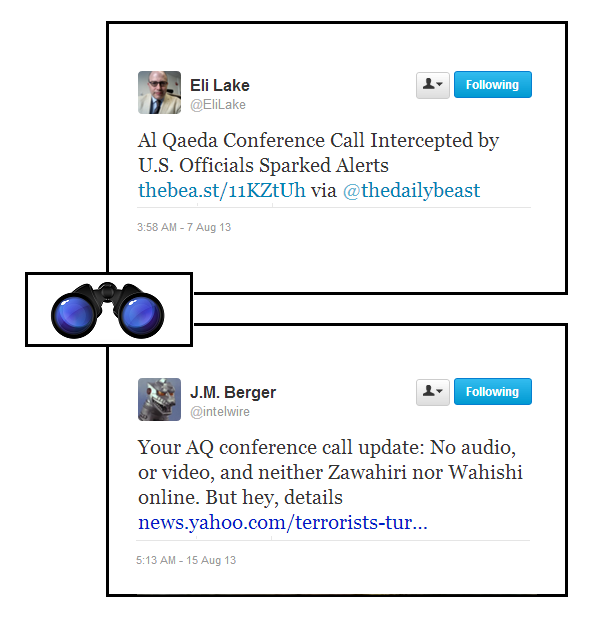
AQ Conference Call, 2: what a difference a week makes

Thursday, August 15th, 2013

[ by Charles Cameron — all the AQ leaders teleported into this one cave for their annual conference, see, and spoke to reporters as they were leaving for “near” and “far” – no wardrobe malfunctions, though ]
.

Following up on my post, AQ Conference Call, 1

.

When Eli Lake and Josh Rogin broke the story it was huge, wardrobe-malfunction huge, although AQ doesn’t really do wardrobe malfunctions the way we do at the Superbowl:

It wasn’t just any terrorist message that triggered U.S. terror alerts and embassy closures—but a conference call of more than 20 far-flung al Qaeda operatives, Eli Lake and Josh Rogin report.

Okay, conference call, I’ve been on some of those. Phones, right?

Ah — Skype, maybe, or Google+?

Nope.

Semantic? Okay… but anyway, “The crucial intercept that prompted the U.S. government to close embassies in 22 countries was a conference call between al Qaeda’s senior leaders and representatives of several of the group’s affiliates throughout the region” — right?

Um, no.

Here’s the more recent piece by Lara Jakes and Adam Goldman for AP to which JM Berger’s quote (lower panel, above) was pointing:

Al-Qaida fighters have been using secretive chat rooms and encrypted Internet message boards for planning and coordinating attacks — including the threatened if vague plot that U.S. officials say closed 19 diplomatic posts across Africa and the Middle East for more than a week.

It’s highly unlikely that al-Qaida’s top leader, Ayman al-Zawahri, or his chief lieutenant in Yemen, Nasser al-Wahishi, were personally part of the Internet chatter or, given the intense manhunt for both by U.S. spy agencies, that they ever go online or pick up the phone to discuss terror plots, experts say.

More specifically:

A U.S. intelligence official said the unspecified threat was discussed in an online forum joined by so many jihadist groups that it included a representative from Boko Haram, the Nigerian insurgency that has loose and informal ties to al-Qaida. Two other intelligence officials characterized the threat as more of an alert to get ready to launch potential attacks than a discussion of specific targets.

One of the officials said the threat began with a message from al-Wahishi, head of the Yemen-based al-Qaida in the Arabian Peninsula, to al-Zawahri, who replaced Osama bin Laden as the core al-Qaida leader. The message essentially sought out al-Zawahri’s blessing to launch attacks. Al-Zawahri, in turn, sent out a response that was shared on the secretive online jihadi forum.

So the jihadis have a web-forum, and messages from Zawahiri get quoted there?

A stunning new development!

**

DoubleTweet Sources:

  • Eli Lake
  • JM Berger
  • Articles pointed to:

  • Eli Lake
  • JM Berger
  • **

    Edited to add:

    FYI, there’s an extended treatment of the whole affair by Ken Silverstein now up at Harper’s, Anatomy of an Al Qaeda “Conference Call” — h/t Joshua Foust.

    You will be gamed

    Saturday, August 10th, 2013

    [by Lynn C. Rees]

    It is dangerous to promote an ideal and pretend it’s not for entertainment purposes only.

    Motivational constructs like “national interest” and “grand strategy” have, from time to time, proved useful for prodding the slothful along. Fiction has power to move people and move people it does. Mixing up myth for reality, however, inevitably leads to cognitive whiplash when reality steps, as it must, on myth. Many gleaming ideals are little more than bright colors painted on after the fact to cover up the grimy back stage shenanigans and less than visionary ad hoc improvisations, usually for temporary short term political gain. It’s too late in this historical cycle for a gritty reboot of statecraft. But a review may help some.

    Consider three of the most consequential peace treaties of the twentieth century:

    Key West Agreement” (Function of the Armed Forces and the Joint Chiefs of Staff)

    Signed: April 21, 1948

    Belligerents: United States Army, United States Navy, United States Air Force

    Results:

    • ‘The Navy would be allowed to retain its own combat air arm “…to conduct air operations as necessary for the accomplishment of objectives in a naval campaign…”‘
    • “The Army would be allowed to retain aviation assets for reconnaissance and medical evacuation purposes.”
    • “The Air Force would have control of all strategic air assets, and most tactical and logistic functions as well.”

    Pace-Finletter Memorandum of Understanding

    Signed: November 4, 1952

    Belligerents: United States Army, United States Air Force

    Results:

    • “removed the weight restrictions on helicopters that the U.S. Army could use”
    • “widened the range of tasks the Army’s helicopters could be used for”
    • “created an arbitrary 5,000 pounds weight restriction that limits the Army’s ability to fly fixed-wing aircraft”
    • “the U.S. Army…is dependent upon the U.S. Air Force to purchase and man fixed-wing ground-attack aircraft to fulfill close air support missions”

    Johnson-McConnell agreement

    Signed: April 6, 1966

    Belligerents:  United States Army, United States Air Force

    Results:

    • “the U.S. Army agreed to give up its fixed-wing tactical airlift aircraft”
    • “the U.S. Air Force relinquished its claim to most forms of rotary wing aircraft”
    These are all examples of what former Assistant Secretary of Defense Paul Wolfowitz said about the decision to use “weapons of mass destruction” as the primary justification for the American led intervention in Iraq:

    “The truth is that for reasons that have a lot to do with the U.S. government bureaucracy, we settled on the one issue that everyone could agree on which was weapons of mass destruction as the core reason,” Wolfowitz was quoted as saying in a Pentagon transcript of an interview with Vanity Fair.

    The magazine’s reporter did not tape the telephone interview and provided a slightly different version of the quote in the article: “For bureaucratic reasons we settled on one issue, weapons of mass destruction, because it was the one reason everyone could agree on.”

    Within every institution, there are tribes. Tribes seek to 1) keep and 2) elevate (if possible) their place in the pecking order. Usually the tribe’s place in the great chain of being is identical with what its leadership sees as their place in the great chain of being. When this place does not correspond to what the tribal membership thinks their place in the crap chain is, they will voice, exit, subvert, revolt, or just vote present, possibly undermining the leadership. Outside the tribe, tribes may voice, exit, subvert, revolt, or just vote present in conflict or in alliance with other tribes. Tribes may unite against external threats outside the institution or they may exploit institution-level conflict to keep, elevate, or even secede from their prior institutional crap chain. Then the crap will roll downhill on some other poor tribe of suckers.

    Ideals are one tool in the tribal and institutional toolbox. They can unite the tribe by elevating its supposed virtues and downplaying its supposed vices. This is especially useful when it elevates supposed virtues and downplays supposed vices in a way that downplays supposed virtues and elevates supposed vices of other tribes in the vicinity. Yet, in spite of whatever good ideals may generate, the zero sum game of politics is never far behind. One tribes gain is always another tribes loss. The greatest virtue in politics is victory while its greatest vice is defeat. The motto governing the division of power is “What have you done for me lately?”. Or, as Harry Truman didn’t say, “If you want a friend in this world, get a dog.”

    Entering into the political arena, if you lead with an idealistic chin then you will find you have only a glass jaw. As Warren Buffet might have said, “If you’ve been playing poker for half an hour and you still don’t know who the patsy is, you’re the patsy.” This is even true in institutions that are reputedly non-political. Experience suggests that, the more someone protests how non-political they are, the more political they are.

    America’s armed forces have always been dens of vipers scrambling for procurement dollars. For every Col. John Boyd, USAF, warrior monk, willing to live on morning dew and lichen gnawed from the bottom of rocks for principle, there are fifty Major General James Wilkinsons who keep their eyes single to the glory of their tribal bottom line. Sometimes this is due to the incentives that let lose the inner sociopath when an individual previously constrained by circumstance, usually of the sort involving bootlicking of the most groveling kind, is promoted to a new level of power and a new level for opportunity. As a professor of H.W. Brands like to observe, a “country gets the foreign policy it can afford” since political power is a form of supply that creates its own demand. So, just as today’s U.S. has a finger in every global pie despite protests or ideals to the contrary, a problem at a lower rank can become a catastrophe upon promotion to higher rank merely because more opportunities for pratfalls come with more power to commit them.

    Sherlock Holmes called his adversary Professor James Moriarity the “Napoleon of crime”. Most petty politicians in the armed services today lack the capability to rise to the elevation of the Corsican Ogre. But they have plenty of opportunities to become the John Bell Hood of crime. Hood is the poster child for decent officers at lower rank who became deranged upon elevation to supreme command. The same is true of political opportunity: an officer gets the Paula Broadwell they can afford.

    Politics of the most nefarious kind usually takes place at a level so extravagantly large and visible that it can’t be seen. Its scale exceeds the carrying capacity of the average imagination. For most, their experience of politics is so tribal and so tactical that it’s governed by Sayre’s law:

    In any dispute the intensity of feeling is inversely proportional to the value of the issues at stake. (Corallary: “That is why academic politics are so bitter.”)

    Fights over micropolitics will be more bitter than macropolitics because their bitterness is cognitively easier to grasp. The availability heuristic’s political downfall is its efficiency:

    The availability heuristic is a mental shortcut that occurs when people make judgments about the probability of events by how easy it is to think of examples. The availability heuristic operates on the notion that if something can be recalled, it must be important. The availability of consequences associated with an action is positively related to perceptions of the magnitude of the consequences of that action. In other words, the easier it is to recall the consequences of something, the greater we perceive these consequences to be.

    This is what feeds Parkinson’s law of triviality:

    In the third chapter, “High Finance, or the Point of Vanishing Interest”, Parkinson writes about a finance committee meeting with a three-item agenda.

    The first is the signing of a £10 million contract to build a reactor, the second a proposal to build a £350 bicycle shed for the clerical staff, and the third proposes £21 a year to supply refreshments for the Joint Welfare Committee.

    The £10 million number is too big and too technical, and it passes in two minutes and a half.

    The bicycle shed is a subject understood by the board, and the amount within their life experience, so committee member Mr. Softleigh says that an aluminium roof is too expensive and they should use asbestos. Mr. Holdfast wants galvanized iron. Mr. Daring questions the need for the shed at all. Mr. Holdfast disagrees.

    Parkinson then writes: “The debate is fairly launched. A sum of £350 is well within everybody’s comprehension. Everyone can visualize a bicycle shed. Discussion goes on, therefore, for forty-five minutes, with the possible result of saving some £50. Members at length sit back with a feeling of accomplishment.”

    Parkinson then described the third agenda item, writing: “There may be members of the committee who might fail to distinguish between asbestos and galvanized iron, but every man there knows about coffee – what it is, how it should be made, where it should be bought – and whether indeed it should be bought at all. This item on the agenda will occupy the members for an hour and a quarter, and they will end by asking the Secretary to procure further information, leaving the matter to be decided at the next meeting.”

    Political perceptions are primordially primed to patrol along our territorial boundaries and periodically beat our chests to demonstrate to our neighbors that we are mighty indeed and our trinkets are even mightier. The brain can sweat over small details so that is what it grasps when it searches for something political to sweat over. It is relative power compared to others in our vicinity, the narcissism of small differences, that motivates us on our rat brain level. As Eric Falkenstein has argued:

    Assume you were the designer of a species of conscious agents: God, the program developer of avatars in a game (actually considered possible by thoughtful philosophers!), or anthropomorphize natural selection. The objective you face is to give these agents a utility function such that they are motivated to create buildings, art, and of course children by themselves based on some instinct. So, as a designer you can add a mechanism so that people feel hungry if famished, and lustful when in the presence of mating opportunities, so they survive over generations. Yet, each of these desires has a clear governor that has a ‘high’ and ‘low’ setting, when you feel full or empty: you don’t want people eating or having sex so much they ignore everything else, such as getting ready for eating and having sex tomorrow. Now consider the governor that signals the will to want more ‘stuff’. The person one creates must have a specific function if we have an ‘absolute utility’ function. That is, say people developed a utility function x^½, which is satisfies our basic intuition that self interest is both increasing in wealth, but at a decreasing rate. Back in 1800 it worked pretty well. But now we are 10 times wealthier, so we should have much lower risk aversion if our utility were not of that very specific formulation–x^(1-a)/(1-a)–such that risk means roughly the same thing then as it does now. If risk aversion today is correct, then back then you were afraid to look at you shadow if you people’s utility is like x^½, and interest rates would not have been 15% or so as we know from Medieval times, but rather, 100%. Our DNA need a very specific functional form of happiness that seems patently absurd. I guess one could always invoke the anthropic principle and leave it at that (i.e., if it were not so, we wouldn’t have enough wealth to be discussing this on the internet).

    In contrast, it seems more likely our little governor simply said: be above average to you peers. As humans always lived in societies with others, benchmarks are not lacking, so this is a very feasible goal. Then, things take care of themselves. People are constantly doing more each generation because even if you are on top you have to run fast just to stay in the same place. Desire, striving, want, has no abstruse functional knife-edge, but a more reasonable feedback mechanism that does not lead to, or start with an absurdity.

    While boundary-work may be driven by idealism, it is even more driven by envy, that desire to be just a little more powerful than the Jones next door.

    Macropolitics, the sort of politics that shapes national destinies, looks like this:

    People like to talk about a 1/3, 1/3, 1/3 split in the defense budget. This is not now true, nor has it been true for some time. Mostly because only about 80% of the defense budget actually gets split among the services, with OSD skimming off 19% or so for its growing fiefdoms. What is true is that through multiple strategic reviews, National Military Strategies, QDR’s and Bottom Up Reviews–the Department of the Navy, Air Force and Army get a remarkably consistent portion of the defense budget. The Navy—with two services—gets about 29%, the Army about 25% and the Air Force about 27%. That’s right. No matter WHAT military strategy our nation has pursued since the fall of the Berlin Wall, we’ve split the base defense budget in essentially the same way.

    While the services can’t seem to agree on much, they do agree that taking turf issues outside could lead to dangerous intervention by powers that were already outside. Such political considerations fed the Johnson-McConnell agreement:

    In late 1965, private negotiations began between Generals McConnell and Johnson over the transfer of Caribou and Buffalo aircraft to the Air Force. These were encouraged by the Chairman of the Joint Chiefs of Staff, General Earle Wheeler, who wished to avoid involving the Secretary of Defense, Robert McNamara, or the Joint Chiefs of Staff (where the other two services might exert their influence).

    This may not be ideal ideal, but it is politically ideal. Scott linked this article earlier today titled “The Air Force’s Awesome Attack Plane Has a Pretty Sad Replacement. The A-10 is the best warplane for saving lives?—?too bad its days are numbered.” Following the Ideal, righteousness and common sense demand that close air support be taken from the Air Force and given to the Army despite three treaties against it. Since, in my idealized heart of hearts I regard an independent air force as the most narcissistic of small differences and think that service should be abolished since its nonsensical existence has tormented this nation long, I agree with this Ideal. But logic dictates otherwise.

    The A-10 was procured without a natural political base. Any weapons platform has two missions:

    • provide patronage for political supporters
    • defeat the nation’s enemies

    Since war is occasionally interrupted by bouts of peace and small wars killing primitive savages are more frequent than large wars fighting peer savages, patronage often becomes the more important mission of a weapon. Consider the wisdom of our Founding Fathers:

    Secretary Knox suggested to President Washington that six different construction sites be used, one for each ship, rather than building at one particular shipyard. Separate locations enabled the alloted funds to stimulate each local economy, and Washington approved the sites on 15 April 1794. At each site, a civilian naval constructor was hired to direct the work. Navy captains were appointed as superintendents, one for each of the six frigates as follows:

    Ship Site Guns Naval constructor Superintendent
    Chesapeake Gosport, Virginia 44 Josiah Fox Richard Dale [40]
    Constitution Boston, Massachusetts 44 George Claghorn Samuel Nicholson [40]
    President New York, New York 44 Forman Cheeseman Silas Talbot [40]
    United States Philadelphia, Pennsylvania 44 Joshua Humphreys John Barry [40]
    Congress Portsmouth, New Hampshire 36 James Hackett James Sever [40]
    Constellation Baltimore, Maryland 36 David Stodder Thomas Truxtun [40] 

    The original six frigates had little effect on the technical outcome of the War of 1812. The early victories they scored over British peers produced important political outcomes, the most important tactical consideration in war. Americans were heartened after our disgraceful failure to extend our natural frontiers to the Arctic by liberating Canada from the Canadians. Britons were embarrassed that some two bit country had challenged their rule of the sea during the glorious age of Nelson. Technically, their role made no difference: Britain ruled the seas and clamped down the Atlantic seaboard when stirred by our impertinence. Sequential warship-to-warship actions were actually a military waste of a good frigate. They reached peak performance when cumulative preying on enemy shipping, either by direct action or by causing enemy shipping to go out of its way or stay in port because the U.S. Navy represented a Pirate Fleet in Being. The first rule of war is to take strength on weakness encounters over strength on strength or weakness on strength encounters.

    Yet, judged by political standards, the six frigates are models of victory. They divided the goods between six voting blocs, even targeting the South where floating thingeys on “water” are usually seen as a sinister Yankee conspiracy. Most of the preferred materials were ideally placed for spending money in the Southern Piedmont from Virginia to Georgia. Southerners have historically been suspicious of Yankees but they’ve proved more than willing to take Yankee money as long as it comes Yankee-free.

    There have been many formidable defensive works made throughout history. The Great Wall around the Peking region. Vauban’s frontier fortresses. The Siegfried Line. The poor maligned Maginot Line.

    Amateurs.

    Compared with the fortifications erected around around a large-scale American weapon program, these are chicken scratches in the barnyard. The Iron Triangle of the congressional-military-industrial maze, anchored by the dense defense in depth of the F-35 Line, is more formidable than those. Compound it with tribal defensive lines like those dividing the services from each other and branches within services from each other, and you have an arrangement that finds resilience in the awesome scale of its fragility. Its tribal sparring all the way down.

    Before you can evaluate the defenses of the United States, you have to get past any illusions about seeing it as a ideal that can be solved by contemporary America’s go to magic bullet: heroic Führerprinzip leadership. This is the core micropolitical fallacy that allows macropolitical corruption: if we only get the right square-jawed man in the right place, his heroic brow will banish politics from politics. In reality, you can’t divide zero by zero. Politics happens. The only non-political group of people you will ever encounter is a graveyard. Only the dead have seen the end of politics. It is appalling to the Ideal but every weapons procurement request should be designed to not only win the nation’s wars but buy enough senior bureaucrats and congress critters and voters in Mississippi to keep the system afloat.

    For example, in combat, the LCS class would sink with the first paper cut inflicted by serious Chinese print stock. However, it has already fulfilled its primary mission as a political platform for patronage distribution and has even taken on additional missions like fighting for gun control. Children can sleep soundly in coastal Alabama and Mississippi tonight knowing that an LCS on patrol from its dry-dock in Mobile, vigilantly keeping their bills paid. It may not ever sink anything bigger than a row boat but it will always sink any attempt to keep it from occupying dock space in the nation’s most uncritical ports. The tragedy of the A-10 is that while its 30 mm GAU-8/A Avenger Gatling-type cannon can fire 3,900 rounds per minute, it is fatally crippled by its inability to divide power between critical supporting constituencies at a similarly devastating clip.

    Idealists march in where angels know not to tread. However, the nation is better served by idealists with eyes pre-opened who will even live on dew and lichen gnawings if pushed to extremes. Learn to  look past the micropolitical troops of monkeys patrolling their borders and periodically breaking out in furious narcissism and small differences in arm waving and screeching technique. Learn to grasp the extravagances of scale that is the macropolitical division of spoils that drives the system. Those who maintain an iron curtain of idealistic obtuseness should be warned: Politics happens. You will be gamed.

    How to Lose a War: A Primer

    Sunday, July 28th, 2013

    [by Mark Safranski a.k.a. “zen“]

    Since Pakistan is now attempting to get its victory over the United States in Afghanistan formally ratified, now seemed to be a good time to reflect on the performance of American statesmen, politicians and senior generals.

    It has occurred to me that we have many books and papers outlining how to win wars. Certainly the great classics of The Art of War, The History of the Peloponnesian War and On War are the foremost examples, but there are also other useful classics in the strategic canon, whole libraries of military histories, memoirs of great commanders and an infinite number of PDFs and powerpoint briefs from think tanks and consultants. Strangely, none of these have helped us much. Perhaps it is because before running this war so few of this generation’s “deciders” read them en route to their law degrees and MBAs

    We should engage in some counterintuitive thinking:  for our next war, instead of trying to win, let’s try to openly seek defeat. At a minimum, we will be no worse off with that policy than we are now and if we happen to fail, we will actually be moving closer to victory.

    HOW TO LOSE A WAR

    While one of these principles may not be sufficient cause for losing an armed conflict, following all of them is the surest road to defeat.

    1. War is the Continuation of Domestic Politics:

    The point of politics is to acquire, hold and enjoy using power. When we lose sight of this fact due to romantic notions of “national interest” or “duty” and spend too much attention prosecuting a war against foreign armies then our real enemies – the political opposition – can take advantage. What good is overseeing a global victory over an epochal tyranny if the result is you get immediately voted out of office like some hapless loser? While on the surface, it might seem wise during a war to staff a government with able statesmen, experienced generals, capable diplomats and other experts, the truth is that if you do so you will have very few plum jobs left with which to reward the cronies, ideologues, campaign consultants, activists, wealthy grafters and partisan hacks who got you into power in the first place. Without their continued support, you will not be long for political office.

    The fact is that the nation can survive many lost wars far longer than your career will survive lost elections.  Once you view the war solely through the prism of how any action might impact your fortune in domestic politics, you will have a marvelous clarity that the war is the best pretext upon which to expand your power at the expense of the opposition and the people.

    2. Policy is the True Fog of War:

    Having a clearly defined, coherently articulated policy based upon vital interests and empirical facts that sets a few realistic objectives in a way that makes possible shared understanding and broad political support is no way to go about losing wars.

    Keeping in mind #1, the point of war policy is to generate a set of politically compelling slogans that remain ill-defined enough to serve as an umbrella  under which many contradictory and competing agendas can cohabit until some of them can be opportunistically realized. These agendas may not be realistic – in fact, it is easier to put them forward as attractive fantasies for the public if your administration is unburdened with officials with genuine expertise in warfare, economics, foreign cultures, history and other inconvenient information that the media and the political opposition will only be too happy to seize upon. The more abstractly and arcanely expressed the policy the harder it is for critics to demolish and the  better it is for losing wars. “Unconditional surrender” for example, is bad because it is too concrete and easily evaluated – either an enemy is totally defeated and in your power or he is not. “Make the world safe for Democracy” by contrast,  is better as it is more ill-defined and subjective, permitting a larger range of politically tolerable bad outcomes.  “Responsibility to Protect” and “War on Terror” are even more abstract, being essentially unlimited, open-ended, process goals that do not have any point of “victory” whatsoever and can thus not only potentially bring about losing wars but very long ones.

    3.  Strategy is a Constraint to be Avoided:

    Strategy is about lining up Ends-Ways-Means to construct a theory of victory. While that might give us hope of prevailing over an enemy in an armed conflict, forging a strategy – any strategy -comes with a severe cost: namely the discipline of the government adhering to a strategy requires choices be made about the use of limited resources rather than keeping “all options open” to react  to transient and trivial political concerns on a moment’s notice. Strategy for the nation equates with diminished political flexibility and mobility for the politician.

    In other words, having a strategy might require elected officials expend their precious political capital in order to pursue it without getting anything in return that might expand their powers or further their personal careers.  Doing strategy would mean prioritizing winning the war over other possible objectives and putting key decision-makers in the uncomfortable position of having to say “No” or “Not now” to powerful and influential people or factions. Worse, having a strategy also implies that the results can be quantified and evaluated for success, costs, failure and ultimately, personal accountability for leaders.

    Obviously locking ourselves into a strategy is something to be avoided if we wish to stay in power, so “strategy” is only invoked rhetorically to mean a wide and confusing array of other non-strategy things – tactics, goals, operational art, planning,  public relations, nation-building,  diplomacy, policy, routine procedures, withdrawal dates, theories, fantastical pipe dreams and so on.  When “strategy” means anything and everything it ultimately means nothing.

    4. All Lost Wars are based on Self-Deception: 

    It is not enough to avoid strategy, there must also be a collective political determination to avoid reality enforced from the inception until the bitter end.

    Wars have real and physically destructive consequences for the people who fight them, but unless you are engaged in a desperate struggle to repel a foreign invader, chances are the battlefield is far away from your home territory. This gives political leaders wiggle room to manipulate perceptions – most importantly their own – to political advantage by controlling information about the war and shaping the ideological boundaries of acceptable public discourse. This will eventually lead to a vicious cycle of bad decisions as misinformation and deceit corrupts the OODA Loop, but political leaders will maintain their political advantage over their critics, at least until the day of reckoning arrives.

    Here we must begin with an insistence of a position of firmly held ignorance regarding the prospective enemy, their military capabilities, economic resources, the geographic characteristics, their cultural attitudes toward conflict and their history as a people. Should such information become widely known, it might result in popular skepticism about the wisdom of the entire enterprise, the difficulties that might be encountered and the prospects for success. If you wish to lose a war ignominiously, the less you know the better.

    Likewise, once war has begun, the initial jingoistic overconfidence that greeted the war will quickly fade unless actively sustained by preventing an honest analysis of  events and providing a steady stream of rationalizations for the gullible public. It would be a good idea to ban discussion that accurately characterizes the form of warfare  or the nature of the enemy, though these things alone will not be sufficient. The intelligence process itself should be corrupted when possible to provide the “right” answers and censored or circumvented when it is not; while public assessments should use irrelevant metrics divorced from their  context so that they will not have to be gamed later.  Critics, truth-tellers, whistleblowers and those not towing the party-line should be retired, fired, demonized and punished.

    5. Isolate the War and those Fighting it from the People: 

    A war forgotten by the folks at home is a war that is much easier to quietly lose.

    At the outset of the war, ask no sacrifice of the people because that will give them too much of a stake in a victorious outcome and raise expectations about your own leadership. Neither raise their taxes (at least not for the war at any rate) nor conscript their sons. Do not even issue a national call to the colors for volunteers, instead encourage people to be at ease and go about their business. Supplement your small regular army that increasingly feels itself a caste apart with highly paid mercenaries and foreign paramilitaries while neglecting the needs of your own troops. Speaking of the troops, always lavish the soldiers with superficial public pieties about service, sacrifice and heroism, but cynically break faith when it comes to your obligations to look after their interests.

    6.  Complexity= Opacity and Micromanagement= Power

    Most things in war are simple, but they are not easy. By deliberately making everything incredibly complicated, war can also become impossible too

    While adding superfluous complexity does not help win wars, it does offer a number of immediate benefits for the political class. First, in real life the consequence of increasing complexity in any governmental endeavor (not just war) is that you will have more jobs and contracts to hand out to followers as bureaucracy and regulations require new inspectors, secretaries, managers, clerks, lawyers, advisers and in a military context, also new commands, staff officers, promotions, headquarters, increased budgets and so on. Chances are, most of these new jobs will continue on, if not forever, for a very long time.

    Secondly the sheer complexity and number of offices, bureaus, agencies, departments, teams, commands, commissions and committees offer excellent “cover” for carrying out unpopular or illegal actions “under the radar” and with diffusion of responsibility, should these antics come to light.  If everyone is in charge, then no one is.  So if your military, intelligence agencies, diplomats, cultural advisers, aid and development people and senior administration officials talk and behave as if they are all hailing from different planets, you are well on your way to losing the war.

    Third, the control of people at the top is reinforced by excessive complexity because the initiative of lower levels is strangled by micromanagement. If every idea from the field ( or even basic actions) requires two, three or more levels of command approval with consultation with lawyers at each step the answer is always going to be “No” or a very delayed “Yes” long past the point of being useful. This, plus making examples of those who exercise initiative and act without orders, teaches everyone in the system to eschew risk, value passivity, play it safe and wait for higher-ups to spoon-feed them instructions. With modern, networked online communications every colonel, brigadier to three-star can play company commander while the President of the United States can ride virtual shotgun on SEAL team raids.

    7.  Enormous Tail, Tiny Tooth: the Worse the ROI the Better

    When you regularly use hundred million or billion dollar platforms to kill illiterate tribesmen with AK-47s and RPGs and build food courts in the Hindu Kush, something is eventually going to give.

    Generally, a reasonably well governed country at war can afford to employ either a massive military force for a short campaign or a small, “light footprint“, force for the long haul. What few nations in history can afford, unless it is Persia under Xerxes, is to field a massive force disproportionately composed of rear echelon support troops and what used to be called “camp followers” and “auxiliaries” for years on end. There are two ways this can bring you to defeat.

    First, obviously, fielding an enormous army for too long can lead to bankruptcy as costs of the war exceed tax revenues and the state begins to rely on various forms of credit, foreign bankers and debasing the currency to carry on. This does not guarantee an economic collapse or hyperinflation as war can also greatly stimulate production and other variables are always in play, but the risk of dire negative economic effects is significantly increased.

    The second issue is that if you are moving your armed host into a desperately poor region to wage war against an impoverished enemy, the passage and encampment of your own military introduces the economic surplus to the local economy the enemy needs to afford to wage war. You are like a red hot iron in a bucket of ice water. Through bribery, extortion and theft the enemy will siphon from you money, arms and contraband and eventually, corrupt your own officials and officers.

     8. Cultivate Hatred and Contempt:

    If you wish to lose a war, be hated but not feared.

    While most principles of losing a war  are political, strategic or operational in nature and therefore the province of incompetent politicians and generals, cultivating contempt and hatred in all observers can be done at anytime by anyone regardless of rank, experience or status. Technology has revolutionized this sphere of losing warfare: where once undermining an entire war effort could only be done by an arrogant national blowhard, today any grinning idiot on a battlefield with a smart phone is only a tweet away from an international media firestorm.

    It is import in cultivating hatred to remember that mere violence, an inevitable part of all wars, is not sufficient. One can respect and admire an honorable but fierce opponent. Conveying a bullying attitude of casual cruelty to all onlookers by mistreating prisoners and civilians, especially if you humiliate and abuse them is a surefire goad to hatred while also alienating allies and neutrals, especially when doing so contradicts the nation’s deeply held values.  Hatred can also be stirred in less dramatic ways, from posing with Nazi flags to widespread ignorance of and expressions of disdain for local customs and mores. Disrespect has legs.

    Contempt by contrast, is earned more by exhibiting moral weakness and truckling appeasement of the enemy and his sympathizers. For example, have your own PA and diplomatic organs in speaking to the media, repeat enemy propaganda against your own soldiers and abuse the military justice system to prosecute soldiers for splitsecond combat decisions in order to appease these critics. Loudly trumpet the “culturally appropriate meals” to the guys you are going to waterboard and appoint enemy sympathizers as “cultural advisers” and “liaisons” to government security and law enforcement agencies. Do nothing as your own heavily infiltrated host nation “ally” repeatedly frags your soldiers.

    9. Protect that Which is Most Unimportant:

    Organizations signal what they really value not by what they say, but what they spend time and money on.

    Make sure that as the war is steadily being lost that top brass and their civilian overseers frantically emphasize politicized trivialities and institutional martinet nonsense. Reflector belt mania, giving everyone and their brother breathalyzer tests, cultural sensitivity training, counterproductive regs for MEDEVAC helicopters, promoting the gender equality of foreign societies and gender-neutrality of our own should bump out boring, old training exercises for future combat deployment in terms of priority. Remember, the military is not really there to win wars – it is a captive social engineering project for things the wackier members of Congress wish they could impose on their constituents were it not for those damned free elections.

    10. Level the Playing Field: Paralyze Your Own Tactical Advantages.

    While a war is often lost by having a bad strategy or no strategy at all, the power of crapping away your tactical advantages to no purpose ought not be underestimated. There are thousands of ways to do this but if you are cutting the enemy repeated breaks you can’t go wrong.

    First and foremost, you wish to avoid bringing all of your combat power to bear on the enemy’s weakest point in a combined arms assault because he very well may break and then where the hell will you be? You can hardly lose a war if the enemy dies or surrenders first.

    Treat your combat arms, services and host nation military as separate, autonomous and almost unrelated units, each with their own objectives and set of ROE guidance more restrictive than required by the Laws of War (while mixing in allied and host nation forces of varying levels of capability and different ROE). Make it difficult for fire support, armor and air to work with your infantry commanders dealing with unforseen circumstances, who you should also spread thin over remote operational areas the size of, say, Iowa to maximize their vulnerability. If a battalion is needed, send a company. If a company is called for, send a squad. Allow the enemy to have safe havens in adjacent countries whose military power is dwarfed by your own by many orders of magnitude. Make sure that your intelligence and public diplomacy services are shorthanded on personnel  fluent in the languages used by the enemy, whom you allow to practice perfidy without punishment.

    Remember, there are no guarantees in war. No matter how badly you screw up, the enemy might still be more poorly led and less adaptive than are you. That said, if you practice these ten principles you can become a master of the art of defeat.


    Switch to our mobile site

