[ by Charles Cameron — the subject of interest is in the details ]
.
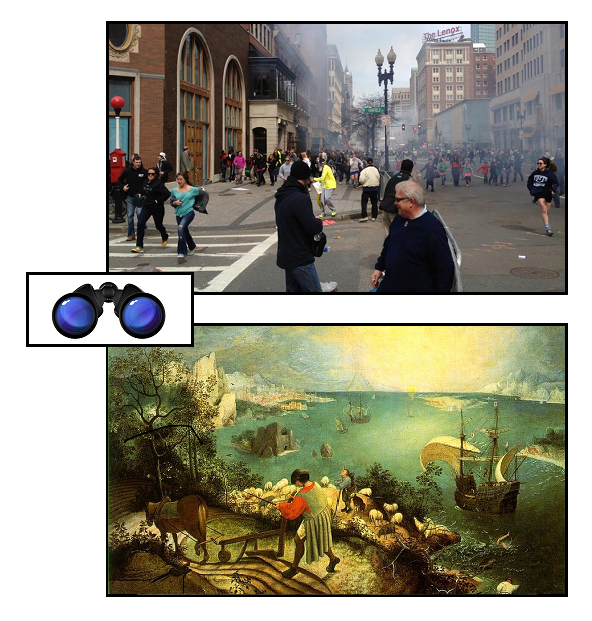
My friend Jim Friedrich, an Episcopalian priest and artist, posted a thought-provoking juxtaposition of images on FaceBook yesterday, which I have resized and cropped to fit my own DoubleQuotes format:
Fr Friedrich’s comment:
This photo snapped Monday in Boston is like Brueghel’s “Fall of Icarus.” The critical subject in each is, from the viewer’s position, just a small detail practically lost in the totality of the scene. Very strange to look at, and to think about – ethically, existentially, theologically…
About suffering they were never wrong,
The old Masters: how well they understood
Its human position: how it takes place
While someone else is eating or opening a window or just walking dully along;
How, when the aged are reverently, passionately waiting
For the miraculous birth, there always must be
Children who did not specially want it to happen, skating
On a pond at the edge of the wood:
They never forgot
That even the dreadful martyrdom must run its course
Anyhow in a corner, some untidy spot
Where the dogs go on with their doggy life and the torturer’s horse
Scratches its innocent behind on a tree.
In Breughel’s Icarus, for instance: how everything turns away
Quite leisurely from the disaster; the ploughman may
Have heard the splash, the forsaken cry,
But for him it was not an important failure; the sun shone
As it had to on the white legs disappearing into the green
Water, and the expensive delicate ship that must have seen
Something amazing, a boy falling out of the sky,
Had somewhere to get to and sailed calmly on.
**
I hope to post something tomorrow on the Mahdist video that Tamerlan Tsarnaev “liked” on FaceBook and added to his “Islam” folder. In its own way, that’s a minor — yet significant — detail, too.
[ by Charles Cameron — on peace in Northern Ireland, soldiers and Christ ]
.
The upper image is of the celebrated “Shroud of Turin” — in which it is thought by some that Jesus was wrapped to be buried, leaving a negative image of his features on its linen. Below it, the image of “a British soldier behind a bullet-resistant riot shield in Northern Ireland in 1973, during the Troubles” which heads an article by the novelist Colum McCann in today’s NY Times magazine, Remembering an Easter Miracle in Northern Ireland.
McCann writes:
PEACE, said W. B. Yeats, comes dropping slow.
After 15 years, the Good Friday peace agreement in Northern Ireland still occasionally quivers, sometimes abruptly, and yet it holds. It is one of the great stories of the second half of the 20th century, and by the nature of its refusal to topple, it is one of the continuing marvels of the 21st as well. While rockets fizzle across the Israeli border, and funeral chants sound along the streets of Aleppo in Syria, and drones cut coordinates in the blue over Kandahar, Afghanistan, the Irish peace process reaffirms the possibility that — despite the weight of evidence against human nature — we are all still capable of small moments of resurrection, no matter where we happen to be.
This is the Easter narrative: that the stone can be rolled away from the cave.
Hundred of years of arterial bitterness, in Ireland and elsewhere, are never easy to ignore. They cannot be whisked away with a series of signatures. It takes time and struggle to maintain even the remotest sense of calm. Peace is indeed harder than war, and its constant fragility is part of its beauty. A bullet need happen only once, but for peace to work we need to be reminded of its existence again and again and again.
In the twinned images above, we see the crucifixion and burial of Christ, commemorated on Good Friday and Holy Saturday, and their analog in the lives we ourselves live, in a world whose body is blooded with strife and buried in the many forms of forgetfulness and denial.
Here we should recall Wilfred Owen’s words — seeing in the soldier before him, Christ:
For 14 hours yesterday, I was at work-teaching Christ to lift his cross by the numbers, and how to adjust his crown; and not to imagine he thirst until after the last halt. I attended his Supper to see that there were no complaints; and inspected his feet that they should be worthy of the nails. I see to it that he is dumb, and stands before his accusers. With a piece of silver I buy him every day, and with maps I make him familiar with the topography of Golgotha.
In McCann’s piece we may find a modern type and hope of resurrection:
This is the Easter narrative: that the stone can be rolled away from the cave.
[ by Charles Cameron — once again noting the value of seeking out parallels before rushing to judgment ]
.
**
I’m not in a position to say whether the event at University College, London was “segregated” or not — a Muslim woman who favors separated seating and was present wrote:
As a woman, I should have the choice who I choose to mix with. The organisers were accommodating to all – for those who wanted to sit separately, and for those who wanted to sit together. During the event, 2 men demanded to sit in the women’s section in between the women, after much discussion, the organisers cleared space for them to sit – (there were so many rows), while still trying to respect the position of the women who had requested to be seated separately. A man in particular demanded to sit in between the women in order to ‘challenge their beliefs’
Meanwhile, a man who describes himself as an ex-Muslim atheist wrote:
The evening turned sour right at the outset, as attendees were herded through segregated entrances into ‘Ladies’ and ‘Gentlemen’ sections.
Five minutes of remonstration yielded a slender two-row mixed section for the debauched, with the remaining twenty devoted to good old-fashioned chastity, whilst the five rows at the back with the worst views of the stage comprised the ‘Ladies Area’.
Matters came to a head when two male attendees were forcibly evicted from a section of the auditorium which turned out to be part of the ‘Ladies’ Area’.
Incensed, they raised the matter with the organisers, but were staggered to see the organisers set the guards on them instead, this time with the express intention of evicting them from the auditorium itself for “unruly behaviour”.
This behaviour cited consisted of little more than the temerity to occupy a vacant seat in a public auditorium, and to protest one’s unjust eviction, without recourse to raised voices or physical contact.
Again, I wasn’t there. But perhaps we should think about the Perlman concert and its seating arrangements, and decide that offering seating in three sections, two “separated” for those who prefer that arrangement, and one “mixed” for those with that preference, is a civilized way to accommodate the wishes of a variety of people.
[ by Charles Cameron — on the ceremonial installations of the 266th Pope in Rome, and the 105th Archbishop of Canterbury, together with a brief excursus on getting through doors ]
.
This particular pairing of photographs is a light-hearted offering, showing the Pope being quietly and graciously assisted down the steps of St Peter’s to the open air altar, while the Archbishop of Canterbury must pretty much force his way into his own cathedral with three strong blows from his pastoral staff… both ceremonies having taken place over the last few days.
**
The gesture of beating on the church door, requesting permission to enter, is in fact an old one. Here is video of the same ceremony, as enacted on the death of the Archduke Otto von Hapsburg, when the body of that exalted aristocrat and devout Catholic was brought the Capuchin Cloister to be buried:
The text of the ceremony proceeds in a beautifully constructed threefold fashion. First, the Archduke begs admission to the church under his hereditary stiles and titles:
Prior: Who desires entry?
MC: Otto of Austria; once Crown Prince of Austria-Hungary; Royal Prince of Hungary and Bohemia, of Dalmatia, Croatia, Slavonia, Galicia, Lodomeria and Illyria; Grand Duke of Tuscany and Cracow; Duke of Lorraine, Salzburg, Styria, Carinthia, Carniola and the Bukowina; Grand Prince of Transylvania, Margrave of Moravia; Duke of Upper and Lower Silesia, of Modena, Parma, Piacenza, Guastalla, of O?wi?cim and Zator, Teschen, Friaul, Dubrovnik and Zadar; Princely Count of Habsburg and Tyrol, of Kyburg, Gorizia and Gradisca; Prince of Trent and Brixen; Margrave of Upper and Lower Lusatia and Istria; Count of Hohenems, Feldkirch, Bregenz, Sonnenburg etc.; Lord of Trieste, Kotor and Windic March, Grand Voivod of the Voivodeship of Serbia etc. etc.
It is not enough:
Prior: We do not know him.
On the second occasion, he presents himself in terms of his own accomplishments and honors:
(The MC knocks thrice)
Prior: Who desires entry?
MC: Dr. Otto von Habsburg, President and Honorary President of the Paneuropean Union, Member and quondam President of the European Parliament, honorary doctor of many universities, honorary citizen of many cities in Central Europe, member of numerous venerable academies and institutes, recipient of high civil and ecclesiastical honours, awards, and medals, which were given him in recognition of his decades-long struggle for the freedom of peoples for justice and right.
And again it is not enough, it is not simple enough:
Prior: We do not know him.
(The MC knocks thrice)
This third and final time, the appeal is simple and all too human:
Prior: Who desires entry?
MC: Otto, a mortal and sinful man.
Prior: Then let him come in.
And thus, ceremonially, neither his high position nor his accomplishments suffice the man to enter the church, whose threshold requires humility…
**
I am, I suppose, at the antipodes from many of my fellows these days — a futurist who nonetheless glories in ceremonial and tradition, believing that gestures such as the knocking on the door just described carry a symbolic impact which can move us deeply.
Accordingly, I am going to append here the two booklets containing the respective orders of service in Canterbury and Rome these last few days:
The entire ceremony of the installation of Pope Francis has been made available on YouTube, and while I do not expect many Zenpundit readers to watch it in its 4-hour entirety, I am first posting here a single excerpt, the Te Deum by Tomás Luis de Victoria sung at the conclusion of the Mass of Inauguration:
Here, for those who may be interested, and for the record, is the telecast in full:
**
I have only been able to find a severely edited BBC version of the enthronement ceremony in Canterbury, which gives little sense of the majesty of the English ritual and choral music —
There was also some African drumming, as can be seen in this (far shorter) Telegraph video:
**
By way of comparison, here is a surviving video of the coronation of HM Queen Elizabeth II in London, about sixty years ago:
I would like on some other occasion to walk you through one or more such great rituals as these, exploring the depths and symbolic meanings of such things as the red coloration of a cardinal’s robes, signifying a sworn willingness to die for the faith, and the anointing and robing of a British monarch, symbolizing her (or his) quasi-priestly function as Supreme Governor of the church…
The details of such rituals — strong statements uttered in a moment of high purpose, such as “Be so merciful that you be not too remiss, so execute justice that you forget not mercy” in the English coronation rite — can shape a lifetime, and a people.
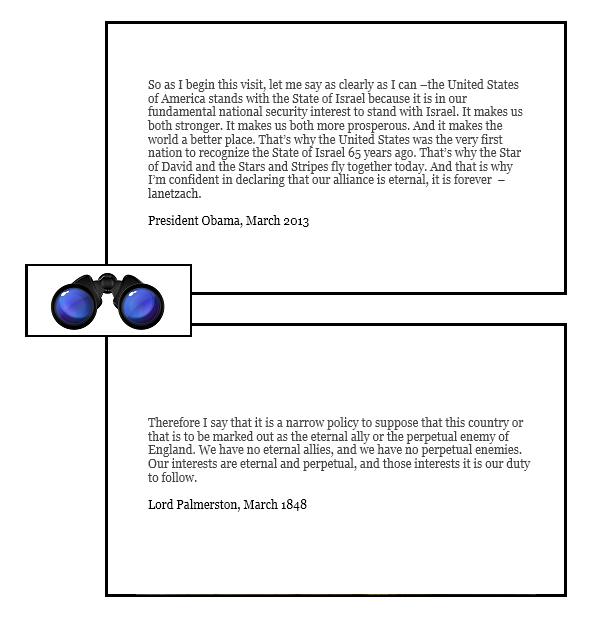
[ by Charles Cameron — a terrific example of the DoubleQuote form, drawing on Obama at Ben Gurion Airport and Palmerston in the House of Commons, and why the form is useful ]
.
Some time in between t-zero and t-aleph-null, some time between the First Day of Creation and Judgment Day, some time in between the Big Bang and the Heat Death of the Universe, there’s a stretch of time known as always.
**
What does juxtaposing the two statements allow us to understand?
That times have changed?
That what you tell a foreign government is not what you tell your own?
That Brits are more understated and Americans more plainspoken?
That President Obama is showing specific support for Israel, while Palmerston was expressing the general rule which covers all such utterances?
That the word “always” doesn’t necessarily mean “for ever”, “unto the ages of ages” as the Eastern Church has it?
Perhaps “for the foreseeable future” would be a better phrase to use, if it didn’t sound so iffy. I’d say it means something closer to “in continuity” than to “in perpetuity”.
**
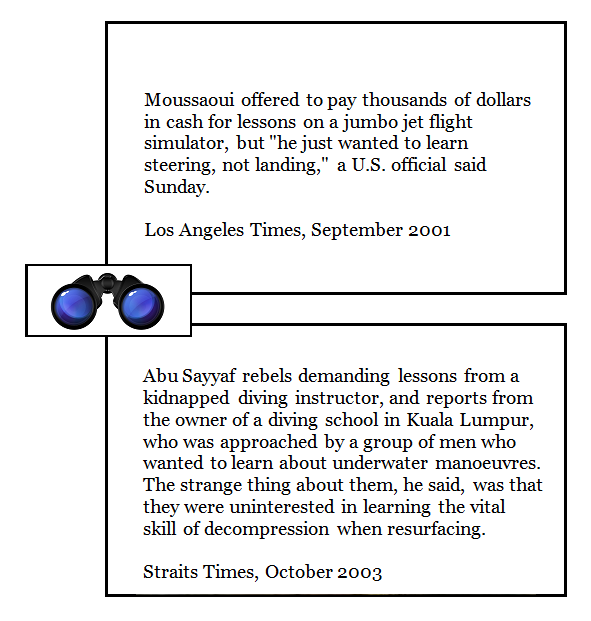
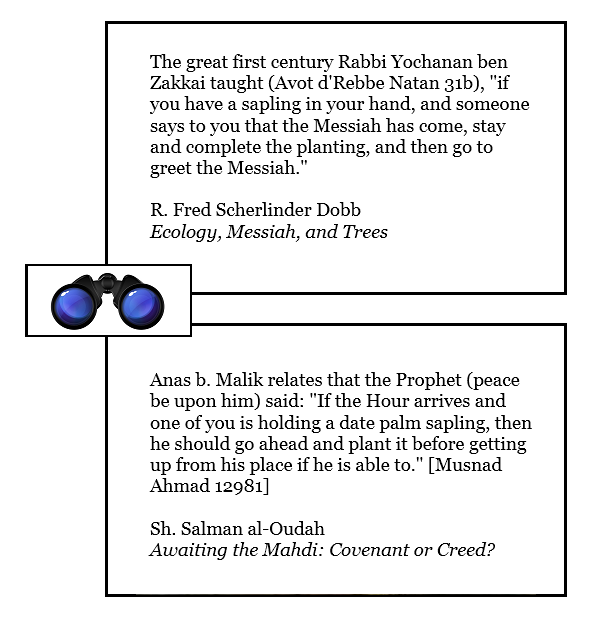
The great thing about DoubleQuotes as a form is that they jump-start you into thinking about samenesses and differences, without demanding which particular implications you will select, thus giving rise to multiple possibilities and enlarging the scope of narrative or discussion.
And while I’ve sharpened the pairing of quotes — or graphics — into a tool for repeated use, it’s already a habitual form of thinking, as we can see from the fact that these two particular quotes were juxtaposed by Sam Roggeveen in his post, America’s BFF: Obama calls it, in the Lowy Institute’s Interpreter today.
**
We naturally pair similars to contrast and compare them: it may be the most basic device that human memory affords us — this reminds me of that.
Here are a few of my own old favorites…
**
You can read Obama’s speech, from which the excerpt above was taken, on this Israel Times page.
Zenpundit is a blog dedicated to exploring the intersections of foreign policy, history, military theory, national security,strategic thinking, futurism, cognition and a number of other esoteric pursuits.