zenpundit.com » Specs

Archive for the ‘Specs’ Category

What all these measures will not address is the mindset

Monday, December 24th, 2012

[ by Charles Cameron — concerning the implications of the phrase “all things visible and invisible” ]
.
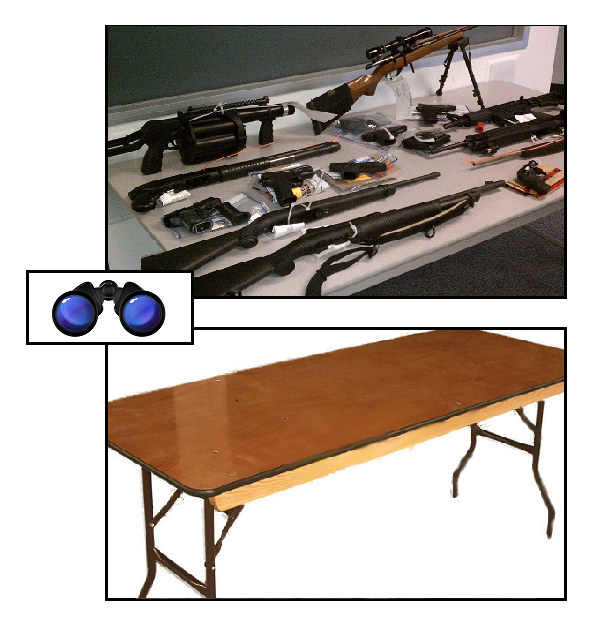
In the upper panel above, you can see a bunch of “guns and ammo” displayed on a table, and in the lower panel, a bunch of “hearts and minds” similarly displayed. Putting that another way, you can see guns and ammo but you can’t see hearts and minds — they’re invisible, you can only intuit them.

And therein lies the reason we focus so much on the quantitative and so little on the qualitative: we can see and count the one, the other is invisible and unaccountable.

**

I thought the paragraph that follows was terrific. The article I’ve taken it from happens to be about a multiple rape of a teenage girl this July in India, and it was posted on the Times of India site. If that’s an issue of importance to you, the article is Why Indian men rape by Anand Soondas. It’s not the whole article that I’m pointing you to, though — it’s just this one paragraph:

We at The Times of India in our edition today laid out a 6-point action plan to make India safer for women – harsher punishment, sensitization of the police force, setting up of fast-track courts, better patrolling, cleverer use of technology like GPS and CCTVs and a data base of public transport personnel – but what all these measures will not address is the mindset.

More specifically, I want to address you to its concluding phrase: What all these measures will not address is the mindset.

I want to re-purpose that paragraph. I want to remove the specific problem and proposed solutions, and to see the paragraph as a form, a vessel into which all manner of liquids could be poured.

The form would look something like this:

What follows is an n-point plan to make the world a better place — do x, do y, do z, do abc if it comes to that — but what all these measures will not address is the mindset.

What all these measures will not address is the mindset.

**

We almost always think about ways to fix the world, but forget that any and every fix has to work its way through not just our own mindset — though that can be a problem in itself — but also the multiple mindsets and differing culture sets of multiple others.

  • Do this, that and the other in Afghanistan — but what all these measures will not address is the mindset.
  • Do this, that and the other about Syria, about Egypt, about the Middle East, the Arab Spring — but what all these measures will not address is the mindset.
  • Do this, that and the other to combat global warming — but what all these measures will not address is the mindset.
  • Do this, that and the other about the possession and use of firearms — but what all these measures will not address is the mindset.
  • Do this, that and the other, and the world will be a far better place.
  • The thing is, you can’t simply deploy other people’s hearts and minds, the way you can deploy your own troops and materiel.

    Finding a novel use for my two-quote format..

    Sunday, December 23rd, 2012

    [ by Charles Cameron — on straight shooting, but more about logic than guns ]
    .


    .

    If you tie me down across some railroad tracks (no, that’s not me) and I can feel a train coming and you say you’ll cut me loose if and only if I vote for or against “gun control” I’ll hastily but reluctantly admit to being for it.

    The haste, you’ll understand, comes from my not wishing to be cut in three or four by the onrushing train, while the reluctance comes from my sense that my political opinions, such as they are, are usually more indicative of my generally kindly nature than of any rigorous analysis of likely first, second, third and nth order impacts of whatever it is we’re discussing.

    But okay, my sympathies are with gun control — while my awareness of my own ignorance prompts me not to put much stock in those sympathies.

    **

    But then I come across this article in Forbes, which disturbs me enough to prompt me into a new idea, a novel use for my SPECS or DoubleQuotes format.

    I’ll use that format to present you with two paragraphs from that article, one of them slightly abridged, which follow one another directly. And my question for you, as you read them, is how can the authors get from the top paragraph, with all its questions and cautious qualifications, to the one immediately below it, with its claim of unquestioning certainty.

    I’d say that the paragraph that immediately follows the first one doesn’t follow from it at all, logically speaking — I’d say there’s a non sequitur in there. And for me, that’s a novel use of the two quotes format — to suggest that someone is taking an impermissible leap.

    **

    Because as far as I can see, the only way to get from the first paragraph to the second is via a leap of hope — a determination, present from the beginning, to arrive at a fixed conclusion, in this case, that firing guns is addictive.

    As I’ve said, I have some sympathy with gun control legislation — but I don’t much like it when sympathies masquerade as science, even when I share them.

    So what do we call that kind of leap?

    Leaping to a hasty conclusion? Jumping the gun, perhaps? Jumping the shark?

    The Freeland motif

    Tuesday, December 11th, 2012

    [ by Charles Cameron — how those first seen as liberators may later be seen as oppressors ]
    .

    Sir Ian Freeland

    Lt-Gen Sir Ian Freeland, GBE KCB DSO

    I was reading up on Ian Freeland, the husband of my mother’s first cousin and lifelong best friend, in search of some details on his role in The Troubles in Northern Ireland, and ran across his comment on liberators who become oppressors, which rang a bell or two. That was a couple of days ago, and I found the same basic pattern mentioned in a post today on Gulf News:

    FWIW, Ian Freeland’s previous experiences would have been with the Mau Mau in Kenya and in Cyprus during the Makarios days.

    **

    So the purpose of this post would be to raise the question: how far back can we trace this observation, and what are the memorable examples (a) of people saying it, and (b) of events bearing it out?

    DoubleQuoting Rubio and Obama

    Friday, November 23rd, 2012

    [ by Charles Cameron — one fault-line in current American political tectonics runs through the age of the planet ]
    .

    I thought Daniel Engber‘s piece in Slate doublequoted Rubio and Obama very nicely the other day:

    The top quote is from Sen. Rubio, the second from then-Sen. Obama, and indeed, they both hedge their bets, as Engber goes on to suggest:

    1) Both senators refuse to give an honest answer to the question. Neither deigns to mention that the Earth is 4.54 billion years old.

    2) They both go so far as to disqualify themselves from even pronouncing an opinion. I’m not a scientist, says Rubio. I don’t presume to know, says Obama.

    3) That’s because they both agree that the question is a tough one, and subject to vigorous debate. I think there are multiple theories out there on how this universe was created, says Rubio. I think it’s a legitimate debate within the Christian community of which I’m a part, says Obama.

    4) Finally they both profess confusion over whether the Bible should be taken literally. Maybe the “days” in Genesis were actual eras, says Rubio. They might not have been standard 24-hour days, says Obama.

    In light of these concordances, to call Rubio a liar or a fool would be to call our nation’s president the same …

    **

    I don’t however think Engber is right in saying of Sen. Rubio — and by implication of Pres. Obama too:

    By arguing that every viewpoint has a claim to truth — that the geologists and theologians are each entitled to their own opinions — the senator gave up on dealing with reality at all.

    This runs deeper than the “age of the earth” question, it seems to me, and the two sides currently facing off on a whole slate of issues seem to articulate, respectively, these two questions

  • Doesn’t anyone recognize the truth of Revelation when they see it?
  • Doesn’t anyone recognize the truth of Science when they see it?
  • My own question — which I think has the capacity to reconcile the two — would be along the lines of:

  • Doesn’t anyone recognize the truth of Poetry when they see it?
  • **

    An afterthought:

    Current American political tectonics: an issue of homeland security?

    A Meditation In Time Of War: “precision”

    Wednesday, November 21st, 2012

    [ by Charles Cameron — comparing two species of precision and imprecision found in time of war, one which the camera can record, one which the heart must wait to learn — let us pray the cease-fire holds ]
    .

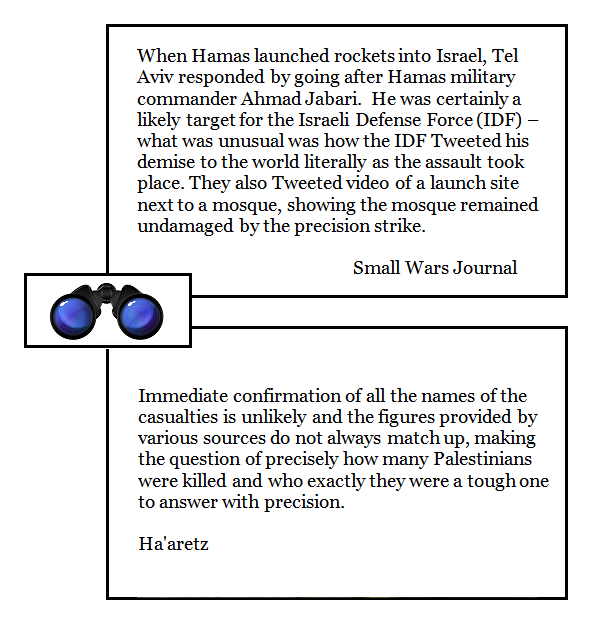
    The key phrases here are “the mosque remained undamaged by the precision strike” and “how many Palestinians were killed and who exactly they were a tough one to answer with precision” — both of which are addressing issues of precision in the course of war.

    **

    What interests me here is the notion of two kinds of precision — each of them significant, but in different ways.

    The IDF wants to publicize the precision with which it takes down its targets, and showing that

    the mosque remained undamaged by the precision strike

    is clearly preferable to admitting that

    Among the Palestinians killed in Gaza this week are the 12 members of the Daloo and Manzar families, including four small children, who died when an Israel Air Force pilot bombed their home by mistake, according to the IDF.

    War is not yet perfected.

    **

    But what of the other type of precision?

    After a certain point, numbers simply numb the mind. Eighty-seven died, or ninety-six? When I, several thousand miles distant, read a statistic of this kind, the lack of precision I can tolerate is somewhere in the region of “plus or minus twenty percent”. Thus fifty deaths would differ in my mind from a hundred, but not by much, not by as much as a human life — of which the Talmud, in Sanhedrin 37a, says: —

    Whosoever preserves a single soul of Israel, Scripture ascribes to him as if he had preserved a complete world

    as is confirmed in Qur’an 5.32:

    Therefore We prescribed for the Children of Israel that whoso slays a soul not to retaliate for a soul slain, nor for corruption done in the land, shall be as if he had slain mankind altogether; and whoso gives life to a soul, shall be as if he ha given life to mankind altogether. Our Messengers have already come to them with the clear signs; then many of them thereafter commit excesses in the earth.

    Forty-seven killed, fifty-three killed — who notices the difference?

    Six “complete worlds”, six times “mankind altogether” lies within the “margin of error” I find it hard to notice.

    **

    That, in a nutshell, is why I’m a strong Qualit advocate against the pervasive Quantification of modern life.

    The eye of the camera may record how precise a given strike was, or conversely show the collateral damage — but it is the eye of the heart which must wait in an agony of suspended grief to know who, what uncle or niece, perhaps at a Sbarro pizzeria two blocks away, may have died.


    Switch to our mobile site