zenpundit.com » Specs

Archive for the ‘Specs’ Category

Crucifixion and Resurrection, ancient and modern

Wednesday, April 18th, 2012

[ by Charles Cameron — religious resonances of the Tupac video, from the Drachenloch cave bears to today ]
.
1.

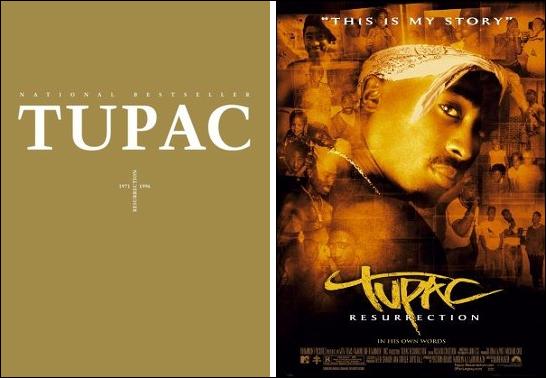
As the 2006 book and DVD covers above suggest, the themes of crucifixion and resurrection have been associated with Tupac Shakur for a while.

R.N. Bradley blogs at Red Clay Scholar and is a doctoral candidate in African American Literature and Culture at Florida State University. She makes the same connection clear in a post titled Smilin’ Serpent: the Violent Passion of Tupac Shakur on September 13, 2010:

Projects revealed Shakur’s pseudo-schizophrenic obsession with death and resurrection. These tropes manifested in videos like “I Ain’t Mad Atcha” or the collabo featuring Scarface “Smile,” and the coverart of The Don Illuminati: the 7 Day Theory(1996).

2.

Death comes before resurrection: Tupac Shakur died of gunshot wounds in 1996, after completing his final album, Makaveli — which was posthumously released:

3.

What may be more surprising is that he was brought back to something approximating life — in a holographic performance that included a duet with a decidedly non-holographic Snoop Dogg— just this week…

4.

But then, that’s religion.

Time-bound, mortal and frankly disintegrating as we are, we’d like there to be more to the story after death, and that yearning is something that religion addresses.

Perhaps to get the point across in an interesting way you’ll allow me to quote from a move in a game I played some years back:

Exploring the Drachenloch cave in Switzerland, Emil Bachler found cave bear skulls arranged in wall niches in one part of the cave, and stone tombs in another chamber containing cave bear skulls and bones. Ursus spelaeus, the cave bear, has now been extinct 10,000 years, while the Neanderthal inhabitants of the caves appear to have ceased as a species themselves about 40,000 years ago.

In Shepard and Sanders’ book, The Sacred Paw, which deals with both the natural history of the bear and its appearances in myth and ritual, Bachler surmises that his finds provide “the first evidence in man of an already awakened higher spiritual life.”

But why the bear in particular? What could we learn from the bear that we couldn’t learn anywhere else? Shepard and Sanders’ answer is that the bear seemed able to teach us how to survive bodily death. Hibernation isn’t just a “natural” phenomenon — it’s also a “spiritual” revelation… I’ll let them explain in their own words:

The bear, more than any other teacher, gave an answer to the ultimate question… an astonishing, astounding, improbable answer, enacted rather than revealed. Its passage into the earth, winter’s death, and burial under the snow was like a punctuation in the round of life that would begin again with its emergence in the spring…

The miracle was double, for the bear burst out with young — birth and rebirth. Somehow the bear knew when to reenter the world again, emerging just ahead of the snowmelt, as though its very heat set the new year in motion… Clearly the bear was master of renewal and the wheel of the seasons.

The bear ‘knows’ about death and how to survive it… She is therefore seen by traditional peoples as a guide to the movement between worlds.

So the bear is not only the first shaman, s/he’s also the first dying and rising God, and the first divine “Mother and Child” — teaching us two things that are still at the heart of religion 40,000 years later: nativity and resurrection!

5.

Death and resurrection certainly date back quite a ways. Attis, Osiris and Odin are only a few of those thought to have died and been resurrected — and indeed the early Christian writer Justin Martyr confirms (In his First Apologia XXI), the similarities between Christian and pagan teachings when he writes:

In saying that the Word, who is the first offspring of God, was born for us without sexual union, as Jesus Christ our Teacher, and that he was crucified and died and after rising again ascended into heaven we introduce nothing new beyond those whom you call sons of Zeus. You know how many sons of Zeus the writers whom you honor speak of — Hermes, the hermeneutic Word and teacher of all; Asclepius, who was also a healer and after being struck by lightning ascended into heaven –as did Dionysus who was torn in pieces; Heracles, who to escape his torments threw himself into the fire; the Dioscuri born of Leda and Perseus of Danae; and Bellerophon…

6.

Here’s the video:

7.

Max Eddy, blogging at The Geeoksystem today, not only describes the technology used to bring Tupac back to artificial life, but gives us a feel for the event:

The Tupac Hologram put on an eerie performance. When it appeared, the crowd became noticeably quiet while the show continued so achingly aware of its strangeness. The CG simulacrum even declared “I’m a ghost” during a rendition of “Hail Mary.” The ghostly, semi-transparent image went on to do two more numbers – one opposite a likely perturbed Snoop Dogg – before, no kidding, dissolving into triangles in a blaze of otherworldly light.

He also gives us an overview of the endurance of the resurrection motif within the music biz. He writes:

While I must confess ignorance to the life and body of work of Tupac, the resurrection obsession is part and parcel of the music industry. We can get specific: Back in 1995, the surviving Beatles recorded two new tracks along with unreleased demos recorded by John Lennon in 1977. Lennon had been dead since 1980. For his 75th birthday in 2010, Elvis Presley netted $60 million despite having been dead since 1977. Deceased in 2004, Ol’ Dirty Bastard still managed to appear on 2009?s “Blackroc,” a rap album put together by the Black Keys.

Though resurrections are a phenomenon that is particularly common in the music industry, it’s notable that CG recreations of dead actors haven’t broken into mainstream film. Perhaps it’s because fooling the ear is easier than fooling the eye.

Posthumous musical careers are clearly not unique to Tupac, but Shakur’s has been particularly lively. Since his death, seven albums have been released under the rapper’s name. For Forbes’ 2002 edition of the magazine’s annual list of top-earning dead celebrities, Shakur came in at number ten. A 2003 documentary about Shakur’s life, titled Tupac: Resurrection, was narrated entirely by Shakur. From 1997 on, Shakur has made 49 guest “appearances” on the tracks of other recording artists.

All of this is not to mention the rumors held by some ardent fans that Shakur is, in fact, still alive and in hiding somewhere.

8.

I don’t know whether this image is taken from an early archaeological report on the Drachenloch caves, or is just a reconstruction of what those first bear-altars with their carefully arrange skulls and bones might have looked like. I don’t really know if the dying-and-rising-god meme has been overblown or not — or the circumpolar bear cult for that matter.

But bears hibernating and coming back to life, Attis and Adonis, Christ, Arthur, the Once and Future King, more recently, Elvis sightings — and now Tupac coming back, as a hologram — it makes me wonder.

9.

I’ll give Max Eddy the final word:

When a singer is on stage, he or she is mostly their celebrity, with their humanity tucked safely away for later. At home, they are someone else, but on stage they fill a role assigned to them by their fans and perhaps by themselves. Some take it to an extreme – Ozzy bit the head off a bat. For others, it’s subtle – Roy Orbison’s dark glasses, for instance.

Unlike them, the Tupac Hologram has no humanity; it is only celebrity. The Tupac Hologram will not go home and read Shakespeare, as Shakur did. The Tupac Hologram will not make controversial political statements. The Tupac Hologram will not visit Tupac’s mother, Afeni Shakur Davis. The Tupac Hologram is empty, and we made it.

[ … ]

When we look into the Tupac Hologram, we see ourselves reflected brightly on a thin Mylar screen.

_________________________________________________________________________________________________________
A hat tip to Doug Breitbart, for suggesting I check out the Tupac video and nudging me along the way. The details of Crucifixion and Resurrection are from the superlative Isenheim Altarpiece by Matthias Grunewald (ca. 1510).

Tweeting Syria

Monday, April 9th, 2012

[ by Charles Cameron — an exchange from Easter Sunday ]
.

*

Emile Hokayem is Senior Fellow for Regional Security at the International Institute for Strategic Studies.

The 13th century Sufi poet Jalaluddin Rumi‘s sermons were collected in his Fihi ma fihi.

I posted Rumi’s words in response to Hokayem, because I find his words are as apt for Syria today as they were for scholars and princes when he first spoke them. Such truths remain true always and everywhere…

Of the real and the imaginal

Monday, April 9th, 2012

[ by Charles Cameron — from sight to vision? ]
.

*

Which of these two images — the photo above, the MC Escher print below — calls you closer? Which takes you deeper?

*

And which draws you closer here — the MC Escher print above, or the Tenniel illustration for Alice, below? Which carries you deeper?

Where does the realistic end, and the imaginal begin?

*

Marina Warner writes in the introduction to her recently reviewed book, Stranger Magic:

The faculties of imagination — dream, projection, fantasy — are bound up with the faculties of reasoning and essential to making the leap beyond the known into the unknown. At one pole (myth), magic is associated with poetic truth, at another (the history of science) with inquiry and speculation. It was bound up with understanding physical forces in nature and led to technical ingenuity and discoveries. Magical thinking structures the processes of imagination, and imagining something can and sometimes must precede the fact or the act; it has shaped many features of Western civilization. But its influence has been constantly disavowed since the Enlightenment and its action and effects consequently misunderstood.

*

For the brilliant juxtaposition of images in the upper pair, I am grateful to http://www.giovis.com/atrani.htm, with an h/t to http://www.log24.com.

Two for the Dalai Lama, and one more

Thursday, April 5th, 2012

[ by Charles Cameron – the UN panel of happiness experts, human nature on and off the freeway, and royal rainmaking in Thailand and Tanzania ]
.

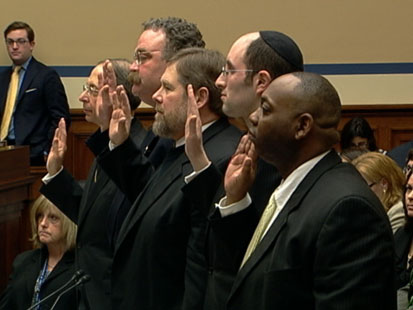
Seeings as how the Kingdom of Bhutan just convened a UN forum on the topic of Happiness and Well-being: Defining a New Economic Paradigm, I thought it might be interesting to compare the faces in reports of a recent, controversial congressional panel on contraceptive issues with those of the folks on the happiness panel:

And to be frank, neither panel looked particularly cheerful. I thought it might be nice to get away from all that seriousness, so I featured the Dalai Lama’s often playful eyes as an inset…

Seriously: is happiness something we should figure out in committee?

To be fair, though, they did have some decent guest speakers — Joan Halifax for one. My guess is, some people just bring their happiness with them.

*

And while I have the Dalai Lama in mind and in a conveniently copiable graphic, I thought I’d post a second, quick item — this one also having to do with happiness, I suppose, and raising the question of what human nature is.

When you’re stuck on the San Diego Freeway on the way back from work, you may not feel as “one with nature” as you do when you’re out for an evening walk on the beach in Malibu. But are the ribbons of the Interstate system really that different from the veining of a leaf?

I suspect that question might bring some quiet laughter to the Dalai Lama’s eyes…

Hat-tip: I have Andrea Lobel of Concordia U to thank for this second pair of images, which she very kindly sent me knowing of my delight in such pairings.

*

Time for one more?

Given my strong interest in ritual, you won’t be surprised to learn that royal rainmaking is of interest to me.

The insignia on the left is that of the Thai Bureau of Royal Rainmaking and Agricultural Aviation, founded by Thailand’s King Bhumibol Adulyadej, who holds European patents on several of his methods:

According to the notes attached to this video:

Among the best-known and most successful of His Majesty’s water provision projects has been the Royal Rainmaking programme. He began to study how clouds might be seeded to produce rain. In 1969 he carried out preliminary tests at Khao Yai National Park using a Cessna 180 and dry ice. In August 1969, he moved to Hua Hin and used two aircraft in a variety of weather conditions to determine what worked best. Initially, he financed the research with his own funds but in 1970, he sought temporary funding for a “Rainmaking Project” from the government. With it, he established the Royal Rainmaking Research and Development Institute. Based on it, he has spent succeeding years refining his techniques to accord with varying cloud conditions and to suit differing climatological and geographic areas, enjoying considerable success throughout Thailand.

On the right is the encampment for the mapolyo a mbula or ancestral offerings for rain of the Ihanzu of Tanzania.

Todd Sanders, in his book Beyond Bodies: Rainmaking and Sense Making in Tanzania, writes:

Because the Ihanzu have long depended on the rain for their very existence, it is not surprising that rainmaking is central, both conceptually and practically, to their everyday lives. They have two royal rainmakers – one male, the other female – whose job it is to ensure the rains arrive on time and fall properly each year. … Through varied rain rites carried out each year in the village of Kirumi, royal rainmakers regulate the annual movement from the dry ‘male’ season (kipasu) to the wet ‘female’ one (kitiku) and back again. These rites take various forms, as we shall see…

For a detailed account of the mapolyo a mbula rites and the legend that accompanies and explains the diagram above, see Sanders’ Reflections on Two Sticks: Gender, Sexuality and Rainmaking in Cahiers d’Etudes Africaines:

These rites take place only when the rains have utterly failed and it has been divined that the royal Anyampanda clan spirits have demanded such an offering. Offerings take place over two days, but the entire ritual sequence often lasts a month, sometimes longer. It is only the two Anyampanda royal leaders, and no one else, who can bring such rain offerings to fruition.

*

Enough, I’m done for now — I’m happy.

Of Solomon and the Ant

Thursday, April 5th, 2012

[ by Charles Cameron — King Solomon’s battle order in the Qur’an, the speech of ants, science confirms scripture, two possible directions of scriptural interpretation ]
.


.

If I might connect two recent strands of my thinking here on Zenpundit:

1.

One thing I have been puzzling over is the relationship between highly charged metaphysical realities in battle, and the physical personnel and materiel of war, in posts such as Quantity and Quality: angelic hosts at Badr and / or Armageddon and More “night watch” than “guardian angels” perhaps.

This Qur’anic passage, 27.16-19 which I shall quote in the Marmaduke Pickthall version, presents an interesting “battle order” in this regard:

And Solomon was David’s heir. And he said: O mankind! Lo! we have been taught the language of birds, and have been given (abundance) of all things. This surely is evident favour. And there were gathered together unto Solomon his armies of the jinn and humankind, and of the birds, and they were set in battle order; Till, when they reached the Valley of the Ants, an ant exclaimed: O ants! Enter your dwellings lest Solomon and his armies crush you, unperceiving. And (Solomon) smiled, laughing at her speech, and said: My Lord, arouse me to be thankful for Thy favour wherewith Thou hast favoured me and my parents, and to do good that shall be pleasing unto Thee, and include me in (the number of) Thy righteous slaves.

How’s that? “Armies of the jinn and humankind, and of the birds, and they were set in battle order…”

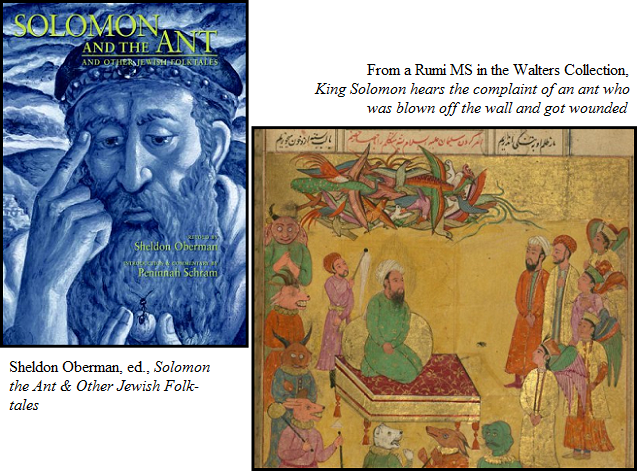
Note also the Jewish folk-tale concerning King Solomon and the ant… and Rumi’s telling, illustrated above from Walters manuscript W.626

2.

I have also been talking about mapping the conceptual way-stations that are found in conversations leading to radicalization – but that’s really just a target of opportunity for me, I am interested in mapping concepts in general. Here again, that Qur’anic passage is of interest.

That’s because it “maps” – in a very double-quote-ish way – to recent findings in science, as exemplified by:

Francesca Barbero, Jeremy A Thomas, Simona Bonelli, Emilio Balletto, Karsten Schönrogge, Queen Ants Make Distinctive Sounds That Are Mimicked by a Butterfly Social Parasite, in Science, Vol. 323 no. 5915 pp. 782-785 (2009).

Ants, it appears, talk among themselves, but the voices of their queens are distinctive: and the Maculinea rebeli butterfly larvae can mimic the speech of a Myrmica schencki queen. As reporter Jeremy Hance discussing this study puts it:

While ant vocalizations had not been as widely studied as their chemical communications, the researchers believed this might hold the key to the butterfly’s success. They recorded the vocalizations of both the ant workers and the queens, and discovered significant differences in the queens’ “dominant frequency and overall acoustics”. When the queen’s vocalizations were replayed, worker ants would gather around the caller and guard it. The researchers found that this was “consistent with the exalted status and protection afforded to queens in the hierarchy of a colony”.

Researchers then turned to the parasitical butterfly larvae, whose vocalizations were mimics of their hosts’. However, the scientists discovered that the sounds were 23 to 27 percent closer to the queens’ over the workers’, thus providing them with first-class treatment. While the butterfly larvae may use chemical resemblance to infiltrate the colony, once inside the colony it is the mimicked vocalizations that allow it to rise to the top, often at the expense of its hosts’ offspring.

3.

So ants talk, and butterfly larvae can communicate with them – successfully enough, in fact, that “living M. rebeli larvae are rescued in preference to ant larvae when a colony is disturbed,” and “nurse workers kill and feed their own brood to the social parasite if food is scarce”.

And so ants talk, and Solomon can understand them – enough so that their concerns about his army bring a laugh to his lips.

And the overlap between those two ideas – one scripturally based and dating back fourteen hundred years, the other a product of recent science – is of the kind that provides confirmation for believers of their belief along these lines:

the Qur’an says that ants speak, now science has shown this to be literally true… and this provides additional evidence that the Qur’an is Truth.

4.

Here, then, is yet another use of the “overlapping concepts” notion that I’ve explored in posts on Ada Lovelace, and more recently Nancy Fouts, Walter Benjamin, and the confluence of Hamlet and the Heart Sutra in a poem of mine…

Arthur Koestler affirms in The Act of Creation that such intersections are to be found at the heart of tragedy and catharsis, humor and laughter, and discovery and eureka: here we find them providing confirmation for religious belief.

5.

Such intersections can in practice be read in two directions, as Bernard McGinn notes in the article on Revelation he wrote for Robert Alter and Frank Kermode‘s Literary Guide to the Bible – here’s his comment on Martin Luther‘s interpretive process:

Earlier interpreters, such as Joachim (but not Augustine), had also claimed to find a consonance between Revelation’s prophecies and the events of Church history, but they had begun with Scripture and used it as a key to unlock history. Paradoxically, Luther, the great champion of the biblical word, claimed that history enabled him to make sense of Revelation…

When the overlaps are between scientific knowledge and scriptural statements, believers tend to read science as an empirical support for scripture – they don’t read scripture as supporting the findings of science.

When it comes to prophecy and fulfillment, however, the danger exists that current events will be forced into the Procrustean bed of scripture – as when JF Kennedy, Jimmy Carter, Ronald Reagan, and Barack Obama have each in turn been accused of being the Antichrist…

6.
.

.
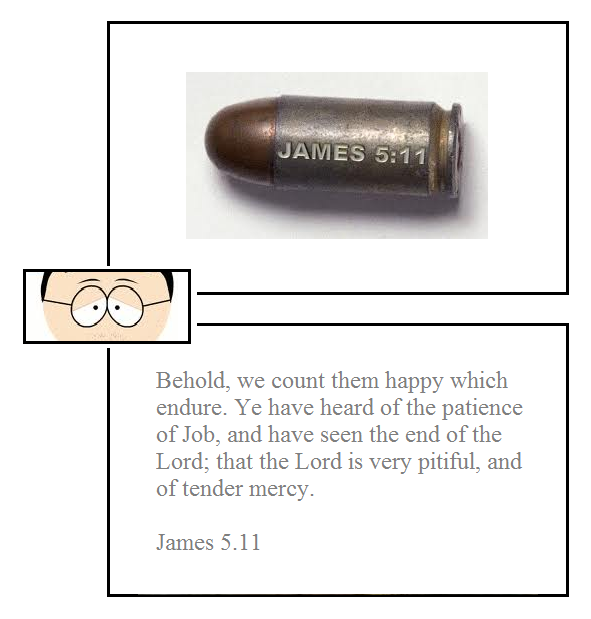
The bullet image above is available from Way 2 Worship as wallpaper for your computer screen. The verse below it, James 5.11, is the verse the bullet “cites”.

Comedy, tragedy — or inspiration?


Switch to our mobile site