zenpundit.com » Specs

Archive for the ‘Specs’ Category

Pattern recognition: backlash

Sunday, October 20th, 2013

[ by Charles Cameron — on human obstinacy, a change of heart, and what seems to me a major piece from Res Militaris ]
.

There’s a pattern of backlash that occurs when you present people with facts that don’t fit their preconceptions — they don’t switch, they double up. Here’s the opening of io9‘s report, The Backfire Effect shows why you can’t use facts to win an argument:

“Never let the facts get in the way of a good story” isn’t just a maxim for shady politicians and journalists. It’s also the way people often live their lives. One study indicates that there may even be a “backfire effect,” which happens when you show people facts that contradict their opinions.

Then there’s a study — Brendan and Jason Reifler, When Corrections Fail: The persistence of political misperceptions. I won’t go into the details, it’s the pattern it finds that’s of interest to me, but I will note that the title is a tip of the hat to Leon Festinger‘s When Prophecy Fails, a classic study in the same pattern of denial as it applied to a group whose belief in an end time prophecy was not shattered when the day arrived and the world went on as usual…

Here’s how the pattern works:

Participants in the experiments were more likely to experience the Backfire Effect when they sensed that the contradictory information had come from a source that was hostile to their political views. But under a lot of conditions, the mere existence of contradictory facts made people more sure of themselves — or made them claim to be more sure.

Everyone has experienced the frustration of bringing up pertinent facts, in the middle of an argument, and having those facts disregarded. Perhaps the big mistake was not arguing, but bringing up facts in the first place.

Okay? That’s a veeery interesting pattern to think about any time you’re considering ways to persuade people to change their minds during, for instance, a CVE campaign.

I’d like to dig into it a great deal more, of course.

**

Maajid Nawaz, a former recruiter for Hizb ut-Tahrir who renounced his membership and is now Chairman of the counter-extremist Quilliam Foundation, seems to have persuaded Tommy Robinson, until recently a leader of the English Defence League, to renounce the EDL and join Qulliam — a move whose results and second-order effects have yet to be seen. Both men, however, offer us examples of people who have in fact changed their minds on matters of profound belief, religious and political, and the odd uncomfortable fact may have played some role in those changes.

The role of anomalies (cf. “outliers”) in Kuhn‘s The Structure of Scientific Revolutions comes to mind.

And if showing people the error of their ways (a very loose equivalent of telling them unwelcome facts, I’ll admit) doesn’t work, here’s another anomaly that I ran across only yesterday, that “proves the rule” by, well, partially disproving it.

Dutch ex-politician Arnoud van Doorn, previously a senior member of Geert Wilders‘ fiercely anti-Islamic party, has changed his mind — or his heart was changed for him, within him, depending on your perspective. He has made the Shahada and is henceforth Muslim himself. In this photo, van Doorn is performing the Hajj, the pilgrimage to circumambulate the Kaaba in Mecca:

Do I detect a hint of enantiodromia here?

**

In closing, I would like to offer this link to an article in Res Militaris by Jean Baechler, titled Outlines of a psychology of war. It’s a weighty piece, as befits its grand sweep, and I believe it throws some light on the obstinacies of the mind to which this post is addressed.

I tried excerpting it, but it appeared to me that each sentence in every paragraph in turn begged to be highlighted, approved, tweaked, questioned, or disagreed with, and I wound up feeling you should read it for yourselves. I’ll be very interested to see if it captures the attention of the ZP readership, and leads to a more extended discussion…

Concerning four flags and two tees

Wednesday, October 16th, 2013

[ by Charles Cameron — a brief meditation on word and image ]
.

Flags have been in the news quite a bit recently. There were the Marine Corps and Confederate flags carried by the protester outside the White House in the upper panel below:

and the flag some protesting Native American (Lakota?) grandmothers took from the white supremacists who hoped to establish a community of the like-minded in the tiny town of Leith, North Dakota — in what one account called an improv “game” of “capture the flag”.

So that’s two protests, right there. But the title of this post suggests it will concern “four flags and two tees” — and thus far I have mentioned three flags. The fourth is the flag worn as a tee-shirt decoration by one of the Grandmothers, and as shown below (upper panel) it is in fact the flag of the American Indian Movement:

while by way of contrast, the tee worn by the confederate-and-marine-flags chap is a logo rather than a flag — it’s a Southern Thread Men’s Special Deluxe Art Tee to be exact. As the ad says:

Alone or under a snap front shirt or a button down, you can show your southern roots or the vintage inspired western look.

**

My mind is a side-winder, as you know, so all this thinking about flags and logos got me thinking too about the Logos (or Word of God) and his standard.

When the Emperor Constantine, for better or worse, co-opted Christianity or converted to it or both, his battle cry in hoc signo vinces (or in this sign you will conquer in late Barbarian, in case that’s your maternal tongue) raised the chi-rho as the sign, ensign, or battle flag — the logo if you will — of the newly baptised Roman Empire. The chi-rho — ☧ — combining the first two letters of the Greek word Christos, and meaning the Anointed One.

**

Flags and mottos are consequential things. Which comes first: the image, or the word?

Questionnaires of life or death

Monday, October 14th, 2013

[ by Charles Cameron — sometimes the answer to a simple question is a matter of life ansd death ]
.

Two days ago, the New York Times ran a remarkable article about a retired IRA gunman, Sean O’Callaghan, titled Behind Flurry of Killing, Potency of Hate. At the heart of this article was what I call a DoubleQuote in the Wild — an observed and noted parralelism, in thoughts and or events, with echoes and implications far beyond the two particular instances in question. It’s that DoubleQuote I want to present to you here, drawing on two other news reports for my presentation.

I examined the idea of a jihadist life or death questionnaire a short while back, as exemplified in the upper panel here and the Nairobi slaughter to which it refers:

When I read the second quote in the lower panel, however, it gives new context to my understanding of the first.

**

Sources:

  • BBC, Ten dead in Northern Ireland ambush
  • Telegraph, Nairobi shopping mall attacks
  • One person’s this is another person’s that

    Saturday, October 12th, 2013

    [ by Charles Cameronunder the same black flag ]
    .

    In this case, one neighborhood’s supplier of food relief (upper panel)…

    is another soldier’s execution squad (lower panel).

    Food for a Sunni neighborhood, in other words, death for the Alawite soldier.

    **

    Both images from Aaron Zelin‘s 46 Scenes From The Islamic State In Syria on BuzzFeed today — recommended.

    Raqqa, Syria: the Stations of the Cross

    Saturday, September 28th, 2013

    [ by Charles Cameron — a small devotional exercise for our sometimes too-secular world ]
    .

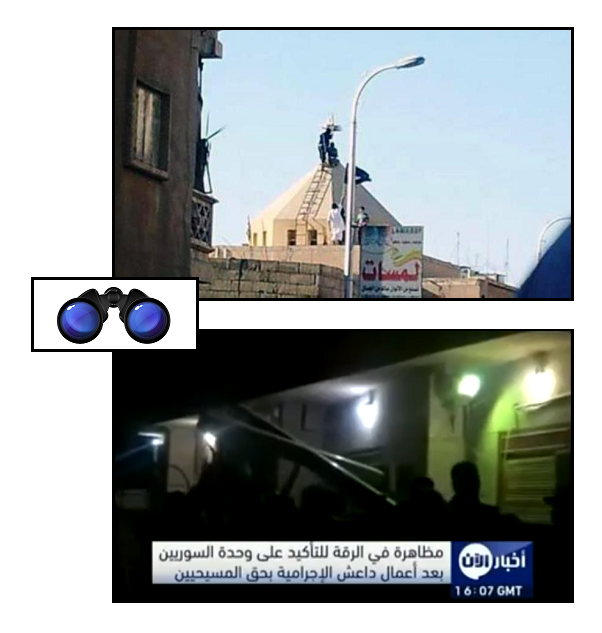
    In the upper image of the pair above, a crowd in Raqqa, Syria, is protesting the desecration of a church by Islamist enthusiasts who had pulled down the cross atop a church. The people of Raqaa took to the streets in protest, chanting:

    Syria belongs to Muslims & Christians.

    The Roman Catholic devotion known as the Stations of the Cross involves a prayerful mini-pilgrimage around fourteen “stations” representing stages in the passion and crucifixion of Christ — each of which is traditionally marked with an image of the “station” in question. In the case illustrated in the lower panel above, the station is that of Simon of Cyrene, who was pressganged into bearing the weight of the cross on his shoulders for part of the way, to give the agonized Christ some relief.

    The good people of Raqqa are thus enacting, informally, with courage and grace, the Station in which Simon of Cyrene is made to bear the cross. And there’s an echo here, too, of Christ’s injunction recorded at Luke 9.23:

    And he said to them all, If any man will come after me, let him deny himself, and take up his cross daily, and follow me.

    There’s a spontaneous beauty that crosses the lines between two world religions — and secularism — in all this.

    **

    But the cross itself also suffers its indignities, and thus the two images of the pair that follows can also be considered Stations of the Cross.

    In the upper image (below), the cross is removed by State of Iraq and al-Sham militants from its proper station atop the church, to be replaced with their black banner one of their number is holding, while in the lower image we see another screen cap of the townspeople, who have retrieved the cross and are carrying it through the streets to safety:

    The people are chanting:

    Syria belongs to Muslims & Christians.


    Switch to our mobile site