zenpundit.com » peace

Archive for the ‘peace’ Category

The Battle of Algiers / Black Friday koan

Saturday, November 17th, 2012

[ by Charles Cameron — a tale of two films, two conflicts, two cities ]
.
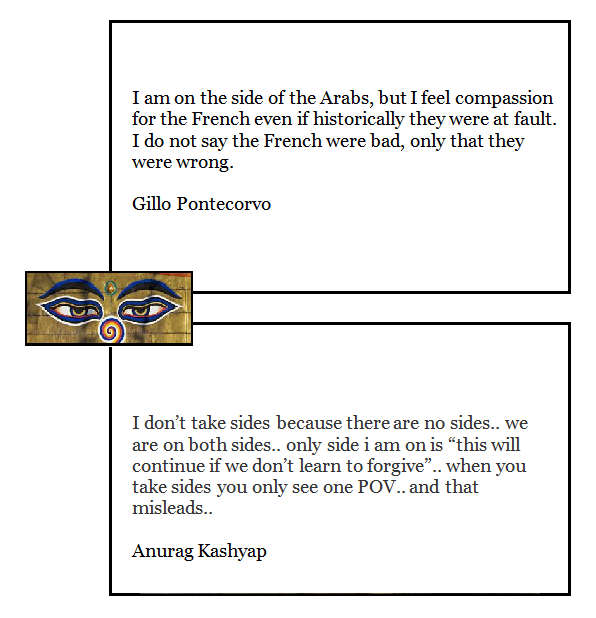
Are these two positions — take one side, take both sides — reconcilable?

That’s the koan, the paradox that’s facing me, after seeing two terrific films by these two directors again, this time back-to-back. The two films their respective directors are discussing are Gillo Pontecorvo‘s Battle of Algiers and Anurag Kashyap‘s Black Friday.

Elie Weisel triggered this set of reflections for me when I saw his stark statement of the “one side” position:

We must always take sides. Neutrality helps the oppressor, never the victim. Silence encourages the tormentor, never the tormented.

Let’s turn to the films.

**

Pontecorvo’s Battle for Algiers is a rightly-celebrated classic, and it’s opening shot confirms the director’s claim to show compassion for both sides:
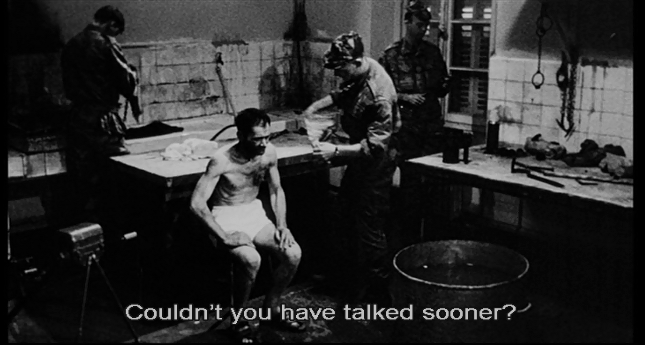
That’s an unexpected question from torturer to the victim he has just “broken”, and speaks volumes about the director’s intent — as does this quote from the french paratroop commander, Col. Mathieu, speaking of Larbi Ben M’Hidi, a leader of the National Liberation Front (FLN) whom he has captured and questioned — and who in “RL” was in fact murdered, though his death was reported at the time as a suicide:

Pour ma part, je peux seulement vous dire que j’ai eu la possibilité d’apprécier la force morale, le courage et la fidélité de Ben M’Hidi en ses propres idéaux. Pour cela, sans oublier l’immense danger qu’il représentait, je me sens le devoir de rendre hommage à sa mémoire.

For my own part, I can only tell you that I had the opportunity to appreciate Ben M’Hidi’s moral strength, his courage and his loyalty to his own ideas. On that account, and without overlooking the immense danger he represented, I feel obliged to salute his memory.

That reads to me as the respect of courage for courage.

The Pentagon, FWIW, held a screening of Battle for Algiers in September 2003, issuing a flyer indicating their reason to be interested in the film:

How to win a battle against terrorism and lose the war of ideas. Children shoot soldiers at point-blank range. Women plant bombs in cafes. Soon the entire Arab population builds to a mad fervor. Sound familiar? The French have a plan. It succeeds tactically, but fails strategically. To understand why, come to a rare showing of this film.

Yes indeed, it does sound a tad familiar.

**

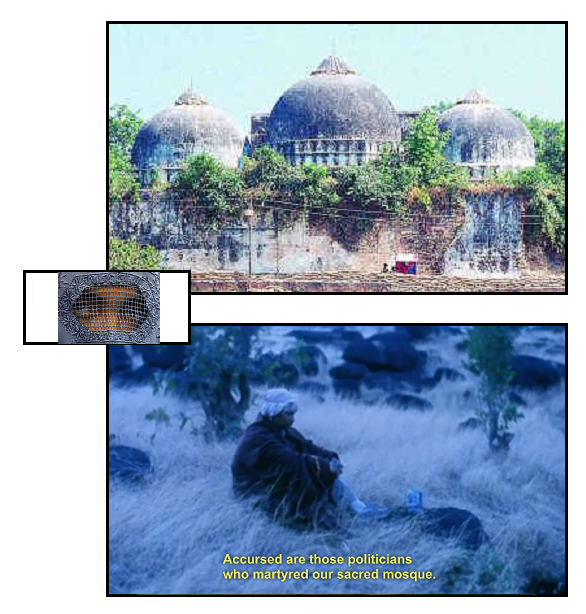
I’ll represent Kashyap’s Black Friday visually with a pair of images, the top one showing the Babri Mosque in Ayodhya / Oudh, which was leveled in December 1992 by an angry Hindu mob who claimed it had been built on the birthplace of Lord Rama, the avatar of Vishnu whose story is told in the Mahabharata

while the lower one represents Muslim rage at that event, making use of voice-over and that remarkable phrase, “martyred our sacred mosque”, to good effect.

Kashyap, then, can understand the feelings behind the horrific series of terrorist bombings that shook Bombay — as well as those of the bombed and terrorized population of that city. As Oorvazi Irani explains in her commentary on the film, Kashyap’s own views are expressed in the voice of DCP Rakesh Maria in the “chapter” on the interrogation of Badshah Khan:

Badshah Khan very proudly takes credit for the bombings and says Muslims have taken the revenge for the atrocities done to their Muslim brothers. That’s when Kay Kay Menon who plays the cop says and speaks in the voice of the director “…Allah was not on your side, on your side was Tiger Memon. He saw your rage and manipulated you. He was gone before the first bomb was even planted. ..he fucked you over. you know why? Because you were begging for it. All in the name of religion. You are a fucking idiot. You are an idiot and so is every Hindu, who murders one of you. Everyone who has nothing better to do … but to fight in the name of religion is a fucking idiot.”

**

Can there be a right side and a wrong side in a game? There can certainly be a winning side and a losing side — but a right side and a wrong side?

I ask, because the connection between wars and games is an ancient one. Can there be a right side and a wrong side in war? Looking at World War II, which was almost certainly the war that Elie Weisel was thinking of, the answer is pretty obviously yes. But what about the reasons given for “our side” being the right side?

Is our cause just because God is on our side? Because might makes right, and the big battalions are on our side? Or simply because it is our side — my country, right or wrong?

And then there is civil war to consider — for all wars are civil wars, when seen within the context of that greater “nationality”, the human race.

Abraham Lincoln, from his Second Inaugural:

Both parties deprecated war, but one of them would make war rather than let the nation survive, and the other would accept war rather than let it perish, and the war came. … Neither party expected for the war the magnitude or the duration which it has already attained. Neither anticipated that the cause of the conflict might cease with or even before the conflict itself should cease. Each looked for an easier triumph, and a result less fundamental and astounding. Both read the same Bible and pray to the same God, and each invokes His aid against the other. … The prayers of both could not be answered. That of neither has been answered fully. The Almighty has His own purposes…

The whole issue of the just war — or of jihad, its Islamic approximate equivalent — revolves around the question of whether there can be a wrong side in war.

**

If there can be a wrong side, it may be shredded. As Mark Twain once prayed:

O Lord our Father, our young patriots, idols of our hearts, go forth to battle — be Thou near them! With them — in spirit — we also go forth from the sweet peace of our beloved firesides to smite the foe. O Lord our God, help us to tear their soldiers to bloody shreds with our shells; help us to cover their smiling fields with the pale forms of their patriot dead; help us to drown the thunder of the guns with the shrieks of their wounded, writhing in pain; help us to lay waste their humble homes with a hurricane of fire; help us to wring the hearts of their unoffending widows with unavailing grief; help us to turn them out roofless with little children to wander unfriended the wastes of their desolated land in rags and hunger and thirst, sports of the sun flames of summer and the icy winds of winter, broken in spirit, worn with travail, imploring Thee for the refuge of the grave and denied it — for our sakes who adore Thee, Lord, blast their hopes, blight their lives, protract their bitter pilgrimage, make heavy their steps, water their way with their tears, stain the white snow with the blood of their wounded feet! We ask it, in the spirit of love, of Him Who is the Source of Love, and Who is the ever-faithful refuge and friend of all that are sore beset and seek His aid with humble and contrite hearts. Amen.

**

There are things to be said for being on the winning side of a conflict: you get to write history. There may be things to be said for being on the losing side: you gain the sympathy that accrues to the underdog. There are things to be said for supporting neither side, for being on the sidelines to pick up the pieces.

Then again, as Buddha observed in the Dhammapada, there are disadvantages to being on either side —

Victory breeds hatred. The defeated live in pain. Happily the peaceful live giving up victory and defeat.

while Christ muddies the simplicity of the whole business with a further contrarian note:

love your enemies.

Peace is not a bad side to be on, but perhaps love is more nuanced.

**

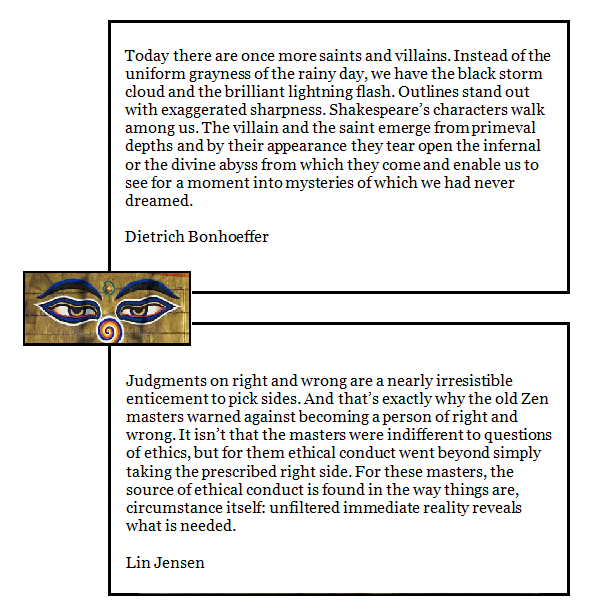
To bring us full circle, here’s another statement of the Elie Weisel position, this time in the words of Dietrich Bonhoeffer, the Lutheran pastor and theologian involved in the plot to assassinate Hitler and executed in one of the concentration camps — together with a response to the question I’ve been posing for myself here which may perhaps providinge some measure of reconciliation, this one from a contemporary Zen Buddhist, someone for whom the appreciation of koans is a way of life:
Does Culture Trump Strategy?

Thursday, November 1st, 2012

The always interesting John Hagel tweeted a link recently to an old post at  Mill’s-Scofield Innovanomics, a blog run by a business strategist and consultant with a science background, Deb Mills-Scofield.

Summer’s Trump Cards 

….Culture Trumps Strategy: The best made plans are worthless if they’re not aligned with the culture. Sometimes the strategy can help transform the culture (for good or bad), but if the culture doesn’t support it, it won’t happen.  Perhaps that’s why I think CEOs need to be CCS’s – Chief Culture Stewards.

Challenge:  Start to check the health of your culture – really, be brutally honest -before the end of August.

This was interesting to me.

Obviously, Mills-Scofield was concerned here with “business strategy” and organizational theory and not strategy in the classical sense of war and statecraft. As Dr. Chet Richards has pointed out, unlike a military leader in war, businessmen are not trying to destroy their customers, their employees or even their competition, but while not the same kind of “strategy”, the underlying cognitive action, the “strategic thinking”,  is similar. Perhaps the same.

So, shifting the question back to the original context of war and statecraft, does culture trump strategy?

On twitter, I had a brief twitter discussion on this with Marc Danziger who was sympathetic to the proposition of cultural supremacy. I am not so sure, though I think the relationship between culture and strategy is an iterative one, the degree to which culture matters in strategy is highly contextual and is determined by how broadly you define cultural values as being directly operative in driving the scenario. Some disjointed comments:

  • Your own cultural-societal worldview shapes politics, policy and politik. So indirectly, culture will be a determining factor in conceiving “Ends” worth spilling blood and dying for – particularly in wars of choice. When war, especially existential conflict is forced upon a state by an enemy attack, some of the initiative and room for constructing artful or limited “Ends” has been lost and becomes secondary to survival. Even Stalin’s normally overweening and murderous ideological preferences mattered somewhat less in Soviet policy and strategy the day after Operation Barbarossa began than the day before.
  • If the Ends in view imply forcing a political settlement upon the enemy – “compelling him to do our will” – than the enemy’s culture matters a great deal. All the moreso, if the war entails COIN, military governance of an enemy population and reconstructing an enemy state to our liking. The enemy culture is part of the operational environment because our use of military force (destruction) is going hand in glove with substantial political activity (construction) – mere physical control of the population is not enough, though it is a precondition for success. MacArthur’s role as SCAP in post-war Japan demonstrated an exceptionally shrewd blend of coercion and concession to traditional Japanese cultural touchstones.
  • If our Ends are much more limited – degrading enemy operational capacity and/or simple, spasmodic, punitive expeditions to impose costs on an enemy state or entity in retaliation for aggression; or, if we intend to stand off-shore and strike with air and naval superiority – than the enemy culture matters far less. Force is being used to “bargain” at a very primitive level that does not require much cultural nuance to understand and the message of “we will hit back” . Likewise, if the war is an unlimited one of extermination and Carthaginian peace, enemy culture matters far less than your military capacity to execute your strategy.
  • Your cultural worldview shapes your grand strategy or statecraft because great and lesser powers are not coldly playing chess for material interests alone when they engage in geopolitical conflict and warfare but are establishing, evolving and protecting a national identity on the world stage. What Thucydides called “Honor”, the British “Paramountcy”, Richard Nixon “Credibility” and Joseph Nye “Soft Power” may all have been intangible expressions, difficult to quantify, but are very much part of the strategic calculus of war and peace.
  • Finally, it is important to note that strategic employment of brute force has a large role in setting the parameters of where and when cultural nuance and interpretation matter and exercise political leverage during war. Extreme violence disrupts and warps the cultural norms of belligerents, usually for the worse. It was the wars of the French Revolution and Napoleon that awoke the romantic pan-German nationalism of the 19th century that eventually united Germany and transformed it into the terror of the world in the 20th. The First World War ushered in a century of ideological monstrosities and revolutionary state terrorism on an epochal scale of murder unequaled even by the butchery of the Romans or Mongols. War is often the Abyss that looks into you.

Thoughts?

The war and peace paradox, take 2: of wolves and music

Tuesday, October 30th, 2012

[ by Charles Cameron — second take on the paradox, this time featuring wolves, poetry, lions, honey, and Bach ]
.

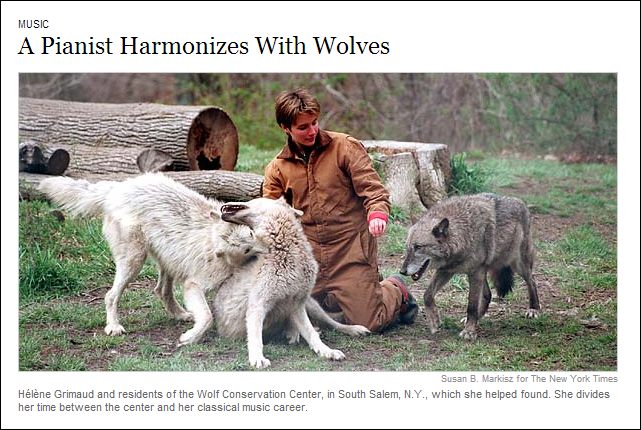
eye-catching headline & image from the New York Times, 2008

.

I’m always trying to see war and peace — violence and gentleness, if you like — in counterpoint rather than in opposition. The distinction is a subtle one, I know, but that’s the task. I tackled it from one angle a few days ago in this earlier post, and imagine I’ll return to it again from time to time.

**

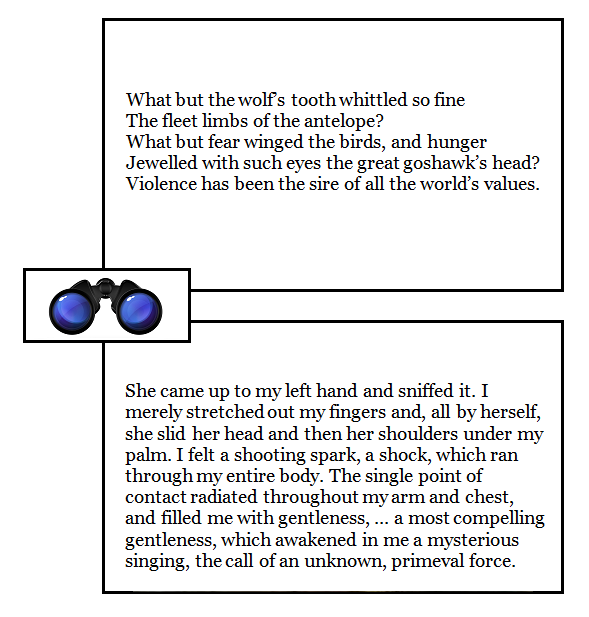
I was fascinated to run across two very different artists talking about wolves these last few days. Robinson Jeffers, in his great poem The Bloody Sire, sees the wolf’s violence (upper panel) as bringing speed and grace to the antelope:

while the extraordinary pianist Hélène Grimaud describes her first encounter with a wolf (lower panel) in terms of gentleness.

After that striking first encounter with a wolf, Grimaud went on to found the Wolf Conservation Center in upstate New York (see NYT article by clinking on image at top of this post).

**

There’s a longish and fairly erotically, religiously and violently charged story in chapter 14 of the book of Judges. Samson, so the story goes, took a liking to a woman of the Philistines, and despite his parent’s urgings went down to see her because, as he delicately put it, “she pleaseth me well.” Along the way he meet a young lion, and “rent him” — tore him apart with his bare hands — “as he would have rent a kid” — here meaning a young goat. Samson continued to like the look of the women of the Philistines, we are told, and on his next visit down to see her, “he turned aside to see the carcase of the lion: and, behold, there was a swarm of bees and honey in the carcase of the lion. And he took thereof in his hands, and went on eating, and came to his father and mother, and he gave them, and they did eat…”

Samson, it seems, was a gambling man, and he soon proposed a bet and a riddle to his bride’s companions — for somewhere around that time they had married, a fact that the story teller omits to tell us in so many words — giving them seven days to solve it:

Out of the eater came forth meat, and out of the strong came forth sweetness.

The companions, of course, could not solve the riddle, since they had not seen the lion, nor its carcase with its swarm of bees and honey… but they pleaded with his new wife so piteously that she pleaded with her new husband so piteously that he revealed the secret to her, and on the seventh day her Philistine companions won the bet and answered Samson’s riddle:

What is sweeter than honey? And what is stronger than a lion?

To which poor Samson replied:

If ye had not plowed with my heifer, ye had not found out my riddle.

The marriage didn’t last — and, we are told, “his anger was kindled…”

**

I certainly heard this story intoned in chapel at one school or another, but recognized neither the eroticism nor the violence nor the significance of the religious enmity between monotheistic Jew and pagan Philistine…

But my mother did make us pancakes on rare and wonderful occasions, and on them I lavished farm butter and Tate and Lyle‘s glorious Golden Syrup, with its image of Samson’s lion and the honey bees:

and the Tate and Lyle motto: Out of the strong came forth sweetness.

It’s that sweetness — that image of the lion and those bees more than the Biblical story itself — that I remember…

**

I am grateful to Steve Engel for bringing Robinson Jeffers’ poem to my attention this last week, and to J Scott Shipman of this blog for introducing me to Hélène Grimaud’s playing of the Bach Chaconne on YouTube:

Out of the strong came forth sweetness indeed.

The war and peace paradox

Saturday, October 27th, 2012

[ by Charles Cameron — a paradox in two graphics ]
.


.
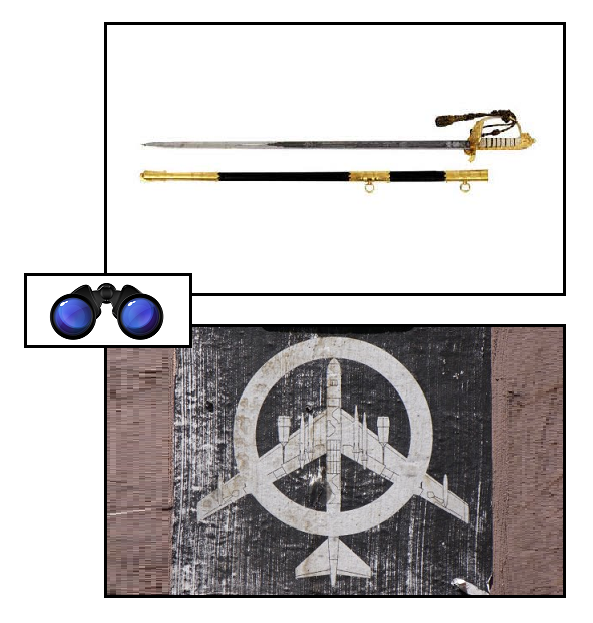
The upper image shows the British “Firmin Sword of Peace” which was awarded this week to the 15 (UK) Psychological Operations Group (15 POG) for their work in Afghanistan. The Ministry of Defence news report described the award thus:

The prestigious Firmin Sword of Peace is given to the unit or establishment of each Service judged to have made the most valuable contribution to humanitarian activities by establishing good and friendly relations with the inhabitants of any community at home or overseas.

The lower image shows an artistic rendering of the peace symbol, seen on a wall in Melbourne, Australia, which is consonant with the old Strategic Air Command motto: Peace is our Profession.

**

Here there be paradox.

Of films, riots and hatred I: Benedict XVI in Lebanon

Sunday, September 16th, 2012

[ by Charles Cameron — where to begin? let’s start with peace ]
.

Photo credit: Ciro Fusco, EPA

.

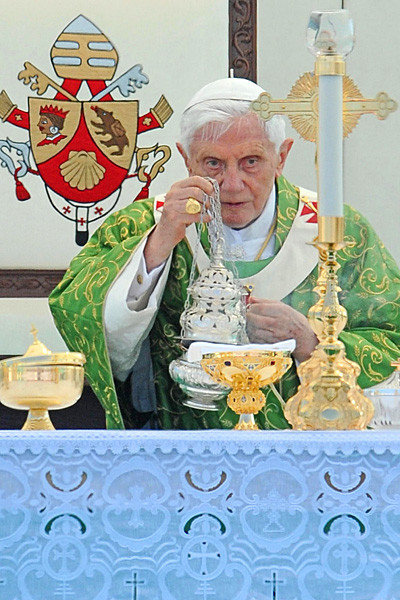
Pope Benedict XVI has been in the Lebanon these last three days, and after an extremely turbulent week in which many discordant religious and / or “religious” notes have been sounded, I thought I’d begin what I imagine will be a series of posts from my POV on the mayhem with some words of peace (Heb: Shalom; Ar: Salaam) from the Pontiff, seen above celebrating an open air mass on the Beirut beachfront.

**

The Pope was in the Lebanon to sign a Catholic document of some significance, the Apostolic Exhortation Ecclesia in Medio Oriente, and it is from that document that I would like to extract some specific paragraphs:

Here’s the kernel of the situation as the Pope sees it, going into it —

How many deaths have there been, how many lives ravaged by human blindness, how many occasions of fear and humiliation! … How sad it is to see this blessed land suffer in its children who relentlessly tear one another to pieces and die!

— grief at human folly.

**

Benedict then begins to address the situation, offering us his definition of peace:

For the sacred Scriptures, peace is not simply a pact or a treaty which ensures a tranquil life, nor can its definition be reduced to the mere absence of war. According to its Hebrew etymology, peace means being complete and intact, restored to wholeness. It is the state of those who live in harmony with God and with themselves, with others and with nature.

Since we are not yet in harmony with each other…

Authentic witness calls for acknowledgment and respect for others, a willingness to dialogue in truth, patience as an expression of love, the simplicity and humility proper to those who realize that they are sinners in the sight of God and their neighbour, a capacity for forgiveness, reconciliation and purification of memory, at both the personal and communal levels.

He observes that such a dialogue should be theologically oriented rather than politically driven:

The Church’s universal nature and vocation require that she engage in dialogue with the members of other religions. In the Middle East this dialogue is based on the spiritual and historical bonds uniting Christians to Jews and Muslims. It is a dialogue which is not primarily dictated by pragmatic political or social considerations, but by underlying theological concerns which have to do with faith.

This dialogue can be grounded in in the one God common to the Abrahamic faiths:

Jews, Christians and Muslims alike believe in one God, the Creator of all men and women. May Jews, Christians and Muslims rediscover one of God’s desires, that of the unity and harmony of the human family. May Jews, Christians and Muslims find in other believers brothers and sisters to be respected and loved, and in this way, beginning in their own lands, give the beautiful witness of serenity and concord between the children of Abraham.

It will demand humility rather than triumphalism:

The truth cannot unfold except in an otherness open to God, who wishes to reveal his own otherness in and through my human brothers and sisters. Hence it is not fitting to state in an exclusive way: “I possess the truth”. The truth is not possessed by anyone; it is always a gift which calls us to undertake a journey of ever closer assimilation to truth. Truth can only be known and experienced in freedom; for this reason we cannot impose truth on others; truth is disclosed only in an encounter of love.

I imagine that some will find here an echo of the Qur’an:

Let there be no compulsion in religion.

— Quran 2. 256

Thus far the pope has expressed his grief at the circumstances, and outlined the basic issues between religions. He now turns his analysis to the situation within the religions:

Like the rest of the world, the Middle East is experiencing two opposing trends: secularization, with its occasionally extreme consequences, and a violent fundamentalism claiming to be based on religion.

Benedict is well know for his opposition to the “occasionally extreme consequences” of secularism: here he speaks in favor of what he terms “healthy secularity”.

Some Middle Eastern political and religious leaders, whatever their community, tend to look with suspicion upon secularity (laïcité) as something intrinsically atheistic or immoral. It is true that secularity sometimes reduces religion to a purely private concern, seeing personal or family worship as unrelated to daily life, ethics or one’s relationships with others. In its extreme and ideological form, secularity becomes a secularism which denies citizens the right openly to express their religion and claims that only the State can legislate on the public form which religion may take. [ … ]

A healthy secularity, on the other hand, frees religion from the encumbrance of politics, and allows politics to be enriched by the contribution of religion, while maintaining the necessary distance, clear distinction and indispensable collaboration between the two spheres.

Religious fundamentalism is the second challenge the Pope addresses:

Economic and political instability, a readiness on the part of some to manipulate others, and a defective understanding of religion help open the door to religious fundamentalism. This phenomenon afflicts all religious communities, and denies their long-standing tradition of coexistence. It wants to gain power, at times violently, over individual consciences, and over religion itself, for political reasons.

Here he addresses his colleagues in religious leadership:

I appeal urgently to all Jewish, Christian and Muslim religious leaders in the region to seek, by their example and by their teaching, to do everything in their power to eliminate this menace which indiscriminately and fatally affects believers of all religions.

He then drives the point home by quoting his own words on an earlier occasion:

“To use the revealed word, the Sacred Scriptures or the name of God to justify our interests, our easy and convenient policies or our violence, is a very grave fault.”

**

That’s the substance of the Pope’s message in the context of recent disturbances in the region. There were a couple of notes he touched on, however, that interested me not for any connection with recent events, but for specific theological connotations:

Growth by individuals in the life of faith and spiritual renewal within the Catholic Church will lead to the fullness of the life of grace and theosis (divinization).

Theosis is a term more commonly found among Eastern Christians, and I wouldn’t want to define the doctrine in words, though I’ll suggest that its spirit is captured in the English mystic Thomas Traherne‘s magnificent meditation [Century I. 29]:

You never enjoy the world aright, till the Sea itself floweth in your veins, till you are clothed with the heavens, and crowned with the stars: and perceive yourself to be the sole heir of the whole world, and more than so, because men are in it who are every one sole heirs as well as you. Till you can sing and rejoice and delight in God, as misers do in gold, and Kings in sceptres, you never enjoy the world.

One of Benedict’s comments specifically addresses an issue of importance as Christianity and Islam find common ground in the Middle East:

In those unfortunate instances where litigation takes place between men and women, especially regarding marital questions, the woman’s voice must also be heard and taken into account with a respect equal to that shown towards the man, in order to put an end to certain injustices.

He gives an account of the Catholic doctrine of scriptural interpretation, which will be of interest to those concerned with such things in specifically Catholic, more generally Christian or comparative contexts:

The representatives of the various schools of textual interpretation were agreed on the traditional principles of exegesis accepted by the Churches of both East and West. The most important of these principles is the conviction that Jesus Christ incarnates the intrinsic unity of the two Testaments and consequently the unity of God’s saving plan in history (cf. Mt 5:17). The disciples would only come to understand this unity after the resurrection, once Jesus had been glorified (cf. Jn 12:16). A second principle is fidelity to a typological reading of the Bible, whereby certain Old Testament events are seen as a prefiguration (a type and figure) of realities in the new Covenant in Jesus Christ, who is thus the hermeneutical key to the entire Bible (cf. 1 Cor 15:22, 45-47; Heb 8:6-7). The Church’s liturgical and spiritual writings bear witness to the continued validity of these two principles of interpretation, which shape the ecclesial celebration of the word of God and inspire Christian witness. The Second Vatican Council went on to explain that the correct meaning of the sacred texts is found by considering the content and unity of the whole of Scripture, in the light of the living Tradition of the whole Church and the analogy of faith.

He also addressed the question of liturgical renewal, in a similar spirit, both orthodox (little o) and catholic (little c):

Such a renewal must of course be undertaken, to the extent possible, in cooperation with those Churches which are not in full communion, yet are also heirs to the same liturgical traditions. The desired liturgical renewal must be based on the word of God, on the proper tradition of each Church, and upon the new insights of Christian theology and anthropology.

As an aside — anthropology is an interesting word to have made its way into that statement. I must admit I am not sure whether he’s in any way suggesting something along the lines of “cultural anthropology” — which has a fair amount to say about ritual and how it functions — but I’m pretty sure his main meaning here is something closer to the original meaning of the word — along the lines of the “sound understanding of man” that he’d mentioned in an earlier passage in the Exhortation.

One passage suggested to me that Benedict might be alluding to the Muslim terminology of the Companions of the Prophet, and suggesting some measure of similarity with the disciples of Christ:

By rediscovering its original inspiration and following in the footsteps of those first disciples whom Jesus chose to be his companions and whom he sent out to preach (cf. Mk 3:14), the Christian presence will take on new vitality.

I’m hoping that will prove to be a deft touch, a tiny but significant gesture of friendship.

**

Finally, Pope Benedict makes another reference which must have resonated with his Eastern Catholic and Orthodox co-religionists, returning to the grief with which he began his orations, appealing to Mary as Theotókos, “the one who gives birth to the one who is God”:

The heart of Mary, Theotókos and Mother of the Church, was pierced (cf. Lk 2:34-35) on account of the “contradiction” brought by her divine Son, that is to say, because of the opposition and hostility to his mission of light which Christ himself had to face, and which the Church, his mystical Body, continues to experience. May Mary, whom the whole Church, in East and West alike, venerates with affection, grant us her maternal assistance. Mary All-Holy, who walked in our midst, will once again present our needs to her divine Son. She offers us her Son. Let us listen to her, for she opens our hearts to hope: “Do whatever he tells you” (Jn 2:5).

In so doing, he remembers also, and reminds us all, of those who are martyred for their Christianity in a world where religion can so often be your excuse to kill, or another’s excuse to kill you.


Switch to our mobile site