zenpundit.com » Buddhism

Archive for the ‘Buddhism’ Category

Religions in the speech of Malala Yousafzai

Saturday, July 13th, 2013

[ by Charles Cameron — a speech worth close attention ]
.


.

I bypassed several opportunities to hear or read Malala‘s speech today, until Shivam Vij tweeted that she had mentioned Badshah Khan. That caught my attention — Khan is not the most well-known of figures, but he’s one that I admire — and when I watched Malala’s speech, I found him in some pretty significant company:

I do not even hate the Talib who shot me. Even if there was a gun in my hand and he was standing in front of me, I would not shoot him. This is the compassion I have learned from Mohammed, the prophet of mercy, Jesus Christ and Lord Buddha. This the legacy of change I have inherited from Martin Luther King, Nelson Mandela and Mohammed Ali Jinnah. This is the philosophy of nonviolence that I have learned from Gandhi, Bacha Khan and Mother Teresa. And this is the forgiveness that I have learned from my father and from my mother. This is what my soul is telling me: be peaceful and love everyone.

That’s really quite a paragraph. And if the lives and thoughts of Gandhi or Mother Theresa, Mandela or Martin Luther King, Buddha, Christ or Muhammad seem important to you, and you are unaware of Bacha or Badshah Khan, I can recommend to you Eknath Easwaran‘s Nonviolent Soldier of Islam: Badshah Khan: A Man to Match His Mountains.

In these times of religious conflict too, it is worth noting that this young Muslim woman speaks, on her sixteenth birthday and before the UN General Assembly, of the inspiration she has received not only from fellow Muslims — from the Prophet of her own faith, Muhammad, from the Father of her Nation, Muhammad Ali Jinnah, and from Benazir Bhutto, whom she terms shahid or martyr — but also from Buddha, Christ, and Gandhi, a Hindu.

**

As my regular readers know, I make a habit of noting patterns where I can find them, so I was struck by one rhetorical trope in particular within Malala’s speech:

Dear sisters and brothers, we realize the importance of light when we see darkness. We realize the importance of our voice when we are silenced. In the same way, when we were in Swat, the north of Pakistan, we realized the importance of pens and books when we saw the guns.

The relationship is a subtle one: darkness is juxtaposed to light not as silence is to voice but as being silenced is — while in the third clause, pens and books is to guns as darkness is to light, a powerful and thought-provoking juxtaposition.

**

Malala’s speech, full text:

Our books and our pens are the most powerful weapons

Malala’s speech in video:

Of dualities, contradictions and the nonduality

Thursday, June 27th, 2013

[ by Charles Cameron — on the basis, the mathematics, the essence of conflict and resolution ]
.


.

This DoubleQuote features two great masters on duality and the coincidentia oppositorum: the upper quote is Yogi Berra at his best, a koan worthy of a discourse by John Daido Loori, Roshi, while the lower image a still from Andrei Tarkovsky‘s first feature film, Ivan’s Childhood — which I stole from the ever-bountiful Gwarlingo.

Two is one and one is all and evermore shall be so.

**

Two into one won’t go, they told me in my schooldays — though not with nearly as much rigor as I presume is found in this article in Physics B

Questions of the two and the one are always of interest, because they are played out in the tensions we are faced with in daily life, and specifically in the tug of war with peace.

Thus, from my miscellaneous readings these past few days, they feature everywhere from a headline like Demonizing Edward Snowden: Which Side Are You On? in the New Yorker, who seem to feel that one should take a side, preferably the one with the least guns:

I’m with Snowden — not only for the reasons that Drake enumerated but also because of an old-fashioned and maybe naïve inkling that journalists are meant to stick up for the underdog and irritate the powerful. On its side, the Obama Administration has the courts, the intelligence services, Congress, the diplomatic service, much of the media, and most of the American public. Snowden’s got Greenwald, a woman from Wikileaks, and a dodgy travel document from Ecuador. Which side are you on?

to some relatively arcane areas of theological debate, in this case Fussing Over the 15th of Sha‘ban:

Question: Is marking out the 15th night of Sha’ban (laylat al-nisf min sha’ban) with extra prayers and devotion sanctioned by Islam, or is doing so judged to be a reprehensible innovation (bid’ah)?

Answer: Each year, a fair amount of fussing and fighting takes place over this issue. Yet the truth of the matter is that scholars have long-held this issue to be one over which there is a valid difference of opinion. The first group considered the night to have no specific virtues over and above any other night of the year, and believed that singling the night out for extra acts of worship is unsanctioned. Another group begged to differ and held that the middle night of Sha’ban does possess special merits and should be earmarked for extra prayers and devotion.

All those who hold the shari’ah to lack nuance and variety, incidentally, would do well to note (a) that it is far from exclusively devoted to the chopping off of hands or feet, and (b) combines within itself debates worthy of the Tannaim and Amoraim, or of the medieval scholastics of the Roman church…

**

By way of closure, here’s the koan from Alice in Wonderland that Loori Roshi studies in his discourse:

The caterpillar said, “One side will make you grow bigger, and the other side will make you grow smaller.” “One side of what? The other side of what?” thought Alice to herself. “Of the mushroom,” said the caterpillar. Alice looked at the mushroom, trying to make out which were the two sides of it, as it was perfectly round.

If you love your enemies [Matthew 5.44], Who’s side are you on?

And here’s what the great Cardinal Nicholas Cusanus had to say about dualities and opposites in his Of the Vision of God:

I have learned that the place wherein Thou art found unveiled is girt round with the coincidence of contradictories, and this is the wall of Paradise wherein Thou dost abide

Of Alice, Angels and Apsaras

Wednesday, May 15th, 2013

[ by Charles Cameron — squeezed between the space of astronomers and the paradise of the believers, is there yet room for the dancing play of poetry, music and imagination? ]
.

My first question for you today would be — do you believe in Alice?

And further to that, do you believe in the Red Queen?

**

Two things collided to cause me to write this post today. First, Emptywheel opened her blog post on Putin’s outing of an American spy today with a quote from Lewis Carroll:

‘I declare it’s marked out just like a large chessboard!’ Alice said at last. ‘There ought to be some men moving about somewhere–and so there are!’ she added in a tone of delight, and her heart began to beat quick with excitement as she went on. ‘It’s a great huge game of chess that’s being played–all over the world -– if this is the world at all, you know. Oh, what fun it is!’

I can’t really ignore Lewis Carroll when he crops up in my morning feed like that: he’s a Christ Church man and a poet, as I am, and it would be rude of me to ignore him. And besides, what he’s on about here is the world-as-game concept, which is never far from my mind — hence my inclusion of that question about the Red Queen.

**

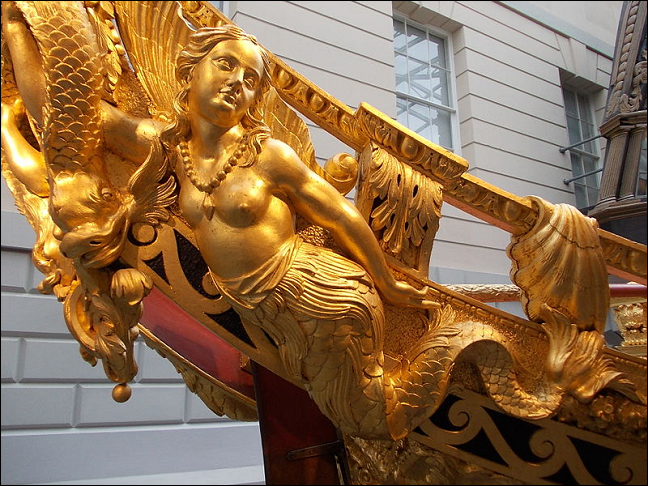
And second, mermaids.

.

It gets more interesting, you see. Because what collided with that first question was a conversation @khanserai aka Humera Khan was having with @mujaahid4life aka Abdallah via Twitter, in which the Harry Potter books were discussed and the topic of unimaginative clerical fatwas on games and works of fiction came up. At which point, Abdallah pointed us all to this now-archived fatwa regarding the permissibility of eating mermaid flesh:

Ruling on eating mermaids

A mermaid is a creature that lives in water and looks like a human. As to whether it really exists or it is a mythical being, that is subject to further discussion.

It says in a footnote in al-Mawsoo’ah al-Fiqhiyyah (5/129): From the modern academic resources that are available to us, it may be understood that the mermaid, which is called Sirène in French, is a mythical creature that is described in fairy tales as having an upper body like a woman and a lower half like a fish.

See the French Larousse encyclopédique on the word Sirène.

The encyclopaedia goes on to say: The widespread notion in ancient times was that the wonders and animals of the sea were more and greater than the wonders of dry land, and that there was no kind of animal in the sea that did not have a counterpart on land. This was confirmed by Prof. Muhammad Fareed Wajdi in his encyclopaedia, quoting from modern academic sources. See: Daa’irah Ma’aarif al-Qarn al-‘Ishreen: Bahr – Hayawiyan. End quote.

Al-Dumayri said in Hayaat al-Haywaan al-Kubra: Mermaid: it resembles a human but it has a tail. Al-Qazweeni said: Someone brought one of them in our time. End quote.

Many of the fuqaha’ mentioned mermaids and differed on the ruling concerning them. Some of them said that they are permissible (to eat) because of the general meaning of the evidence which says that whatever is in the sea is permissible. This is the view of the Shaafa’is and Hanbalis, and is the view of most of the Maalikis and of Ibn Hazm and others. And some of them regarded it as haraam because it is not a kind of fish. This is the view of the Hanafis and of al-Layth ibn Sa’d.

Ibn Hazm (may Allaah have mercy on him) said in al-Muhalla (6/50): As for that which lives in the water and cannot live anywhere else, it is all halaal no matter what state it is in, whether it is caught alive and then dies, or it dies in the water and then floats or does not float, whether it was killed by a sea creature or a land animal. It is all halaal to eat, whether it is the pig of the sea (i.e., a dolphin), a mermaid, or a dog of the sea (i.e., shark) and so on. It is halaal to eat, whether it was killed by an idol-worshipper, a Muslim, a kitaabi (Jew or Christian) or it was not killed by anyone.
What’s outside the box?

And it goes on… ending, mercifully:

And Allaah knows best.

Sometimes I think those might be my favorite words evvah!

**

Are mermaids real enough for religious scholarship to address them?

Is Alice?

John Daido Loori Roshi, late zen master and abbot of the Mountains and Rivers Order’s Mt Tremper abbey, once gave a teisho using a passage from Alice as his koan:

Many Zen koans contain references to myths and folktales of ancient India, China, and Japan. Since Westerners generally are not familiar with these stories, koan study without extensive background information is often a frustrating and exasperating process.

In this dharma discourse, Abbot John Daido Loori fashions a koan, complete with pointer and capping verse, from a classic of children’s literature, Lewis Carroll’s Alice in Wonderland. The koan revolves around Alice’s encounter with a caterpillar who explains the magical properties of a special two-sided mushroom that to Alice’s eyes appears perfectly round. Alice’s struggles with this dilemma make for a stimulating story that mirrors the conflicts and dualities we face in our everyday life.

You can read it here.

**

All of which brings me to the question of the place of deep imagination in a sometimes shallow world.

Alice, do you believe in her? Mermaids and Macbeth mean something to sailors and theater-folk, respetively. Angels? If angels, then the djinn, too? Christian scripture speaks for the existence of one, the Qur’an of both — is one more probable, more real, perhaps, than the other?
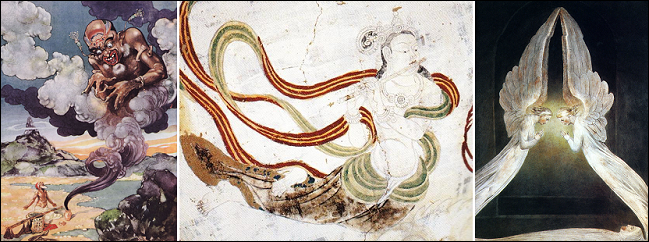
And what of the gandharvas and apsaras — middle panel — the celestial musicians and airy dancers who move to their music? Is there any poet who can claim never to have sensed them?

**

And thus we come to Robert Graves and the muse as he depicts her, in his book The White Goddess, and in many poems such as this:

In Dedication
.

Your broad, high brow is whiter than a leper’s,
Your eyes are flax-flower blue, blood-red your lips,
Your hair curls honey-colored to white hips.

All saints revile you, and all sober men
Ruled by the God Apollo’s golden mean;
Yet for me rises even in November
(Rawest of months) so cruelly new a vision,
Cerridwen, of your beatific love
I forget violence and long betrayal,
Careless of where the next bright bolt might fall.

**

But here the waters are getting deeper…

A Question for Hegghammer & Lacroix

Sunday, April 28th, 2013

[ by Charles Cameron — a single word in a very small book, and the world that hangs in the balance ]
.

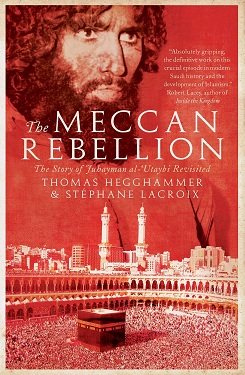
I’ve just read Hegghammer & Lacroix on The Meccan Rebellion. At 78 pages and 5.3 x 8.3 inches, it’s a tiny book in hardback and quite a delight to hold — the electricity in my city block went out for a while the other day, and I took pleasure in reading it out under the sun — and it contains, in essence, the two authors’ paper, Rejectionist Islamism in Saudi Arabia (Int. J. Middle East Stud. 39 (2007), 103–122) and a companion piece by Lacroix titled Between Revolution and Apoliticism: Nasir al-Din al-Albanai and his Impact on the Shaping of Contemporary Salafism.

Blog posts tend to present a point of view – whether to preach to the choir, promote it to unbelievers, stir up trouble, or simply add detail or a fresh angle to an existing narrative. Seldom do they ask questions.

My own instincts — in line with Madhyamaka as I briefly encountered it in the teachings of Elizabeth Mattis-Namgyel — lead me to leave some kinds of questions open: I use my DoubleQuotes format to set the juices flowing, by providing nudges to thought rather than outright statements – but on this occasion I have a question to ask, and as it’s too long for Twitter I’ll post it here.

**

Here’s my question. Juhayman al-Utaybi believed one of his companions, Muhammad al-Qahtani, was the Mahdi, the awaited Coming One of Islam — and that, in our authors’ words, “consecrating him [al-Qahtani] in Mecca on the turn of the hijra century” would ”precipitate the end of the world”.

In my view, a great deal rests on that simple word, “precipitate”. Would “usher in” do as well? Or “mark the beginning of” perhaps? Or is the idea of forcing the hand of God present, as it is in Reuven Paz’ phrase, “hot-wiring the apocalypse”?

There’s a lot riding on that issue: whether or not it is possible to force the hand of God, to accelerate destiny, to hasten apocalypse.

**

Okay, let’s go light-footed into this issue. In The Question in the DC Comics universe, we have a character described thus:

During service in Vietnam Jeremiah Hatch got insane, he began to hear the voice that urged him to do the will of the Lord by serving the Devil. He thought that his mission was “to hasten the corruption, to nurture the foulness until the almighty has no choice but to rain down fire and brimstone and overthrow the cities and the plain and all the inhabitants of cities and all that grows on the ground…”

**

Hastening the apocalypse — it’s an idea you can find in the world of DC Comics, but it was Israeli analyst Dr Reuven Paz who presented it to us in canonical “national security” form in his paper, Hot-wiring the Apocalypse, where his actual words are:

The Jihadi and nationalist insurgency in Iraq, which feeds the motivations and enthusiasm of growing number of Islamist youth to search for Jihad, look for the “culture of death and sacrifice,” and self-radicalize themselves, is another factor in the growing sense of Jihadi pride, which also hotwires the sense of the apocalypse.

That’s a faily imprecise form of words (‘The sense of apocalypse”) from a careful scholar, and Paz applies the concept in a specifically Sunni context. This, however, doesn’t prevent a popular Christian writer such as Joel Rosenberg from applying the same idea to the Shi’ite rulers of Iran:

Only when we understand the eschatology currently driving Iranian foreign policy, can we truly begin to understand how dangerous the regime in Tehran is. Only then can we fully appreciate how events like the revolution underway in Egypt only encourages Twelvers like Khamenei to take still further provocative and perilous actions to hasten the coming of the Twelfth Imam.

So the idea is afloat that both Sunni jihadists in Iraq and the Shi’ite state of Iran ay be about the “hastening” business.

**

Blog-friend Dr. Timothy Furnish, as I’ve noted here before, rebuts the application of Paz’ concept by Rosenberg, Glenn Beck and others to the situation in Iran, saying of it:

It posits that there is a strain of Islamic eschatological thought which hopes to force Allah’s hand in sending the Mahdi, as it were, via sparking a major conflagration (nuclear, or otherwise) with the West (either the U.S. or Israel). This may be true of some of the Sunni jihadits with an apocalyptic bent, but there is very little evidence that such an idea is operative in the upper echelons of the Islamic Republic of Iran. The ayatollahs may be cut-throat, anti-Israeli and anti-American-but they are not stupid. They know full well that any nuclear attack on Israel of the U.S. would be met with a crushing retaliation. (Besides, what good would it do for the Mahdi to come and establish his global caliphate over smoking radioactive ruins?)”

**

And if I might ask a follow-up question — is the first of the Juhayman Letters, which is devoted to the theme of the coming of the Mahdi, available in English?

On getting it right, eh?

Thursday, April 25th, 2013

[ by Charles Cameron — with a little help from the Buddha, fake quotes, self-referential paradox, a pinch of salt, and two tbsps of anthropology ]
.

Over the last ten days we have seen a whole lot of speculation, misinformation, spin and gossip masquerading as analysis and journalism, and that was on my mind when I ran across an alleged Buddha-quote that told me to use my common sense — and since my common sense told me there probably wasn’t a phrase in Pali, the language of the earliest Buddhist texts, that would correspond too closely to the highly idiomatic English usage, common sense, I thought I should check it out with Fake Buddha Quotes, my go-to place for checking what the Buddha is supposed to have said:

I’m pretty sure the Buddha never said “Pretty sure I never said that” too, for much the same reason.

**

But what delights me most about all this is just how self-referential this all is: the Buddha allegedly warns us against trusting what we read even when it’s attributed to him, in what turns out to be a faux quote attributed to him, based on a real quote that reads (in one translation):

Any teaching should not be accepted as true for the following ten reasons: hearsay, tradition, rumor, accepted scriptures, surmise, axiom, logical reasoning, a feeling of affinity for the matter being pondered, the ability or attractiveness of the person offering the teaching, the fact that the teaching is offered by “my” teacher. Rather, the teaching should be accepted as true when one knows by direct experience that such is the case.

**

Fpr what it’s worth, the abbreviated version doesn’t mean the same as the original. From Koun Franz at Sweeping Zen:

his is a very different idea. The original says we need to verify through direct experience; the popular version says that we can stand back from the practice, at a distance, and use reason to determine its authenticity.

Or this, from Bodhipaksa, the Fake Buddha Quotes guy, :

The Buddha of course isn’t saying we should jettison reason and common sense. What he’s implying is that both those things can be misleading and what’s ultimately the arbiter of what’s true is experience. It’s when you “know for yourselves” that something is true through experience that you know it’s true.

**

Another comment on the same page led me to this first comment on cultures and languages —

which in turn reminded me of the second, a long-time favorite of mine from the time when I was some sort of Anthro professor in dreamy Oregon…

**

And, y’lnow, both those quotes in my second pair give you a visceral sense of what today’s SWJ article by Robert R. Greene Sands and Thomas J. Haines, Promoting Cross-Cultural Competence in Intelligence Professionals is very rightly on about, though it’s all phrased in a manner so abstract you might easily miss the point…

Mitigating cognitive, cultural and a host of tradecraft biases is essential for intelligence professionals to navigate through today’s culturally complex environments. Adopting the perspective of contemporary cultural groups, including nation-states, often defies understanding because the intelligence professional is challenged to both appreciate and consequently discern meaning of behavior that is predicated on vastly different beliefs and value systems. Fundamental to this dissonance is a markedly different cultural reality resulting from different histories, traditions and the stasis of culture. The professional’s western and deeply seated worldview impedes either the analysis itself, or is perjured by the cognitive restrictions imposed by the structured analytic strategies used.

The quote about the Wintu — it’s from Dorothy Lee, Linguistic Reflection of Wintu Thought, Chapter 9 in Dennis and Barbara Tedlock‘s Teachings from the American earth: Indian religion and philosophy — goes on to say:

The Wintu relationship with nature is one of intimacy and mutual courtesy. He kills a deer only when he needs it for his livelihood, and utilizes every part of it, hoofs and marrow and hide and sinew and flesh. Waste is abhorrent to him, not because he believes in the intrinsic virtue of thrift, but because the deer had died for him.

Now there‘s “a markedly different cultural reality” for you!


Switch to our mobile site