zenpundit.com » koan

Archive for the ‘koan’ Category

The Pillar of Cloud and the Pillar of Fire

Thursday, November 15th, 2012

[ by Charles Cameron — IDF terminology and the Gaza conflict, explanations of Exodus, an IDF video, Megillah 10b and the koan “with God on our side” / “with God on all sides” ]
.
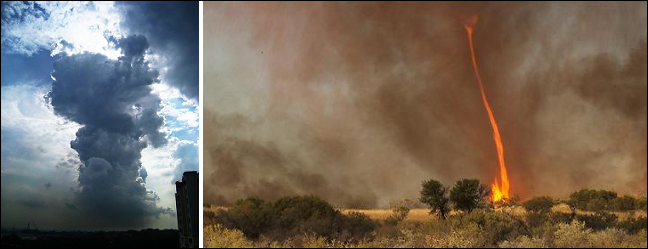
photo credits: Schristia, Cloud; Chris Tangey, Fire

.

I’m curious.

The IDF calls today’s Israeli operation in Gaza “Operation Pillar of Defense” in English, but as John Cook points out in Gawker, uses the term Hebrew term “Pillar of Cloud” in Hebrew.

There’s a great deal of interest here, apart from the difference between their use of non-Biblical terminology in English and Biblical terminology in Hebrew. One point that catches my ear, a poet being a poet, is that the phrase “Pillar of Cloud” is in fact only one half of a double reference…

Thus in Exodus 13.21-22 we read:

And the LORD went before them by day in a pillar of a cloud, to lead them the way; and by night in a pillar of fire, to give them light; to go by day and night: He took not away the pillar of the cloud by day, nor the pillar of fire by night, from before the people.

**

There are various ways of understanding the pillar of cloud and pillar of fire, but it’s pretty clear that there’s only one pillar —

And it came to pass, that in the morning watch the LORD looked unto the host of the Egyptians through the pillar of fire and of the cloud… [Exodus 14.24]

which is called a pillar of cloud by day and a pillar of fire by night, perhaps simply because we are speaking of theophany — the Divine Presence made visible — perhaps because smoke from a brazier is more visible in daylight and flames at night — perhaps because as Hans Goedicke, then chairman of the department of Near Eastern Studies at Johns Hopkins, suggested, the source of both fire and smoke was the eruption of Santorini around 1600 BCE.

The difference in worldviews behind those explanations alone is a matter of considerable interest.

**

Linguistically, however — and this is where the poet being a poet comes in — there are two pillars, and I have to wonder whether the name “Pillar of Fire” is being saved for a later and perhaps more impressive (“shock and awe”) operation, or — in line with the “by day and by night” distinction — refers to the covert side of the same op?

Not that anyone would be likely to give me that information, or that I’d have any use for it if they did.

But the Biblical phrasing is powerful, and “Pillar of Defense” doesn’t make a whole lot of sense — besides, cloud and fire go together in Hebrew in much the same way smoke and mirrors do in English.

Of the three choices, I’d have gone with “Pillar of Fire” myself.

**

An IDF spokesperson, in a response to Cook’s Gawker article, claimed:

I think that every example of Bible quotes you cited has defensive connotations, rather than “vengeful.”

One of those quotes is Exodus 14:24, which I quoted above but will now give in full, along with verse 25:

And it came to pass, that in the morning watch the LORD looked unto the host of the Egyptians through the pillar of fire and of the cloud, and troubled the host of the Egyptians, and took off their chariot wheels, that they drave them heavily: so that the Egyptians said, Let us flee from the face of Israel; for the LORD fighteth for them against the Egyptians.

I think calling that “defensive” is a bit one-sided, but on the other of the two hands in question, so is calling it “vengeful”.

The Israelites saw themselves in the larger context as escaping Egyptian oppression, the Egyptians obviously considered themselves under attack in the short term — just as surely as the people of Gaza must feel under attack by the oppressive Israelis today, while the Israelis clearly feel under attack by terroristic Hamas and its rockets. But hey, the IDF spokesman only offered his explanation that the Pillar of Cloud and Defense was “defensive” as “Just my two cents”…

FWIW, those two verses from Exodus sound just a little like Quran 33.26:

And He brought down those of the People of the Book who supported them from their fortresses and cast terror in their hearts; some you slew, some you made captive. And He bequeathed upon you their lands, their habitations, and their possessions, and a land you never trod. God is powerful over everything.

That’s an ayat that has always interested me, because of the use of the word “terror” found in a number of translations including this one, by AJ Arberry — others have “awe” or “panic”, but “terror” is interesting in the context of its contemporary usage.

**

Here’s the current strike counter strike in two tweets:

**

Okay, let’s get as close to visceral as modern technological warfare permits. After the recent truce was broken and numerous rockets fired into Israel, the IDF fired a missile that killed Hamas military leader Ahmed Jabari, and quickly put the video feed up on YouTube:

**

People are killing and getting killed. Should that be a matter for concern, or delight?

The narrative from which the IDF drew the name of their campaign in Gaza is taken from that of Israel’s escape from Egypt in Exodus, which also includes the parting of the waters and destruction of the Egyptian army:

And the angel of God, which went before the camp of Israel, removed and went behind them; and the pillar of the cloud went from before their face, and stood behind them: And it came between the camp of the Egyptians and the camp of Israel; and it was a cloud and darkness to them, but it gave light by night to these: so that the one came not near the other all the night. And Moses stretched out his hand over the sea; and the Lord caused the sea to go back by a strong east wind all that night, and made the sea dry land, and the waters were divided…. [Exodus 14.19-21]

And it came to pass, that in the morning watch the Lord looked unto the host of the Egyptians through the pillar of fire and of the cloud, and troubled the host of the Egyptians, And took off their chariot wheels, that they drave them heavily: so that the Egyptians said, Let us flee from the face of Israel; for the Lord fighteth for them against the Egyptians. And the Lord said unto Moses, Stretch out thine hand over the sea, that the waters may come again upon the Egyptians, upon their chariots, and upon their horsemen. And Moses stretched forth his hand over the sea, and the sea returned to his strength when the morning appeared; and the Egyptians fled against it; and the Lord overthrew the Egyptians in the midst of the sea. [Exodus 14.24-27]

Here again we see an instance of what I have called the two-fold logic of scriptures: In the Babylonian Talmud, Megillah 10b, R. Johanan tells us:

The ministering angels wanted to chant their hymns, but the Holy One, blessed be He, said, The work of my hands is being drowned in the sea, and shall you chant hymns?

to which R. Eleazar responds:

He himself does not rejoice, but he makes others rejoice.

**

To my mind, what we’re looking at here is a global koan: the immediate and eternal paradox of life and death.

But more on koans shortly.
The war and peace paradox

Saturday, October 27th, 2012

[ by Charles Cameron — a paradox in two graphics ]
.


.
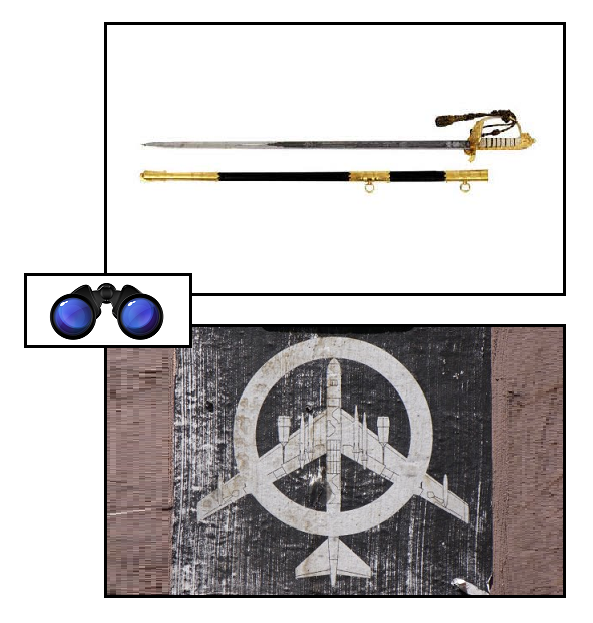
The upper image shows the British “Firmin Sword of Peace” which was awarded this week to the 15 (UK) Psychological Operations Group (15 POG) for their work in Afghanistan. The Ministry of Defence news report described the award thus:

The prestigious Firmin Sword of Peace is given to the unit or establishment of each Service judged to have made the most valuable contribution to humanitarian activities by establishing good and friendly relations with the inhabitants of any community at home or overseas.

The lower image shows an artistic rendering of the peace symbol, seen on a wall in Melbourne, Australia, which is consonant with the old Strategic Air Command motto: Peace is our Profession.

**

Here there be paradox.

An Afghan Buddha koan

Friday, October 5th, 2012

[ by Charles Cameron — for Madhu ]
.

Our friend Madhu has requested that I post poems here on occasion, and this particular poem made me think of her and her request, so here it is:

A copper and gold koan
.

The world happened, the world is drifting away,
the farther away the world floats the deeper into the mists.

In Mes Aynak, Afghanistan, the remains
of a buddhist monastery already eroded by time are adrift,
a sitting buddha is floating into the mist,
headless, gold paint still on his knees and robe,
the devotion has drifted, lifted its focus
to the one without a second, the buddha left
whatever he left in memory, lingering, to gather aromas
of other ideas, realms, dust, archaeology, oblivion,
there is change, ceaseless change,

and adults must decide: is the wealth implied by the copper
beneath the buddha worth more than a trace of halo,
as the moon moves once again across a brilliant night sky.

.
Koans are those brilliant paradoxes zen buddhism uses to pry the mind open, I think they’re important aids to handling complexity, and I have a post about them coming up shortly. Here, it’s enough to say that the issue of copper mining vs archaeology in Mes Aynak seems to me to be a living, breathing koan.

**

It’s awkward, when you write an “ekphrastic” poem, a poem about a painting or photo, to have the image right there when the poem is read, because it trammels the reader’s mind in much the same way that a film can trammel the mind of a reader into “seeing” only the film-maker’s Gandalf, no longer her or his own.

And I’m going on at some length about this, because next up is the image from which that particular poem was built, but I’d like the image to be, as they’d say in the newsprint world, “below the fold” as you read the poem.

So here it is, #4 in a fine series of photos in a Foreign Policy photo essay which I recommend, although I’ve taken this particular (smaller) version from a CNN page, since the subtitle in the lower right corner explains the basic situation handily:

You can hear the archaeologist Brent Huffman, who took the photo, talk about the situation here — local reactions pro and con, who the Taliban are shooting at, the likelihood that the Chinese operation will in fact benefit the locals and more:

The koan of balancing material with immaterial values remains, but in this circumstance the likelihood of local Afghans receiving litter or nothing from the mining project likely tips the scales.

You can petition Afghan President Hamid Karzai for preservation…

But then he’s another wild-card in the continuing Great Game, isn’t it?

Gloria Mundi Rapid Transit

Sunday, September 2nd, 2012

[ by Charles Cameron — that’s the thing: only what’s deep survives ]
.


.

I don’t think the shadow on the wall behind and to the right of Noah Levine (above, left) is wearing a mohawk — I think it’s the shadow of a Tibetan monk wearing the kind of headdress you’ll see on the young Tulku (above, right)… but even so, the picture does remind me of this one, which I posted a few days ago, titled “choir punk”:
.


.

The similarities are more than visual, however — and they’re instructive.

**

As you may recall, the lower of the two images is one that I used to illustrate my opening post on the topic of Pussy Riot, and it illustrates the theme that punk and Orthodoxy have something important in common. The upper image (left) shows another punk who got religion — in this case, Buddhism. His name is Stephen Levine, and he’s the guy who set the Dharma Punx wheel rolling, coming out of a life of prison, punk and crack addiction into the stillness of meditation in much the same way that the punk monks featured in that earlier piece came out of their own nihilism, punk and despair into the stillness of contemplation…

From nihilism to peace.

I’ve never been into punk music myself, I’m a Bach and Gregorian Chant man — but what’s striking me here is the sense that punk knows the first thing there is to know: that the things we do to try to keep ourselves happy necessarily ring hollow after some time. Possessions, status — these things may appease us for a while, but they don’t truly satisfy.

The punk knows this, and the monk knows this — whether the monk in question is Buddhist or Christian or whatever. Only the monk makes the discovery that leads out of contemptus mundi into the alternative strategy.

**

And somehow, you need to reach full tilt boogie to get there, howsoever full tilt boogie may be defined in your own case, and whatever form the contemplative, relaxed, inward life may take.

Here are two versions of what it takes:

Samuel Johnson, I’d say, is seeing something very close to either one of these when he says:

Depend upon it, Sir, when a man knows he is to be hanged in a fortnight, it concentrates his mind wonderfully.

**

A close brush with death — or sure knowledge of one’s mortality. A red-hot iron ball stuck in your throat. Rock bottom…

All of these things can concentrate the mind wonderfully, and the concentrated mind can do things, can allow things that the bothered mind would get insanely bothered by.

You may wear rose-tinted glasses for a while, and get away with it. You can try out the dark glasses of ironic superiority. Both ways of looking involve a measure of self-delusion, however, for they catch surfaces and miss the depths.

At times — when you or someone you love gets an unexpected and advanced cancer diagnosis, say, or you lose your house to the bank — the illusions get stripped away, and you simply see. And what you see will either be enough to make you cry and rage, or enough to make you dance and sing.

Because when the illusions get stripped away, only what’s deep survives.

**

I’d like to take this just a step further.

The old Lakota medicine man Archie Fire Lame Deer told his biographer, Richard Erdoes:

I am no wino or pishko, but I am no saint either. A medicine man shouldn’t be a saint. He should experience and feel all the ups and downs, the despair and joy, the magic and the reality, the courage and the fear, of his people. He should be able to sink as low as a bug, or soar as high as an eagle. Unless he can experience both, he is no good as a medicine man.

I don’t suppose anything I say in words can get this exactly right anyway, but I’ll try.

If you try to give advice to someone who is suffering more than you have ever suffered, your advice is liable to come across as uncomprehending and shallow. You have to have known your own blues to sing the blues. And you have to be in peace to convey peace…

And that, it seems to me, is what allows monks to hear and understand and talk, peer to peer, with punks — and that’s what allows punks to become monks.

**

Noah Levin’s book, Dharma Punx, is available on Amazon, as is the DVD of Meditate and Destroy, the 2007 documentary about him.

**

Punk may still not be my kind of music — but I’m beginning to see the punk mohawk as a kind of instinctive tonsure…

A footnote to a benchmark in boundless cyberspace

Saturday, June 23rd, 2012

[ by Charles Cameron — Taliban use of social media with side ramble on the cognition of similars, parallels and opposites ]
.


.

It’s not like it’s a big deal or anything, it’s just a footnote, a detail — but God is in the details, the devil is in the details. And it looks as though a certain Twitter account does belong to the Taliban after all.

Some back-story:

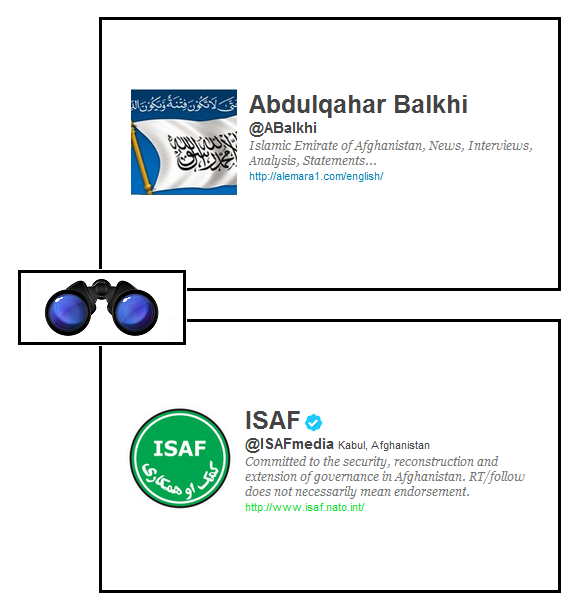
A while back, on my way to make other points, I posted this:

I wasn’t the first or last to make the connection between A Balkhi and the Taliban, nor to note the Twitter-exchanges between Balkhi and the ISAF press office — but I happened to have this habit of juxtaposing similars and opposites, and had developed the “Specs” format used here, with the little binoculars inset, to suggest the idea of seeing parallel or opposite things in parallel or opposition — a sort of mental equivalent of stereoscopic vision or stereophonic sound — in the hope that something about the comparison and contrast would add a depth dimension to understanding.

As a footnote to a footnote to a footnote, I think the Necker Cube can add an interesting aspect to this business of stereoscopic thinking:

When two things are so much the same and so utterly different that, as with a Necker Cube (or the positive and negative of a photo rapidly alternating) the mind flashes rapidly from one view to its exact and opposite other, a metacognitive insight arises about what I can only term the two in one in twoness experienced.

File that under number theory, koans.

But that’s about metacognition, let’s get back to the Taliban on Twitter.

Towards the end of last year, Alex Strick van Linschoten posted his doubts about A Balkhi:

No. Just no. The account @abalkhi appears to have nothing to do with the Taliban (see below). I’d also be interested to see the evidence for the statement that ‘Taliban spokesmen also frequently spar with Nato press officers’. I have not seen a single instance of this. Every other story on these accounts repeats this claim. And it’s presumably quite an important distinction: an official spokesman (we might assume it is a man) engaged in verbal attacks on the official ISAF account is a different thing from some fanboy in his bedroom doing the same thing.

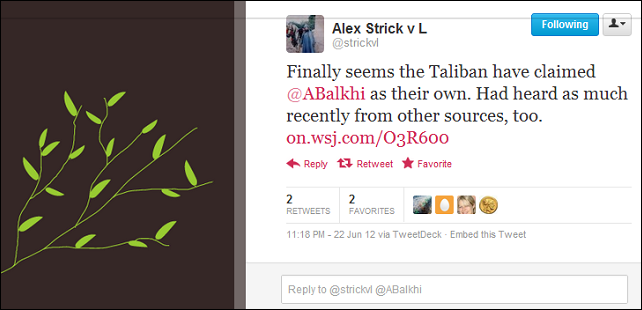
Today, Alex (I hope that’s the appropriate way to name him) reversed himself with the tweet featured at the top of this post.

The pool of people to whom it matters whether A Balkhi is an official Talibvan site or a fan site is probably quite small, and by now they will all surely have either read the Wall Street Journal, seen Alex’s tweet, or arrived at whatever conclusion in the matter their own intelligence sources have suggested to them.

In the enormity of cyberspace, then, this whole post of mine is just a footnote to a footnote.

Alex’s piece from which I quoted above, on the other hand, is a true footnote: it provides us with a decent summary of Twitter-feeds associated with the Taliban, helpfully annotated.

Let’s call it a benchmark — and while this business about A Balkhi may be just a detail, benchmarks are go-tos, and I hope Alex will update his.


Switch to our mobile site