[ by Charles Cameron — the symbolic importance of Mullah Omar with the cloak of the Prophet, comparative, frankly long, and IMO worth it ]
.
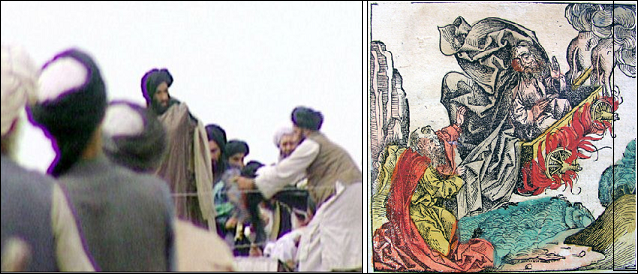
Mullah Omar in Kandahar; Elijah & Elisha from the Nuremberg Chronicle
.
I would like to give you a sense of the significance of an apparently insignificant detail, which I was reminded of today while skimming
Charles Kurzman‘s
The Missing Martyrs: Why There Are So Few Muslim Terrorists, page 74:
To gain legitimacy as he was taking over Afghanistan,Taliban leader Mulla Muhammad Umar literally wrapped himself in the cloak of the Prophet Muhammad, a cherished relic stored for two centuries at a shrine in Qandahar. He ordered the custodians to unlock the sanctuary, then stood on the roof of a nearby mosque and placed his hands in the cloth as a crowd of supporters chanted “Commander of the Faithful,” a title associated with the first caliphs to succeed the Prophet Muhammad.
To better grasp the significance of the situation, I will first quote from the Jewish and Buddhist scriptures to illuminate the symbolic power that can be vested — interesting word — in a cloak or robe.
**
John Daido Loori is a zen master in whose teishos or teachings I often find insight and delight. Here’s his description of the original transmission of “bowl and robe” in Buddhism, from the Buddha to his disciple Mahakashyapa:
After Buddha died, Ananda became the attendant of Mahakashyapa. One day he asked, “That time on Mount Gudhakutra, when the World-Honored One gave you the bowl and robe, and transmitted the Dharma to you, what else did he give you?” Mahakashyapa called out, “Ananda.” Ananda responded, “Yes, Master?” Mahakashyapa said, “Take down the flagpole.” At that point, Ananda finally had a realization. He realized what Mahakashyapa had realized. So it has been, down through successive generations, mind-to-mind for 2,500 years.
The Buddha’s teaching later passes from India into China, where the transmission continues. Here’s how Hui Neng, in the Platform Sutra, describes his own enlightenment and reception of the teachings:
At midnight the Fifth Patriarch called me into the hall and expounded the Diamond Sutra to me. Hearing it but once, I was immediately awakened, and that night I received the Dharma. None of the others knew anything about it. Then he transmitted to me the Dharma of Sudden Enlightenment and the robe, saying: ‘I make you the Sixth Patriarch. The robe is the proof and is to be handed down from generation to generation. My Dharma must be transmitted from mind to mind. You must make people awaken to themselves.’
**
There’s a remarkable story told in 2 Kings 2.8-15 that concerns the transmission of prophetic gifts by similar means, when the prophet Elijah is carried up into heaven:
And Elijah took his mantle, and wrapped it together, and smote the waters, and they were divided hither and thither, so that they two went over on dry ground. And it came to pass, when they were gone over, that Elijah said unto Elisha, Ask what I shall do for thee, before I be taken away from thee. And Elisha said, I pray thee, let a double portion of thy spirit be upon me. And he said, Thou hast asked a hard thing: nevertheless, if thou see me when I am taken from thee, it shall be so unto thee; but if not, it shall not be so.
And it came to pass, as they still went on, and talked, that, behold, there appeared a chariot of fire, and horses of fire, and parted them both asunder; and Elijah went up by a whirlwind into heaven. And Elisha saw it, and he cried, My father, my father, the chariot of Israel, and the horsemen thereof. And he saw him no more: and he took hold of his own clothes, and rent them in two pieces.
He took up also the mantle of Elijah that fell from him, and went back, and stood by the bank of Jordan; And he took the mantle of Elijah that fell from him, and smote the waters, and said, Where is the Lord God of Elijah? and when he also had smitten the waters, they parted hither and thither: and Elisha went over. And when the sons of the prophets which were to view at Jericho saw him, they said, The spirit of Elijah doth rest on Elisha. And they came to meet him, and bowed themselves to the ground before him.
The beauty, the power in this telling comes from the cloak’s ability to part the waters, as on an earlier occasion Moses‘ staff had done, not merely in the hands on Elijah, but also, once the transmission has been made, in the hands of Elisha. It is that double motif of the parting of the waters that demonstrates the efficacy of the prophetic transmission.
Coming fresh from the Buddha, Mahakashyapa, Hui Neng, Elijah and Elisha, we should be ready to appreciate that the mantle, cloak or robe of a sacred person is imbued with that person’s power — Matthew 14.36 describes crowds bringing the sick to Jesus:
that they might only touch the hem of his garment: and as many as touched were made perfectly whole.
**
In light of these examples, let us consider the reports of the day when Mullah Omar was proclaimed Amir of the Faithful:
There was a tremendous stir in Kandahar: we followed the crowds to a mosque in the city center. The Taliban had been holding an assembly of mullahs from all over Afghanistan. Now the results were about to be made public. Holy war was announced against the government of President Rabbani in Kabul. The head of the Taliban, Mullah Omar, was declared to be the Amir or leader of all Muslims everywhere. Because this was regarded as a key moment for the Afghan nation, Mullah Omar displayed the holy cloak of the Prophet Muhammad to the crowd. It’s kept in Kandahar and shown only in times of crisis. The last time was sixty years ago. Neither the cloak nor the ceremony has ever been filmed before, not has Mullah Omar. People in the crowd threw up their turbans to touch the cloak and be blessed by it. It was like being at some great religious ceremony in the Middle Ages.
That’s from the soundtrack of a video I sadly can’t post here, but which you can see for yourself on a BBC site under the title Mullah Omar reveals the Prophet’s cloak.
Adam Curtis, who posted the clip, describes it thus:
In the early 90s the students returned to Afghanistan and set up the Taliban – to cleanse the country of a revolution that had gone wrong, compromised by the futile idea of modernising Islam. And in April 1996 Mullah Omar went to the Shrine of the Holy Cloak. He took out the cloak for the first time in 60 years and waved it from the roof – just as Amanullah had in 1929 – and announced a jihad against the Islamist factions in Kabul.
The BBC producer Tom Giles and John Simpson were in Kandahar that day – and they captured this extraordinary moment on video.
When King Amanullah had held the cloak above his head in 1929 it symbolised the end of his dreams of creating a modern world in Afghanistan. Now – in 1996 – Omar was saying the same thing – forget the future, listen to the ghosts of your past – and follow their rules.
Let’s note in passing that Omar holds the cloak up — neither in the video clip nor in the two accounts is it suggested that he wore it — and that it had previously been held up by Amanullah Shah in 1929.
**
For the symbolic impact as reported in the West, let’s turn to Tim Weiner‘s piece, Seizing the Prophet’s Mantle: Muhammad Omar, in the NYT of December 7, 2001:
And as the country was falling to the Taliban five and a half years ago, Mullah Omar literally cloaked himself in the trappings of the Prophet Muhammad.
On April 4, 1996, as the Taliban neared total control, he was moved by zeal to unseal a shrine in Kandahar that held a cloak believed to have belonged to the prophet, the founder of Islam. The cloak had not been touched since some time in the 1930’s. He lifted it in the air as he stood on a rooftop, displaying it to a crowd of followers. The event was caught on videotape, one of the very few times that he was ever photographed. He placed the cloak, which only the Prophet was said to have worn, upon his own shoulders.
And at that moment, he declared himself the commander of the faithful, the leader of all Islam. No one had claimed that title since the Fourth Caliph, more than 1,000 years ago.
That’s impressive stuff, and “Seizing the Prophet’s Mantle” and “Omar literally cloaked himself in the trappings of the Prophet” do a decent job of capturing the marriage of literal and symbolic that’s at work here.
But “he placed the cloak … upon his own shoulders”? I’m not so sure.
**
It was a tremulous moment, evidently, even for Omar, as Norimitsu Onishi reported in the NYT a couple of weeks later on December 19, 2001, in A Tale of the Mullah and Muhammad’s Amazing Cloak:
The first time Mullah Muhammad Omar was allowed to enter the Shrine of the Cloak of the Prophet Muhammad here in Kandahar, and cast his gaze on the sacred ancient robe, he trembled. So disoriented was Mullah Omar that as he prepared to pray, he mistook the way toward Mecca.
“He turned to face toward the south,” recalled Qari Shawali, 48, the keeper of the prophet’s cloak. “So I made him change his position to turn toward Mecca.”
I suspect that here we have an indication that Omar was surprised by the event, that he was in fact acclaimed by the assembly of mullahs rather than claiming the robe and title for himself.
However, as the saying goes: Allah is the best of knowers.
**
Mujib Mashal‘s piece, The myth of Mullah Omar on al-Jazeera, 6 June 2012, gives us a few clues as to informed Afghan responses to the event, throwing in the detail that bin Laden was there at the time -– but also informing us that Omar “donned the cloak” and claiming this was the first time in 250 years that this had happened:
To formally announce his leadership in 1996, Mullah Omar, then 36 years old, brought forth the purported cloak of the Prophet Mohammed, one of Afghanistan’s most cherished Islamic relics. For the first time since the reign of Ahmad Shah Abdali more than 250 years before, Omar donned the cloak in the presence of about 1,500 religious leaders, including the late Osama bin Laden.
“Wearing the cloak was a masterstroke,” Sharifi said, adding that it linked the ex-guerrilla fighter to both Abdali and the Prophet. But Wahid Muzhda, an Afghan analyst and one-time high-ranking official in the Taliban foreign ministry, disputes that narrative. “From what I know, from sources close to Omar, and from a chat with the keeper of the shrine [where the cloak is kept], Omar did not wear the cloak.” “With great respect, he held the cloak in front of the religious leaders gathered for allegiance.”
This gesture, more than any other, was the impetus that allowed Mullah Omar, without any deep political or tribal base, to become the iron-fisted ruler of about 90 per cent of Afghanistan until the US invasion in 2001.
**
I know, you’re fatigued and I’m excited: bear with me, let’s hear the story of Ahmad Shah as told by Steve Inskeep on NPR in The Cloak of the Prophet some time in 2002:
According to the version of the legend that I heard, Ahmad Shah traveled to Bokhara — once one of the major centers of Islamic scholarship and culture, now a modern city in the former Soviet state of Uzbekistan . There he saw the sacred Cloak of the Prophet Mohammed, and decided to bring it home. He wanted Kandahar to have the artifact, so he asked to “borrow” the cloak from its keepers.
The keepers knew he might steal it, and told him he must not take the cloak from Bokhara. So Ahmad Shah pointed to a stone in the ground and made a promise. He said, “I will never take the cloak far away from this stone.”
Relieved, the keepers let him take the cloak. Ahmed Shah kept his word, in a sense. He had the stone taken up out of the ground, and had it carried back to Kandahar, along with the cloak, which he never returned. Today, the stone stands on a pedestal near the shrine.
The Cloak of the Prophet is normally hidden from public view. It is taken out only for special occasions. The last such occasion came in 1996, as the Taliban seized control of the country.
The Taliban leader, Mullah Omar, made what was considered a brilliant propaganda move. He took Mohammed’s shroud out of storage and wore it in a public rally, as a way to identify himself with the Prophet, and give himself legitimacy.
That’s an interesting tale in its own right, and reminds me of another Abrahamic treasure, the Stone of Scone, throned above which Scottish and British Kings and Queens are crowned. For your viewing delight: Stone of Destiny.
**
Fast forward to July 1928, a more recent moment when Afghanistan was in crisis.
Adam Curtis reports in The Weird World of Waziristan, 5 April 2010:
Amanullah fled to Kandahar. He knew that his attempt at modernization had failed and to save himself he tried to prove that in reality he was a traditional Islamic monarch. He did it in a final dramatic gesture.
Amanullah went to the Shrine of the Holy Cloak in the centre of Kandahar. He opened up the brass bound chest where the cloak which was reputed to have been the Prophet’s had lain for over a 100 years. Amanullah lifted it above his head and demanded of the mullahs in front of him whether Allah would allow a heretic or an apostate to perform such a sacred act.
**
And so to our most serious analytic effort on the topic, and a couple of indicators of the point I’m so often trying to make, here and in other posts on ZP. Here are Thomas H. Johnson and M. Chris Mason, writing in Terrorism, Insurgency, and Afghanistan as published by the Naval Postgraduate School, where both of them work in the Program for Culture & Conflict Studies:
Omar joined this rogues gallery of politicized insurgent Mullahs by means of a politico-religious stunt that is of enormous importance to the Taliban movement but that is considered insignificant by most Western analysts, if they are aware of it at all. In doing so, he became the epitome of the charismatic leader as described by Max Weber, who he defined as having:
… a certain quality of an individual personality, by virtue of which he is set apart from ordinary men and treated as endowed with supernatural, superhuman, or at least specifically exceptional powers or qualities. These are such as are not accessible to the ordinary person, but are regarded as of divine origin or as exemplary, and on the basis of them the individual concerned is treated as a leader.
The event in question was Omar’s removal in 1994 of a sacred garment -— believed by many Afghans to be the original cloak worn by the Prophet Mohammed -– from its sanctuary in Kandahar, and actually wearing it while standing atop a mosque in the city. Whereas Omar had been a nonentity before this piece of religious theatre, the audacious stunt catapulted him to a level of mystical power (at least among the 90 percent of Pahstuns who are illiterate) in a manner that is almost impossible for Westerners to understand, and it resulted in his being proclaimed locally the Amir-ul Momineen, the Leader of the Faithful — not just of the Afghans but of all Muslims.
I would draw your particular attention to this phrase:
a politico-religious stunt that is of enormous importance to the Taliban movement but that is considered insignificant by most Western analysts, if they are aware of it at all.
Why? Why do we continually overlook such indications of the depth of feeling that animates the Taliban? Perhaps another analogy, from closer to home, will help us here.
I’m not sure that I’d call the exposition of the Shroud of Turin a “piece of religious theatre” or an “audacious stunt” — even if Pope Benedict, famously concerned at the secularization of Europe, visited it and remarked both on the Shroud as an icon of the death and burial of Christ, and of our era’s participation in the “death of God” “after the two World Wars, the lagers and the gulags, Hiroshima and Nagasaki”:
Jesus remained in the tomb until dawn of the day after the Sabbath and the Turin Shroud presents to us an image of how his body lay in the tomb during that period which was chronologically brief (about a day and a half), but immense, infinite in its value and in its significance.
You may regard the Son of God and the Prophet of Allah as similar figures or utterly different: but to understand the emotions roused by Mullah Omar’s gesture, these correspondences drawn from other religious traditions may provide a useful place to start.
**
As for myself, I have a poet’s reverence for symbols, but I recognize that it is what they symbolize that is important — and so I’ll close as I began, with the Buddhist robe and bowl and another delighful teisho from Abbot Loori:
Ming was chasing after Hui-neng, determined to retrieve the bowl and robe of Bodhidharma from him. Finally, when he caught up to Hui-neng, the Sixth Ancestor put down the robe and bowl and said, “This robe was given to me on faith. How can it be fought for by force? I leave it for you to take it.” Ming tried to pick up the robe and bowl but couldn’t—they were as heavy as a mountain. He fell to his knees, trembling, and said, “I come for the teachings, not the robe. Please teach me, oh lay brother.” Completely open, completely receptive, completely ready, he was a man teetering on the brink of realization. Immediately, the Sixth Ancestor struck. “Think neither good nor evil,” he said. “At that very moment, what is the true self of monastic Ming?”