zenpundit.com » judaism

Archive for the ‘judaism’ Category

Rabbis, Islam & End of Days II, also 2013 Mahdism Update, II

Tuesday, January 22nd, 2013

[ by Charles Cameron — continuing my updating of Mahdist issues, also surprising parallels and oppositions ]
.

By the time you’ve learned the various signs of the times — pre-, mid- and post-trib rapture dispensationalist, preterist, Mormon, I dunno, ecological, Sunni, Shiite — the list, like Tolkien‘s Road, goes ever on — who’s on which side, and who might be somebody else’s something — you may feel as confused as I do.

**

The very first sentence of Tim Furnish‘s book, Holiest Wars: Islamic Mahdis, their Jihads and Osama bin Laden — which I may never tire of quoting — reads:

One man’s messiah is another man’s heretic.

I was rereading the amazing section on the Gharqad tree in Anne Marie Oliver and Paul Steinberg‘s book, The Road to Martyrs Square, the other day, and noticed on p. 21 yet another intriguing variant on Furnish’s point:

Even before the intifada, the figure of the Dajjal was equated by many Islamists with the Jewish Moshiach, the Messiah, as when the highly influential Pakistani Islamist Malauna Maududi claimed in the 1960s that “the stage has been set for the emergence of the Dajjal who, as was foretold by the Holy Prophet (PBUH), will rise as a ‘Promised Messiah’ of the Jews.” By the late intifada, the equation was commonplace in the West Bank and Gaza. When the Lubavitcher Hasidim in the early 1990s began to refer to Rabbi Menachem Mendel Schneerson as the Messiah, the claim had considerable effect on Palestinian Islamists. Some actually began to include Schneerson on their list of False Prophets, referring to him as “the Antichrist Liar.”

**

Compare this, however, with the Muslim Harun Yahya‘s willingness to declare his expectation of the King Messiah / Moshiach in the screen-cap below. Yahya is presumably referring to the same salvific end-times figure he elsewhere refers to as the Mahdi.

Here we have the reverse possibility to the one Furnish points to — it certainly looks as though here, one man’s Messiah is another man’s Mahdi. On one of his websites, King-Messiah.com, Yahya makes the identification of these figures from two traditions explicit:

And “King Messiah” is a particularly interesting phrase for Yahya to use — among other things, it’s the term some followers of the late Lubavitcher Rebbe Schneerson use to describe their rebbe.

**

As I pointed out two days ago in Expecting the unexpected: Rabbis, Islam, and the End of Days, there’s a whole lot going on here, and it takes patience to tease all the strands out…

One of these days I’ll have to put together an extended list of messiah / mahdi correspondences — and prophet / false prophet and christ / antichrist correspondences between competing eschatologies, too, both within specific religions and across them.

I suspect Ayatollah Muhammad Baqir al-Sadr was thinking along similar lines to Yahya when he wrote the paragraph I quoted towards the end of The Messianic Mahdist Moebius strip — or maybe Maze?:

The Mahdi is not an embodiment of the Islamic belief but he is also the symbol of an aspiration cherished by mankind irrespective of its divergent religious doctrines. He is also the crystallization of an instructive inspiration through which all people, regardless of their religious affiliations, have learnt to await a day when heavenly missions, with all their implications, will achieve their final goal and the tiring march of humanity across history will culminate satisfactory in peace and tranquility. This consciousness of the expected future has not been confined to those who believe in the supernatural phenomenon but has also been reflected in the ideologies and cult which totally deny the existence of what is imperceptible. For example, the dialectical materialism which interprets history on the basis of contradiction believes that a day will come when all contradictions will disappear and complete peace and tranquility will prevail.

The Iranian scholar Muhammad Ali Shumali, whom I also quoted, said much the same:

Imam Mahdi is not a saviour for [just] the Shias. Imam Mahdi is a saviour for all mankind…

**

Parallels and oppositions…

My language here will probably not be precise enough for mathematicians or logicians — but isn’t the thing that most closely resembles another thing its exact opposite?

And to give this already twisty rope yet another twirl… not in terms of apocalyptic, but of Jewish / Muslim relations more generally…

Here’s Pastor John Hagee — the preacher who was so far right that Sen. John McCain rejected his endorsement in the 2008 presidential campaign — talking with Rabbi Daniel Lapin about Muslims being blessed, and how their five-times-daily prayers are particularly listened to by God:

These unpredictable “outlier” nuances and their attendant shocks and surprises are ongoing…

**

The “signs” graphic at the head of this post is from a post titled Preparing for the Second Coming on LDS Why? — you can download their answers for teens in Chapter 12 of the book The Big Picture. It begins:

Imagine it’s a bright and sunny afternoon, and as you drive down the road with your parents you look up and notice that the sky looks different than normal. The clouds are luminescent, bright, and heavenly. Suddenly, without warning, the sky seemingly bursts open and the veil between heaven and earth is split. Trumpets start sounding from the sky, and you see above you the most glorious being your mind could ever conceive of descending out of heaven and touching down on earth — Jesus Christ in all His glory…

That’s a sign that might be hard to miss…

Expecting the unexpected: Rabbis, Islam, and the End of Days

Sunday, January 20th, 2013

[ by Charles Cameron — strange intersections between Islamic, Judaic and Christian teachers around the end times, also Yehuda Etzion of the Jewish Underground, and Habayit Hayehudi’s Jeremy Gimpel ]
.

My guess is that at least one aspect of this screen-grab will surprise you — but it’s hard to say which!


.

One possible surprise is a 2013 end times prediction from an Islamic source — but there are enough other surprises here to go around, I think…

Okay, here it is. I ran across two videos of rabbis on two sites connected with Islamic end times expectations today, and they’re causing a bit of a re-set in my thinking about the various alignments possible in the complex world of competing contemporary eschatologies.

**

I imagine the rabbi in the first of the two videos is from Neturei Karta or Satmar, because at one point he says:

this country (Israel) does not have the right to exist

and refers to the State of Israel as “the origin of evil”.

There is obviously much more going on here, and I’m none too confident of the accuracy of the subtitles, so I’d appreciate any comments from those who know more about either the rabbi’s Jewish context or the Muslim eschatological site‘s place within the Mahdist spectrum.

2013? C’mon!

**

The second video comes from Adnan Oktar / Harun Yahya. What’s most intriguing to me here is the rabbi’s assertion that “Islam is the religion of Adam himself” — the Noahide or universal faith into which we are all born according to Judaism. And once again, I’d appreciate any commentary on the participants and their respective contexts:

He’s definitely an interesting fellow, this Harun Yahya — his teachings on Mahdism feature a peaceable Mahdi, he has reached out in dialogue to Joel Richardson, the author of Mideast Beast: The Scriptural Case for an Islamic Antichrist, and his Jewish contacts include Adin Steinsaltz, Talmudic scholar par excellence and president of the revived Sanhedrin.

**

By way of abrupt contrast, consider the inflammatory words of this current candidate for the Knesset, Jeremy Gimpel, drawn from a speech he gave in a Florida church in 2011:

Imagine if the Golden Dome – I’m being recorded so I can’t say ‘blown up’ – but let’s say the Dome was blown up, right? And we laid the cornerstone of the Temple in Jerusalem. Can you imagine? None of you would be here – all of you would be like, “I’m going to Israel, right?” No one would be here, it would be incredible!”

Alongside these of Harun Yahya, from his conversation with the rabbinic delegation from the Sanhedrin:

Out of a sense of collective responsibility for world peace and for all humanity we have found it timely to call to the World and exclaim that there is a way out for all peoples. It is etched in a call to all humanity: We are all the sons of one father, the descendants of Adam, and all humanity is but a single family. Peace among Nations will be achieved through building the House of G-d, where all peoples will serve as foreseen by King Solomon in his prayers at the dedication of the First Holy Temple. Come let us love and respect one another, and love and honor and hold our heavenly Father in awe. Let us establish a house of prayer in His name in order to worship and serve Him together, for the sake of His great compassion. He surely does not want the blood of His creations spilled, but prefers love and peace among all mankind. We pray to the Almighty Creator, that you harken to our Call. Together – each according to his or her ability – we shall work towards the building of the House of Prayer for All Nations on the Temple Mount in peace and mutual understanding.

**

Further reading:

  • Hachrazah 5769 Tamuz 9 from the revived Sanhedrin site, a fascinating overview.
  • Joel Richardson, Muslim Leader wants Temple Rebuilt, WND
  • Haaretz, Is it the End of Days for Jeremy Gimpel?, also with fascinating detail
  • Note particularly, in Joel Richardson’s piece, this quote attributed to Rabbi Hollander:

    It is said that the structure of the Dome in Haram E-Sharrif (the Temple Mount) was originally meant by (Caliph) Omar to be a House of Prayer for Jews, and the Al-Aqsa for Muslims.

    When considering Gimpel’s remark, bear in mind also that Yehuda Etzion was imprisoned in the early 1980s for his part in a conspiracy to blow up the Dome of the Rock –a four year effort which included the recruitment of an air force pilot, the theft of military explosives, and the making of 28 bombs — oy — which was only called off when no rabbi could be found to give it his official blessing, and which resulted in a trial at which the judge praised the defendants for their “pioneering ethos”.

    On this, see, eg:

  • David New, Holy War: The Rise of Militant Christian, Jewish and Islamic Fundamentalism, pp 154-56.
  • Infinite in faculty, quintessence of dust

    Saturday, January 12th, 2013

    [ by Charles Cameron — on the cutting off of hands, the eternal life of martyrs, and the vast and petty nature of we poor amazing humans ]
    .

    As you know, I love apposite juxtapositions between religious texts – if you’re into cognition, it’s called pattern recognition, in Jung or Plato it would be familiarizing oneself with the archetypes, and in terms of creativity it’s “one swell foop” of analysis and synthesis, an oak in an acorn, insight in a nutshell.

    At times, as here, the comparison presents a significant similarity that “sees things” from a very different vantage point from our everyday selves – a refreshing and salutary reminder, perhaps, from high altitude, even if it’s not the street-level view we require to navigate life’s many smaller obstacles and minor goals.

    **

    Here are two such comparisons that have served a somewhat different purpose for me –- showing me that aspects of another religion’s practice that I find shocking have echoes in my own tradition. I do not claim these correspondences to be exact — but if we allow them to be, I believe we may find them illuminating:

    and:

    My hope is that such examples can help us to approach the “other” with greater respect and understanding — where we agree, and even where we strongly disagree.

    In the way of peace. For it is written in the Injil, in the Gospel (Matthew 5:9):

    Blessed are the peacemakers: for they shall be called the children of God.

    **

    But to return us to the high altitude view from which we began, I’ll give Shakespeare the final word:

       HAMLET: I have of late–but
    wherefore I know not–lost all my mirth, forgone all
    custom of exercises; and indeed it goes so heavily
    with my disposition that this goodly frame, the
    earth, seems to me a sterile promontory, this most
    excellent canopy, the air, look you, this brave
    o’erhanging firmament, this majestical roof fretted
    with golden fire, why, it appears no other thing to
    me than a foul and pestilent congregation of vapours.
    What a piece of work is a man! how noble in reason!
    how infinite in faculty! in form and moving how
    express and admirable! in action how like an angel!
    in apprehension how like a god! the beauty of the
    world! the paragon of animals! And yet, to me,
    what is this quintessence of dust?

    2013 Mahdism Update, I: duet or duel?

    Sunday, January 6th, 2013

    [ by Charles Cameron — comparative contemporary Turkish Mahdisms ]
    .

    Image from the Adnan Oktar / Harun Yahya site http://www.mahdinevershedsblood.com/

    .

    Here’s an intriguing paragraph today from Tim Furnish‘s MahdiWatch blog, as one prospective Mahdi candidate evaluates another:

    Another Mahdi-related figure (sometimes seen as a forerunner, other times as a successor) is al-Qahtani. Heretofore the most prominent such was Muhammad Abd Allah al-Qahtani (d. 1979), the putatative “mahdi” held up as inspiration for the abortive coup against the Saudis led by Juhayman al-Utaby in 1979. Now, however, another-and, thankfully, more pacific-Qahtani has been identified: he is Fethullah Gülen, the exiled-to-America neo-Sufi Turkish leader of a massive global charter school system This is according to a man whom some consider to be the Mahdi himself, Istanbul-based Adnan Oktar. (And in fact it’s not overly cynical to observe that since Oktar and Gülen are in many ways rivals for the mantle of the late Ottoman/early Turkish Mahdist thinker Said Nursi (d. 1960), the former’s relegation of the latter to a supporting role is quite astute in Mahdist circles.)

    Both Adnan Oktar / Harun Yahya and Fethullah Gülen are worth paying attention to as popular leaders who might well be treated as Mahdi by their devotees — much as the late Lubavitcher Rebbe Menachem Mendel Schneerson was considered the Messiah by some of his followers — though both of them seem to be of the opinion that the authentic Mahdi would not claim that title for himself.

    Both men, as I understand it, also make the claim that the Mahdi will be peaceable. I don’t want to promise a more detailed account of the Mahdi-related writings of either one of them at this time, because the research effort would exceed my grasp — but for a quick glimpse, see the Adnan Oktar page on the Mahdi illustrated above, or this page on the Mahdi from Gülen.

    **

    There’s more interesting stuff in the rest of Furnish’s piece, but that’s the paragraph that caught my attention and triggered this post.

    The War and Peace koan, episode n+1

    Wednesday, November 21st, 2012

    [ by Charles Cameron — glimpsing the Necker Cube effect, when the weapons of war meet the prayers of peace ]
    .

    Necker cube image credit -- youramazingbrain.org

    .

    A while back I co-authored a book with a physician friend, Cleaves Bennett MD, on the control of high blood pressure, and since he wanted to include the idea that humor had a role to play in reducing stress, we included a joke with each week’s exercises — and one of the jokes I suggested, and which made it into the book, was this:

    A Catholic priest, a Dominican, once walked into London’s Farm Street Jesuit Church and found one of his Jesuit friends kneeling in prayer, smoking a cigarette.

    “How do you get away with it?” the Dominican muttered. “I asked my father confessor if I could smoke while I was praying and he absolutely forbade it.”

    “No wonder,” said the Jesuit. “I inquired if I could pray while I was smoking, and my confessor said, ‘Of course, old boy, feel free. … I don’t believe you should ever stop praying.'”

    **

    This post could well be included in my “form is insight”: series, with the form in question being “the reversal”.

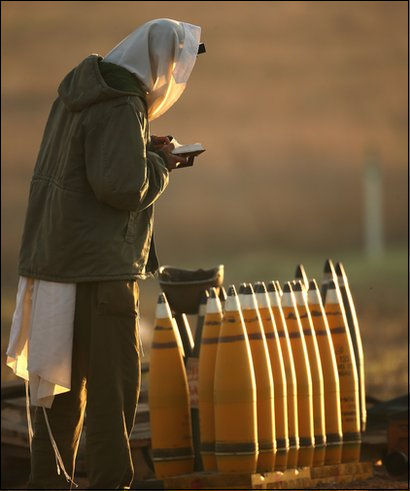
    Here’s a recent BBC picture with the tag-line “An Israeli soldier prays at dawn on Israel’s border with the Gaza Strip”:

    Some readers might look at that picture and recall Psalm 94, verses 3-5:

    Lord, how long shall the wicked, how long shall the wicked triumph? How long shall they utter and speak hard things? and all the workers of iniquity boast themselves? They break in pieces thy people, O Lord, and afflict thine heritage.

    Some might reflect on Psalm 122, verses 6-7:

    Pray for the peace of Jerusalem; may they prosper that love thee. Peace be within thy walls, and prosperity within thy palaces.

    Some might recall the Qur’an 49, verse 13:

    O mankind, We have created you male and female, and appointed you races and tribes, that you may know one another.

    Others might think of the Gharqad Tree hadith, quoted in the charter of Hamas:

    The Day of Judgement will not come about until Muslims fight the Jews (killing the Jews), when the Jew will hide behind stones and trees. The stones and trees will say O Muslims, O Abdulla, there is a Jew behind me, come and kill him. Only the Gharkad tree, would not do that because it is one of the trees of the Jews.

    And I myself have no idea what the prayers that Jewish soldier offered were all about — his own safety, that of his family and loved ones, that of his own people, that of all the world’s people — nor about the prayers of young Muslims on the other side of the wall…

    **

    I look at that photo of the soldier boy praying beside the munitions of a brutal war, and my first instinct is to feel sadness — because the essence of prayer, surely, is shalom, peace, salaam.

    And then I am reminded of the Dominican and the Jesuit in that story I told you.

    Substituting “peace” for “prayer” and “war” for “munitions” to get at the essence here — should I be more sad that here, peace is depicted in the presence of war — or more glad that here, war is depicted in the presence of peace?


    Switch to our mobile site