zenpundit.com » poetry

Archive for the ‘poetry’ Category

Between the warrior and the monk (iii): poetry and sacrament

Friday, May 25th, 2012

[ by Charles Cameron — a warrior, a monk, and (still to come, in a fourth and final post) where that leaves me ]
.


.

How I have loved that handwriting! How I loved that man! How I have loved that book…

*

I am fifteen, seventeen years old. I walk a few hundred yards in the chill English dawn to our little parish church to “serve Mass” at 6am, for this man whose intense gaze and tireless care for those he is with made him take of his hat to Mrs Tutu, and ask Hugh what would get him out of his hospital bed fastest. He brings the same gaze and care to bear on me, and talks to me about the English Jesuit poet Gerard Manley Hopkins, whose work he loves.

Trevor Huddleston taught me to love poetry when he showed me Hopkins, and I cannot exactly tell this story without “reading” you a bit of the man’s work, because it gets to the heart of the matter.

Hopkins has a very brilliant poem, As king fishers catch fire, which requires quite a bit of “unpacking” since Hopkins writes poetry as though packing an intolerable amount of sound and meaning into a very small space. The poem is about what Hopkins calls “selving”: being the self you are, ie being true not just to your possibilities, but to your flavor, your individuality. In the theological termino0logy of Duns Scotus: hacceitas.

Here’s how Hopkins expresses it:

Each mortal thing does one thing and the same:
Deals out that being indoors each one dwells;
Selves — goes itself; myself it speaks and spells,
Crying What I do is me: for that I came.

We selve, we become ourselves — we deal out into the world that being which dwells indoors, inside, within us.

The second half of the poem goes like this:

I say more: the just man justices;
Keeps grace: that keeps all his goings graces;
Acts in God’s eye what in God’s eye he is —
Christ. For Christ plays in ten thousand places,
Lovely in limbs, and lovely in eyes not his
To the Father through the features of men’s faces.

Let me try at least to unpack this much:

The man who is just, he’s saying, goes about doing acts of justice (there’s no difference between his nature and his deeds), he is tethered to grace (has an inward center with which he is perpetually in touch), and that tether is what ensures his actions (“goings”) are of the quality of grace.

He — and here Hopkins tell us what this is really all about, from his own perspective as a deeply religious man and a Catholic priest in the Jesuit order — acts Christ, for that is how God sees him. Each one of us is, in God’s eye, Christ, “for Christ plays in ten thousand places”. That’s the great gift Hopkins brings us, the understanding that being made in the image of God, we play here on earth like so many Christs, each with its own character and “self”, each one capable of grace… and thus, each individual beautiful to God “through the features of men’s faces”.

Here, should you care to read it, is the whole poem.

*

Trevor offers his hands and voice as a priest at Mass to the great poetical transformation of “bread” into “body” and “wine” into “blood” that stands at the heart of the Christian mystery, and eats, digests, the divine presence among us, and offers that divine presence in the appearance of a wafer of bread and sip of wine to whoever “partakes of communion” with him.

And walking to Mass, or walking back from Mass, he talks to me about South Africa, and the kids he knew there — Desmond and Hugh among them no doubt, though I learned those particular stories far later — and the pass laws which penalized his students when they were late getting home from work in a “white” part of town, and his fights in the courts and in the press for young people he loved — Hugh or Desmond or Oscar or whoever goes to Mass, receives Christ on his tongue, and that “keeps all his goings graces” — because “Christ plays in ten thousand places”, and Sophiatown, a shanty town just outside Johannesberg, is one of them.

Father Trevor, school teacher, photo credit Constance Stuart Larrabee

Am I making any sense? It was Trevor’s love, which “saw” the divine in each individual child he taught and coached and loved, which could not tolerate apartheid, which could not stop at a boy’s skin color and segregate or tolerate segregation.

*

Loving the individual before him with that gaze and care, he loved and taught me, for seven or eight years, in four hundred wonderful letters and many visits, Masses, days spent flyfishing for trout, voyages by car or train to visit a friend or a cathedral…

And if I could express the essence, it was this: that you tether yourself to the divine on the inside, by belief, by ritual, above all by contemplation — and then you move through the world infused with that sense of the sacred in and around you, and do whatever is needful to bring about a more just society.

You justice, you keep grace. That keeps all your goings graces.

Christ the King, Sophiatown, photo credit Eliot Elisofon

Not surprising, then, that his devotion to the kids of a shanty town in South Africa led him into court battles, into association with Luthuli and Mandela, into becoming one of a handful of “white” signatories of the African National Congress, into the award of the Isitwalandwe, the writing of his great book, Naught for your Comfort [link is to a free download] — which was smuggled out of the country to be published just a day ahead of the Special Police impounding all his papers — to bestsellerdom, to stirring the conscience of the world, to the Presidency of the Anti-Apartheid Movement, and finally to an archbishopric and a knighthood.

He saw Christ, which was his name for love, and served him.

Simple.

*

Father Trevor Huddleston wrote what I think must be among the most powerful words of eucharistic theology I have ever read in Naught for Your Comfort — and they convey as nothing else can the immediacy with which he connects his ritual gestures and acts as a priest with the political necessity to overthrow the apartheid regime in his beloved South Africa — and for that matter, any and all hatred and oppression everywhere…

On Maundy Thursday, in the Liturgy of the Catholic Church, when the Mass of the day is ended, the priest takes a towel and girds himself with it; he takes a basin in his hands, and kneeling in front of those who have been chosen, he washes their feet and wipes them, kissing them also one by one. So he takes, momentarily, the place of his Master. The centuries are swept away, the Upper Room in the stillness of the night is all around him: “If I, your Lord and Master, have washed your feet, ye ought also to wash one another’s feet.” I have knelt in the sanctuary of our lovely church in Rosettenville and washed the feet of African students, stooping to kiss them. In this also I have known the meaning of identification. The difficulty is to carry the truth out into Johannesberg, into South Africa, into the world.
Carlos Fuentes (1928 – 2012)

Wednesday, May 16th, 2012

[ by Charles Cameron — in memory of Carlos Fuentes, requiescat in pace ]
.


.

Carlos Fuentes‘ great novel, Terra Nostra, opens with these words:

Incredible the first animal that dreamed of another animal.

It’s a sentence to stop you in your tracks, a sentence to give pause to time itself, circling back on itself like the serpent that eats its own tail, a dream of a sentence, a dream sentence.

Fuentes continues:

Monstrous the first vertebrate that succeeded in standing on two feet and thus spread terror among the beasts still normally and happily crawling close to the ground through the slime of creation. Astounding the first telephone call, the first boiling water, the first song, the first loincloth.

How does a mind move so agilely among these many and diverse firsts — the sleeping, the archeo-anthropological, the technical, the musical, the shameful or sinful or perhaps decorative, even erotic? In a single paragraph — the first in a book that will run 890 pages and not tire?

And Fuentes continues:

About four o’clock in the morning one fourteenth of July, Pollo Phoibee, asleep in his high garret room, door and windows flung wide, dreamed these things, and prepared to answer them himself.

Pollo Phoibee dreamed these things, Carlos Fuentes dreamed Pollo Phoibee…

And we are in Paris, Paris of the artists, of the garret, and yet a Paris where the Seine is boiling, where the Louvre has become crystalline, the black eyes of the gargoyles of Notre Dame see “a much vaster panorama”…

*

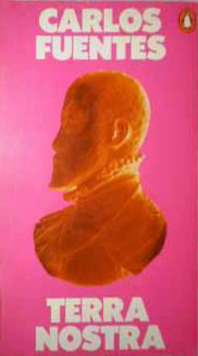
Carlos Fuentes died today, and I am saddened — remembering him signing my short, fat British Penguin paperback of Terra Nostra (its fondly remembered cover image above) and commenting that it was his preferred English edition, since one could slip it into one’s pocket…

And Terra Nostra was special to me, both as a great and tumultuous fiction, and as a fiction that quoted Norman Cohn‘s In Pursuit of the Millenniun, the book that back in my Oxford days introduced me to the history of apocalyptic thought… a fiction also familiar with Frances Yates, another scholar I greatly admire, and her writings on the Memory Theater

Carlos Fuentes, the imagination that conceived Terra Nostra, is no longer with us.

*

He had been a diplomat, this great imagination. Born into a diplo family, he had served as Mexican ambassador to Paris — Paris of the diplomatic banquets, but also of the artist’s garret, of this New World imagination spanning continents and centuries as though they were a playground, the playground of a single, multiple, cosmopolitan and erudite mind.

The poet Paul Claudel, French ambassador to Japan, was reproved by the Surrealists in 1925 with the words:

One cannot be both ambassador for France and poet!

The poet Saint-John Perse was secretary to the French Embassy in Peking, and later General Secretary of the French Foreign Office. The poet Giorgos Seferis was Royal Greek Ambassador to the United Kingdom. The poet Pablo Neruda was Chilean ambassador to France… The poet Octavio Paz, Mexico’s ambassador to India.

Among novelists, it was Lawrence Durrell — an Englishman born in India with what he described as “a Tibetan mentality” — one who found life in England itself “like an autopsy … so, so dreary” — who was British press attaché in Alexandria, Egypt, during World War II, where as they say:

Ostensibly working, Durrell was in reality closely observing the assortment of sights, sensations, and people that wartime Alexandria, a crossroads of the East and West, had to offer.

The result was his masterpiece, The Alexandria Quartet.

*

Fuentes is heir to many lineages: of Mexico, of the world, of literature, of diplomacy, of the imagination.

In honoring him today, my researches turned up this apposite quote from Aldo Matteucci at the Reflections on Diplomacy blog:

To survive, a diplomat needs poetry. Filed amidst the many layers of the brief, the short poem will refresh the bleary mind. Poetry brings distance – hence perspective and insight. Poetry reminds the diplomat that the best professional is the amateur.

Most deeply – poetry is truth.

Carlos Fuentes survives us all.

Sanctity, vision, science, ecology and the creativity of diagrams

Saturday, May 12th, 2012

[ by Charles Cameron — of [almost] no military or intelligence interest, this is a post for computer scientists, historians, scientists, artists, contemplatives and other creatives ]
.

I’ve been on a bit of a binge about medieval and renaissance diagrams recently, putting together an anthology of early “semantic networks” for the Sembl game site – but also thinking about the alternate track of art history which would focus on diagrams rather than paintings (I’m thinking of two dimensions here, hence no mention of sculpture) – an alternate history which may have something to teach our richly diagrammatic and data-visual times.

My interest in all this tracks back at least to my early encounter with an essay by the computer scientist Margaret Masterman in Theoria to Theory (1967).

*

Yesterday brought me a post from Jason Wells, a scientist and bright all-rounder I follow on Google+, in which he posted an image of the cosmos from the Ptolemaic (pre-Copernical) point of view, which I’ve put at the head of this post.

Jason commented on this diagram:

As pretty as this is, this is not how your universe works.

That is all.

The diagram Jason posted purports to be mathematically and astronomically based: it is, if you like, a quantitative diagram. I don’t happen to think it’s pretty, although the two creatures (angels, goddesses?) up towards the top of the circle may be, and the serpent eating its tail around it is nicely done -– I think it has a rather austere beauty to be honest, but I’m likely to concede to Jason that it isn’t “true” in the sense of being an accurate representation of the (abstract) laws of celestial motion.

But then I also think there’s more to truth than accuracy, useful though that may be – there’s also a qualitative element to truth, and perhaps “beauty” is (among other things) a name for it.

*

Yesterday also brought me a news bulletin that ties into that same interest in medieval and renaissance diagrams. From the Vatican Information Service (via Chant Cafe) , we learn that Hildegarde of Bingen (1098 – 1179) is now a saint of the Catholic Church with universal cultus:

Vatican City, 10 May 2012 (VIS) – The Holy Father today received in audience Cardinal Angelo Amato S.D.B., prefect of the Congregation for the Causes of Saints. During the audience he extended the liturgical cult of St. Hildegard of Bingen (1089-1179) to the universal Church, inscribing her in the catalogue of saints.

Consider, then, in contrast to Jason’s mechanistic Ptolemaic diagram, this diagram which today’s fresh-minted saint produced in the late 1140s or early 1150s to illustrate her visionary intuitions of the universe in the first of three books, Scivias:

and these two, from Liber divinorum operum:

and:

These, I take it, are purely qualitative images in contrast to the Ptolemaic diagram — making no propositional claims as to physical or mathematical accuracy, but portraying Hildegarde’s sense of cosmic order. And just as we would not argue whether it is Van Gogh or El Greco who is “right” about the skies in their respective paintings, so I don’t think Hildegarde is worried about which of her diagrams is “right” in its portrayal of the world she lived and prayed in – each one illustrates some aspect of her vision of the world, and one does not necessarily contradict another.

*

Here are two descriptions of Hildegarde’s world, which may give us some insight into the diagrams above. For the top one:

For Hildegard of Bingen, twelfth century German Benedictine abbess, the universe is like an egg in the womb of God. Her view of the universe, conditioned as it is by her times and her education, represents her visionary understanding of God’s motherhood of this sphere that we call the universe. Hers is a view that is organic and holistic, coloured neither by Greek philosophy nor Enlightenment rationalism, refreshing and strikingly “true” in its perceptions around the source of created life.

Jean Evans, RSM, Viriditas and Veritas: The Ecological Prophets Hildegard of Bingen and Miriam Therese MacGillis, OP

And for the third:

God created the world out of the four elements, to glorify His name. He strengthened the world with the wind. He connected the world to the stars. And he filled the world with all kinds of creatures. He then put human beings throughout the world, giving them great power as stewards of all Creation. Human beings cannot live without the rest of nature, they must care for all natural things.

von Bingen, Physica, 755, quoted in Stephanie Roth, The Cosmic Vision of Hildegard of Bingen,” The Ecologist 30, no. 1 (2000).

It’s probably worth mentioning that three of the “four elements” of the ancients are still known to us, though we call them “states” rather than “elements” at this point — the solid, liquid and gaseous states correspond with what the ancients called “earth”, “water” and “air”, respectively — and it has even been suggested that their “fire” corresponds to the fourth state we now term “plasmas” — not my line of business, however, so who knows?

*

Hildegarde picked up the word “viriditas” from Gregory the Great and made it peculiarly her own. It means greeness, literally, and freshness by extension — but for Hildegarde’s integral view of all that is, it also carries a theological dimension, Christ being the greening of the world for her:

For Hildegard, viriditas was an attribute of the Divine nature, a reflection of God’s goodness and beauty. It stood for vitality, fertility, fruitfulness and growth; in fact all the things that we now associate with the “greenness” of nature. For us today “greenness” is a sign that the Earth is healthy and flourishing. Similarly, for Hildegard, viriditas was synonymous with physical and spiritual health, with the continuing vivifying force of the Holy Spirit.
.
Dr Carmel Bendon Davis, Hildegard of Bingen: Eco-warrior and Superwoman

This greening or freshening is not, for Hildegarde, just a matter of earth and water, of river and forest, it is also infused with fire and air:

I am likewise the fiery life of the substance of divinity. I flame over the beauty of the fields and sparkle in the waters, and I burn in sun, moon, and stars. And with an airy wind that sustains all things with invisible life, I raise them up vitally. For air lives in greenness and flowers, waters flow as if alive, the sun, too, lives in his light, and when the moon comes to her decline she is kindled by his light, as it were to live again… Thus I, the fiery force, am hidden in [the winds], and they take fire from me, just as breath continually moves a man, and as a windy flame exists in fire. All of these live in their essence and are not found in death, because I am life.

Nor is it “merely” natural, it can also be found in the soul:

Understanding in the soul is like the Veriditas of the branches and the leaves of the tree

It is, in fact, neither exclusively natural nor supernatural, but non-dual.

*

Dylan Thomas, being a Welshman and a poet, thus has an insight that bears a family resemblance to Hildegarde’s, but phrases it in a way that leaves the “force” neither personified nor otherwise… and thus with no necessary doctrinal implication:

The force that through the green fuse drives the flower
Drives my green age; that blasts the roots of trees
Is my destroyer.
And I am dumb to tell the crooked rose
My youth is bent by the same wintry fever.

Due to the idiocy of copyright, you’ll have to go elsewhere to read the whole, fine poem.

For Hildegarde, this “force” is also Christ — for he himself is the “the fiery life of the substance of divinity” — and his coming to earth a greening and freshening of a world until then barren of the love he brought.

*

Hildegarde was the abbess in charge of a small flotilla of nuns — but also a mystic, a visionary, philosopher, poet, painter and songstress…

Her song of creation, O Viriditas, bears comparison in spirit with St FrancisCanticle of the Sun. She writes to her “green” Christ and his “green” planet:

O greenness of God’s finger
with which God built a vineyard
that shines in heaven
as an established pillar:
You are glorious in God’s preparation.
And o height of the mountain
that will never be dispersed
in the judgment of God,
you nevertheless stand from afar as an exile,
but it is not in the power
of the armed man
to seize you.
You are glorious in God’s preparation.
Glory be to the Father and to the Son
and to the Holy Spirit.
You are glorious in God’s preparation.

And she sets her words to the music of the times:

Indeed, her music is sung even today…

How’s that for a twelfth century statement of what we’d these days call “ecology”?

*

But all this risks getting far too ethereal, I have wandered far along my own epicycles from Jason Wells’ point, and methinks I should bring us back down to earth.

Dennis The Constitutional Peasant, in Monty Python and the Holy Grail, meets King Arthur and complains, “What I object to is you automatically treatin’ me like an inferior.” It’s understandable — but so, perhaps, is king Arthur’s response: “Well, I am king.”

Two worldviews clash here — and in the ensuing debate, Arthurian myth meets contemporary politics:

Dennis’ Mother: Well how’d you become king, then?
Arthur: The Lady of the Lake,… [Angel chorus begins singing in background] her arm clad in the purest shimmering samite, held aloft Excalibur from the bosom of the water signifying by Divine Providence that I, Arthur, was to carry Excalibur. [Angel chorus ends] That is why I am your king!
Dennis: Listen. Strange women lying in ponds distributing swords is no basis for a system of government. Supreme executive power derives from a mandate from the masses, not from some farcical aquatic ceremony.
Arthur: Be quiet!
Dennis: You can’t expect to wield supreme power just ’cause some watery tart threw a sword at you!
Arthur: Shut up!
Dennis: I mean, if I went ’round saying I was an emperor just because some moistened bint had lobbed a scimitar at me, they’d put me away!

Or if some bint told me the universe was a cosmic egg in the womb of God, for that matter — even if Benedict XVI did just add her to the calendar of saints.

*

Here you go, courtesy of YouTube:

*

Frankly I appreciate both modes of thinking — the mythic and the scientific — and believe we’re in the sort of territory here that Nils Bohr was thinking of when he said:

The opposite of a true statement is a false statement. But the opposite of a profound truth may be another profound truth.

For more on the story of diagrammatic and pictorial imagery in western civilization, see Ioan Couliano, Eros and Magic in the Renaissance (University of Chicago, 1987). And for more diagrams from the renaissance, there’s nothing I know of better than SK Heninger, The Cosmographical Glass: Renaissance Diagrams Of The Universe (Huntington Library, 1977).

Change: a poem from The Poetry of the Taliban

Tuesday, May 8th, 2012

[ by Charles Cameron — poetry in time of war, symbolism / semiotics of blood and martyrdom, analogies with Jefferson and St Augustine, sacramental nature of reality ]
.

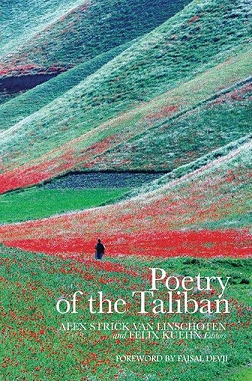
Felix Kuehn and Alex Strick van Linschoten’s book The Poetry of the Taliban (Hurst, Columbia UP) contains a remarkable poem composed in the 1990s by one Bismillah Sahar:
.

Change

The spring of change needs blood to rain down,
It requires the irrigation of the gardens with blood.
Valuing the blood of the people of the past
Requires the price of human blood.
Each drop of it has become a Nile of the dawn’s blood;
The Pharaohs want to fill the Nile with blood

Sitting here in California seven thousand miles and many cultures distant and more than a decade later, the phrase “spring of change” has an interesting ring to it – but it was likely not the not-yet-deposed Mubarak that Sahar was thinking of when he penned his lyric about the Pharaoh, but “the Oppressor” — whomever that might be. The imagery of the Pharaoh is a common enough trope, in fact, used for instance by the Taliban to describe President GW Bush in their magazine Al-Sumud [ link is to preview, relevant chapter of Master Narratives of islamist Extremism.

And while it is true that, as Asim Qureshi notes, “poetry links the ancient past with the modern day”, neither the trope itself nor the reference to the plight of the Jews in Egypt is exclusive to Afghanistan in specific or Islam in general. Indeed, Martin Luther King explicitly views himself as what theology would term a “type” of Moses when he says:

We’ve got some difficult days ahead. But it doesn’t matter with me now. Because I’ve been to the mountaintop. And I don’t mind. Like anybody, I would like to live a long life. Longevity has its place. But I’m not concerned about that now. I just want to do God’s will. And He’s allowed me to go up to the mountain. And I’ve looked over. And I’ve seen the promised land. I may not get there with you. But I want you to know tonight, that we, as a people will get to the promised land. And I’m happy, tonight. I’m not worried about anything. I’m not fearing any man. Mine eyes have seen the glory of the coming of the Lord.

These sacramental bleedings of the past into the present as in a palimpsest are native to the imagination and powerful in their poetic impact, as MLK’s life, final speech and death eloquently testify.

But there is a second layer of sacramental reality at work in the poem, and it lies in the repeated mention of blood. – the transition between past an present itself being presented in terms of blood spilled in the lines:

Valuing the blood of the people of the past
Requires the price of human blood.

The past requires a price from the present, then, and that price is paid in blood.

*

The poem is six lines long, and there is not a line of it that does not contain the word blood. Again:

The spring of change needs blood to rain down,
It requires the irrigation of the gardens with blood.
Valuing the blood of the people of the past
Requires the price of human blood.
Each drop of it has become a Nile of the dawn’s blood;
The Pharaohs want to fill the Nile with blood.

*

Zeus “poured bloody drops earthwards, honoring his own son, whom Patroklos was soon to destroy in fertile Troy far from his homeland”, Homer writes in the Iliad, 16.459, and the associations of rain with tears, and of spilled blood with spilled life, are ancient and pervasive.

Blood lust, blood sacrifice – the word blood is as powerful as any in the human vocabulary, so much less abstract that birth or death yet richly associated with both, while the sight or thought of blood stirs us at some archaic level of primal imagination. And what of the “irrigation of the gardens with blood”?

The gardens, first, are paradise. Next, they are paradise on earth, perhaps in one’s own village. I have written before of my memories of:

one small white-walled mosque way out on a dry stretch of road between Herat and Kandahar and its small, lush, green garden, all these years later: whatever it was to the inhabitants of that small village, to me it was “oasis” and “paradise” in perfect miniature, and it remains so in memory.

The rivers of Islam’s paradise flow with water, milk, honey and wines: so what place has blood there?

One answer would be found in the hadith, “Know that paradise is under the shade of swords”.

In his book The Shade of Swords: Jihad and the Conflict Between Islam and Christianity, named after the hadith in question, the noted journalist MJ Akbar writes:

The only reason why a person could ever want to leave paradise for this earth would be to get martyred again. Death was only a welcome release; there was no possible deed in this life that could equal jihad in reward after death. The Prophet urged Muslims to seek Firdaus, the best and brightest part of paradise, just below Allah’s throne. Allah had reserved one hundred grades of paradise only for the martyrs. The blood of the wounded would smell like musk on the day of resurrection; and nothing could interfere with Allah’s reward.

The blood of the wounded would smell like musk…

For more on musk, blood, martyrdom and the “odor of sanctity”, see my Of war and miracle: the poetics, spirituality and narratives of jihad.

And so blood is linked to paradise by martyrdom.

*

The spring of change “requires the irrigation of the gardens with blood” the poet tells us, much as Thomas Jefferson told William Stephens Smith in a letter of November 13, 1787:

The tree of liberty must be refreshed from time to time with the blood of patriots and tyrants. It is it’s natural manure.

But hold on, the same trope is found in St. Augustine‘s City of God, xx.7:

Through virtue of these testimonies, and notwithstanding the opposition and terror of so many cruel persecutions, the resurrection and immortality of the flesh, first in Christ, and subsequently in all in the new world, was believed, was intrepidly proclaimed, and was sown over the whole world, to be fertilized richly with the blood of the martyrs.

And the imagery continues, in the West, into our own day. When Pope Benedict XVI visited Mexico earlier this year, he was treading on “land that was wet with the blood of martyrs” according to Mgr. Fidel Hernández Lara, Episcopal Vicar of the Mexican Archdiocese of León.

*

The very earliest Christian accounts of martyrdom, indeed, have a distinctly sacramental flavor, as one sees by juxtaposing Ignatius of Antioch (quoted by Carolyn Forche in Susan Bergman, ed., Martyrs):

I am God’s wheat ground fine by the lion’s teeth to become purest bread for Christ

with Tertullian (Apologeticum in the translation by Lewis Carroll‘s father):

The blood of the Christians is their harvest seed

*

Joseba Zulaika subtitles his book Basque Violence — which Leah Farrall kindly pointed me to — with the words “Metaphor and Sacrament”.

Sacrament is a key word for me, obviously, and for the sake of those disinclined to religion, may I point to Gregory Bateson‘s comment in the first paragraph of the Introduction to his Mind and Nature:

Even grown-up persons with children of their own cannot give a reasonable account of concepts such as entropy, sacrament, syntax, number, quantity, pattern, linear relation, name, class, relevance, energy, redundancy, force, probability, parts, whole, information, tautology, homology, mass (either Newtonian or Christian), explanation, description, rule of dimensions, logical type, metaphor, topology, and so on. What are butterflies? What are starfish? What are beauty and ugliness?

The concept of “sacrament” occupies a place of honor second only to “entropy” in Bateson’s listing.

I am not arguing the pros and cons of publishing these poems, although I side firmly with the publisher on this. Nor am I attempting to assess the poetic value of the one poem I have quoted and examined. What I am trying to do is to give that poem the kind of reading I would want to give to any poem that interested me — one that seeks out its resonances in both local and world cultures as far as my wits can manage, showing, if possible, what power it gains from archetype, authority and form… If the poem were from the South English Legendary, for instance — which expresses similar sentiments — I’d have no hesitation calling its worldview “sacramental”.

But this is a poem from Afghanistan and Islam, not from medieval Christian England, so I should perhaps explain that in my view, any perspective which views the world as a series of legible “signs from God” — ayat, in the Arabic of the Qur’an — is a sacramental view, under the definition of sacrament that calls it “an outward and visible sign of an inward and spiritual grace”.

Blood is such a sign — of life, of its value, of its continuity by descent, and of its redemptive power even in death.

It is in sensing this semiotic / sacramental quality to Islam that we begin to grasp what translations such as these can point us to, but not directly reveal.

*****

Further reading:

From today’s NYT: Why Afghan Women Risk Death to Write Poetry
Poetry reading in Afghan culture: Reading Poetry In Kandahar
Afghan poetics: Poetry: Why it Matters to Afghans? Understanding Afghan Culture [.pdf], NPS, 2009
Talib poetry as propaganda: Johnson & Waheed, Analyzing Taliban taranas (chants): an effective Afghan propaganda artifact, Small Wars & Insurgencies, 2011
And finally, Afghans Build Peace, One Stanza at a Time

The uniform, the disruptive, & from Colditz to Mt Kenya

Thursday, May 3rd, 2012

[ by Charles Cameron — out of the box thinking, the blues, prison escape literature and more ]
.

As you’ll see by the time we get to the Colditz segment of this post, I’m not arguing that anyone should change out of uniform.

But oh yes, I do fish for eddies in the currents of words — or to put that the other way around, eddies in the currents of words tend to catch my eye, and when I read this paragraph in Kohlmann‘s Response to the Critics of Disruptive Thinking:

Jon Favreau, the head speechwriter for President Obama, was 27 when appointed. Aaron Schock, a Congressman from Illinois, is 30. Mark Zuckerberg created Facebook when he was still an undergrad at Harvard. Tom Brady won multiple Super Bowls in his twenties. This is a remarkable list, with some household names. Yet, I must ask, where are our young strategic military geniuses in uniform?

it was that last word that grabbed my attention — because somewhere in the back of my mind I have this idea that there’s nothing uniform about genius: it’s supremely individual.

Besides, I’m 67.

*

All of which brings me circuitously to Blind Lemon Jefferson and his Lock Step Blues:

Mean old jailor : taking away my dancing shoes
I can’t strut my stuff : when I got those lock-step blues

Again, I’m not claiming that “military” equates to “prison”, or that marching involves leg-irons… just hop, skipping and dancing from one thought to another, to see whether there’s a creative leap available…

*

And indeed it seems there is.

Thinking about disruptive thinking and uniforms and, well, prison, finally put me in mind of the place where the uniformed are required by their own code to be disruptive — that is, when they’re in POW camps.

There’s a great deal of noise these days about outside the box thinking — as a synonym for creativity — but it has only now occurred to me as I’m writing this post that one of my very first boyhood obsessions was in fact a kind of training ground for thinking outside the box.

And the box in question was Colditz Castle, the POW camp where the Germans sent those who had already escaped from at least one such camp and been recaptured.

I don’t know Emily Short, but in a post at her Interactive Storytelling blog, she describes the German “idea of putting all the most clever and resourceful prisoners together in an old building riddled with hiding places and odd physical quirks” as “not the brightest”, and notes that “those imprisoned found an astounding number of escape possibilities”.

That’s the essence of The Colditz Story, as described by PR Reid in his 1953 book of that name and its sequel, Men of Colditz [link is to double volume]. And I was fixated on Colditz and other World War II escape narratives for a boyish year or two thereafter.

*

Decades after that obsessive interest of mine in military escape literature had faded from view, I ran across another tale that fits the genre: Felice Benuzzi‘e extraordinary 1953 No Picnic on Mount Kenya.

Benuzzi was an Italian POW in a British camp in Kenya, with little to no prospect that even if he could escape the camp he’d be able to avoid recapture:

The idea of escaping is a vital factor in the mind of every prisoner. On our arrival in East Africa I had as a matter of course carefully considered the chances of reaching the nearest neutral territory, Portuguese East Africa; but I had concluded that, for me at least, this would be impossible. The distances one had to cover were enormous, one needed a frightful lot of money, the opportunity of getting a car, knowledge of the country and of the main languages, and faked documents…

But imprisonment is appalling boredom, and boredom didn’t suit Benuzzi’s temperament. One night he saw Mt Kenya from the camp for the first time:

an ethereal mountain emerging from a tossing sea of clouds framed between two dark barracks — a massive blue-black tooth of sheer rock inlaid with azure glaciers, austere yet floating fairy-like on the near horizon. It was the first 17,000-foot peak I had ever seen.

I stood gazing until the vision disappeared among the shifting cloud banks.

For hours afterwards I remained spell-bound.

*

Escape from boredom was imperative, climbing Mt Kenya would be Benuzzi’s return to life.

Fortunately, Bennuzi had a map:

Admittedly it was just the label from a can of “meat and vegetable rations” — but beggars and prisoners can’t be choosers, necessity is the mother of invention, and a meat rations can was what they had.

The dangers they faced were real enough. From the introduction:

“In order to break the monotony of life (in prison) one had only to start taking risks again,” Benuzzi writes as he and his comrades design their escape. The risks are real. Sneaking out of camp, they may be shot. For the first two days they must travel at night, across fields and past settlements. Once in the forest, away from what Benuzzi calls “the human danger-zone,” they will enter the “beast danger-zone.” Finally they will escape into the relative safety of the alpine tundra. Every mountaineer and outdoor person reading this tale will feel kinship to Benuzzi here, when he writes that “all the landscape around us reflected our happiness … green-golden sunrays filtered through the foliage … bellflowers seemed to wait for the fairy of the tale who would ring them. We were now into a world untainted by man’s misery, and bright with promise. Other dangers undoubtedly in store for us, but not from mankind, only from nature.”

Benuzzi avoided the worst that humans and beasts could throw at him, scaled Mt Kenya’s Point Lenana (16,300 ft), with equipment scrounged from around the camp, returned, surrendered himself to the British and to solitary confinement — knowing himself a free man — and lived, as they say, to tell the tale.

*

So what do we learn?

It’s not that uniforms frustrate creativity, it’s that necessity procures it.

As the great Islamic poet Jalaluddin Rumi [quoted in Idries Shah, Tales of the Dervishes, p. 197.] says:

New organs of perception come into being as a result of necessity.
Therefore, O man, increase your necessity, so that you may increase your perception.

That’s where this whole “disruptive thinking” discourse is eventually headed.


Switch to our mobile site