zenpundit.com » Islam

Archive for the ‘Islam’ Category

Of Alice, Angels and Apsaras

Wednesday, May 15th, 2013

[ by Charles Cameron — squeezed between the space of astronomers and the paradise of the believers, is there yet room for the dancing play of poetry, music and imagination? ]
.

My first question for you today would be — do you believe in Alice?

And further to that, do you believe in the Red Queen?

**

Two things collided to cause me to write this post today. First, Emptywheel opened her blog post on Putin’s outing of an American spy today with a quote from Lewis Carroll:

‘I declare it’s marked out just like a large chessboard!’ Alice said at last. ‘There ought to be some men moving about somewhere–and so there are!’ she added in a tone of delight, and her heart began to beat quick with excitement as she went on. ‘It’s a great huge game of chess that’s being played–all over the world -– if this is the world at all, you know. Oh, what fun it is!’

I can’t really ignore Lewis Carroll when he crops up in my morning feed like that: he’s a Christ Church man and a poet, as I am, and it would be rude of me to ignore him. And besides, what he’s on about here is the world-as-game concept, which is never far from my mind — hence my inclusion of that question about the Red Queen.

**

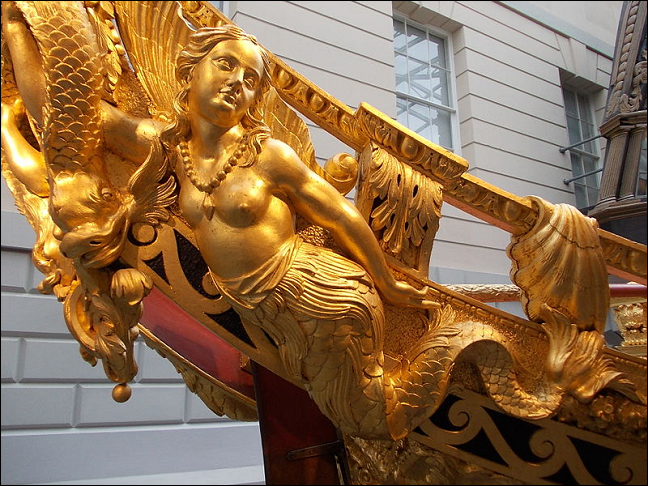
And second, mermaids.

.

It gets more interesting, you see. Because what collided with that first question was a conversation @khanserai aka Humera Khan was having with @mujaahid4life aka Abdallah via Twitter, in which the Harry Potter books were discussed and the topic of unimaginative clerical fatwas on games and works of fiction came up. At which point, Abdallah pointed us all to this now-archived fatwa regarding the permissibility of eating mermaid flesh:

Ruling on eating mermaids

A mermaid is a creature that lives in water and looks like a human. As to whether it really exists or it is a mythical being, that is subject to further discussion.

It says in a footnote in al-Mawsoo’ah al-Fiqhiyyah (5/129): From the modern academic resources that are available to us, it may be understood that the mermaid, which is called Sirène in French, is a mythical creature that is described in fairy tales as having an upper body like a woman and a lower half like a fish.

See the French Larousse encyclopédique on the word Sirène.

The encyclopaedia goes on to say: The widespread notion in ancient times was that the wonders and animals of the sea were more and greater than the wonders of dry land, and that there was no kind of animal in the sea that did not have a counterpart on land. This was confirmed by Prof. Muhammad Fareed Wajdi in his encyclopaedia, quoting from modern academic sources. See: Daa’irah Ma’aarif al-Qarn al-‘Ishreen: Bahr – Hayawiyan. End quote.

Al-Dumayri said in Hayaat al-Haywaan al-Kubra: Mermaid: it resembles a human but it has a tail. Al-Qazweeni said: Someone brought one of them in our time. End quote.

Many of the fuqaha’ mentioned mermaids and differed on the ruling concerning them. Some of them said that they are permissible (to eat) because of the general meaning of the evidence which says that whatever is in the sea is permissible. This is the view of the Shaafa’is and Hanbalis, and is the view of most of the Maalikis and of Ibn Hazm and others. And some of them regarded it as haraam because it is not a kind of fish. This is the view of the Hanafis and of al-Layth ibn Sa’d.

Ibn Hazm (may Allaah have mercy on him) said in al-Muhalla (6/50): As for that which lives in the water and cannot live anywhere else, it is all halaal no matter what state it is in, whether it is caught alive and then dies, or it dies in the water and then floats or does not float, whether it was killed by a sea creature or a land animal. It is all halaal to eat, whether it is the pig of the sea (i.e., a dolphin), a mermaid, or a dog of the sea (i.e., shark) and so on. It is halaal to eat, whether it was killed by an idol-worshipper, a Muslim, a kitaabi (Jew or Christian) or it was not killed by anyone.
What’s outside the box?

And it goes on… ending, mercifully:

And Allaah knows best.

Sometimes I think those might be my favorite words evvah!

**

Are mermaids real enough for religious scholarship to address them?

Is Alice?

John Daido Loori Roshi, late zen master and abbot of the Mountains and Rivers Order’s Mt Tremper abbey, once gave a teisho using a passage from Alice as his koan:

Many Zen koans contain references to myths and folktales of ancient India, China, and Japan. Since Westerners generally are not familiar with these stories, koan study without extensive background information is often a frustrating and exasperating process.

In this dharma discourse, Abbot John Daido Loori fashions a koan, complete with pointer and capping verse, from a classic of children’s literature, Lewis Carroll’s Alice in Wonderland. The koan revolves around Alice’s encounter with a caterpillar who explains the magical properties of a special two-sided mushroom that to Alice’s eyes appears perfectly round. Alice’s struggles with this dilemma make for a stimulating story that mirrors the conflicts and dualities we face in our everyday life.

You can read it here.

**

All of which brings me to the question of the place of deep imagination in a sometimes shallow world.

Alice, do you believe in her? Mermaids and Macbeth mean something to sailors and theater-folk, respetively. Angels? If angels, then the djinn, too? Christian scripture speaks for the existence of one, the Qur’an of both — is one more probable, more real, perhaps, than the other?
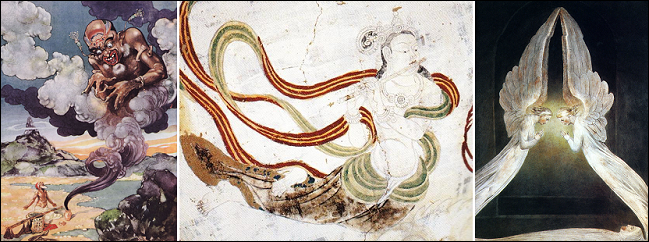
And what of the gandharvas and apsaras — middle panel — the celestial musicians and airy dancers who move to their music? Is there any poet who can claim never to have sensed them?

**

And thus we come to Robert Graves and the muse as he depicts her, in his book The White Goddess, and in many poems such as this:

In Dedication
.

Your broad, high brow is whiter than a leper’s,
Your eyes are flax-flower blue, blood-red your lips,
Your hair curls honey-colored to white hips.

All saints revile you, and all sober men
Ruled by the God Apollo’s golden mean;
Yet for me rises even in November
(Rawest of months) so cruelly new a vision,
Cerridwen, of your beatific love
I forget violence and long betrayal,
Careless of where the next bright bolt might fall.

**

But here the waters are getting deeper…
If I could slip a couple of quotes into the water supply

Thursday, May 9th, 2013

[ by Charles Cameron — pretty much just thinking out loud about mental processes ]
.

The thing is, changing minds is a delicate business, pushing too hard can be counter-productive, and all the more so when the conclusion you want to bring about is clean contrary to the ethos of those you would far rather see thinking — and acting — very differently.

**

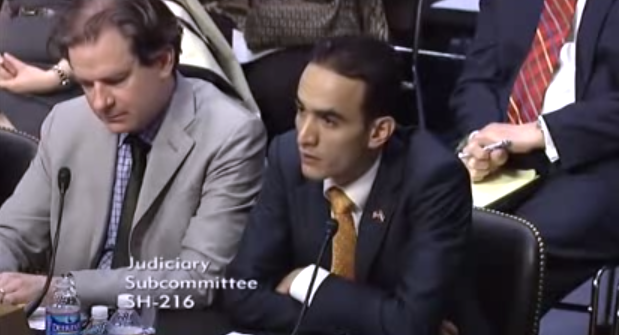
My first example doesn’t actually need to be dropped into the water supply, it’s there already, in the public discourse. It is taken from Farea Al-Muslimi‘s testimony on Drone Wars: The Constitutional and Counterterrorism Implications of Targeted Killing, April 23, 2013:

Had the United States built a school or hospital, it would have instantly changed the lives of my fellow villagers for the better and been the most effective counterterrorism tool. Instead of first experiencing America through a school or a hospital, most people in Wessab first experienced America through the terror of a drone strike. What radicals had previously failed to achieve in my village, one drone strike accomplished in an instant: there is now an intense anger and growing hatred of America.

If that can quietly penetrate thinking in Washington DC, it might alert us to our tendency to act with thought only for direct consequences, never for unanticipated second and second plus order effects…

And diminish hatred. And thereby also diminish radicalization and recruitment.

**

Knowing what words might best counteract pro-jihadist sentiments among potential recruits for purposes of CVE is a far trickier business, and I don’t think it’s my job or the job of government to attempt to influence anyone’s religious belief directly — as I said above, it all too easily backfires.

Nevertheless, I think that getting a clear picture of how the jihadist mind typically works is a useful exercise, and I’ve suggested before now that accepting the concept of jihad as individual obligation — fard ‘ayn — marks a decisive turning point. That’s why Abd al-Salam Faraj made it a “sixth pillar” of Islam and the centerpiece of his tract The Neglected Duty — see also this article on Faraj in Islamopedia.

Having said that, these words of bin Laden to Sheikh `Atiyya should at the very least give pause to any who have, like Faisal Shahzad, obtained US citizenship under oath:

You have perhaps followed the media trial of brother Faisal Shahzad, may God release him, during which the brother was asked to explain his attack [against the United States] in view of having taken an oath [not to harm it] when he was awarded his American citizenship. He responded that he lied [when he took the oath]. It does not escape you [Shaykh `Atiyya] that [Shahzad’s lie] amounts to betrayal (ghadr) and does not fall under permissible lying to [evade] the enemy [during times of war]…please request from our Pakistani Taliban brothers to redress this matter…also draw their attention to the fact that brother Faisal Shahzad appeared in a photograph alongside Commander Mahsud. I would like to verify whether Mahsud knew that when a person acquires an American citizenship, this involves taking an oath, swearing not to harm America. If he is unaware of this matter, he should be informed of it. Unless this matter is addressed, its negative consequences are known to you. [We must therefore act swiftly] to remove the suspicion that jihadis violate their oath and engage in ghadr.

That’s from Letters from Abbottabad: Bin Ladin Sidelined? by Nelly Lahoud et al, Harmony Program, the Combating Terrorism Center at West Point, 3 May 2012, p. 36.

For convenience — and here you see the compulsive editor in me helplessly at work — I’d leave out the names and bracketed explanatory phrases, and give the essence of his remarks thus:

When a person acquires an American citizenship, this involves taking an oath, swearing not to harm America. … The brother was asked to explain his attack in view of having taken an oath when he was awarded his American citizenship. He responded that he lied. It does not escape you that amounts to betrayal (ghadr) and does not fall under permissible lying to the enemy …

**

Obviously, that single quote doesn’t accomplish total de-radicalization — but what it might do is give some wannabes pause for further reflection, And as JM Berger has pointed out recently:

there are hundreds of thousands to millions of people in the world who are radicalized, and only a handful take up violence

My point here is that if bin Laden himself counseled forms of restraint which young jihadi wannabes acted in ignorance of — how much more would an aspirant need to exercise caution, knowing that divine sanction depends on an accurate theological understanding of what is halal and what haram?

Because once an individual becomes convinced that jihad is an individual obligation, the fear of being an irhabi terrorist rather than a mujahid fi sabil Allah is about the only restraint left — and that theological distinction, which at the moment of death separates Jannah from Jahannam, paradise from hell, is way above the wannabee’s theological level of competence.

Something that bears thinking about, no?

Religions 101

Wednesday, May 8th, 2013

[ by Charles Cameron — prone to be wrong himself, for that matter ]
.

The media seems having a hard time of it. Journalists are neither all scholars of religion, nor necessarily religiously inclined, so it’s only too easy for the New York Times to get Easter wrong:

or for AP to manage the same sort of trick with Islam.

**

The New York Times has had time to repent of its sins, and has published a retraction that comes close enough to accuracy for my taste:

An earlier version of this article mischaracterized the Christian holiday of Easter. It is the celebration of Jesus’s resurrection from the dead, not his resurrection into heaven.

The AP needs to make a similar confession. The Hajj is not a pilgrimage directed to Muhammad’s place of birth, but to the Ka’aba — which is indeed in the city where the Prophet was born, but is believed to have been a site of pilgrimage since the time of Abraham, and to have been cleansed of idols by Muhammad and restored to its original purpose as a shrine to the one God.

And BTW, the honorific would be “Hajji” not “Hajii” — FWIW.

**

This is Islam 101, just as the Resurrection is Christianity 101. I’ve forgotten what the numbering system is for remedial classes, but we need them.

Guess I’d best get back to reading Zen Mind, Beginner’s Mind.

Jottings 6: How the network works, it seems

Sunday, May 5th, 2013

[ by Charles Cameron — often puzzled & shocked at the way some algorithms behave in public ]
.

I was on Silobreaker this evening, looking at a page called Dead Terrorist Tamerlan Tsarnaev Channeled Islamic Videos, and what I found curious was this little network diagram, presumably algorithmically-generated from the Silobreaker database:

I have to tell you, I like network diagrams — but what are we supposed to infer from that?

Do you see the same diagram when you visit the site — or is this display just for me, knowing what books I buy, what movies I see, what friends I have — and tailored to sell me something, or get my vote?

Jottings 1: Wittypedia

Friday, May 3rd, 2013

[ by Charles Cameron — concerning the Dajjal, the Muslim antichrist — and introducing “jottings” ]
.

.

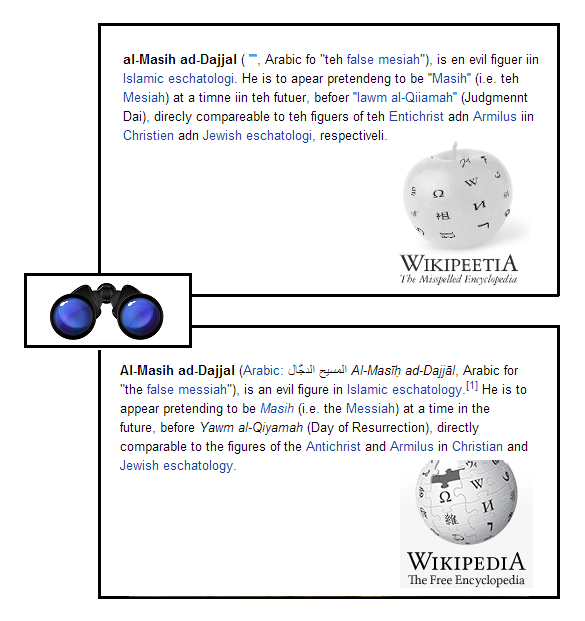
That’s witty — Wikipeetia, a version of Wikipedia that you may some day find yourself reading if you mis-spell a search term.

Like, if you write Entichrist.

Fascinating.

**

Jottings:

I am hoping to make Jottings a continuing series of brief posts, some serious and some light-hearted, that release the toxins of fascination and abhorrence from my system rapidly, ie without too much time spent in research. Jottings — hey, my degree was in Theology, Mother of the Sciences — derives from the English “jot” — and thence from the Greek iota and Hebrew yod, see Wikipedia on jots and tittles.


Switch to our mobile site