zenpundit.com » nuance / subtlety

Archive for the ‘nuance / subtlety’ Category

Details, nuances and blind-spots…

Sunday, November 4th, 2012

[ by Charles Cameron — Zen, Mahdism, and the importance of details ]
.

If you hear the phrase, “Details, details” from time to time, you may have noticed it is often accompanied by a sigh.


.

I’m never quite clear on which came first, the saying “God is in the details” or the saying “the Devil is in the details” — but whichever it is, the details are where you’ll find it.

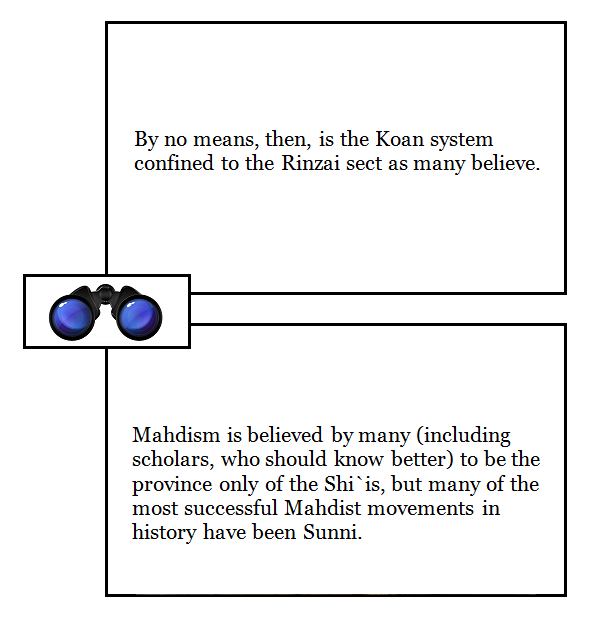
I ran across Philip Kapleau Roshi’s comment on koans (above) in his classic book, The Three Pillars of Zen, the other morning, and it sent me from Zen by rapid mental transit to Mahdism — one of the other termini in my mental system — and to the quote fro m Tim Furnish, one of many to the same effect, which I’ve juxtaposed to it.

If you still think Ahmadinejad (Shiite), and only Ahmadinejad, in terms of Mahdism, then you’ve missed the general point that Furnish is rightly making — and the specific point that Al-Qaeda (Sunni), and not only Al-Qaeda but many Sunnis are also liable to hold strong Mahdist expectations — Abu Musab al-Suri among them.

Because the Whichever-it-is is in the details, the details are the nuances and — when we make decisions without knowing the details, we’re liable to sail right into our blind-spots.

**

Now if you go to a zen master for instruction, you may or may not bee taught shikantaza (“just sitting”) or given a koan (“meditation paradox”) — both descriptions are simplistic; Kapleau Roshi’s book will take you deeper — but one way or another you’ll soon find out, and hopefully you and the master in question can figure things out.

If, on the other hand, you don’t know that Mahdism may be a Sunni as well as a Shiite phenomenon, watch out!

Amplified Mahdist expectation transforms the mental “set” of a jihadist from someone “fighting the good fight” in a generalized way into someone who believes the fight they are fighting is the Culminating War of Good against Evil.

Which, as Furnish’s article’s title, What’s Worse than Violent Jihadists? suggests, is a whole lot more intense.

**

I argued for taking “wide-angle view” at the end of my recent post, Sensitive dependence on initial conditions — here. I’m at the other end of a mental zoom, arguing for precise and nuanced focus on distinctions.

As with Hayakawa‘s Ladder of Abstraction, it pays to be able to work both ends of the spectrum — from the detailed specifics of “my cow Bessie” abstract statistical generalities of “livestock in Colorado” — and beyond.

Ladders will feature one of these days in a “form is insight” post of their own — Hayakawa’s Ladder, and William Blake‘s, and Herman Kahn‘s.

**

Details have their own details, and details are essentially differences — so there’s a lot of zooming in and out to do before you gain clarity. In Gregory Bateson‘s terms, you want to be clear on the differences that make a difference.

Sensitive dependence on initial conditions — & more

Saturday, November 3rd, 2012

[ by Charles Cameron — on human impact, with a quick glance at Pundita’s wide-angle thinking ]
.

The “butterfly effect” identified by meteorologist Edward Lorenz suggests that when you are dealing with highly complex systems such as weather patterns, what eventually happens may be “sensitively dependent on initial conditions”. Very small differences at one moment in such systems may result in very large differences later on. As Lorenz explains in the upper quote above, however, we’re dealing with a myriad of influences simultaneously, and it’s entirely possible that our own meteorological impact exceeds and outweighs that of the butterfly species…

I’ve chosen to post this particular pair of quotes, in fact, because both examples point to severely deleterious effects of human impact on our home environment in the larger sense — “the world we live in” — at a level where human individuals may not feel they have much of an individual impact, but where the cumulative effect is much greater: global warming? devastating storms? loss of rain forest? — narcarchy?

Narcarchy: hereby defined as rule by cartel — see this fascinating news piece, and note in particular the presence of a significant religious thread in the midst of the drug / crime / warfare picture.

**

On the question of sensitive dependence on initial conditions, this graphic paints the picture nicely and with nuance, for those who “think in pictures”:

I found it attached to the Wikipedia entry on Lorenz’s Butterfly Effect which may also help if like me you’re a lay reader, mathematically speaking.

**

I also wanted to juxtapose the two quotes above because they give me a chance to talk about “wide angle views” and their virtues, and to point you to a recent Pundita post that set me thinking along those lines. The post is Then and Now: Instructive parallels between 9/11/01-Benghazi and Katrina-Sandy storms, and part of my comment read as follows:

…you have an amazing breadth of thought going on here – especially in your paragraph:

It’s as if a new era arrived, with its vast changes in weather patterns and attack patterns, and nobody is yet fully processing the nature of the threats. I guess such an observation is actually old news. But Sandy coming on the heels of Benghazi struck me as a kind of exclamation mark to the fact that civilizations start to fall at the point where they’re no longer able to process the cumulative effects of their past.

Seeing parallels between Benghazi and 9/11, or between Sandy and Katrina, would be one thing – but managing to see parallel changes in both “weather patterns and attack patterns” is quite another — and even though people may want to question and qualify some of the details, the overall scope and view is breathtaking.

We need this kind of wide-angle thinking, it seems to me, and I offer my two quotes here in much the same spirit.

So if “sensitive dependence on initial conditions” is one analytic thought pattern I’m promoting here, “wide-angle thinking” and the capacity to zoom from significant detail to global context is surely another.

A little diligence makes for a long post, 1: Kahlili

Wednesday, October 24th, 2012

[ by Charles Cameron — first part of a post on misreading Mahdism in Iran ]
.

book credit: amazon -- Mahdist graphic credit: Tim Furnish / MahdiWatch

.

Our blog friend Pundita has been relying on Reza Kahlili, the pseudonymous Iranian author of A Time to Betray: The Astonishing Double Life of a CIA Agent Inside the Revolutionary Guards of Iran, quite a bit recently, pointing to his recent discussion with John Batchelor and some reports of his on World Net Daily.

There are a number of people whose views on the religious issues surrounding an Iranian nuclear weapons program interest me — I leave other aspects of the problem to others better informed than I — some because they have insight, some because they have megaphones, and so on.

I’m not the person you’d want to ask whether Reza Kahlili was a CIA source, whether he was trusted, and if so, on what issues – issues which might range from troop movements to popular opinion of the IRG rank and file to theology and apocalyptic, a range that no single source is likely to be omnicompetent in – but WND is a media source I’ve followed off and on for a dozen years, it’s strongly associated with one of the strands of recent Christian apocalyptic with its own messianic take on Islam and Mahdism, and it isn’t necessarily a source I’d trust without verification…

**

So I did some checking of my own on Reza Kahlili, and found that he, or more likely some ghost writer employed to write his book for him (along with his publisher’s copy editor), simply doesn’t know what a hadith is. A hadith is a statement attributed to the Prophet (or in the Shi’a case, one of the infallible Imams who succeeded him) and passed down through an authoritative train of transmission (isnad). For a practicing Muslim, the corpus of hadith is second only to the Qur’an, and knowing what a hadith is is like knowing what the Epistles are for a practicing Christian: basic. For a theologically nuanced scholar from Qom or Najaf, it’s kindergarten.

Kahlili gets the use of the word “hadith” right early on in his book, but when he starts talking about the return of the Twelfth Imam or Mahdi he writes (p. 334.):

Like others who think as he does, Ahmadinejad believes that many of the signs of Mahdi’s return have emerged. Known as hadiths, these signs include the invasion of Afghanistan, the bloodshed in Iraq, and the global economic meltdown. According to prophecy, the hadiths will grow increasingly furious as Mahdi’s return comes closer, including “persecution and injustice” engulfing the earth, “chaos and famine,” and “many wars.” The hadiths predict that “many will be killed and the rest will suffer hunger and lawlessness.” People like Ahmadinejad so completely believed that these conditions would hasten the return of the twelfth Imam that they were willing to foment universal war, chaos, and famine to bring it about.

That’s at best very sloppy writing — the signs are known as ayat (as are the verses of the Quran), and the Quran states (28.59):

Nor was thy Lord the one to destroy a population until He had sent to its centre a messenger, rehearsing to them Our Signs; nor are We going to destroy a population except when its members practise iniquity.

Some translators actually render what this translation calls “signs” as “verses”.

Giving this passage from Kahlili a charitable reading, it could be understood to mean that signs as described in reliable hadith “include the invasion of Afghanistan, the bloodshed in Iraq, and the global economic meltdown” – though there’s a lot of interpretive scope in there, as there is in locating Gog and Magog (are both place names, or is one a prince of the other?) in comparable Christian eschatological circles.

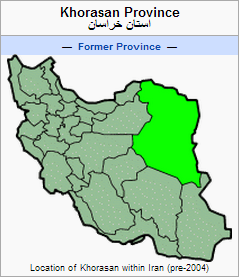
Taliban recruiters (Sunni) certainly take “Khorasan” as mentioned in some Mahdist hadith as referring to “Afghanistan” – see Ali Soufan‘s book, The Black Banners – but an Iranian would read “Khorasan” as referencing the region of that name in Iran, or perhaps a wider zone that includes it, but also encompasses portions of Afghanistan and other neighboring states – it was, after all, the name of Iran’s largest province until divided in three parts, North, South and Razavi Khorasan in 2004:
Interestingly too, the hadith traditions in question are considered likely to have been written by and for the Abbasids. David Cook, for instance, in his magisterial Contemporary Islamic Apocalyptic Literature writes of Khorasan (p. 173.):

The ‘Abbasids sought to present their movement as the fulfillment of messianic expectations, and so they produced a great quantity of materials given in the form of hadith traditions to indicate that the Mahdi would come from this region.

— not that scholarship of this kind is liable to influence popular apocalyptic sentiment…

**

Okay, so with a little creative forgiveness, we can read that first passage of Kahlili’s as saying that within the hadith can be found signs such mentions of Afghanistan / Khorasan, bloodshed in Iraq, and economic woes. But then we read this (p. 337.):

With the eyes of the world on them, the mullahs and the thugs who took orders from them fought mercilessly to hold on to the power that had never been their right, using extreme force to deny that their time was over. In their minds, Mahdi was coming and the blood they shed now was yet another hadith.

C’mon, now, has Kahlili even read his own book? Blood shed equals hadith?

The most charitable thing I can find to say is that Reza Kahlili may or may not have been some level of CIA source, but his credibility in matters involving any aspect of Iranian theology is utterly unconvincing.

**

Jeff Stern, in a WaPo piece from 2010, doesn’t sound any too convinced that Kahlili is worth our trust in other matters either, writing:

Reza Kahlili, a self-proclaimed former CIA “double agent” inside Iran’s Revolutionary Guards, appeared in disguise at a Washington think tank Friday claiming that Iran has developed weapons-grade uranium and missiles ready to carry nuclear warheads.

The pseudonymous Kahlili, whose previous accounts have been greeted with widespread skepticism, also said Iran was planning nuclear suicide bombings with “a thousand suitcase bombs spread around Europe and the U.S..

and:

Several current and former U.S. intelligence officials in the audience “rolled their eyes” at Kahlili’s claims, said one observer who was present.

Some in attendance compared Kahlili with Ahmed Chalabi, the former Iraqi exile who helped convince the George W. Bush administration that Iraqi leader Saddam Hussein had weapons of mass destruction. After the U.S.-led invasion of Iraq, the claims were proved false.

My personal knowledge-map features huge areas of ignorance where many others have strong opinions. On matters religious, Kahlili is not to be believed. On the siting of nuclear labs, or weapons development and deployment, we’re in areas that bear the legend “Here there be Smoke and Mirrors” on my map.

Thus endeth my blog-epistle to Pundita, whose knowledge of many of the other moving parts in the wider geopolitical situation far exceeds my own.

**

I’ll follow up with part II of this essay, in which I’ll talk a bit about Glenn Beck and Joel Rosenberg, and some other significant ways in which Shi’ite eschatology is being misrepresented via popular media in the west.

For those following the development of my book / media project, I am hoping the project will include a section of longer essays such as this one, in which I pull apart some of the myths currently surrounding western understanding of Islam, while pulling together major strands of a more nuanced view.
Games of telephone and counter-telephone?

Wednesday, October 3rd, 2012

[ by Charles Cameron — embassy or consulate — a minor detail for an editor, perhaps, but all the difference in the world for Ambassador J Christopher Stevens ]
.

Here’s a screen grab of a piece posted on the Atlantic site today:


.

The article itself is worth your time, and I’ll get back to the screen grab later. Here’s the text para that interests me:

In the famous “Bin Ladin Determined to Strike in US” Presidential Daily Brief of August 6, 2001, one of the major analytic points was that “Al-Qa’ida members — including some who are US citizens — have resided in or traveled to the US for years, and the group apparently maintains a support structure that could aid attacks” (emphasis added). Notice that this analysis uses two hedges in a single sentence. Given the lack of certainty on the issue, such linguistic dodging made sense — as it does in report after report where individuals are discussing information below the level of actionable intelligence.

Leah Farrall has been tweeting about the way this characteristically cautious phrasing used by analysts gets lost as “the higher up the food chain an analytical report goes the greater the tendency for bosses in [the] food chain to add their two cents worth” — so that by the time it reaches the politicians, “there is absolutely WMD.”

The shift from “apparently” to “absolutely” is an interesting one.

**

The 2007 National Intelligence Estimate featured a section on the nomenclature of such distinctions, which I trust and imagine was directed more at its readers than towards the analysts who produced it:

What We Mean When We Say: An Explanation of Estimative Language

When we use words such as “we judge” or “we assess”—terms we use synonymously — as well as “we estimate,” “likely” or “indicate,” we are trying to convey an analytical assessment or judgment. These assessments, which are based on incomplete or at times fragmentary information are not a fact, proof, or knowledge. Some analytical judgments are based directly on collected information; others rest on previous judgments, which serve as building blocks. In either type of judgment, we do not have “evidence” that shows something to be a fact or that definitively links two items or issues.

Intelligence judgments pertaining to likelihood are intended to reflect the Community’s sense of the probability of a development or event. Assigning precise numerical ratings to such judgments would imply more rigor than we intend. The chart below provides a rough idea of the relationship of terms to each other.

We do not intend the term “unlikely” to imply an event will not happen. We use “probably” and “likely” to indicate there is a greater than even chance. We use words such as “we cannot dismiss,” “we cannot rule out,” and “we cannot discount” to reflect an unlikely—or even remote—event whose consequences are such it warrants mentioning. Words such as “may be” and “suggest” are used to reflect situations in which we are unable to assess the likelihood generally because relevant information is nonexistent, sketchy, or fragmented.

In addition to using words within a judgment to convey degrees of likelihood, we also ascribe “high,” “moderate,” or “low” confidence levels based on the scope and quality of information supporting our judgments.

• “High confidence” generally indicates our judgments are based on high-quality information and/or the nature of the issue makes it possible to render a solid judgment.
• “Moderate confidence” generally means the information is interpreted in various ways, we have alternative views, or the information is credible and plausible but not corroborated sufficiently to warrant a higher level of confidence.
• “Low confidence” generally means the information is scant, questionable, or very fragmented and it is difficult to make solid analytic inferences, or we have significant concerns or problems with the sources.

**

You could think of these as counter-telephone measures — attempts to avoid the distortions and corruptions that tend to arise when a message is passed from one person to another, And that’s important a fortiori when an ascending food-chain of transmitters may wish (or be persuaded) to formulate a message that will assure them the favorable attention of their superiors — but also because the higher the report goes, the closer it gets to decision-time..

As the Atlantic article says, this kind of “linguistic dodging” (aka attention to nuance) makes sense “in report after report where individuals are discussing information below the level of actionable intelligence.”

Inevitably there’s a shift in tempo between contemplation and action.

**

Anyway, messages tend to get distorted as they’re passed along.

Consider, for instance, the caption to the photograph that graces the Atlantic piece at the top of this post:

The U.S Embassy in Benghazi burns following an attack in September. (Reuters)

There’s only one problem there. The US didn’t have an Embassy in Benghazi — they had a Consulate — and that’s not a distinction that lacks a consequence. Whatever else may be the case, Ambassador Stevens would certainly have been better guarded had he been back in Tripoli in his embassy.

Whoever wrote that caption wasn’t as deeply immersed in the situation as the former CIA analyst who write the article. And when you’re not deeply immersed, it is perilously easy to get minor but important details wrong.

The Shariah twins and other ads

Sunday, August 26th, 2012

[ by Charles Cameron — attempting the unbiased exploration of nuance in often low-nuance discourses ]
.

As usual, billboards, pamplets and ads on the sides of buses are worth watching. Let’s start with the Shariah twins:

The similarities are pretty obvious — what are the differences?

Well, the upper one was put up first, while the lower one was a response to it — that’s one difference, and it accounts for the similarities. Another difference has to do with the URLs each of them provides for further inquiry:

http://www.defendingreligiousfreedom.org
http://www.defendingreligiousfreedom.us

Again, the second is a response to the first and mimics its URL, although it switches automagically to http://freedomdefense.typepad.com/leave-islam/ when you click through. And “defending religious freedom” is clearly a double-sided coin…

The actual situation is neither that “Islam is a religion of Peace” nor that “Islam is a religion of War” — I would suggest it is that Islam is a religion that believes in opposing injustice in the name of peace, for the sake of eventual peace. In this regard, Islam is not unique.

Islam also has adherents who would like to see the entire world under Islam’s banner. In this again, Islam is not unique. Islam has given the world great poetry, history, architecture, philosophy, music, mathematics, science. Again, Islam is not unique in this. In one of my own fields of special interest, social entrepreneurship, Islam has given use Muhammad Yunnus and the Grameen Bank… The Islamic world also includes many religious leaders who espouse virulent anti-Semitism. In short…

Islam as expressed for better or worse in a vast diversity of human lives and situations neither renders each and every adherent an angel nor a beast. God may be perfect, but Muslims are only human. In this again, Muslims are not unique.

**

Let’s turn from religion to patriotism:

According to the lower image, the Tea Party is not the enemy. That’s fine by me — I have friends who are Tea Party stalwarts. According to the upper image, which was put up by a local Tea Party related organization using the Tea Party name, the sitting President of the US is the equivalent of Hitler and Stalin. And if they weren’t seen as enemies by the US, I don’t know what the Second World War and Cold War were all about…

So let’s just say that when Obama‘s death camps pass the five million mark in Jews, gypsies, homosexuals, poets, Christians or whoever killed, I will no longer think the comparison a trifle overheated. To put it mildly.

But hey, I have a question for the Oath Keepers among our readership.

If you are supposed to fire on the enemy, and the illustration in your ad specifically features British red-coats, but you’re not allowed to fire on American citizens, and Col. Kevin Benson, who wrote the disputed article in Small Wars Journal, is an American citizen whom you consider a “red-coat” — are you supposed to shoot him? Please note, I also have friends who are SWJ stalwarts.

What about droning Anwar al-Awlaki? I suppose these paradoxes of double identity all belong in the same category as Bertrand Russell‘s celebrated paradox of the Spanish barber:

There was once a barber. Some say that he lived in Seville. Wherever he lived, all of the men in this town either shaved themselves or were shaved by the barber. And the barber only shaved the men who did not shave themselves.

All of which is fine, until you begin to wonder, as Russell did, whether the barber shaves himself?

**

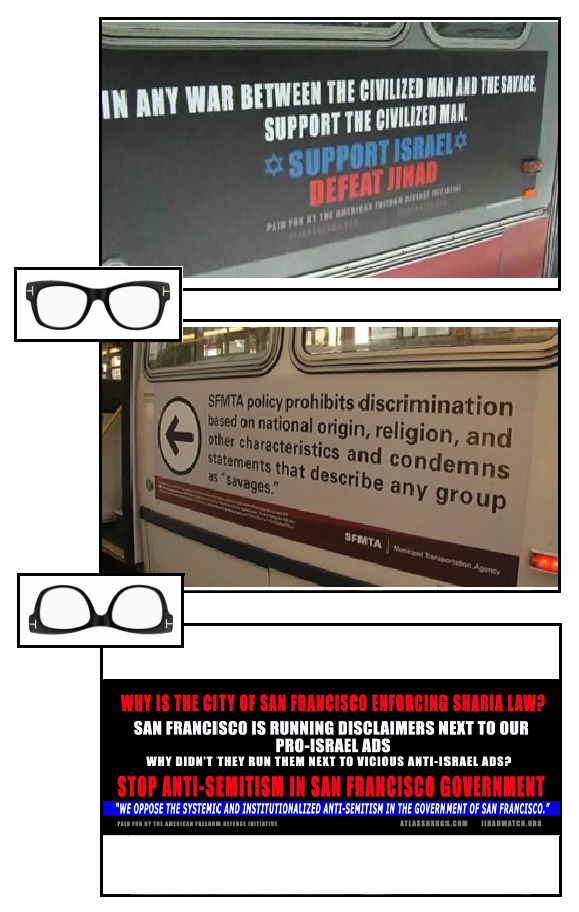
Back to religion (jihad) — or are we still on politics (Israel)? — for a quick look at the San Francisco Muni advertising discourse, which has now reached the point where I need to amend my usual two panel format:

Pamela Geller paid for the first ad, which encourages US support for Israel, okay, but also seems to call some group or other “savages” — we’re not quite sure who that group consists of since she doesn’t specify it — but she could plausibly be meaning all Palestinian suicide bombers, all Palestinians, all Arabs, all Muslims, even perhaps all those who support Israel… we just don’t know.

Given the amount of hatred floating around on the Israeli-Palestinian issue, I’d suggest the ad is indeed inflammatory, and that the Muni — who didn’t think they could refuse it under applicable US law — was acting appropriately if somewhat surprisingly in posting its own ad in response, seen here in the middle panel.

Now Geller has announced her intention to respond to the Muni’s ad with one of her own, seen here in the third panel — and all eyes will be on Muni if and when she does — to see if they will continue the back and forth.

**

The world is the cinema. There actually are people setting fires in several parts of the cinema, and others whose words could be the sparks that ignite yet more fires. Some of the fire-setters have names like Ajmal Kasab and Osama bin Laden, some like Timothy McVeigh or Anders Breivik, some like Vellupillai Prabhakaran. The theater is crowded, and some people are yelling “fire”…

Furthermore, there’s a difference between panic and precaution.


Switch to our mobile site