OSINT CON Links
Saturday, September 13th, 2008Michael Tanji sums up his views on the recent DNI OSINT conference that he and other blogfriends attended in Washington, DC.
Official DNI OSINT blog can also be consulted ( hat tip to Suki Fuller)
Michael Tanji sums up his views on the recent DNI OSINT conference that he and other blogfriends attended in Washington, DC.
Official DNI OSINT blog can also be consulted ( hat tip to Suki Fuller)
Check out Fabius Maximus on the “books vs. internet” debate with an older set of posts The Internet makes us dumber: the Bakken euphoria, a case study and Euphoria about the Bakken Formation.
and
Selil Blog where Professor Sam has done some cyberwar theorizing “From Information operations to cyber warfare and a new terrain”
I thoroughly enjoyed John Hagel’s post Stupidity and the Internet where he analyzed the implications of the book vs. snippet debate initiated by Nick Carr’s Atlantic article “Is Google Making Us Stupid?”. Hagel properly broadened the debate away from content format to encompass the social sphere:
But if the concern is about intelligence, thinking and the mind, then isn’t content just one small piece of the puzzle? Nick and many of the digerati who line up against Nick have one thing in common – they are content junkies. They consume content voraciously and care deeply about the form that content takes.
In the heat of debate, they seemed to often lose sight of the fact that most people are not content junkies. Most people use the Internet as a platform to connect with each other. Sure, they are exchanging information with each other, but they are doing a lot more than that. They are learning about each other. They are finding ways to build relationships that expand their understanding of the world and enhance their ability to succeed in their professions and personal lives.
I’m going to back the discussion up a half-step by pointing out that these online relationships are often, initially of a transactional nature. Information is being exchanged and the kind of information used as a “hook” to capture attention may be determinative to the trajectory the social relationship may take and the rate of information exchanged may determine if the social connection can be sustained. To simplify, we are discussing Depth, Breadth and Velocity of information:
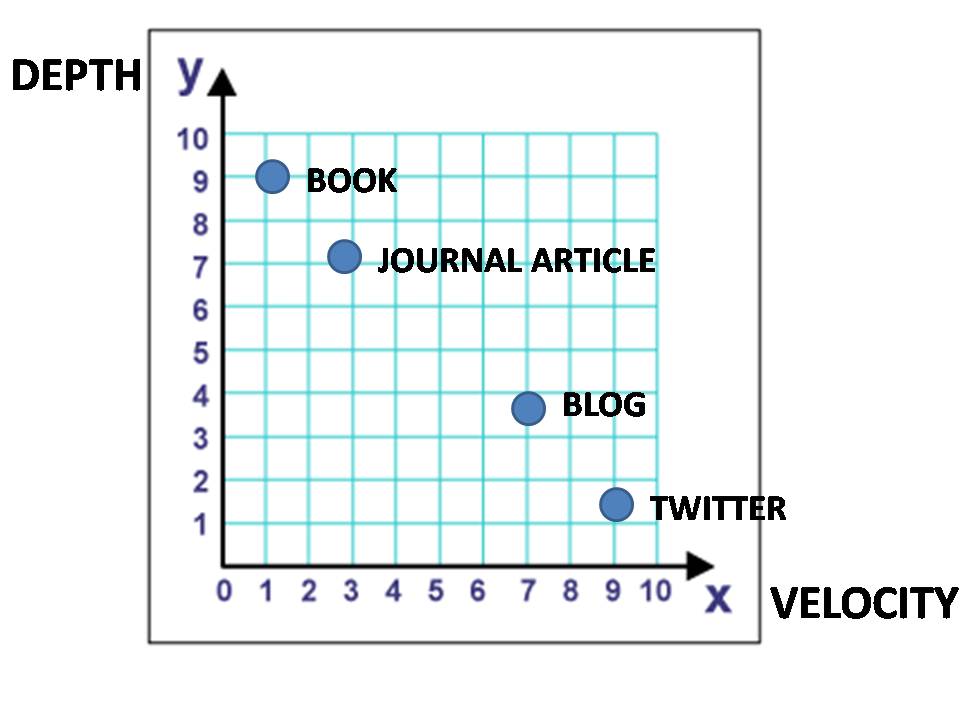
Books, journal articles, blog posts and Twitter “tweets” ( 140 character microblogging) could have their relative informational and transactional qualities be represented on a simple graph. Books have the greatest potential depth but the least level of timely, qualitatively reciprocal, informational transaction for the author ( primarily gained from the relationship with the editor or a “sounding board” colleague). Peer review journals are next, with a narrow community of experts sanctioning the merit of the article or rejecting it for deficiencies that put the work below or outside the field’s recognized professional standards. Blog posts can potentially generate an enormous volume of feedback, though at the cost of a dramatically inferior “signal to noise ratio“. Microblogging services like Twitter have hyperkinetic transaction rates but unless used strategically ( for example, by Robert Scoble) or within an existing social network, they generate little other than useless noise.
Attention can be attracted by a clever “snippet” – particularly if the concept itself has ambiguity or nuance that would intrigue more people than if it were precisely defined – but the attention will not be held unless the author can sustain the flow of interesting material, something that requires depth of knowledge about a subject. Even better is to have depth in a subject along with breadth, the ability to think horizontally across many domains to spot emergent patterns, construct powerful analogies and distill a meaningful synthesis. In turn, pulling a willing audience of useful collaborators into a relationship around such intellectual pursuits hinges on first gaining their attention with a comprehensible simplification of complex abstractions and exhibiting a willingness to interact on a reciprocal basis.
It’s not a case here of “Books vs. Google”. Depth, breadth and velocity of information are interdependent and mutually reinforcing.
I find that I have fallen criminally behind on reviewing books in the past six or so months and I’m going to try to make an effort to post on at least some of what I have been reading. Time to begin:

Presentation Zen: Simple Ideas on Presentation Design and Delivery (Voices That Matter)
Garr Reynolds has done more than write a book about design; he has taken Zen principles and used them to design the book that he wrote. Zen Presentation is an aesthetic pleasure to read, a truly beautiful book where the author walked his talk.
Specifically, Reynolds will show you how you can make your slideware presentations better but Presentation Zen is really more than that; it’s about effective communication. Understanding your own message and then crafting an authentic and persuasive vision. The principles Reynolds articulates while discussing sound design work equally well for the writer, the artist, the salesman or the organizational leader. Here are a few sections particularly worth your time to read:
What makes Messages Stick?
The Art of Working With Restrictions ( all the Boydians out there will grasp this concept immediately)
Two Questions: What’s your Point? Why Does it Matter ?
Kanso, Shizen, Shibumi
Signal to Noise Ratio
The Need for Solitude
Many times, as the text itself is intentionally broken up visually by images and white space, I found myself reflecting at length on the implications of the passage before moving on to the next. Now that’s something that happens with reading certain classics – The Art of War


If messages are meant to “stick” then Presentation Zen is a sticky book.
Danger Room was most excellent today. Two items here worthy of attention:
Michael Tanji, my CTLab colleague, put in an appearance at Danger Room with How to Fix the Spooks’ New ‘Vision’:
The Office of the Director of National Intelligence recently released their new vision for the future of the spooks and spies community. And, shockingly enough, it’s actually pretty smart — sparking a bit of optimism for those who think serious change is too long in coming. It’s a more far-reaching document than I have seen come out of the IC (Intelligence Community) in the past. The parts about supplying intelligence to everyone from the Departments of Health and Human Services to international organizations to private sector and non-governmental organizations were especially heartening.
That said, it still doesn’t reach far enough. Everyone in the IC likes to say that we’re in a period of unprecedented and extensive change. If that’s the case, I’d expect the response to match the challenge. Some suggestions:
They’re good ones. Go read them!
Next, Noah Shachtman brings us some official Pentagon futurism pried loose by Justin Elliott of Mother Jones magazine with a FOIA request, Military Study Looked to Rome for Lessons:
The Pentagon’s legendary Office of Net Assessment is known for peering into the future of conflict — at subjects like wartime biotech, fighting robots, networked battles, and the military in space. The office’s head, Andrew Marshall, has been called the Pentagon’s “futurist-in-chief.” But for one study, concluded in 2002, Net Assessment-funded researchers looked back, to the empires of Alexander the Great, Imperial Rome, Genghis Khan, and Napoleonic France.
Military Advantage in History (PDF) is a fascinating read but very quirky in it’s historical interpretation. I base this assessment on a spot check of the Roman section where some elements are correct but some variables are underplayed – the political dynamics of proconsular authority begetting Roman aggressiveness and adaptiveness in the field or the resilience of the Roman state for example. The rush to try and synthesize such a vast scope of history in a few paragraphs will inevitably create distortions ( Napoleon or Alexander are far more manageable subjects for such abstraction – but they influenced rather than institutionalized in the long run).

Zenpundit is a blog dedicated to exploring the intersections of foreign policy, history, military theory, national security,strategic thinking, futurism, cognition and a number of other esoteric pursuits.
Customized Web Site & Blog Design