zenpundit.com » hinduism

Archive for the ‘hinduism’ Category

Of Alice, Angels and Apsaras

Wednesday, May 15th, 2013

[ by Charles Cameron — squeezed between the space of astronomers and the paradise of the believers, is there yet room for the dancing play of poetry, music and imagination? ]
.

My first question for you today would be — do you believe in Alice?

And further to that, do you believe in the Red Queen?

**

Two things collided to cause me to write this post today. First, Emptywheel opened her blog post on Putin’s outing of an American spy today with a quote from Lewis Carroll:

‘I declare it’s marked out just like a large chessboard!’ Alice said at last. ‘There ought to be some men moving about somewhere–and so there are!’ she added in a tone of delight, and her heart began to beat quick with excitement as she went on. ‘It’s a great huge game of chess that’s being played–all over the world -– if this is the world at all, you know. Oh, what fun it is!’

I can’t really ignore Lewis Carroll when he crops up in my morning feed like that: he’s a Christ Church man and a poet, as I am, and it would be rude of me to ignore him. And besides, what he’s on about here is the world-as-game concept, which is never far from my mind — hence my inclusion of that question about the Red Queen.

**

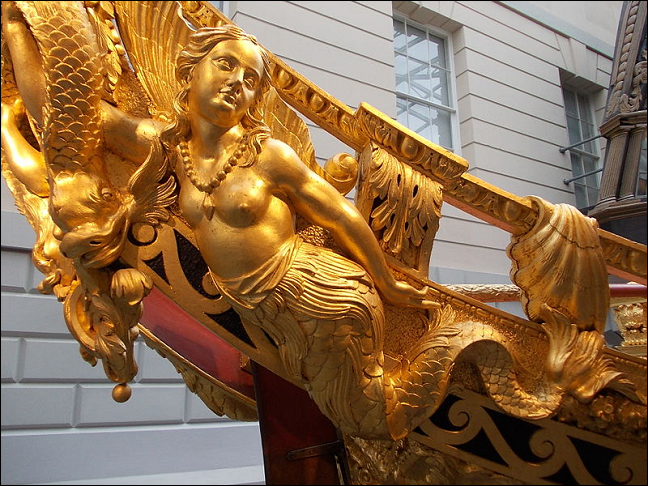
And second, mermaids.

.

It gets more interesting, you see. Because what collided with that first question was a conversation @khanserai aka Humera Khan was having with @mujaahid4life aka Abdallah via Twitter, in which the Harry Potter books were discussed and the topic of unimaginative clerical fatwas on games and works of fiction came up. At which point, Abdallah pointed us all to this now-archived fatwa regarding the permissibility of eating mermaid flesh:

Ruling on eating mermaids

A mermaid is a creature that lives in water and looks like a human. As to whether it really exists or it is a mythical being, that is subject to further discussion.

It says in a footnote in al-Mawsoo’ah al-Fiqhiyyah (5/129): From the modern academic resources that are available to us, it may be understood that the mermaid, which is called Sirène in French, is a mythical creature that is described in fairy tales as having an upper body like a woman and a lower half like a fish.

See the French Larousse encyclopédique on the word Sirène.

The encyclopaedia goes on to say: The widespread notion in ancient times was that the wonders and animals of the sea were more and greater than the wonders of dry land, and that there was no kind of animal in the sea that did not have a counterpart on land. This was confirmed by Prof. Muhammad Fareed Wajdi in his encyclopaedia, quoting from modern academic sources. See: Daa’irah Ma’aarif al-Qarn al-‘Ishreen: Bahr – Hayawiyan. End quote.

Al-Dumayri said in Hayaat al-Haywaan al-Kubra: Mermaid: it resembles a human but it has a tail. Al-Qazweeni said: Someone brought one of them in our time. End quote.

Many of the fuqaha’ mentioned mermaids and differed on the ruling concerning them. Some of them said that they are permissible (to eat) because of the general meaning of the evidence which says that whatever is in the sea is permissible. This is the view of the Shaafa’is and Hanbalis, and is the view of most of the Maalikis and of Ibn Hazm and others. And some of them regarded it as haraam because it is not a kind of fish. This is the view of the Hanafis and of al-Layth ibn Sa’d.

Ibn Hazm (may Allaah have mercy on him) said in al-Muhalla (6/50): As for that which lives in the water and cannot live anywhere else, it is all halaal no matter what state it is in, whether it is caught alive and then dies, or it dies in the water and then floats or does not float, whether it was killed by a sea creature or a land animal. It is all halaal to eat, whether it is the pig of the sea (i.e., a dolphin), a mermaid, or a dog of the sea (i.e., shark) and so on. It is halaal to eat, whether it was killed by an idol-worshipper, a Muslim, a kitaabi (Jew or Christian) or it was not killed by anyone.
What’s outside the box?

And it goes on… ending, mercifully:

And Allaah knows best.

Sometimes I think those might be my favorite words evvah!

**

Are mermaids real enough for religious scholarship to address them?

Is Alice?

John Daido Loori Roshi, late zen master and abbot of the Mountains and Rivers Order’s Mt Tremper abbey, once gave a teisho using a passage from Alice as his koan:

Many Zen koans contain references to myths and folktales of ancient India, China, and Japan. Since Westerners generally are not familiar with these stories, koan study without extensive background information is often a frustrating and exasperating process.

In this dharma discourse, Abbot John Daido Loori fashions a koan, complete with pointer and capping verse, from a classic of children’s literature, Lewis Carroll’s Alice in Wonderland. The koan revolves around Alice’s encounter with a caterpillar who explains the magical properties of a special two-sided mushroom that to Alice’s eyes appears perfectly round. Alice’s struggles with this dilemma make for a stimulating story that mirrors the conflicts and dualities we face in our everyday life.

You can read it here.

**

All of which brings me to the question of the place of deep imagination in a sometimes shallow world.

Alice, do you believe in her? Mermaids and Macbeth mean something to sailors and theater-folk, respetively. Angels? If angels, then the djinn, too? Christian scripture speaks for the existence of one, the Qur’an of both — is one more probable, more real, perhaps, than the other?
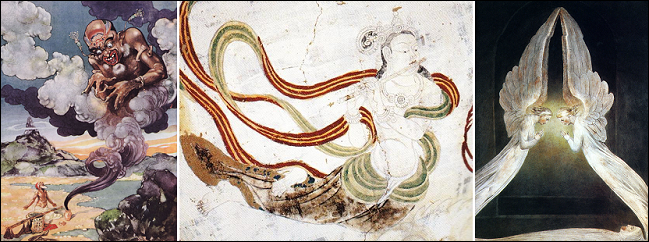
And what of the gandharvas and apsaras — middle panel — the celestial musicians and airy dancers who move to their music? Is there any poet who can claim never to have sensed them?

**

And thus we come to Robert Graves and the muse as he depicts her, in his book The White Goddess, and in many poems such as this:

In Dedication
.

Your broad, high brow is whiter than a leper’s,
Your eyes are flax-flower blue, blood-red your lips,
Your hair curls honey-colored to white hips.

All saints revile you, and all sober men
Ruled by the God Apollo’s golden mean;
Yet for me rises even in November
(Rawest of months) so cruelly new a vision,
Cerridwen, of your beatific love
I forget violence and long betrayal,
Careless of where the next bright bolt might fall.

**

But here the waters are getting deeper…

Arresting Citizens, part II: Religion

Saturday, March 23rd, 2013

[ by Charles Cameron — on the religious and irreligious attributes of the sovereign citizen movement, with a glance at syncretism and the Grateful Dead ]
.


.
**

There’s something of a question as to whether the US sovereign citizens movement is religious and perhaps apocalyptic, or basically secular in nature. As I said in part I of this double post, its main manifestations haven’t seemed particularly religious, and I have accordingly not been paying them a whole lot of attention.

This sense — that the movement is primarily legal rather than religious in emphasis, is nicely captured in this personal communication from JM Berger:

Very few of the beliefs that we use to define the sovereign citizen movement are by definition religious. The things that most often define a sovereign have to do with interpretations of secular law. Athough those interpretations are sometimes supported by religious concepts, the beliefs themselves are centered on what adherents think is a pragmatic reading of law. So to explain that, most sovereigns wouldn’t refuse to answer a policeman’s questions by citing a religious principle. They would instead cite some secular legal principle they believe is valid. But some sovereigns do mix religion in more aggressively, such as those who follow outgrowths of the old Moorish Science Temple religion. But even they rely on legal arguments.

The most common sovereign how-to materials and recruitment websites tend to be pretty secular and based on a reading of history that, while fanciful, is predicated on a misreading of history rather than on ideas we would normally consider religious. In fact, I think the big challenge in understanding this movement is figuring out how these ideas take such powerful hold having neither a consistent religious dimension nor any evidence — even subjective or anecdotal — that they work on a practical level.

JM is the author of Jihad Joe: Americans Who Go to War in the Name of Islam and of the New America Foundation report, PATCON: The FBI’s Secret War Against the ‘Patriot’ Movement… His views as expressed in the quote above are based on recent research.

**

Jean Rosenfeld is also a researcher with an interest in both foreign and home-grown violent movements. She authored what may have been the first detailed inquiry into Al-Qaida from a religious studies perspective, The `Religion’ of Usamah bin Ladin: Terror As the Hand of God, back in 2001, edited the anthology Terrorism, Identity, and Legitimacy, and was one of the FBI’s advisory scholars during the [“sovereign”] Justus Freemen standoff, see her article The Justus Freemen Standoff: The importance of the analysis of religion in avoiding violent outcomes in Cathy Wessinger, ed., Millennialism, Persecution & Violence.

Also in a private communication, Jean writes:

Sovereign citizen ideology is basically a religious ideology. It is deviant, of course, and is often mixed with Christian Identity religion. It comes out of the same “cultic milieu” as the Posse Comitatus of the 1970s and CSA of the 1980s.

Setting these two opinions regarding the religiosity or otherwise of the sovereign citizens side by side, what strikes me most is the juxtaposition of the Moorish Science Temple in JM’s quote with the Covenant, Sword and Arm of the Lord in Jean’s. Both are “new religious movement” of considerable interest to scholars of such things.

For more on the Moorish Science Temple, see Peter Lamborn Wilson‘s Lost/Found Moorish Time Lines in the Wilderness of North America [part 1 and part 2]. For more on the CSA, see Kerry Noble‘s book, Tabernacle of Hate, with an Introduction by Jean Rosenfeld.

**

Given my interest in the religious imagination — which is manifesting itself these days in a wild profusion perhaps unmatched since the times of Qumran , Nag Hammadi and the Corpus Hermeticum — I was intrigued, in looking a little deeper into the US Sovereign Citizens movement, to find at least one individual with an approach to religion that’s suitably sui generis.

The deliciously named (and I quote) ©H.I.R.M. J.M. Sovereign: Godsent™ is the author of TITLE 4 FLAG SAYS YOU’RE SCHWAG! The Sovereign Citizen’s Handbook (version 3.1), in which we read:

The source of all Sovereignty is God. God holds Absolute Sovereignty, meaning He rules over all He surveys and answers to no-one above Himself, every force in nature including human conduct is His subject and under the control of “The Laws of Nature”. For example, “gravity”.

The author then quotes 1 Chronicles 29:11-12

Yours, O Lord, is the greatness and the power and the glory and the victory and the majesty, for all that is in the heavens and in the earth is yours. Yours is the kingdom, O Lord, and you are exalted as head above all. Both riches and honor come from you, and you rule over all. In your hand are power and might, and in your hand it is to make great and to give strength to all.

and follows this directly with the seal of the “Church of Sovereigns” depicted at the top of this post, right. On the left of the same image is a graphic taken from a video titled Calling the Sheriff 2.1.2012, which, if you recognize it, will give you an immediate and visceral sense of the Deadhead spirit of this particular writer.

Here, by way of confirmation, is his bio:

©H.I.R.M. J.M. Sovereign: Godsent™, a veteran of the 2nd American Civil war, A.K.A the “War on Drugs” was born sovereign and free out of the the love generation but, was cast into slavery at age 5 in the police state of New Mexico, when his parents divorced. Struggling with the contradictions between society and the laws of nature, Godsent spent the next 33 years casting off the shackles of institutional conditioning, with the ultimate triumph of regaining the throne of his very own sovereign nation and setting new standards in the way Sovereign Americans and government employees interface.

Shown the path of ahimsa (non-violence) at an early age, he is a lover of music and art, who has traveled the world to dance with friends at over 400 Grateful Dead shows in 5 countries. Surviving repeated attacks at shows and on the streets, by public employees, and noting the patterns and the damage done, he concluded that the World needed a treatise on Sovereignty and Reservation of Sovereign Rights. With the Investment of 23 years of field research, networking and litigation, and 7 years of writing, he has recently authored the definitive treatise on Reservation of Sovereign Rights. Along with the first automated sovereignty e-course, accompanied by an inspirational soundtrack, network services, a private, third-party document tracking system and educational videos.

A monk of the 9 Sacred paths of Catholic, Buddha Rasta, Tao, Maya, Jain, Shvaite, Vaishnava, and Eckankar, he has traveled the world in search of priceless wisdom, humor, melody and artifacts. He has learned the most confidential knowledge and has been given the keys the Kingdom of God, by the enlightened masters, which he gives entrance to you here, in this book. He has never owned a weapon in his life.

**

I am not totally immune to the charms of the Grateful Dead, and take an interest in Catholicism, Buddhism, Taoism, and Shaiva tantra myself.

But but but… please!! Even Christ recommends we should “render unto Caesar that which is Caesar’s”. And When the Taoist Chuang Tze expresses his lack of interest in governance, he does so not by way of refusing to pay parking tickets or taxes, but by politely refusing an offer of high office [Basic Writings, p 109]:

Once, when Chuang Tzu was fishing in the P’u river, the king of Ch’u sent two officials to go and announce to him: “I would like to trouble you with the administration of my realm.”

Chuang Tzu held onto the fishing pole and, without turning his head, said, “I have heard that there is a sacred tortoise in Ch’u that has been dead for three thousand years. The king keeps it wrapped in cloth and boxed, and stores it in the ancestral temple. Now would this tortoise rather be dead and have its bones left behind and honored? Or would it rather be alive and dragging its tail in the mud?”

“It would rather be alive dragging its tail in the mud,” said the two officials.

Chuang Tzu said, “Go away! I’ll drag my tail in the mud!”

Valentine — our first global saint?

Friday, February 15th, 2013

[ by Charles Cameron — a mixed reception for St Valentine and his Day ]
.

Above: Pakistan, 2103. Below: Saudi Arabia, 2013

**

Blog-friend Omar Ali has a piece up at the Brown Pundits blog, How easy is it to be accused of blasphemy in Pakistan? — which included the upper of the two images above, along with this comment and more…

The website of the Express Tribune (liberal by Pakistani standards) published a picture. its a modestly dressed woman posing next to an anti-valentine day billboard with a sign that says “let love be”. (It doesnt seem to be on the tribune site anymore… I am told it was there but has been removed … I just thought of taking THIS blog post off the net too, but since PKKH has their original post up, I doubt if we are materially adding to any possible legal case that may be concocted to bully the people involved).

[ … ]

It took only a few minutes for Paknationalists to notice and become outraged. See details here.

Of course no blasphemy was intended or committed. But the poor girls, and the editors and publishers of the Tribune, could still be in trouble.

**

I have noted the distaste some festivals which seem innocuous enough to many of us can stir in some others, and Valentine’s Day among them, mentioning both Hindu and Muslim reactions to the feast of hearts, roses, restaurants and beds along with Halloween in “Trick or Shirk” Indeed. Today, I’d like to raise the possibility that Valentine is may be the first saint of globalization, if Santa Claus hasn’t already won that honor — a saint, that is, of commerce, which tends to obliterate all boundaries of faith and nation.

Here’s an interesting indicator… This year, the Saudi Gazette reports Saudi religious police deny intent to close flower shops (see the lower image above):

The head of Saudi Arabia’s Commission for the Promotion of Virtue and Prevention of Vice (CPVPV) denied on Tuesday plans to close shops selling flowers during Valentine’s Day, Feb. 14.

Sheikh Abdullatif Al-Sheikh told the Saudi daily newspaper Al-Jazirah: “This is not our specialty. It is the specialty of other parties. We reject what violates the book (Qur’an) and the Sunnah (the Prophet’s teaching) and Saudi Arabia’s regulations.”

“We deal with issues on a case by case basis, and if there is a violation our role is to liaise with concerned government parties,” he added.

Al-Sheikh’s statements followed widely-circulated reports that the commission is planning to close all shops selling flowers on Valentine’s Day.

Previously, the commission banned the sale of red roses ahead of Valentine’s Day, forcing couples to think of new ways to show their love.

**

For a quick peek at St Valentine’s skull — and the heart of St Lawrence for that matter, see my post Of dust and breath, which dealt with their respective show-cased relics.

Battling bus ads revisited

Saturday, January 12th, 2013

[ by Charles Cameron — today’s “shout it from the rooftops” is “advertise it on the bus” — the wars of sound-bite religion, plus special extra, the perils of dehumanization ]
.


.

I am pretty sure that when Sojourners puts up an ad saying Love your Muslim neighbors” (above, right) it’s a religiously motivated act with political implications, but not quite so sure when Pamela Geller puts up an ad that’s certainly anti-Hamas and likely anti-Muslim (below), whether to consider it religiously or politically motivated: the two things aren’t always easily untangled.

*

But hey, at least in Portland according to this AP article, the Pamela Geller ads were posted in response to this one, which I’d tend to characterize as politically motivated, with a plausible religious undercurrent:

**

Of course, there are other maps.. including this one, from American Trial Attorneys in Defense of Israel:

**

Okay, I’ve been on about ads as a medium for religious dispute for a while now [1, 2], and frankly I don’t know why we need seminaries in Oxford, Qom or Dharamsala if all you need to know about a religion can be found on the side of a bus…

But it does get confusing, eh?

For instance, when Mona Eltahawy defaces one of Pamela Geller’s ads, is she erasing freedom of speech, or hate speech — or freedom of hate speech?

**

Look, here are a series of ads that CAIR has just put out, using the term “jihad” in a way that’s both a legitimate meaning of the term within Islam and compatible with western democratic ideals:

**

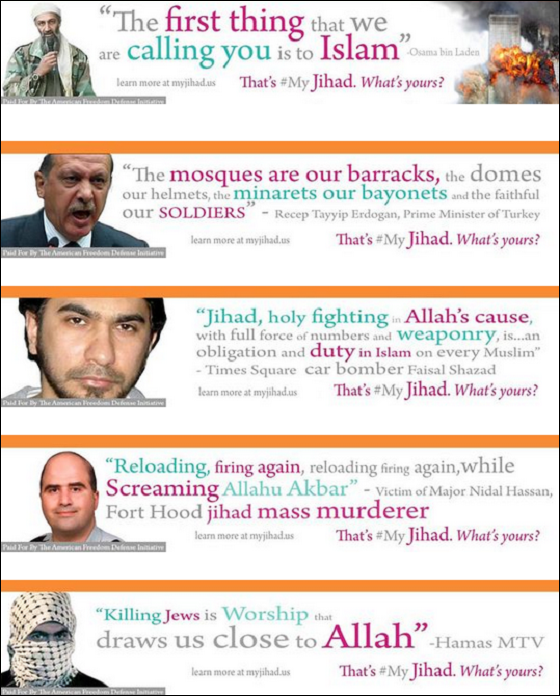
And here are Pamela Geller’s reworkings of the same series of ads, using the term “jihad” in a way that’s both a legitimate meaning of the term within Islam and entirely incompatible with western democratic ideals.

The thing is, there’s an enormous spectrum of beliefs and nuances of belief within Islam, and even within Salafism…

And buses and subway ads aren’t the go-to places to understand that spectrum.

**

But they’re worth watching to get a sense of how the public is being swayed.

Ironic, isn’t it, that as the New York Times reports, Erika Menendez told the cops:

I pushed a Muslim off the train tracks because I hate Hindus and Muslims ever since 2001 when they put down the twin towers.

Hindu, Muslim, Sikh..

**

For what it’s worth, Sojourners could have posted an ad that said, Love your enemies rather than Love your neighbor — both are equally biblical:

Ye have heard that it hath been said, Thou shalt love thy neighbour, and hate thine enemy. But I say unto you, Love your enemies, bless them that curse you, do good to them that hate you, and pray for them which despitefully use you, and persecute you.

Matthew 5. 43-44

But then, that’s a bit long for an advertisement, isn’t it?

**

Somewhere between Christ‘s command “Love your enemy” and Sun Tzu‘s “Know your enemy” we can surely find a place for “Honor your enemy” — and that, it turns out, may be of considerable importance. Describing the work of Lt. Col. Dave Grossman, Lin, Mehlman and Abney write in their Greenwall Foundation report, Enhanced Warfighters: Risk, Ethics, and Policy:

Grossman has interviewed many US veterans of the Vietnam War. Not all of his subjects, however, were those with lingering psychological trauma. Grossman found that some of the men he interviewed had never truly achieved emotional distance from their former foes, and seemed to be the better for it. These men expressed admiration for Vietnamese culture. Some had even married Vietnamese women. They appeared to be leading happy and productive post-war lives. In contrast, those who persisted in viewing the Vietnamese as “less than animals” were unable to leave the war behind them.

That, more generally, may be key to understanding why demonizing Islam and Muslims is such a bad idea. In Grossman’s own words:

It can be easy to unleash this genie of racial and ethnic hatred in order to facilitate killing in time of war. It can be more difficult to keep the cork in the bottle and completely restrain it. Once it is out, and the war is over, the genie is not easily put back in the bottle. Such hatred lingers over the decades, even centuries, as can be seen today in Lebanon and what was once Yugoslavia.

Bouleversé by forgiveness

Tuesday, January 8th, 2013

[ by Charles Cameron — not just “thinking outside the box” — how about upending the whole thing and seeing what shakes out? ]
.

FWIW, this isn't the world, nor is it upside down -- it's just a rather different map, eh?

.

A celebrated stanza by the Indian poet-saint Kabir — beloved of both Hindus and Muslims — asks:

Is there any guru in the world wise enough
to understand the upside-down Veda?

There’s a style of poetry used by Kabir and others to describe experience of the divine called “ulatbamsi” or the “upside down language” — and Linda Hess, Kabir’s great translator, writes of it as a language “of paradoxes and enigmas” — not too dissimilar, perhaps, to the koans or meditation paradoxes often encountered in zen training.

**

Boom! The French have the word “bouleversé” to cover the way we feel when suddenly our whole world seems turned upside down.

Maybe it’s a modern idea? Bob Dylan, I’m delighted to say, no longer belongs to Robert Zimmerman except for purposes of copyright — his songs have entered the cultural bloodstream. Here’s his version:

The battle outside ragin’
Will soon shake your windows
And rattle your walls
For the times they are a-changin’

The world often seems upside down, our values are often quite the reverse of what they might be if we had the kind of clarity that is implied in Samuel Johnson‘s celebrated quote:

Depend upon it, sir, when a man knows he is to be hanged in a fortnight, it concentrates his mind wonderfully.

And then there are those great ones for whom our world is manifestly unjust, manifestly topsy-turvy — or “through the looking-glass”, if you prefer.

I mean, what else can being “in the world, but not of it” be all about, if it’s not about a major shift in perspective?

**

I’m writing about this at such length because I just read one of those paragraphs that turns my own world upside down. It came in the middle of a long piece on “restorative justice” and it focuses on the power of forgiveness.

This particular paragraph describes how an Indian-American woman, Sujatha Baliga, came to see the unexpected power of forgiveness, and for her it occurred in a Buddhist context — but the power itself is beyond the boundaries of specific religions:

Baliga had been in therapy in New York, but while in India she had what she calls “a total breakdown.” She remembers thinking, Oh, my God, I’ve got to fix myself before I start law school. She decided to take a train to Dharamsala, the Himalayan city that is home to a large Tibetan exile community. There she heard Tibetans recount “horrific stories of losing their loved ones as they were trying to escape the invading Chinese Army,” she told me. “Women getting raped, children made to kill their parents — unbelievably awful stuff. And I would ask them, ‘How are you even standing, let alone smiling?’ And everybody would say, ‘Forgiveness.’ And they’re like, ‘What are you so angry about?’ And I told them, and they’d say, ‘That’s actually pretty crazy.’ ”

**

I like the dark blue “sky” and the “clouds” at the top of the map I began this post with — but then, I’m a mostly vertical human who seldom stands on his head, so it looks “natural” to me. But that’s simply a matter of my point of view.

I imagine maps like that one must please our friends “down under”.

**

A hat-tip to Hadar Aviram, whose California Corrections blog first pointed me to the article about Sujatha Baliga.


Switch to our mobile site