[ by Charles Cameron — two guest posts posted, a forthcoming book chapter written, and more to come ]
.
I very much enjoy 3 Quarks Daily, it’s my aggregator of choice, and so I was particularly delighted and honored when my friend Bill Benzon of New Savanna invited me to guest blog on his monthly 3QD spot today, with the very recent papal encyclical about climate change as my topic: Pontifex as Bridge Builder: the Encyclical Laudato Si’
Here’s a sample:
I propose that in his recent encyclical Laudato Si’, Pope Francis is exercising his function as Supreme Pontiff, or @pontifex as he calls himself on Twitter – a pontifex being literally a bridge builder. It is my contention that in his encyclical he bridges a number of divides, between Catholic and Orthodox, sacramental and social, liberal and conservative, religious and scientific, even Christian and Muslim, traditional and of the fast advancing moment, in a manner which will impact our world in ways yet unforeseen.
It is my contention, also, that his pontificate provides the third step in a momentous journey.
The first step, as I see it, was taken by Christ himself in the Beatitudes – blessed are the poor in spirit, they that mourn, the meek, the merciful, the pure in heart, the peacemakers – and in his doctrine of forgiveness, not once only but a myriad of times. The second was taken by Francis of Assisi, in his Canticle of Creatures – praised be you, my Lord, with all your creatures, especially Sir Brother Sun, through Sister Moon and the stars, praised be You, my Lord, through our Sister Mother Earth, who sustains and governs us.. blessed those who endure in peace.. – and in his crossing the front lines of war during the crusades to greet in peace the Sultan Malik Al-Kamil in Damietta, Egypt. And in taking the name Francis, in washing and kissing on Maundy Thursday the feet of both male and female, Christian and Muslim juvenile offenders in prison, and in issuing this encyclical, I would suggest Pope Francis, born Jorge Mario Bergoglio, is taking the third step.
The line, the transmission, is of sheer humility. It begins with the Founder of the line, Christ himself, lapses, which all high inspirations must as routine replaces charisma, only to emerge brilliantly a millennium later in the saintly maverick, Francis, lapses again though still fermenting in the imagination of church and humankind, and now at last shows itself once more, in that most unexpected of places: in the heart of the bureaucracy, at the head of the hierarchy, atop the curia, simple, idealistic, practical – a pontifex building bridges.
And in all this, there is lyricism.
It is characteristic of St Francis that he is lyrical …
Speaking of complementarity, I just completed a 6,000 word essay for a forthcoming volume edited by Robert Bunker, to which Mark “Zenpundit” Safranski has also contributed a chapter. My piece is titled The Dark Sacred — watch this space!
And Dr Edwin Bakker, whose fine Coursera course on Terrorism and Counter-Terrorism I have been a CT for, held a Google Hangout today, in part to celebrate his new book. I managed to sneak in or a few minutes despite my computer woes, and if interested, you can find us here:
[ Charles Cameron — Garry Wills sees “holy war” lurking just around the corner ]
.
Pro-Russia fighters near the eastern Ukrainian city of Starobeshevo in Donetsk region, on 25 February. Photograph: Vasily Maximov/AFP/Getty Images
**
Let’s be clear. the image above is from the confrontation in Ukraine, whereas the holy war that Garry Wills sees is quite another business. Under the headline that also heads this post, he writes:
Discussions ricochet around Pope Francis’s ability to reconcile the Catholic Church’s bureaucracy, theology and practitioners. But for a man of Francis’s scope and skill, this is too narrow an assignment. His real task, for which he is ideally situated, is to prevent the world’s descent into religious war.
Many people want to make our “war on terror” a war on at least a segment of the Muslim religion. Sen. Lindsey Graham (RS. C.) makes this very clear: “We are in a religious war.” Some think of this war as being waged in revenge for the attacks of 9/11 — to prove, as former deputy undersecretary of defense Lt. Gen. William G. Boykin once put it, that their God is greater than Islam’s. But there are 1.3 billion followers of Islam scattered around the world, and an ambitious Gallup poll of Muslims in 35 heavily Muslim countries found that the vast majority of them did not approve of the 9/11 attacks. Significantly, those who condemned the attacks based their opposition to violence mainly on religion, while the 7 percent who considered them “completely justified” relied heavily on political arguments. How can we blame the Muslim religion for this horror?
I don’t agree with everything that Wills says, but his view of Francis’ “scope and skill” is worth pondering.
**
I posted the image above because it gives a vivid and immediate sense of what “Onward, Christian Soldiers” might look and feel like, if it left the churches and turned up on the evening news.
[ by Charles Cameron — more from my endless fascination with the varieties of religious behavior ]
.
Take the news of the diocese of Cologne‘s $3.8bn fortune by itself, and it’s a shock. Compare it with Sri Padmanabha temple in Thiruvananthapuram’s estimated $22bn trove, and it suddenly seems a much less staggering amount.
**
A couple of interesting points from the two articles in question. In Cologne:
Some 2.4 billion euros were invested in stocks, funds and company holdings. A further 646 million euros were held in tangible assets, mostly property. Cash reserves and outstanding loans amounted to about 287 million euros. [ .. ]
Pope Francis has stressed the need for the church to show humility and emphasize its work for the poor.
The Cologne archdiocese published its accounts on Ash Wednesday, which marks the start of Lent, the period of reflection and repentance leading up to Easter week.
and in Thiruvananthapuram:
The loot includes about 1,000 kilograms (2,205 pounds) of gold coins – some dating back 400 years – ropes of gold, sacks of diamonds, and a gold statue of the Hindu god Vishnu studded with precious gems, as well as an 18-foot solid gold ornament weighing 35 kilograms (77 pounds) and rare silver and brass platters.
So far the find is worth nearly double India’s 2011-2012 education budget ($11.61 billion) – and there’s still another vault to be unlocked. The 16th century Sri Padmanabha temple, in the capital of the southern coastal state of Kerala, is now considered to be the richest of India’s temples.
[ by Charles Cameron — this time, the New Testament — this is last of the posts recovered from our down time ]
.
In a previous post I described the release of two white doves from the Papal balcony the other day, and the swift response of two other birds, a crow and a seagull, which attacked them.
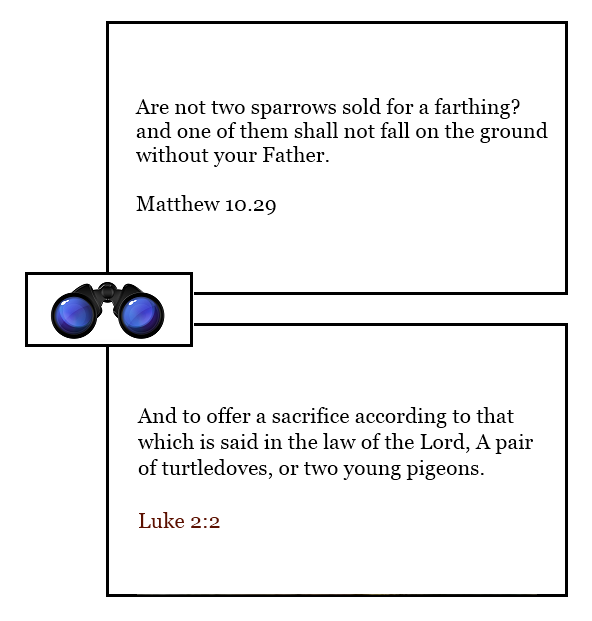
In that earlier post I chose a quote from Heraclitus by way of contextualizing the event — this time I would like to offer one quote from St Matthew‘s gospel and one from that of St Luke.
In the circumstances, the quote from Matthew [upper panel] would make it just a tad difficult for Pope Francis to argue, as the secular-minded can, that this was simply the playing out of nature’s way, and not to be interpreted as a sign from God.
I offer the second quote [lower panel], from Luke’s account of Mary and Joseph bringing the infant Jesus to be circumcized, by way of contrast, since the concept of sacrificing birds to God is now as improbable to the secular mind as the concept that God takes separate and particular care over the life of every bird that flies…
The Pope was not, I am sure, intending to offer the two doves as sacrifices. Nor did he see them as symbolic of the future fate of the Ukraine to the point of prophecy: the attack was not an omen, a mark of fate, as some have interpreted it.
From which it follows that the gesture was a gesture of peace, of hope — and that the Pope takes his Master’s words, “not a sparrow falls” as a metaphor for the ubiquity of divine grace and mercy, not as a proposition in dogmatic logic.
Pope Francis called for peaceful dialogue in Ukraine on Sunday, concluding his remarks by having adorable Italian children release two white doves from the window of the Apostolic Palace in the Vatican. The magical and touching symbol was quickly attacked by the harsh reality of bird-on-bird violence, with one seagull and one black crow attacking the doves. The crowd, inspired and blessed only moments earlier, watched in helpless horror as the crow and gull pecked and pulled at the doves.
National Geographic, in a piece titled Why Birds Attacked the Peace Doves in Rome and subtitled “A crow and a gull targeted the freakish doves, bred to be unnaturally white”, added insight from the natural sciences:
Are doves really peaceful? Not particularly. They have weak feet and small bills and mostly mind their own business, walking around eating seeds and the occasional tiny bug. But they’re just as likely to fight each other over territory (with lots of wing-slapping) as any other species. I once saw a mourning dove chase a blue jay away from a bird feeder. No wimpy bird gets the best of a blue jay.
Why were these doves white? Because white symbolizes peace, purity, serenity, and other good stuff. But here’s the thing: There are no pure-white doves in the natural world. The ones that were released were the result of hundreds of years of domestication and breeding, creating these freakishly white birds for use as pets, and for release at weddings and other ceremonies.
and:
So this wasn’t a sign of the Apocalypse? Hey, I write about nature, not theology. But if I had to bet on whether this is the End of Times or just a couple of predatory birds doing what they do naturally, I’d choose the second as more likely.
**
But it would be churlish of me to leave you on such a note. Instead, I invite you to recall this story of St Francis, whose name the present Pope took, from the Little Flowers of St Francis, an early compendium of hagiographical tales about the saint:
A certain young man having caught one day a great number of doves, as he was to sell them he met St Francis, who always felt a great compassion for such gentle animals; and, looking at the doves with eyes of pity, he said to the young man: “O good man, I entreat thee to give me those harmless birds, emblems in Scripture of humble, pure, and faithful souls, so that they may not fall into cruel hands, which would put them to death.”
And the young man, inspired by God, immediately gave them to St Francis, who, placing them in his bosom, addressed them thus sweetly: “O my little sisters the doves, so simple, so innocent, and so chaste, why did you allow yourselves to be caught? I will save you from death, and make your nests, that you may increase and multiply, according to the command of God.”
Then St Francis made nests for them all, and they began to lay their eggs and hatch them in presence of the brethren, and were as familiar and as tame with St Francis and the friars as if they had been hens brought up amongst them, nor did they ever go away until St Francis had given them his blessing.
[ by Charles Cameron — remembering that there are two calendars, two times, the secular and the sacred, and that there’s more poetry, more depth of heart and thus intellect too, in the sacred calendar — a truth made known also to popes and monarchs ]
.
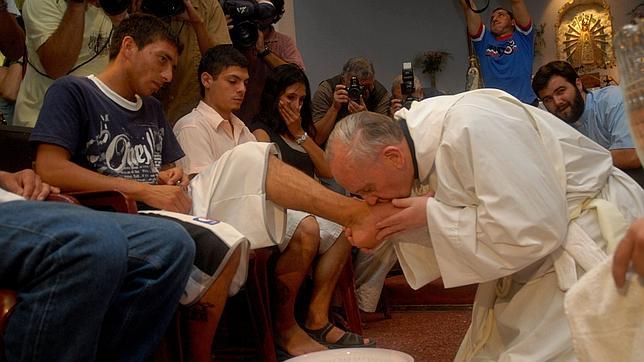
Cardinal Bergoglio, now Pope Francis, washes & kisses the feet of residents of a shelter for drug users, Maundy Thursday, 2008
.
It’s an extraordinary day, today, for myself as it happens, and more significantly for the world. Specifically, it is significant for poor and powerful alike, for it sets them in a proper relation to one another.
Today is Maundy Thursday, the day on which Christ’s Last Supper, which became and remains the prototype of the Catholic Mass, is remembered. His Last Supper would be closely followed by his crucifixion the next day, Good Friday, and resurrection on Easter Sunday.
After that final supper, Christ made a gesture which initially disturbed his close followers — he washed their feet, then instructed them to do the same.
His gesture repeats itself to this day.
**
Pope Francis, who as an archbishop had followed this practice by washing and kissing the feet of young people in drug shelters (image above) and AIDS clinics, is breaking with Vatican tradition — the pope washing the feet of priests in some major basilica in Rome — this year, by going to a youth prison today for the ceremony:
The Mass of the Lord’s Supper that Pope Francis will celebrate on Holy Thursday in the chapel of the Casal del Marmo Penitential Institute for Minors will be, by his express desire, very simple. Concelebrating with the Holy Father will be Cardinal Agostino Vallini, vicar general of the Diocese of Rome, and Fr. Gaetano Greco, chaplain of the Institute.
Around 10 girls and 40 boys will take part in the Mass. The Pope will wash the feet of 12 of them, who will be chosen from different nationalities and diverse religious confessions. The youth will also say the readings and the prayers of the faithful. Given the intimate nature of the pastoral visit, journalists will be restricted to the area outside the building and no live coverage will be transmitted.
That’s a slightly formal Vatican announcement of the occasion: “diverse religious confessions” in this case almost certainly includes Muslims and atheists or agnostics. Father Greco, the prison chaplain, is quoted as saying:
Only eight of our residents are Italian: six boys and two girls … The others are all foreigners. And most of them are Muslim. Then there are some who have no religious belief at all. Therefore many of them don’t even know who the Pope is. For this reason too, it was far from easy to explain to them the importance of the Pope’s visit.
A young Neapolitan who has been here for a while came to my help. He gathered them all together, to try to make them understand above all what the Pope’s act, which is an act of love for them, actually meant. I was upset for a moment by the first looks, that were either blank or only faintly curious about my enthusiasm. Then our friend broke the silence with that most classic of Neapolitan expressions: “Maronna mia, o Papa accà!” [good heavens! The Pope here!] and he ran his hand through his hair, his face betraying emotions mingled with happiness. At that very instant all the others, seeing his amazement, realized that it must really be something very special and began to question me. Little by little, I saw their enthusiasm growing.
Father Greco said of his young charges that the Pope’s visit “will make them see that their lives are not bound by a mistake, that forgiveness exists and that they can begin to build their lives again.”
**
This symbolic gesture, this washing of the feet, does indeed have enormous imaginative power, if we will allow it, to touch the heart and transform our behavior.
I’ve quoted this before, I know: it’s the account given by the man I know who, more than any other, prayed, lived, worked, and saw his great dream and hope accomplished in his lifetime — the overturning of the apartheid regime in S. Africa. For myself, it’s the heart of what he taught me: here, in his own words, Fr Trevor Huddleston CR describes how his own role in that drama began:
On Maundy Thursday, in the Liturgy of the Catholic Church, when the Mass of the day is ended, the priest takes a towel and girds himself with it; he takes a basin in his hands, and kneeling in front of those who have been chosen, he washes their feet and wipes them, kissing them also one by one. So he takes, momentarily, the place of his Master. The centuries are swept away, the Upper Room in the stillness of the night is all around him: “If I, your Lord and Master, have washed your feet, ye ought also to wash one another’s feet.” I have knelt in the sanctuary of our lovely church in Rosettenville and washed the feet of African students, stooping to kiss them. In this also I have known the meaning of identification. The difficulty is to carry the truth out into Johannesberg, into South Africa, into the world.
**
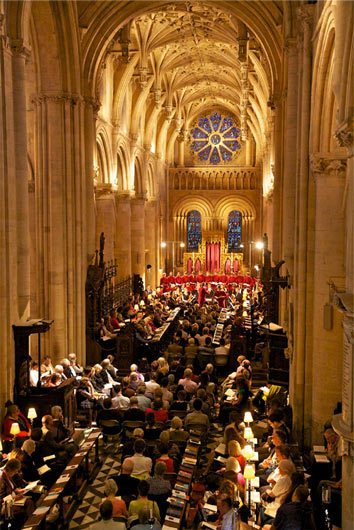
Earlier today, Queen Elizabeth II will have celebrated “the Royal Maundy” in the chapel of my old College and that of my mentor, Trevor Huddleston, at Oxford, Christ Church — our college chapel is also the cathedral of that great city.
The current Dean Of Christ Church, the Very Reverend Christopher Lewis, gave the BBC this historical detail:
The last time it happened here was in 1644 when Charles I was thrown out of London and welcomed in Oxford.
Here’s the glorious building where the ceremony will have taken place:
**
The Royal Maundy is celebrated by the monarch giving two purses to local pensioners — 83 men and 83 women this year since HM is 83 years old — a white purse containing sterling silver 1p, 2p, 3p and 4p pieces, and a red purse contained a £5 and a 50p coin commemorating the 60th anniversary of the Queen’s coronation in 1953.
Maundy Thursday commemorates the day of the Last Supper of Jesus Christ with the Apostles. The word ‘Maundy’ comes from the command or ‘mandatum’ by Christ at the Last Supper, to love one another.
The tradition of the Sovereign giving money to the poor dates from the thirteenth century. The Sovereign also used to give food and clothing, and even washed the recipients’ feet. The last monarch to do so was James II.
It’s a curious survival, the Royal Maundy, but a touching one, looking back to the days when the monarch really was expected to be a bit like a priest for the nation – acting out the great symbols of faith on behalf of everyone. …
And that’s very much what the Royal Maundy is about. What we see today is only a shadow of what used to be done hundreds of years ago, when the monarch would actually do what Jesus did at the Last Supper and wash the feet of a number of poor people. Back in the Middle Ages, this meant that the King was just doing what priests and bishops often did, not only on Maundy Thursday but on many other occasions.
They didn’t all do it because they were lovely humble people – some were, and some definitely weren’t – but because they accepted one great truth that needed repeating over and over again, the one big thing that Christianity had brought into the world of human imagination.
And that was – and is – the truth that power constantly needs to be reminded of what it’s for. Power exists, in the Church or the state or anywhere else, so that ordinary people may be treasured and looked after, especially those who don’t have the resources to look after themselves. The Bible is crystal clear that this is the standard by which the gospel of Jesus judges the powerful of this world.
Power exists, in the Church or the state or anywhere else, so that ordinary people may be treasured and looked after, especially those who don’t have the resources to look after themselves.
**
Here is the text from St John’s gospel — the gospel that focuses its attention at the symbolic level — describing the original event [John 13.1-15]:
He riseth from supper, and laid aside his garments; and took a towel, and girded himself. After that he poureth water into a bason, and began to wash the disciples’ feet, and to wipe them with the towel wherewith he was girded.
Then cometh he to Simon Peter: and Peter saith unto him, Lord, dost thou wash my feet?
Jesus answered and said unto him, What I do thou knowest not now; but thou shalt know hereafter.
Peter saith unto him, Thou shalt never wash my feet.
Jesus answered him, If I wash thee not, thou hast no part with me.
Simon Peter saith unto him, Lord, not my feet only, but also my hands and my head.
Jesus saith to him, He that is washed needeth not save to wash his feet, but is clean every whit: and ye are clean, but not all. For he knew who should betray him; therefore said he, Ye are not all clean.
So after he had washed their feet, and had taken his garments, and was set down again, he said unto them, Know ye what I have done to you? Ye call me Master and Lord: and ye say well; for so I am. If I then, your Lord and Master, have washed your feet; ye also ought to wash one another’s feet. For I have given you an example, that ye should do as I have done to you.
**
Here finally, for sheer beauty, is the great 16th century Spanish composer Tomás Luis de Victoria‘s First Lamentation for Maundy Thursday, sung by the Tallis Scholars in the chapel of Merton College, Oxford — just around the corner from Christ Church:
Zenpundit is a blog dedicated to exploring the intersections of foreign policy, history, military theory, national security,strategic thinking, futurism, cognition and a number of other esoteric pursuits.