zenpundit.com » JM Berger

Archive for the ‘JM Berger’ Category

Turning analytic bifocals on the Islamic State’s Irregulars

Tuesday, December 30th, 2014

[ by Charles Cameron — IS / Daesh focus is not on the question of derangement but of repentance – Dabiq #6, Aquinas, adaequatio ]
.

Lindt police
Lindt cafe worker escapes Man Haron Monis hostage situation, Sydney – credit Jason Reed, Reuters

**

It’s interesting to compare how we think about those like Man Haron Monis on the cusp between derangement, criminality, terrorism and jihad, and how IS views them.

JM Berger remarks of those he classifies as The Islamic State’s Irregulars:

in a number of these cases, it’s unclear whether the attacks were inspired by the Islamic State and its extremist ideology, or whether IS provided a convenient excuse for violence that was already brewing in the hearts of the perpetrators.

while his subtitle asks:

What should we do with lone-wolf attackers who are mentally unstable or deranged? Are they terrorists, too?

**

Berger, among our most discerning analysts and co-author with Jessica Stern of the keenly awaited book, ISIS: The State of Terror, describes Monis as:

a Shiite Muslim born in Iran who had emigrated to Australia. He had been charged in 2013 as an accessory to murder and faced dozens of sexual assault charges related to his “spiritual healing” practice. His own lawyer described him as “unhinged.”

Clearly, the waves of influence running amok in Monis’ head are nowhere near as simply as our routine categorizations – that he was IS, or simply a terrorist, a mental case, a criminal, a murderer perhaps – would like to suggest. Our best inquiry is into his mental state, his psychological “drivers” – how we can understand him, with easy categorization the sound-bite version providing closure.

**

The Islamic State views him differently. As described in the sixth issue of their magazine, Dabiq, he is clearly a religious hero, specifically a martyr:

It didn’t take much; he got hold of a gun and stormed a café taking everyone inside hostage. Yet in doing so, he prompted mass panic, brought terror to the entire nation, and triggered an evacuation of parts of Sydney’s central business district. The blessings in his efforts were apparent from the very outset.

Dabiq then paints western media diagnoses made against him as slurs:

Then, as the situation developed and his identity was revealed, we saw a predictable response from the international media. They immediately began searching for anything negative that they could use against him, and subsequently began reporting numerous allegations made against him in an attempt to smear his character and, by extension, the noble cause that he was fighting for – the cause of Allah (ta’?l?).

And then something interesting occurs. Dabiq, half-admitting the accuracy of some of those slurs, defends him not by denying their accuracy but by framing them in the context of repentance and divine mercy:

The fact is, however, that any allegations leveled against a person concerning their past are irrelevant as long as they hope for Allah’s mercy and sincerely repent from any previous misguidance.

This is so with one who embraces Islam and thereby has his past history of shirk and transgression completely erased – as was even the case with many Sahabah. So how much more so in the case of one who followed up his repentance by fighting and being killed in the path of Allah, knowing the Prophet (sallallahu ‘alayhi wa sallam) declared that such a person would be forgiven the moment his blood is first spilled.

**

“He was deranged, violent, driven, and IS became the hook on which he hanged himself” – or “His sacrificial death absolved him from all flaws and sins”. The contrast is instructive.

It seems best for us to to wear secular / sacred bifocals in our analyses. But how does the analyst gain that faculty which EF schumacher, Thomas Aquinas and Augustine call adaequatio rei et intellectus

according to which to each plane of reality there corresponds an instrument of knowledge adequate to the task of knowing that particular level of reality
??

Whose black banner is it, anyway? — and the Khawarij

Monday, December 29th, 2014

[ by Charles Cameron — a flag flapping in the wind, in the mind ]
.

You see this flag?

Who flies it?

**

The media often call it “the Islamic State flag” these days, and indeed in the photo above, it’s a convoy of IS / Daesh vehicles that’s flying it.

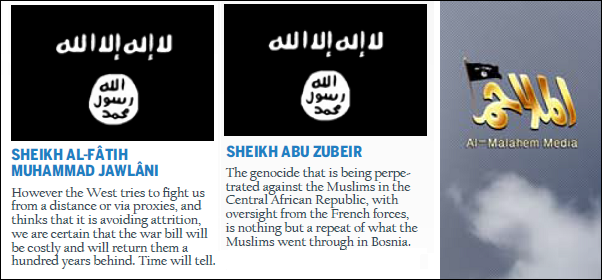
But in the recent 13th issue of Al Qaida in the Arabian Peninsula‘s magazine, Inspire, that same flag is used as an icon for both Mohammad Jawlani, the emir of AQ’s Iraqi branch, Jabhat al-Nusra, and Mukhtar Abu Zubair, late emir of al-Shabaab — and indeed, it also features in AQAP’s Malahem Media logo:

whose black banner

It is one of the ironies of the age that the image of a black banner featuring the white circular “seal of the Prophet” is flown by both sides in the contentious rivalry between the Islamic State and Al Qaida for leadership in the global jihad .

**

And who are the Khawarij today?

Joas Wagemakers, in ‘Seceders’ and ‘Postponers’? — an analysis of the ‘Khawarij’ and ‘Murji’a’ labels in polemical debates between quietist and jihadi-salafis, identifies the central distinctive opinion of the Khawarij thus:

The first of these is the Khawarij’s belief that revolt against Muslim rulers was allowed if they were deemed insufficiently pious. When ‘Ali accepted arbitration with Mu‘awiya, the people later known as Khawarij reportedly shouted ‘judgement is God’s alone’ (la hukm illa li-llah). In the context of that event, this referred to their belief that only God had the authority to arbitrate, not human beings, and that ‘Ali should not have accepted Mu‘awiya’s offer. The slogan later came to represent their broader view that all judgements and rulings should be left to God, thus applying Qur’anic rulings so strictly that they expelled Muslims guilty of major sins from their community and fought them. Because they believed sinful Muslims to be unbelievers (kuffar, singular: kafir), they directly applied passages from the Qur’an pertaining to jihad against non-Muslims to those of their co-religionists who were less than perfectly pious.

Does any of that sound familiar?

**

Well and truly trolled, JM!

Serpentine logic: enantiodromia, or a sudden turn of events

Saturday, September 14th, 2013

[ by Charles Cameron — an intriguing example of enantiodromia aka reversal or the hairpin bend ]
.

Let’s start with this tweet from Glenn Greenwald on September 11th 2013, a dozen years on from that tragic day:

Click on Greenwald’s link, and you’ll find it leads to an article by Mike Riggs, and refers specifically to this image of an ad in a DC metro station:

Riggs, who had written his article Oath Keepers Group Places Massive Pro-Snowden Ad Inside Pentagon Metro Station a couple of months eariler on July 24 2013, clearly thought that OathKeepers’ ad was strange enough to comment:

Last Thursday as I was rolling into the Pentagon Metro station I noticed from the train window a giant sign that read, “Snowden Honored His Oath. Honor Yours! Stop Big Brother!”

Before I could snap a picture or see who’d sponsored the sign, the train was rolling out. For the rest of the weekend I wondered who had the chutzpah (and the inventiveness) to praise Snowden at the Pentagon stop, where it’s far more common to see ads from lobbyists praising the merits of some piece of military tech.

Turns out it was the Oath Keepers, “a coalition of current and former military, police, and other public officials [who] have pledged not to obey unconstitutional commands.”

Following hot on the heels of Greenwald’s tweet of September 11, Charles Johnson wrote a piece on LGF titled Why Is Glenn Greenwald Promoting an Extreme Right Wing Militia?

And that in turn led to friend JM Berger’s tweet, also on Sept 11th:

And the enantiodromia here, the sudden switcheroo? That’s to do with Greenwald suddenly tweeting an appreciation of the OathKeepers — not his usual allies by any stretch of the imagination. So this one might equally be filed under “strange bedfellows”.

Or a “one two combo” perhaps? Left jab right cross, to be specific?

**
So where does the word come from? Carl Jung more or less borrowed the word from Heraclitus, as quoted by Diogenes Laërtius (ix. 7) in a passage that defies easy translation. Fortunately, as Wikipedia helpfully notes:

Plato in the Phaedo will articulate the principle clearly: “Everything arises in this way, opposites from their opposites.” (sect. 71a).

Jung explains Heraclitus’ meaning as he understands it:

In the philosophy of Heraclitus it is used to designate the play of opposites in the course of events — the view that everything that exists turns into its opposite…

and as he himself uses the term:

I use the term enantiodromia for the emergence of the unconscious opposite in the course of time.

Would you prefer a more contemporary reference? John Perry Barlow even gave a TED talk about it:

**

Enantiodromia turns out to be one of the classic forms of paradox in history — t’s a form I’ve written about before on Zenpundit, in my post Jung in Tehran, aka “enantiodromia”, and also referred to in a comment on Pamela Geller.

Here are two notable examples. The first comes from Reinhold Niebuhr‘s The Irony of American History:

Everybody understands the obvious meaning of the world struggle in which we are engaged. We are defending freedom against tyranny and are trying to preserve justice against a system which has, demonically, distilled injustice and cruelty out of its original promise of a higher justice.

The second is from UK’s Labour MP, Sir Gerald Kaufman, who once said:

My grandmother was ill in bed when the Nazis came to her home town a German soldier shot her dead in her bed. … My grandmother did not die to provide cover for Israeli soldiers murdering Palestinian grandmothers in Gaza.

Right or wrong, Kaufman was in effect asserting the danger of enantiodromia

**

Note well that enantiodromia is mostly used to refer to a single switchback: iterative enantiodromia would be a form of boustropehdon.

Note also that David Myatt, whose comment on enantiodromia in Heraclitus I linked to above, is an interesting fellow in his own right, having been a leading UK neonazi for decades, then converting to Islam and preaching jihad and praise of bin Laden — now finally settling into his (hopefully, final) role as an English country gentleman and proponent of moderation in all things — an ex-twice-extremist anti-extremist, itself quite an enantiodromic turn of events…

Hurrumph! Enough for one post…

Of serpent-bites in logic

Saturday, August 31st, 2013

[ by Charles Cameron — continuing my series on the “serpent bites tail” reflexive form (1, 2, 3, 4) in which analytic gems and other insights may often be easily discovered or succinctly expressed — read this post fast for fun, or reflectively (!!) for the ripples ]
.

I’m going to lead off with this tweet, which seems very timely considering the news this last week or so about Syria…

I thought this was another quite beautiful example of “serpent bites its own tail” phrasing — timely too — uttered by JM Berger in summarizing his Loopcast with Daveed Gartenstein-Ross on the current status of Al-Qaeda, highly recommended, BTW:

And if you want to know about Hezbollah and its global reach, this one refers to the book you need…

**

Okay, having given pride of place to those three, I’d like to catch those of you who are interested up on an entire series of self-referencing tweets I’ve run across since I last posted. I’m really collecting these things because I’d like, one of these days, to do a thorough analysis of what they teach us about our modes of thought, and how we can apply that to pattern-recognition in our own readings, and creative insight in our writings and analytic output… In the meantime, don’t feel obliged to read every last one, just dip in as you feel inclined — think of this as a reference section, okay? Take what you need and leave the rest.

Here’s one that uses the Escher‘s hand draws hand format:

And here’s a pair that needs to stay together:

Continuing… I might as well give you a cluster from Teju Cole, since he’s a master…

Okay, here’s another one with timely reference, this time to the whole NSA business:

Really, this is just such a rich vein of humor and insight:

Let’s go to another wordsmith — they’re often good at this stuff:

Two from philosopher Allen Stairs:

One from quasi-Einstein, via the very bright (non-quasi) Seb Paquet:

**

I’ll close with an example from the “all is nothing” category, this one from Peter J Munson:

Twitter mixology

Friday, August 23rd, 2013

[ by Charles Cameron — bemused by all you young people ]
.

Kim Kierkegaardashian is exactly the right amount of Kardashian for me to allow into my life. It’s a twitterstream consisting entirely of combination authentic Kardashian soundbites and Kierkegaard quotes, and it’s usually hilarious.

JM Berger‘s tweet, by contrast, sets out one version of an aesthetic principle which seems to underlie much of today’s culture: mixing pop-reference in with serious culture, for serio-popular effect.

Bashar al-Assad‘s supporters do this, aligning their man with Buffy the Vampire Slayer. Salafi jihadists likewise, borrowing footage from the Lord of the Rings. Dan Drezner does it — using zombies to discuss international politics — and wins an Association of American Publishers honorable mention for the 2011 PROSE Award in Government & Politics. Kim Kierkegaardashian does nothing else…

**

Has this sort of hi-lo-brow mixing always happened?

L’homme armé was a French pop song from the 14th or 15th century, its melody used as the basis for Masses by composers from Dufay and Okeghem to Palestrina — and thence to Peter Maxwell Davies in our own times:

The man, the man, the armed man,
The armed man
The armed man should be feared, should be feared.
Everywhere it has been proclaimed
That each man shall arm himself
With a coat of iron mail.

It must be noted that some believe the “armed man” in question is the Archangel Michael. His fight, unlike Kierkegaardashian’s, is neither with God nor man, but directly with the Devil.

**

DoubleQuotes Sources:

  • Kim Kierkegaardashian
  • JM Berger

  • Switch to our mobile site

