zenpundit.com » complexity

Archive for the ‘complexity’ Category

Sensitive dependence on initial conditions — & more

Saturday, November 3rd, 2012

[ by Charles Cameron — on human impact, with a quick glance at Pundita’s wide-angle thinking ]
.

The “butterfly effect” identified by meteorologist Edward Lorenz suggests that when you are dealing with highly complex systems such as weather patterns, what eventually happens may be “sensitively dependent on initial conditions”. Very small differences at one moment in such systems may result in very large differences later on. As Lorenz explains in the upper quote above, however, we’re dealing with a myriad of influences simultaneously, and it’s entirely possible that our own meteorological impact exceeds and outweighs that of the butterfly species…

I’ve chosen to post this particular pair of quotes, in fact, because both examples point to severely deleterious effects of human impact on our home environment in the larger sense — “the world we live in” — at a level where human individuals may not feel they have much of an individual impact, but where the cumulative effect is much greater: global warming? devastating storms? loss of rain forest? — narcarchy?

Narcarchy: hereby defined as rule by cartel — see this fascinating news piece, and note in particular the presence of a significant religious thread in the midst of the drug / crime / warfare picture.

**

On the question of sensitive dependence on initial conditions, this graphic paints the picture nicely and with nuance, for those who “think in pictures”:

I found it attached to the Wikipedia entry on Lorenz’s Butterfly Effect which may also help if like me you’re a lay reader, mathematically speaking.

**

I also wanted to juxtapose the two quotes above because they give me a chance to talk about “wide angle views” and their virtues, and to point you to a recent Pundita post that set me thinking along those lines. The post is Then and Now: Instructive parallels between 9/11/01-Benghazi and Katrina-Sandy storms, and part of my comment read as follows:

…you have an amazing breadth of thought going on here – especially in your paragraph:

It’s as if a new era arrived, with its vast changes in weather patterns and attack patterns, and nobody is yet fully processing the nature of the threats. I guess such an observation is actually old news. But Sandy coming on the heels of Benghazi struck me as a kind of exclamation mark to the fact that civilizations start to fall at the point where they’re no longer able to process the cumulative effects of their past.

Seeing parallels between Benghazi and 9/11, or between Sandy and Katrina, would be one thing – but managing to see parallel changes in both “weather patterns and attack patterns” is quite another — and even though people may want to question and qualify some of the details, the overall scope and view is breathtaking.

We need this kind of wide-angle thinking, it seems to me, and I offer my two quotes here in much the same spirit.

So if “sensitive dependence on initial conditions” is one analytic thought pattern I’m promoting here, “wide-angle thinking” and the capacity to zoom from significant detail to global context is surely another.

Bassford’s Dynamic Trinitarianism, Part II.

Monday, September 24th, 2012

In Part I.  we looked at a working paper by Professor Christopher Bassford that he he has posted at Clausewitz.com entitled  Tiptoe Through the Trinity, or, The Strange Persistence of Trinitarian Warfare.  As I said previously:

At 31 pages of analytic prose, diagrams and footnotes regarding the nature of  Carl von Clausewitz’s“fascinating” trinity; how Bassford thinks Michael Howard and Peter Paret got some important points in their translation of On War wrong ; the real meaning of Politik and on the perfidy of non-trinitarians – Bassford’s paper is not a quick read but a worthwhile one. I learned some important things about On War from reading this paper and had some uncertain speculations strengthened by Bassford’s expertise on Clausewitz and Clausewitzians.  I am not going to attempt a summary of so long and abstruse an argument, but I would instead like to highlight some of Bassford’s more valuable insights. There were also a couple of points where, in stretching to make analogies with other fields, I think Bassford may be going astray, as well as some commentary I might make regarding “non-state war”.

This paper will be more digestible if we blog the topics one at a time, in succession. 

Having previously tackled Bassford’s interpretation of the “fascinating” trinity and his argument for it’s dynamic nature, the time has come to observe how he explains a concept almost as important for understanding On War, what Clausewitz meant by “Politik“. We have all heard the often quoted maxim that Clausewitz said that “War was the continuation of politics by other means”, but what that sentence actually meant has been subject to both misunderstanding and debate. Here is Bassford:

….That leaves us with the problem of Politik. This is a huge subject, for it encompasses the entire issue of the relationship between it and war; perhaps 90% of debates about Clausewitz turn on it. Let us pause for a (long) moment and consider the meaning of those problematic words, Politik, politics, and policy.

Clausewitz seldom overtly defines Politik in any detail, and when he does so the definition is shaped to fit the immediate context. In translating Politik and related words, English-speakers feel compelled to choose between “politics” and “policy.” Some even prefer the much more specialized term “diplomacy,” which limits the discussion to relations among organized states—that is how Jomini’s Politique was usually rendered into English. Our choices can seriously distort Clausewitz’s argument. Clausewitz himself would probably have been very comfortable with the word “statecraft,” the broad zone of concerns and activities within which “statesmen” operate. But that term avails us no greater clarity and might even lock him exclusively into the state, where so many modern writers want to (uselessly) maroon him. We are interested in what Clausewitz meant by Politik, of course, but our focus here is even more on the question of what we mean by policy and politics. The latter two terms are related but far from equivalent. Each captures a part of the meaning of Politik, but even used together they do not cover quite the same ground.

…..1. Politics and policy are both concerned with power. Power comes in many forms. It may be material in nature: the economic power of money or other resources, for example, or possession of the physical means for coercion (weapons and troops or police). Power is just as often psychological in nature: legal, religious, or scientific authority; intellectual or social prestige; a charismatic personality’s ability to excite or persuade; a reputation, accurate or illusory, for diplomatic or military strength. Power provides the means to attack, but it also provides the means to resist attack. Power in itself is therefore neither good nor evil. By its nature, however, power must be distributed unevenly, to an extent that varies greatly from one society to another and within the same society over time.*25

2. “Politics” is the highly variable process by which power is distributed in any society:the family, the office, a religious order, a tribe, the state, an empire, a region, an alliance, the international community. The process of distributing power may be fairly orderly—through consensus, inheritance, election, some time-honored tradition. Or it may be chaotic—through intrigue, assassination, revolution, and warfare. Whatever process may be in place at any given time, politics is inherently dynamic and the process is always under pressures for change. Knowing that war is an expression of politics is of no use in grasping any particular situation unless we understand the political structures, processes, issues, and dynamics of that specific context…..

….The key characteristics of politics, however, are that it is multilateral and interactive—always involving give and take, interaction, competition, struggle. Political events and their outcomes are the product of conflicting, contradictory, sometimes cooperating or compromising, but often antagonistic forces, always modulated by chance…..

….War—like politics—is inherently multilateral, of course, though Clausewitz often uses the term sloppily in the sense of a unilateral resort to organized violence…..

….3. “Policy,” in contrast to politics, is unilateral and rational. Please do not confuse rationality with wisdom, however. As you may already suspect, there is no shortage of unwise policy out there. Policy (like strategy) represents a conscious effort by one entity in the political arena to bend its own power to the accomplishment of some purpose—some positive objective, perhaps, or merely the continuation of its own power or existence. Policy, is the rational and one-sided subcomponent of politics, the reasoned purposes and actions of each of the various individual actors in the political struggle.

….The key distinction between politics and policy lies in interactivity. That is, politics is a multilateral phenomenon, whereas policy is the unilateral subcomponent thereof.

….This makes policy and politics very different things—even though each side’s policy is produced via internal political processes (reflecting the nested, fractal *27 nature of human political organization).*28 This is not of merely semantic importance. The distinction is crucial, and there is a high price for confusion.

….In general, H/P’s word-choice reflects this logic, despite its strong bias towards “policy.” Whenever the context can be construed as unilateral, as in the Trinity discussion, we see “policy.” In Clausewitz’s final and most forcefully articulated version of the concept, however, the context is unarguably multilateral, with so strong an emphasis on intercourse and interactivity that, ultimately, even H/P is forced to use “politics” and “political”:

We maintain, on the contrary, that war is simply a continuation of political intercourse, with the addition of other means. We deliberately use the phrase “with the addition of other means” because we also want to make it clear that war in itself does not suspend political intercourse or change it into something entirely different. In essentials that intercourse continues, irrespective of the means it employs. The main lines along which military events progress, and to which they are restricted, are political lines that continue throughout the war into the subsequent peace. How could it be otherwise? Do political relations between peoples and between their governments stop when diplomatic notes are no longer exchanged?*30

….The clash of two or more rational, opposing, unilateral policies brings us into the realm of multilateral politics. Thus there really is no reason to avoid translating the Trinity’s politischen Werkzeuges literally, i.e., as “political instrument.”
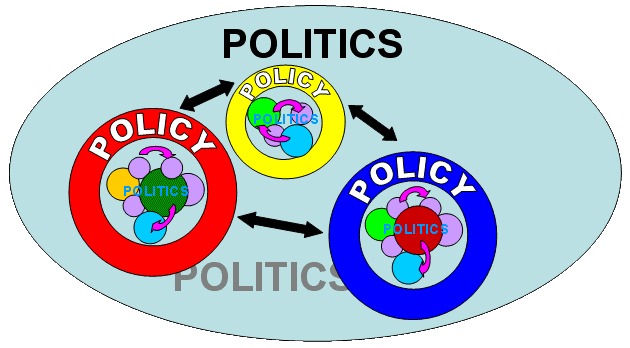
That brings us to the problem of instrumentality. Force or violence is, of course, an instrument, in the sense of a hand-tool or weapon, of unilateral policy. War, however, must be bi- or multilateral in order to exist. Thus, while military force is indeed an instrument of unilateral policy, we should see war as an instrument of politics only in a very different, multilateral sense, as the market is an instrument of trade or the courtroom an instrument of litigation (“which,” as Clausewitz says, “so closely resembles war”)

….Clausewitz seems simply to assume that his readers will distinguish, on the fly, whether he is speaking in the unilateral or the multilateral sense. After all, he has stressed time and again the interactive nature of war, and, of course, his own language’s term Politik encompasses both our multilateral politics and our unilateral policy. But this casual stance results in constant confusion for the translator and the reader.

….We sometimes forget, of course, that Clausewitz’s magnum opus is not about policy or politics, nor about human nature or the nature of reality. It is merely a mark of the book’s profundity that these matters arise immediately in any serious discussion of it. In fact, Clausewitz himself dismisses the political complexities of policy in order to focus on his true subject, the conduct of military operations in war

….On the other hand, he’s offering some good advice here, not necessarily a prediction. It seems rather superfluous to suggest that perhaps Clausewitz actually grasped the facts that there is such a thing as bad policy, that bad policy has military consequences, and that this in turn may have consequences for both the political leadership and the community whose interests it is supposed to represent.

Clausewitz’s analogy to markets and litigation are interesting, partly because they are strained.  Still useful, but strained.

In the case of the former, the relationship is actually the reverse: trading is an instrumentality of economic relationships and economic laws which continue to operate even if their “natural” manifestations are suppressed by political power wielded by the state (i.e. the Soviet Union or North Korea could fix prices or set quotas but then had shortages, surplus goods and black markets instead). However, in CvC’s defense, he was still correct that there was a degree of parallel between economic competition and war and economics was then still in it’s infancy. Some of the classical economists had yet to become regarded as such by wrestling with their own conception of iterative, friction-generating, relationships. Furthermore, in Clausewitz’s day, the heavy hand of the state in economic life was traditional in continental Europe while “liberalism” (allowing freer markets) seemed like a radical innovation rather than an underlying mechanism behind an existing system of distortions.

The same might be said that litigation is the instrument of the courtroom or justice, but I am less sure here. Continental legal traditions and assumptions are sometimes very different from the Anglo-American legal systems based more upon common law and the evolution of judicial independence from the executive. And unfortunately, early 19th century Prussian royal courts are a subject beyond my competence. In any event, the adversarial and zero sum nature of litigation carries through in Clausewitz’s analogy.

In regard to Politik, I think Bassford has done an excellent job teasing out the ambiguities of a German word that does not translate or transliterate precisely into an English equivalent. He offers the reader a method for sensibly discerning when to use “politics” or “policy” in interpreting Clausewitz’s text and reasonably assumes that Clausewitz expected the reader to infer the correct meaning from the surrounding context. That’s how most of us write when dealing with multi-layered, abstract topics – we sacrifice exact clarity for useful brevity and expect (or hope) the audience will intuitively grasp the right nuance in our line of reasoning.

I am also intrigued by Bassford’s diagram. The representation of internal political dynamics is very useful but I am curious how he would weave a visual representation of strategy flowing from policy or (more accurately, policies) and strategy’s relationship with politics, beyond being subsumed. Many a potential strategy is stillborn in the tumult of bureaucratic-military politics, never mind the larger societal kind.

As complex as the text of On War sometimes seems, it really was a brilliant simplification by Clausewitz of the dynamics mediating conflict and war.

What eye and mind can reasonably absorb

Friday, August 24th, 2012

[ by Charles Cameron — visual thinking, graphical presentation, the magical number seven plus or minus two, human intelligence ]
.

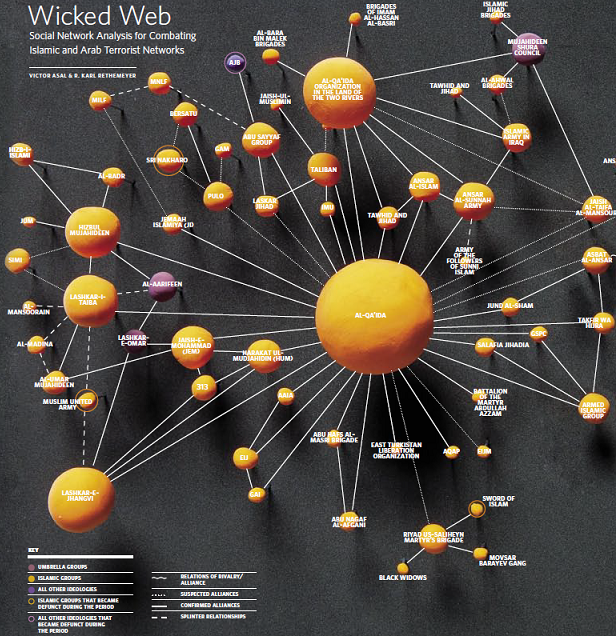
Look:

click image to download pdf & see pp 12-13 for closer, full-size look

Got it? That’s part of a double-page spread from the University of Maryland’s START Program report for 2011:

The National Consortium for the Study of Terrorism and Responses to Terrorism—better known as START – is a university-based research center committed to the scientific study of the causes and human consequences of terrorism in the United States and around the world.

Looking through the rest of the report, I’m tempted to say a snazzier, jazzier magazine I’ve seldom seen!

**

I maintain that’s far nicer to look at, but no more comprehensible than, this gorgeous and justly infamous power point slide:

click image for a closer, full size look

Got that one, too? That was a slide used to help GEN McChrystal understand that war he was fighting.

**

Watson and Crick introduced their 1953 paper in Nature, A Structure for Deoxyribose Nucleic Acid, with these words:

We wish to suggest a structure for the salt of deoxyribose nucleic acid (D.N.A.). This structure has novel features which are of considerable biological interest.

No less witty is the opening of George A. Miller‘s only somewhat less celebrated paper three years later in The Psychological Review, The Magical Number Seven, Plus or Minus Two: Some Limits on Our Capacity for Processing Information:

My problem is that I have been persecuted by an integer. For seven years this number has followed me around, has intruded in my most private data, and has assaulted me from the pages of our most public journals. This number assumes a variety of disguises, being sometimes a little larger and sometimes a little smaller than usual, but never changing so much as to be unrecognizable. The persistence with which this number plagues me is far more than a random accident. There is, to quote a famous senator, a design behind it, some pattern governing its appearances. Either there really is something unusual about the number or else I am suffering from delusions of persecution.

The gist of Miller’s piece (and by gist I explicitly mean the always misleading broad strokes version) is that we can usually manage to hold five to nine chunks of thought in mind at any given time, but that if we want to understand more than that, we need to “chunk” our thoughts in such a way that we think of “seven plus or minus two” items (Miller’s “magical number”) but can peer into any one of them and see it divided into lesser portions which we can also comprehend, in what I’ll call a tree > trunk > limb > branch > twig > leaf arrangement — always remembering that a tree may be part of a forest, and that sometimes ee just can’t see the forest for the trees…

Miller explains chunking succinctly thus:

It seems probable that even memorization can be studied in these terms. The process of memorizing may be simply the formation of chunks, or groups of items that go together, until there are few enough chunks so that we can recall all the items.

Neat, hunh? And he concludes, with another pleasant touch of wit:

And finally, what about the magical number seven? What about the seven wonders of the world, the seven seas, the seven deadly sins, the seven daughters of Atlas in the Pleiades, the seven ages of man, the seven levels of hell, the seven primary colors, the seven notes of the musical scale, and the seven days of the week? What about the seven-point rating scale, the seven categories for absolute judgment, the seven objects in the span of attention, and the seven digits in the span of immediate memory? For the present I propose to withhold judgment. Perhaps there is something deep and profound behind all these sevens, something just calling out for us to discover it. But I suspect that it is only a pernicious, Pythagorean coincidence.

**

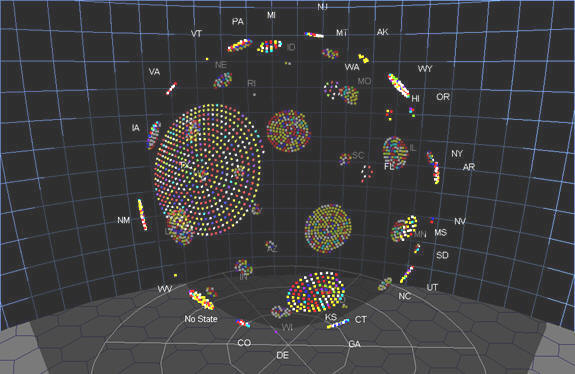
Of course there are high-node graphics programs like Starlight Analytics (from Future Point Systems via Battelle and the Pacific Northwest National Laboratory) which allow you to sample one of a cluster of very similar nodes, or to see where the outliers are and zero in on them…

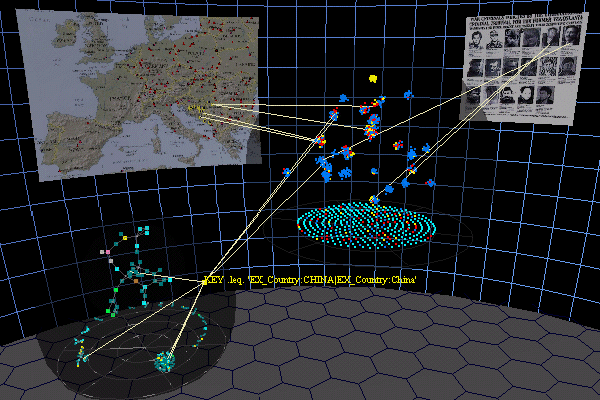
or to focus in on only those nodes connected to one particular name or place on a map:

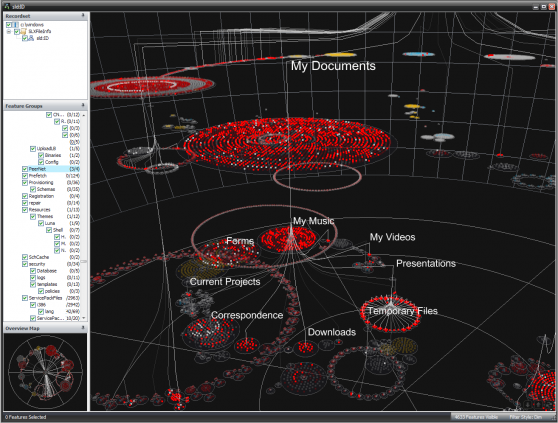
But can you find a file you’re looking for any faster by locating it somewhere in this graphic…

than by using your usual search methods?

So okay, high level analytics like Starlight may be useful for analysts who have the costly software and time to pinpoint and track and zoom and annotate and comprehend, become alarmed or calmed, and respond appropriately.

But people reading that glossy report from the START program? People trying to brief GEN McChrystal from a powerpoint slide?

Seven. Seven plus or minus is your number.

**

Once more, with feeling.

The moral of this tale is that graphical presentations of ideas to explain complexities should generally feature seven plus or minus two nodes, maximum, for eye and mind to consider at any one time, with perhaps an additional three or four that the eye can glide across to, forming a second chunk — thus delivering a maximum of 13 nodes without zooming in.

for the direct communication of major drivers in a complex situation — seven nodes plus or minus two is your optimal number.

**

Ah — but see, I forgot to show you the rest of that first image:

You can handle grasping the import of an image two parts, surely, can’t you?

Okay then — if you can, perhaps you can help me out…

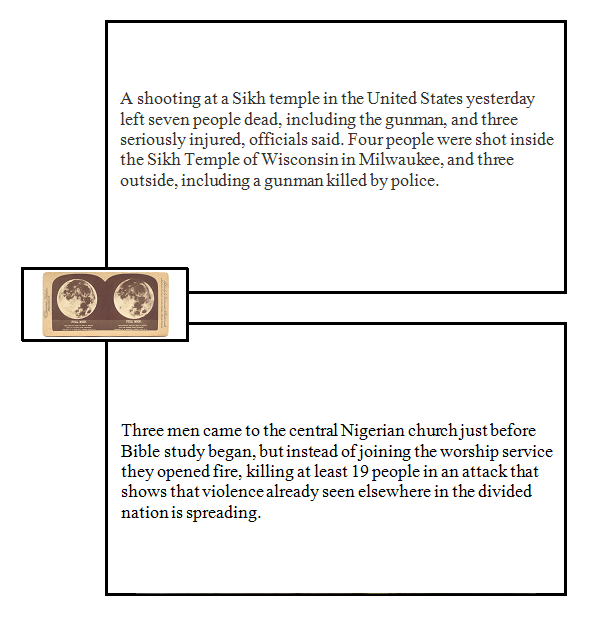
Who among us can comprehend religion? — recent shootings

Wednesday, August 8th, 2012

[ by Charles Cameron — slaughters of Sikhs and Christians and questions of nomenclature: second addendum to my post responding to Scott Atran ]
.

Scott Atran recently argued that it is imperative that we understand religions, and in my post Landmines in Paradise Garden I agreed, while differing with Atran on what kinds of people are best suited to the task.

Here I would like to offer a second addendum to that post of mine, this time inviting ZP’s readers to compare and contrast the two quotes above, and likewise the two tweets below:

using them as, in effect, verbal Rorschach blots — allowing each of us individually to see something of our own ways of comparing and contrasting the two situations, their respective contexts and the ways in which we feel they have been treated by the media — and the two ways of “accurately” describing the tragic event in Oak Creek, Wisconsin.

We can see religion — we can see politics — we can see our own — we can see the other — the possible views and manners of relating to these events are many and varied, but the untimely deaths remain.

It is imperative for us to begin to get a better understanding of religion, in all its shadows and its lights. A little discussion might help.

**

Sources:

Shooting at the Wisconsin Gurudwara
Shooting at the Nigerian Church

Accuracy Org tweet
Chip Berlet tweet

For a chilling account of the Nigerian shooting, see this Christian Science Monitor piece (h/t Daveed Gartenstein-Ross)

Percussions and repercussions

Monday, August 6th, 2012

[ by Charles Cameron — ecology, fire, forests, an elevator in Denver, and how one thing leads to another ]
.

Guy Davenport, a stylist worthy of his Masters

.

HeraclitusHerakleitos — sees this world as one seamless “all” in constant motion and taking many forms — with what we call “fire” as the recurring form within that flux that he can point to by name, using it as his best metaphor for that “all”…

In the beautiful translation of Guy Davenport (drawn here from fragments 28 and 29 in his book, 7 Greeks, p 161:

Everything becomes fire, and from fire everything is born, as in the eternal exchange of money and merchandise.

This world, which is always the same for all, neither god nor man made: it has always been, it is, and always shall be: an everlasting fire rhythmically dying and flaring up again.

**

This is just a quick post, a little creativity flaring up and dying down again while I am preparing longer pieces on Nidal Hassan (as discussed by Daveed Gartenstein-Ross, JM Berger and emptywheel), a zennish biography of John Cage, and Rain (with a capital roar) in African religion and urban settlements.

I was glancing at Chris Bright‘s entry Anticipating Environmental “Surprise” in State Of The World 2000, and my eye was caught by the phrase, “Surface fires do not climb trees and become crown fires.”

I’d never heard of “surface fires” and “crown fires” before, and “crown fires” in particular had me thinking there’s poetry here…

So I took a deep breath, slowed down, and read more carefully. And as I was reading the whole short section that began with those words, one part of my mind was soaking in the vivid images the text conjured up for me, but another part was calculating percentages in what seemed to be a rapidly accelerating descent.

I have tried to picture that double effect — of lush rainforest and the numbers that illustrate its fiery fall — in what follows:

**

100%

Surface fires do not climb trees and become crown fires. They just crackle along the forest floor, here and there, as little patches of flame, going out at night, when the temperature drops, and rekindling the next day. They will not kill the really big trees, and they do not cover every bit of ground in a burned patch. But they are fatal to most of the smaller trees they touch. Overall, an initial surface fire may kill perhaps 10 percent of the living forest biomass.

90%

The damage may not look all that dramatic, but another tract of forest may already be doomed by an incipient positive feedback loop of fire and drying. After a surface fire, the amount of shade is reduced from about 90 percent to around 60 percent, and the dead and injured trees rain debris down on the floor. So a year or two later, the next fire in that spot finds more tinder, and a warmer, drier floor. Some 40 percent of forest biomass may die in the second fire. At this point, the forest’s integrity is seriously damaged; grasses and vines invade and contribute to the accumulation of combustible material.

50%

The next dry season may eliminate the forest entirely.

0%

.
**

Those falling numbers remind me of the floors whizzing by in an elevator I once frequented in Denver — where the framed elevator license said, ominously enough, Type: Plunger.

And so here we are at “Ground floor: Perfumery, Stationery and leather goods”.

One very simple part of how complex the world we live in really is has to do with repercussions…


Switch to our mobile site