zenpundit.com » nuclear

Archive for the ‘nuclear’ Category

Obama mentions Khamenei “nuclear fatwa”

Tuesday, September 24th, 2013

[ by Charles Cameron — I believe this is the first time a US President — perhaps even a senior US official — has affirmed the existence of Ayatollah’s Khamanei’s previously disputed so-called “nuclear fatwa” ]
.

Here, from the Washington Post‘s full transcript of President Obama‘s address to the UN General Assembly, is the relevant section — I’ve emphasized his reference to the fatwa in red:

Since I took office, I’ve made it clear in letters to the supreme leader in Iran and more recently to President Rouhani that America prefers to resolve our concerns over Iran’s nuclear program peacefully — although we are determined to prevent Iran from developing a nuclear weapon. We are not seeking regime change, and we respect the right of the Iranian people to access peaceful nuclear energy. Instead, we insist that the Iranian government meet its responsibilities under the Nuclear Non-proliferation treaty and U.N. Security Council resolutions.

Meanwhile, the supreme leader has issued a fatwah against the development of nuclear weapons. And President Rouhani has just recently reiterated that the Islamic republic will never develop a nuclear weapon. So these statements made by our respective governments should offer the basis for a meaningful agreement. We should be able to achieve a resolution that respects the rights of the Iranian people while giving the world confidence that the Iranian program is peaceful. But to succeed, conciliatory words will have to be matched by actions that are transparent and verifiable.

**

Further reading:

I believe we tend to underestimate the significance of religious and apocalyptic influences in international affairs, since the development of Iranian nuclear weaponry is a potential casus belli, and since the use of nuclear weapons has a distinctly apocalyptic aura, I’ve tried to take an interest — here’s my lengthy overview of “religion and nukes” in religion and myth worldwide, from 2008.

  • I catalogued my own understandings about the fatwa here on Zenpundit in a 2011 post, Striking Iran — response to Cheryl. I lack access to both Iranian language and classified sources, however, so that post represented a best effort to corral what I could find, but kis far from definitive.

  • Cheryl Rofer has also been following this discussion with interest, and her two posts for Nuclear Diner, The Fatwa Against Nuclear Weapons of January this year and The Nuclear Fatwa of March present her latest understandings — Cheryl, please correct me if you have written anything more recent or more comprehensive.

  • Selfscholar claims to be a “portal for unique, pertinent research on law and human rights in the Middle East”. I cannot speak to the particular interests, influences, credentials or biases of those who posts there, but the materials on our topic, that I have found there — in English but with extensive citations of original texts — will surely provide any researcher who possesses the appropriate language skills with many further pointers to track down… My starting point would be a search of the site for the keywords “nuclear fatwa”. The most recent post there would be Radioactive Fatwas: The Growing Islamist Legitimization of Nuclear Weapons from the 17th of this month. And Go, Learn About Atoms: Iranian Discourse on Nuclear Weapons, 1962-Present, at 32 pp. and posted in June 2013, would appear to offer a detailed historical presentation.

  • **

    And for further context:

  • Yesterday’s Financial Times brought us a piece by Najmeh Bozorgmehr titled Words of seventh-century imam signal Iran’s change of approach, which begins:

    The Iranian regime’s sudden focus on a seventh-century Shia imam may be the strongest indicator yet that Tehran is serious about negotiating on its nuclear programme. Imam Hassan, grandchild of the Prophet Mohammed and the second of 12 Shia imams, is famous for negotiating a peace treaty with those opposed to the principle that only descendants of the prophet could rule over Muslims. In Shia texts, his actions are defended as a compromise for the greater good of the religion, rather than a defeat.

    When Ayatollah Ali Khamenei, Iran’s top decision maker, called last week for “heroic flexibility” in talks over the nuclear programme, he was echoing the title of a religious text about Imam Hassan that he translated decades ago: Imam Hassan’s Peace: the Most Glorious Heroic Flexibility in History. The comment boosted hopes in Iran and the west of a possible nuclear deal, even though the ayatollah added that any flexibility was simply a tactic, presumably to deal with a difficult period and head off more economic sanctions or the possible threat of military confrontation with Israel or the US.

  • **

    I’d particularly welcome a post or comment from Selfscholar responding to Pres. Obama’s remarks today, and informed commentary on the Selfscholar site from those with appropriate skills to set it in religious, political, and scholarly context — as well as the usual fine interplay of views in the ZP comments section.

    Guest Post: Cheryl Rofer – I Hope the Government Doesn’t Listen to Nathan Myhrvold

    Monday, September 23rd, 2013

    Cheryl Rofer, scientist, WMD expert and founder of Nuclear Diner.com and long-time friend of ZP blog, will be cross-posting here today regarding the report “Strategic Terrorism: A Call to Action” by Microsoft billionaire, venture capitalist, theoretical mathematician and cookbook author, Dr. Nathan Myhrvold

    I Hope The Government Doesn’t Listen to Nathan Myhrvold

    by Cheryl Rofer

    Shane Harris at Foreign Policy tells us that Nathan Myhrvold, fresh off introducing the world to liquid nitrogen and other expensive innovations for cookery, is now going to straighten out the US government on terrorism. He has produced a thirty-three page paper that he is shopping around Washington to help the government get things right.

    Except that Myhrvold does not understand the definition of a threat: intent + capability. And he gets a lot of things wrong.

    He has a lot to say about what he calls, and barely defines, “strategic terrorism.” This is apparently intended to be parallel to the strategic nuclear threats of the Cold War. But during the Cold War, both the United States and Russia had nuclear weapons aimed at each other. They still do. The terrorists that Myhrvold discusses do not have weapons that can kill millions of Americans, which seems to be central to “strategic terrorism.” It’s not even clear that they have intent, but, for the sake of argument, let’s assume they do. That is only half a threat.

    Could they get that capability? Myhrvold is convinced they can, but he offers little in the way of evidence, and some of that is incorrect. Further, he confuses possibility with actuality throughout the paper, slipping easily from might to could to can.

    Let’s get the biggest factual error out of the way first. On page 5, Myhrvold says:

    The collapse of the Soviet Union has also greatly aided the dispersal of nuclear knowledge and potentially even complete weapons.

    Note that potentially. again on page 10:

    Today, tremendously lethal technology is available on the cheap. Anyone—even a stateless group—can have the deadliest weapons on earth. Several trends led to this inflection point. One is nuclear proliferation, which in recent years reached a tipping point at which access to nuclear weapons became impossible to control or limit in any absolute way. The collapse of the Soviet Union scattered ex-Soviet weapons across many poorly governed and policed states, and from there, the weapons may spread further into the hands of terrorists. At the same time, the set of ragtag countries that have developed homegrown nuclear devices is large and growing. The entrance to the nuclear-weapons club, once limited to a small number of sophisticated and stable countries, is now far more open.

    Myhrvold is simply wrong that “The collapse of the Soviet Union scattered ex-Soviet weapons across many poorly governed and policed states.” He may have heard that when the Soviet Union split into fifteen separate states in December 1991, four of them had nuclear weapons: Russia, Ukraine, Kazakhstan, and Belarus. This was a consequence of Soviet basing policy and the rapidity with which the Soviet Union fell apart. Kazakhstan decided it didn’t want to be a nuclear power and sent its missiles back to Russia. It took a bit more persuasion to convince Belarus and Ukraine, but they sent theirs back too. Twenty-two years after the breakup, there is no evidence that any Soviet nuclear weapons are outside Russia.

    And the “large and growing” number of “ragtag countries” that “have developed homegrown nuclear devices”? Well, let’s count them. Outside the five nuclear weapons countries enumerated in the Nuclear Nonproliferation Treaty, India, Israel, and Pakistan that are known to have significant numbers of nuclear weapons. North Korea has tested three nuclear devices; whether they have weaponized any is not known. And, despite Iran’s insistence that it is not developing nuclear weapons, some people believe that is the case. That’s all I can think of. Nine is not a large number, nor is it growing particularly rapidly. I’ll leave it to Myhrvold to tell us which of those countries are “ragtag.”

    So his assumption that nuclear weapons are easily available to terrorist organizations fails. I’m not as closely acquainted with the issues of biological weapons, but if Myhrvold’s arguments there are equivalent to the ones on nuclear weapons, I’m not worried. Likewise, he cites only one example, Aum Shinrikyo, for the terrorist use of chemical weapons, but there have been no incidents since. And he uses his expansionary sense of capability: If they had been able to disperse the sarin more effectively, more people would have died. But they didn’t; these weapons are difficult to make effective, and small groups, even with expertise, have shown themselves not up to the capability of states.

    It’s worth going back to that paragraph from page ten to examine Myhrvold’s rhetorical methods, which persist throughout the paper. The first two sentences are sensational assertions with no specific content. And it is an inflection point – everything has changed! This is a common trope for computer guys, and the rest of us are on to it. Again, no specifics. Then the “facts,” which turn out to be wrong and unsupported. And then the sensational conclusion that the first two sentences told us we would come to.

    He provides a number of old chestnuts, again with no support. Many of them have been shown to be doubtful.

    • Terrorists have no home address; therefore retaliation and deterrence are difficult or impossible.
    • “If a nation-state really wants to hurt the United states, why risk reprisal? Why not inflict damage by giving encouragement, resources, and direction to a group such as al Qaeda?”
    • “The quickest path to power for a ruthless and ambitious 21st-century man in many parts of the world is now to lead a stateless terror group.”
    • “The bully pulpit afforded by modern communications has allowed what once would have been isolated fringe groups to knit together into formidable adversaries against the most powerful nations on earth.”

    He conflates all terror groups with al-Qaeda and almost asserts that their single goal is to build a caliphate. I say “almost” because throughout the paper, he implies or states pseudo-conclusions loosely connected to earlier statements, not quite willing to own his implications. However, since he includes them, one might assume that they represent his thinking. This method of presentation, however, leaves him ample room to say “I didn’t say that.”

    He defines (or, in his loose way, almost defines) tactical and strategic terrorism, presumably attempting a parallel with tactical and strategic nuclear weapons. Tactical terrorism – the shooting up of shopping malls and bombing of marathons – can be handled by normal means of law enforcement. Strategic terrorism – which seems to mean actions that can kill millions of Americans – needs Myhrvold’s advice.

    The parallel, however, doesn’t work, because strategic nuclear weapons exist, but the capability for a terrorist group to kill millions of Americans doesn’t and isn’t likely to for some time, if ever.

    But let’s consider Myhrvold’s advice. It is to centralize and highly fund (ah, now we see why he’s getting an audience in Washington) an organization with a single executive to prevent strategic terrorism.

    Business knows best, he says, and this is how business does it. But, whatever the virtues, this has been tried before. Any number of politicians and lobbyists have advocated a special agency with an executive focused like a laser on their preferred goals. Sometimes the agency is formed. It would be helpful if Myhrvold would list the successful examples.

    The government is doing many of the things that Myhrvold advocates; he seems not to have researched what is being done and what is not. And some of his (almost) suggestions are scary: we must reconsider whether the dangers from the Bill of Rights outweigh the benefits. Not even that explicitly, his goals of preventing strategic terrorism imply a great deal of surveillance, probably a lot more than the NSA is now being accused of.

    Harris says that Myhrvold is talking to people in federal agencies concerned with terrorism, although Myhrvold is shy about saying whom. There are always a few people in federal agencies who are impressed by a Big Name with Big Money. Perhaps they just wanted him to sign their copy of his cookbook. And perhaps some see an opportunity to use Myhrvold’s recommendations to enhance their agency’s budget or reach.

    But it’s the sameold sameold: be very afraid, the terrorists are coming to get you! The country seems to be moving past that after twelve long years.
    It’s been a while since anyone last used a nuclear bomb, right?

    Monday, September 9th, 2013

    [ by Charles Cameron — keeping you in the “loopy” loop ]
    .

    There’s more ridiculous sloshing around on the web than I can hope to monitor, but my personal collection hit a couple of high points recently that I thought I should share with you. Did you know, for instance, that Israel recently exploded a nuclear bomb in Syria? How could you consider yourself informed, and be unaware of such a thing? It was on YouTube…

    But pshaw, that’s secular nonsense, and as you know, my tastes run to the religious. So did you know the emeritus Pope Benedict had a demonic advisor by his side while he was making a major speech?

    That sure as hell beats out the namby-pamby 10 Weirdest Fundamentalist Christian Conspiracy Theories an Alternet writer came up with, eh?

    In any case, please watch both the above videos: I trust you will then realize that the world is in far worse shape than you thought it was before reading this post.

    After all, it’s on YouTube.

    **

    How about this?

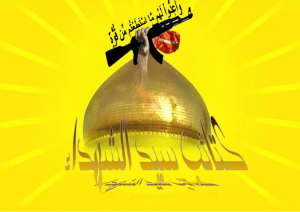
    Hang on a moment, Sayyida Zaynab is the shrine dear to Shiites that Kata’ib Sayyid al-Shuhada is defending, as this graphic suggests:

    And last but not least, consider this, from a US Senator:

    Coincidence!?!? — or just a clumsy creative leap?

    _________________________________________________________________________________________________

    NB: Updated to replace “Hezbollah” with “Kata’ib Sayyid al-Shuhada” above — h/t Phillip Smyth.

    Nukes — and red lines that should not be crossed

    Sunday, April 21st, 2013

    [ by Charles Cameron — just your usual compare and contrast… ]
    .

    I also wanted to see how the DoubleQuotes format might work with one “portrait” and one “Landscape” image juxtaposed.

    Hermit Kingdom of Darkness

    Sunday, April 7th, 2013

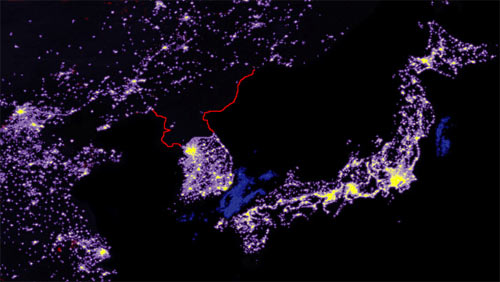
    North Korea’s shopworn game of bluster, threaten, bully, violate international norms and eventually be rewarded with concessions and bribes has stopped working, which is why there now is a crisis. With the suckers (ROK, USA and Japan) refusing to play three card monty and with even  Pyongyang’s confederate China wearying of the scam when they have their own fish to fry, Kim Jong Eunhas few options to save face except to double down on painting himself into a smaller and tighter corner. There are some who would like to play the game of appeasement for a temporary respite but both Seoul and Washington are taking a harder line on North Korean antics.

    One gets the impression that -unofficially, mind you – Beijing would not mind “Fatty the Third” getting a comeuppance that could push him from power and lead to the ascension of a more mature, more reasonable, more seasoned and more Sinicized leader of the Kim dynasty.

    Here is a round up of more intelligently thought out (or at least interesting) articles and posts about the Nut of the North and possible war with North Korea:

    Colonel Dave Maxwell– north Korean Leadership Assessment and The Realist Prism: North Korea Gambles on Strategic Assumptions and U.S. would seek regime change in North Korea if attack occurs

    Colonel Maxwell is an area specialist on the DPRK, these are the “must read” pieces

    Robert Baer –Viewpoint: North Korea’s Gaddafi Nightmare 

    Gordon Chang –Is Kim Jong Un’s Bluster Really a Prelude to Reform?

    Thomas PM Barnett –The Tricky Thing about Kim Jon Eun 

    Patrick Cronin – Tell me How this Starts

    IHT –Detecting Shift, U.S. Makes Case to China on North Korea 

    Let me try my hand at reading the tea leaves. I don’t know that much, relatively speaking, about the “sovietology” of analyzing North Korean nuances which I will leave for experts like Colonel Maxwell to concentrate on other angles. Some points i no particular order:

    • First, any hope of an internal coup against Eun is probably nonexistent. Not only for the the consistent ruthlessness and lavish bribery which the Kim Family regime has treated it’s military, but the fact that coups of this nature have a poor track record in Communist states, even weird ones like the DPRK. From the inception of Communist power in the USSR, Soviet leaders fretted about “Bonapartism” by counterrevolutionary generals on white horses from Kornilov to Tukhachevskii to Zhukov. That these plots were mostly imaginary did not matter and Communist rulers neutralized this threat by binding the military leadership into the Party leadership at a level subordinate to the Politburo and periodically shooting likely upstarts. The political space for successful military coups do not exist in Communist regimes even for the key insiders, just ask Lin Bao. The North Korean military does not have the will to do this except in conjunction with massive Chinese intervention. Perhaps not even then.
    • For all the talk of irrationality, North Korea has been been playing this game as a survival strategy for sixty years and only miscalculated once, with the original invasion of South Korea in 1950 – which only happened, after Kim Il-Sung received the blessing of Stalin and promise of massive support from Mao ZeDong – and it was an unmitigated disaster for North Korea and China. Pointedly, the North has not initiated a war since and their subsequent violent provocations, while infuriating, have been quixotic and weird rather than existential threats that would guarantee a crushing military response.
    • The “win” for the US and ROK here is in frustrating the regime’s grasp for status, however self-deluded, in extorting more material concessions by acting like the international community’s equivalent of a crazy, menacing, homeless person ranting on a street corner. We need to make this charade appear to be a diplomatic sure-fire loser this time in the eyes of Pyongyang’s elite with an endgame where the North emerges empty handed and Eun feels that pressing further risks a greater loss of face. We do this by making moves where the spillover costs of North Korean intransigence and public lunacy drift in China’s direction; a tightly constrained North Korea out of diplomatic and economic options is really Beijing’s problem.
    • The strategic equation for “victory” from the North’s perspective depends heavily upon the reaction of the US and ROK governments to get drawn into tiresome negotiations before the North ceases it’s behavior, something they ultimately cannot control. Washington and Seoul cold hold firm or even (conceivably) take a harder line. If frustrated in their quest for concessions, the regime could exercise several options a) shift gears to a different propaganda campaign to distract internal audience b) engage in an act of terrorism elsewhere in the world, such as against a ROK embassy c) engage in a military demonstration that while provocative, like ballistic missile test, is not a casus belli d) all of the above e) undertake a military strike under the mistaken impression the ROK will not retaliate.

    Comments welcomed.


    Switch to our mobile site