zenpundit.com » russia

Archive for the ‘russia’ Category

Pussy Riot, Holy Foolishness and Monk Punk

Sunday, August 19th, 2012

[ by Charles Cameron — mystery beyond the senses, holy of holies behind the veil, altar beyond the iconostasis, and other considerations bearing on Orthodoxy, Pussy Riot, holy folly and monastic punk ]
.

Life is full of surprises.
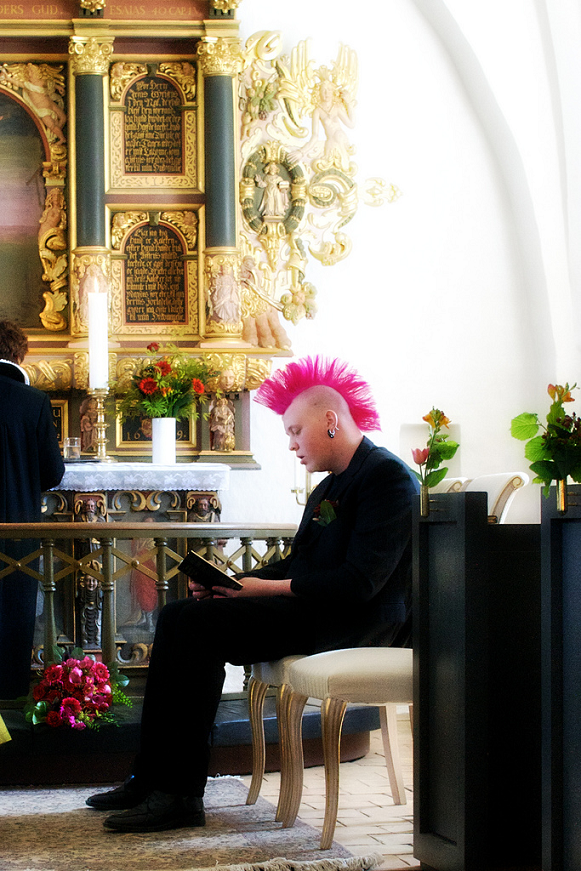
glorious photo credit: choir punk by teosartori under cc license

.

Okay, I started fishing around the web the way I do because when I first ran across the Pussy Riot story, I kept seeing press reports that said the grrls had been protesting on the altar of Christ the Savior Cathedral [Russian Orthodox] in Moscow.

**

What surprised me about this was that the altar in an Orthodox church would be behind the closed doors of the Iconostasis, because what takes place on the altar is too mysterious for us to grasp through the unaided senses.

Aside: there’s a lot of religious “clash of civs” going on in the Pussy Riot affait, so let me untangle some of the interesting threads, and then see where that leads us.

You may recall that when Christ died on the cross outside the City walls, there was a parallel incident inside Jerusalem: “the veil of the temple was rent in twain from the top to the bottom; and the earth did quake, and the rocks rent” [Matt 27.51]. This could, it seems to me, be an involuntary gesture of mourning on the part of the earth and temple — but it also opens the holy of holies..

In very broad strokes then, there are three spaces in Orthodoxy, separated by two doors, and they correspond to three ways of knowing.

    • Outside the church, there’s the realm where the senses and rational mind can be pretty much relied on for the kinds of transactions that humans mostly engage in, food, drink, shelter, exchange of goods…
    • Passing in through the church door we are in a space of devotion, the nave, in which attention is focused on the second doorway, that of the iconostasis, where the icons are presented. Here the mental activity is typically one of prayer, and the icons are available to lead the senses and mind towards that which the mind cannot comprehend.

.
.

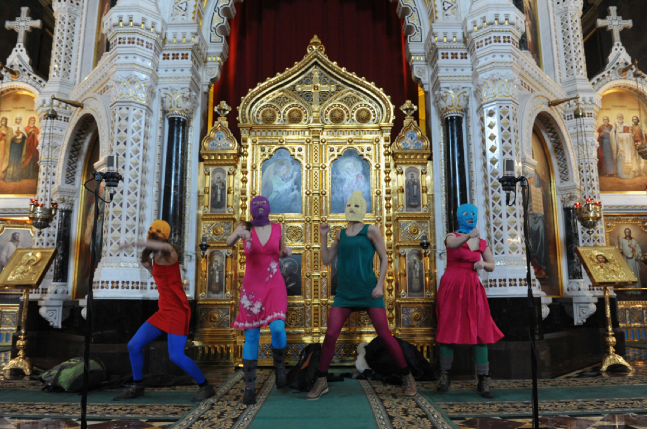
  • And passing, as only the ordained may, through the doors of the iconostasis into the Sanctuary, we enter the space of the altar and the sacramental transformation of the Eucharist — which neither rational mind nor senses can apprehend, and which is accordingly the realm of Mystery properly defined.

The Pussy Riot grrls are clearly dancing (and singing and prostrating and crossing themselves in the video) in front of the doors of the iconostasis — not “on the altar” — a big difference, which I would suggest is comparable in kind to the difference between human prayer and divine revelation.

No, they were not “staging an anti-Kremlin protest on the altar of Moscow’s main cathedral” [Telegraph], nor “performing what they called a ‘punk prayer’ on the altar of Moscow’s Christ the Savior Cathedral” [ABC News].

**

By way of giving you some context, Eurasia Review has the religious politics:

The actions of Pussy Riot inspired indignation on the part of Church leaders and regime officials. Patriarch Kirill called their action a “mockery of a sacred place.” Sergei Lavrov, the Russian foreign minister, said it was “blasphemy.” The women were described as “satanic devils” and “prostitutes” and there were calls for them to be ripped to pieces on the ancient execution site in Red Square.

What was lost in all this was the identification of the Russian Orthodox Church with the Putin regime. Putin’s inauguration was marked by the ringing of church bells in the Kremlin. Kirill held a special prayer service for his “health” and “success in government,” in the Cathedral of the Assumption in the Kremlin. In the Novodevichy Monastery, the nuns sang psalms round the clock for Putin’s health.

And then there was that 2009 London Times article:

The Russian Orthodox Church will choose tomorrow between three alleged former KGB agents as its next spiritual leader.

More than 700 priests, monks and lay representatives will decide who should become the new Patriarch in the first Church election since the collapse of the Soviet Union.

The contest at Christ the Saviour Cathedral in Moscow pits the favourite, Metropolitan Kirill of Smolensk and Kaliningrad, against two rivals who also rose through the heirarchy at a time when the Church was under strict Communist control.

**

Here are the lyrics to the “punk-prayer” Virgin Mary, Put Putin Away that they were singing:

(choir)

Virgin Mary, Mother of God, put Putin away
?ut Putin away, put Putin away

(end chorus)


Black robe, golden epaulettes
All parishioners crawl to bow
The phantom of liberty is in heaven
Gay-pride sent to Siberia in chains

The head of the KGB, their chief saint,
Leads protesters to prison under escort
In order not to offend His Holiness
Women must give birth and love

Shit, shit, the Lord’s shit!

(Chorus)

Virgin Mary, Mother of God, become a feminist
Become a feminist, become a feminist

(end chorus)

The Church’s praise of rotten dictators
The cross-bearer procession of black limousines
A teacher-preacher will meet you at school
Go to class – bring him money!

Patriarch Gundyaev believes in Putin
Bitch, better believe in God instead
The belt of the Virgin can’t replace mass-meetings
Mary, Mother of God, is with us in protest!

(Chorus)

Virgin Mary, Mother of God, put Putin away
?ut Putin away, put Putin away

(end chorus)

Here’s a linguistic comment, which I can neither affirm nor refute, from The Economist:

“The Lord’s Shit!” is a literal translation, while the expression “Sran’ Gospodnya” found in the lyrics is an equivalent of English “holy shit”, which is a totally diferrent matter.

And then there’s this:

But prosecutors sought to downplay the political angle and highlight the blasphemy, overriding the defense’s objections with the help of Syrova’s many “question disallowed!”

“Do you believe it acceptable to say ‘Holy sh*t!’ in the church?” a prosecutor asked a father of one of the defendants in the courtroom.

The man denied it, pointing out Russia’s ancient tradition of skomorokhi – traveling actors afforded the degree of freedom of speech that apparently exceeded that allowed to Pussy Riot. Of course, the skomorokhi sometimes faced burning at the stake, but this was not mentioned at the hearing.

**

Which brings us to the entire issue of holy fools in Orthodoxy…
The holy fools are understood to “feign madness in order to provide the public with spiritual guidance” — but I wonder if that’s a rationalization of behaviors that were simply sane, direct and challenging at the time. Consider this description from the National Catholic Register:

In Russian history the greatest of the “holy fools” was Basil the Blessed, a man so revered that the famous Cathedral in Moscow’s Red Square next to the Kremlin was named in his honor. Basil walked through Moscow wearing nothing more than a long beard. He threw rocks at wealthy people’s houses and stole from dishonest traders in Red Square.

Few doubted Basil’s holiness. Tsar Ivan the Terrible feared no one but Basil. Basil was also given to eating meat on Good Friday. Once he went to Ivan’s palace in the Kremlin and forced the tsar to eat raw meat during the fast saying, “Why abstain from eating meat when you murder men?” Countless Russians died for much less but Ivan was afraid to let any harm come to the saintly Basil.

And the grrls explicitly claimed the Holy Fools inspired their mode of protest:

Nadia said. “We were searching for real sincerity and simplicity, and we found these qualities in the yurodstvo [the holy foolishness] of punk.”

Well, there are similarities, and there are differences. The canonical Holy Fools were presumably orthodox in their beliefs, which the Riot may not be — but on the other hand, they are clearly “speaking truth to power” to use the admirable Quaker phrase.

Folly is a tad under-appreciated these days.

**

On the other hand, maybe it’s demonic possession. From the examination of “altar warden Vasily Tsyganyuk, classified as a victim because he claimed to have suffered psychological trauma as a result of the performance” during the trial:

VICTIM: “Those who are possessed can exhibit different behaviors. They can scream, beat their heads against the floor, jump up and down…”

DEFENSE ATTORNEY NIKOLAI POLOZOV: “Do they dance?”

VICTIM: “Well, no.”

JUDGE: “Stop questioning him about those who are possessed. Tsyganyuk is not a medical professional and is not qualified to render a diagnosis.”

Nah, not possessed — possession would be a medical diagnosis.

**

Hey — the name Pussy Riot is a riot — and riots are not always comfortable.

Who would have imagined the name “Pussy Riot” would appear on the digital tongue of Archbishop Cranmer — who only the other day was chastised for saying that British Olympic athletes had “given the nation a veritable golden shower of success after success” when the kind of golden shower he was thinking of was presumably the kind Zeus showered on Danae.

But the good Archbishop — or at least the conservative Christian blogger who has taken that name — has in fact been vociferous in support of the Pussy Tribe, their name notwithstanding:

This is foolish. If history teaches us anything about the murky fusion of religion and politics – the spiritual with the temporal – it is that you cannot persecute the prophets of truth without multiplying the message and spreading the cult. These women had no bombs or bullets: they are not terrorists, but anarchic artists. The more inflated and preposterous the charges laid against them, the more they are elevated to martyrdom. The longer they rot in prison at the behest of a puffed-up Patriarch, the more that martyrdom becomes a cause.

Pussy Riot have nailed their 95 Theses firmly to the door of the Cathedral of Christ the Saviour. You can’t kill a movement by crucifying the radicals.

That’s theology!

But look, ecclesial nomenclature can be ambiguous in its own right. The original Archbishop Cranmer was a Puritan divine, and Richard Hooker the latitudinarian divine who wrote the classic Of the Lawes of Ecclesiastical Politie.

I think we can be safely if secretly amused that one of Cranmer’s respondents in the Pussy matter has chosen the online moniker “The Judicious Hooker”. In fact he’s the one who posted:

I realise that YG was rather plain in the chancel department (praise God for the Laudian revival!) but the ‘prisoners of conscience’ were not dancing on the altar. The Orthodox Holy Table lies behind the iconostasis screen and access is confined to sacred ministers.

The Orthodox – of all Christians – still maintain the sense of the sacred. The Cathedral’s iconostasis – where icons of our Lord and his Saints are displayed for veneration – looks rather impregnable and its doors firmly shut against profanation.

But I digress, I contain multitudes, I know.

**

One of the more interesting blogs I’ve run across discussing the Putin Pussy event has been Khanya — here’s a taste:

Is there an Orthodox culture, and does it have anything to say about this?

Yes, I believe there is an Orthodox culture, and it is well expressed in one of the hymns we sing repeatedly in the Paschal season.

Let God arise, let his enemies be scattered
Let those who hate him flee from before his face.

Does that apply to Pussy Riot?

Yes, I believe it does.

But you have to come to the end of the hymn to see how it applies.

This is the day of resurrection.
Let us be illumined by the feast.
Let us embrace each other.
Let us call “Brothers” even those that hate us, and forgive all by the resurrection, and so let us cry:
Christ is risen from the dead
Trampling down death by death
And upon those in the tombs bestowing life.

So what do we call the members of Pussy Riot?

Sisters.

And what do we do with them?

Embrace them, forgive them by the resurrection and tell them that God loves them and we love them too.

That’s Orthodox culture.

**

Another insightful blog has been Registan, where Sarah Kendzior came at things from a different angle:

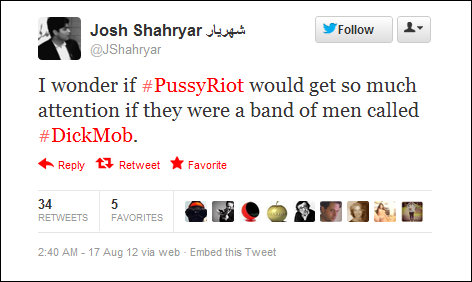
Media outlets that regularly cover Russian politics have noted how male Russian dissidents have been ignored as Pussy Riot draws world sympathy.
.

.
Removing Pussy Riot from the broader problem of political persecution in Russia is a mistake, but the case also raises specific questions about gender, media and politics.

In the same week that Pussy Riot was profiled in the New York Times style section, the Boston Review republished a 2010 interview with Hillary Clinton, in which she was asked who her favorite designer was. “Would you ever ask a man that question?” she snapped. “Probably not, probably not,” the reporter replied. The American media embraced Clinton’s riposte, reprinting it widely. But when it comes to foreign female dissidents, they promote the values Clinton rejects.
**

Meanwhile — and I mean meanwhile, since this has nothing directly to do with Pussy Riot, and a great deal to do with them in indirect ways — in my own beloved California:

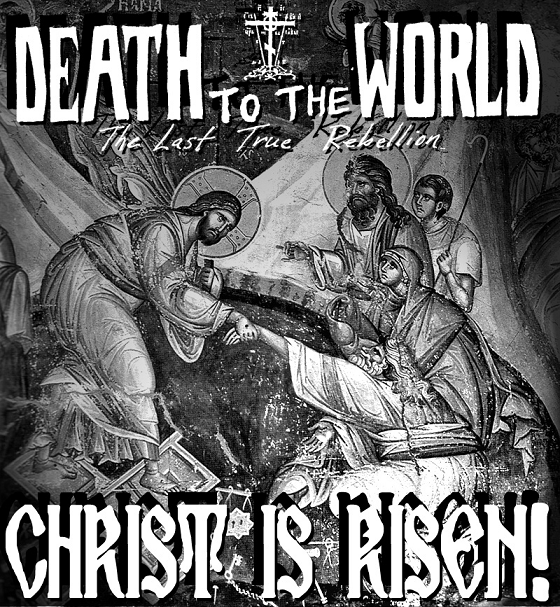
In the wilderness of Northern California, Monks John and Damascene searched in hopes of finding a way to reach out to the Punk scene, which John had escaped. Seeing that the scene was full of kids that were sick of themselves and crippled by nihilism and despair, the Monks set out to give them the same hope that they found in Ancient Christianity. To do this, they decided to submit an article about Father Seraphim Rose in the popular magazine, Maximum Rock and Roll.

When Father Damascene read over the magazine, he knew that they would never publish something like it. Struggling to show truth to the darkened subcultures, they tried again, but this time only placing an ad for Saint Hermans Brotherhood. They got a response from the editor, saying “What the @#*% is a Brotherhood?” and the Monks were told “We only run ads for music and ‘zines*.” A light bulb went on and thus, Death to the World was born.

The first issue was printed in the December of ’94 featuring a Monk holding a skull on cover. The hand-drawn bold letters across the top read “DEATH TO THE WORLD, The Last True Rebellion” and the back cover held the caption: “they hated me without a cause.” …
.


.

The first issue, decorated with ancient icons and lives of martyrs inside, was advertised in Maximum Rock and Roll and brought letters from all around the world. People from Japan, Lithuania, and Ireland wanted to get their hands on this new radical magazine. The mailing list grew and grew and the ‘zine was distributed at punks shows and underground hangouts. It was photocopied and passed around by hundreds who wanted to read about the radical lives of the lovers of truth and the mystery of monasticism. It was estimated that at one time, there were 50,000 in circulation.

Father Paisius, who is a Monk at the monastery, said, “This subculture is raucous and deeply disturbed because of their own pain. They see life as worthless. We want to show them an ideal that is worth their life. These are marginalized youth who are wounded, and Death to the World is meant to touch with a healing hand that wound.”

Writing and putting together issues 1-12, the Monks lived in the forests of Northern California in the midst of deer, bears, mountain lions, and rattlesnakes, translating and publishing wisdom from the holy fathers and mothers of ages past. The Monks and friends of the monastery also went to rock concerts and festivals, distributing Death to the World ‘zines and t-shirts, together with icons and other books that the monastery published. The Monks did not put out any issues after issue 12, but they continued to share and hand out back orders of Death to the World.
**

That may be where the guy up there in the choir with the shocking pink mohawk comes in.

Some New Old Books

Saturday, July 28th, 2012


Arakcheev: grand vizier of the Russian Empire by Michael Jenkins

Time Of Stalin, The: Portrait Of A Tyranny by Anton Antonov-Ovseenko

I just returned from a short vacation in Door County and was able to squeeze in some time to browse some of their independent and used bookstores. One in Ellison Bay had an unusually good Russian and Soviet collection and I picked up a few titles. Naturally, it would have been even cheaper on Amazon, but the used and rare bookstore is an experience for a serious reader, not just a transaction. Supporting their existence and preserving the tacit knowledge about books, authors and publishers of that niche market is worth a few extra dollars.

Count Alexei Andreievich Arakcheev was a somewhat terrifying figure from early 19th century Tsarist Russia whose career came to personify the out-of-control military authoritarianism nurtured by “the Gatchina system”. Gatchina was the princely estate of the Tsarevitch under Catherine the Great and it was here that military culture was first imported from Prussia and took root in Imperial Russia. While this had the beneficial effect of stimulating modernizing advances in Russian artillery, the Gatchina system also inculcated a zealous love of  “paradomania” in the Tsars and their army officers who served there – a fetish for obsessive detail in the minutia of barracks square drill, the ritualistic mummery of military insignia and a sadistic excess of harsh disciplinary measures for discipline’s sake.

Arakcheev, a parvenu who climbed into the ranks of the aristocracy through the Petrine state service nobility, embodied both aspects of the Gatchina system and combined it with the fanaticism of a totalitarian bureaucrat. He was loathed by the powerful families of  high boyar-descended nobility, but Arakcheev’s dog-like loyalty to the mad Emperor Paul I and the quixotic Tsar Alexander I made Arakcheev an invaluable figure who was part fixer, part chief of staff, friend and confidant to the supreme Autocrat.

I had not expected that Arakcheev would have a biography in English and skimming this one tells me that Jenkins is writing from an overly sympathetic POV for a historical figure who really merits very little empathy. While no Beria or Himmler and a more than competent artillery general and military reformer, Arakcheev was an intolerant man of violent temper, given to casually arbitrary brutalities that were shocking even by the standards of  Tsarist Russia. He presided over a disastrous experiment in agrarian military socialism that foreshadowed Soviet collective farms that intruded into the most intimate aspects of the lives of peasants and soldiers alike and combined all the disadvantages of serfdom with military service.

Anton Antonov-Ovseenko is the son of an Old Bolshevik executed by Stalin during the Great Terror, Vladimir Antonov-Ovseenko, and a former inmate of Stalin’s Gulag himself. Given that his father had been an ally of Trotskii and Tukhachevskii, it is something of a minor miracle that the author survived to write a denunciation of his family’s great tormentor. Many other Soviet citizens of his generation, with tangential or purely imaginary connections to Stalin’s enemies vanished without a trace, unlettered and unremembered.

Despite being a professional historian, Antonov-Ovseenko’s The Time of Stalin belongs grouped with the dissident/defector literature of the likes of Kravchenko, Solzhenitsyn, Penkovskii, Amalrik, Kalugin, Chambers, Djilas, Pacepa, Voslenskii and many others. This book is less a work of objective history than an impassioned testimony of an eyewitness to horrific crimes or a memoir. Even from a casual thumbing through, one can see that there are valuable nuggets here but a critical eye is required of the reader. Stalin is admittedly one of the greatest monsters in all history but he was not superman, but a conductor of an orchestra of repression and democide.

Many hands lent themselves, often eagerly and more often fearfully, to carrying out Stalin’s will.

Putin and Syria: Siloviki Realism in Geopolitical Strategy

Thursday, July 12th, 2012


Russian President Vladimir Putin made a foreign policy speech to Russia’s ambassadors and Foreign Ministry officials that is very much worth reading in context of his dispatch to Syria of a fleet of warships, including a battleship, to the modest Russian naval base in Tartus. Under Putin’s hand, Russian support for the bloody regime of Bashar Assad has consistently been more about safeguarding and expanding Russia’s strategic place in world than about Syria:

….We are forced to admit that no reliable solution for overcoming the global economic crisis has been found yet. Indeed, the prospects are looking more and more worrying. The debt problems in the Eurozone and its slide towards recession are just the tip of the iceberg as far as the global economy’s unresolved structural problems go. The traditional powerhouses of global development – the USA, the EU, and Japan – are seeing their leadership erode, but the absence of new development models is putting a brake on global growth. There is increasing competition for access to resources, and this provokes abnormal fluctuations on the raw materials and energy markets. The traditional Western economic powers are being weakened by the crisis, which has exacerbated social and economic problems in the developed economies, and by the multi-vector nature of global development today. We can already see this for a fact now. 

Colleagues, this is no cause for joy. We should not take delight in this turn of events, and much less feel malicious glee. On the contrary, we cannot but worry over these developments, because the consequences of these tectonic shifts in the global economy are not yet clear, nor are the inevitable shifts in the international balance of power and in global policy that will follow. 

We are all the more worried when we see attempts by some actors in international relations to maintain their traditional influence, often by resorting to unilateral action that runs counter to the principles of international law. We see evidence of this in so-called ‘humanitarian operations’, the export of bomb and missile diplomacy, and intervention in internal conflicts.

We see how contradictory and unbalanced the reform process is in North Africa and the Middle East, and I am sure that many of you still have the tragic events in Libya before your eyes. We cannot allow a repeat of such scenarios in other countries, in Syria, for example. I believe that we must do everything possible to press the parties in this conflict into negotiating a peaceful political solution to all issues of dispute. We must do all we can to facilitate such a dialogue. Of course this is a more complex and subtle undertaking than intervention using brute force from outside, but only this process can guarantee a lasting settlement and future stable development in the region, and in Syria’s case, in the country itself….

It would be harder for Putin to have been more clear about what his priorities were, or that for Russia, R2P as a doctrine has no standing whatsoever in international law [ incidentally, he’s correct on that point] and Syria is not going to be allowed to go the way of Libya, if the Kremlin can prevent it.

Generally, the media reported this speech, highly misleadingly, as Putin’s prediction of “Western decline” when the message was Russia’s opposition to Western military intervention in Syria to remove Assad from power. Putin neither overestimates the means at Russia’s disposal to accomplish his limited objective (blocking intervention) nor inflates his objective to an unrealizable, vaguely defined, abstraction.

Contrast, with the speech on Syria made recently by SECSTATE Hillary Clinton. Here is a snippet that gives the tenor of her remarks:

….What was accomplished in Geneva by the action group was, for the very first time, to enlist not only all five permanent members of the Security Council including Russia and China, but also important leaders in the region and in the Arab League in support of such a transition. The issue now is to determine how best to put into action what was accomplished there and is continuing here. And I really hope everyone reads the communique from Geneva, because for example, one of the earlier speakers from Syria expressed concern there was nothing about political prisoners. Well, indeed there is. And a call for the release from detention. So it would be very helpful to get everybody on the same page if we’re going to work together about what we have already done and what we need to be doing as we move forward.

Under the Geneva communique, the opposition is for the first time put on an even basis with the government. They are given equal power in constituting the transition governing entity that will have, as we just heard, full executive authority. That could not have been imagined three months ago, let alone a year ago.

So although none of us here is satisfied or comfortable with what is still going on inside of Syria, because it is against every norm of international law and human decency for a government to be murdering its own people, there has been in the last several months, starting in Tunisia, a steady, inexorable march toward ending this regime. What we need to do is to follow through on what each of us can contribute to the end of the Assad regime and the beginning of a new day for Syria. 

….Now what can every nation and group represented here do? I ask you to reach out to Russia and China and to not only urge, but demand that they get off the sidelines and begin to support the legitimate aspirations of the Syrian people. It is frankly not enough just to come to the Friends of the Syrian People, because I will tell you very frankly, I don’t think Russia and China believe they are paying any price at all – nothing at all – for standing up on behalf of the Assad regime. The only way that will change is if every nation represented here directly and urgently makes it clear that Russia and China will pay a price, because they are holding up progress – blockading it – that is no longer tolerable. 

First of all, the Secretary of State needs a more effective speechwriter. Period.

Secondly, there is a substantive problem here with an obsession with the minutia of process, possibly because the legal principle behind American policy on Syria is a novelty of intellectuals and is not accepted by two veto-wielding great powers that sit on the UN Security Council. Moreover this focus on minutia of process obstructs clear thinking in regard to the larger geopolitical picture and the ways to get to the end in mind – the removal of Assad’s regime – or the consequences for opposing American policy. Russia and China are told their continued support for the Assad regime, which they see as being in their own interests, is “intolerable” – an outburst of unseemly frustration as we have no stick and strangely offer no carrots for these states to change their positions. Instead we choose to moralize  in public, a diplomatic technique with a long pedigree of failure.

The comparison of statecraft between Russia and the United States is unflattering. Russia has vastly fewer cards to play, but because  Putin has grounded his policy in a siloviki assessment the realities of power, has limited his objectives to those within Russia’s means and related those to the larger diplomatic context that would appeal to other powers, he has played those cards well. Moreover, Putin has positioned Russia to be an indispensable party in a peaceful resolution of the conflict in Syria at very little cost, as Secretary Clinton herself has admitted and capped it off with a naval show of force in the eastern Mediterranean.

We, who have a wealth of resources to employ, have squandered them ineffectively and navigate the ship of state with our heads in the clouds. We forced a vote in the UNSC on Syria, ignoring all signals that the end result would be failure. Syria shoots down a Turkish warplane intruding in it’s airspace (likely at our request) and we had no plan to capitalize on the incident. We gratuitously leak information or disinformation about covert operations that serves more to make us look amateurish than to intimidate our opponents. We do not even appear to be well-informed about the Syrian opposition we are aiding inside Syria, as opposed to expatriate organizations. Some of the fighters in the opposition are as morally objectionable as Assad’s militia thugs and secret police killers.

We play at tactical geopolitics while the Russians do strategy.

Byzantium, Constantinople, Istanbul

Sunday, July 8th, 2012

[ by Charles Cameron — different styles of online communication, main topic: Istanbul in three Islamic videos ]
.

There’s passionate and visceral communication, and there’s communication that’s more scholarly, dispassionate and calm. Let’s begin and end with calm.

**

Visceral communication is essential for getting people out of a theater on fire, but a 30% application of scholarly distance and calm may be prerequisite for avoiding panic — and scholarly communication may be important for conveying in detail the high-dimensionality of a complex topic, but a drop of visceral may ease the salient points into more general circulation.

In an earlier, text heavy post — Damascus, Dearborn, Rome, Vienna? — I belabored you with details as to just how much ambiguity and fog surrounds the use of place names in scriptural and prophetic contexts. Here I’d like to give you a visceral sense of what some prophetic voices are doing with those place names.

One of the easiest ways to move from scholarly to visceral is to switch from text quotation to video clip, so that’s what I’ll do here — but my first video clip will be relatively calm and scholarly as video clips go, the next one more visceral and exhortatory, while the third and final clip will use all the tricks of the feature movie trade to provide a Tolkien-heroic account of the Muslim siege and taking of then-Christian Constantinople in 1453.

**

First, a very short clip from Adnan Oktar, aka Harun Yahya, widely known in the Islamic world for his lavishly illustrated books, CDs and DVDs presenting an Islamic version of creationism, the Mahdist end times — which he sees as entirely peaceable — and more besides.

In this clip, he’s talking about Istanbul, and he means that very city, even if it has sometimes been called Byzantium or Constantinople — or even on occasion, Rome.
.

**

My second clip is far longer, and presents an interview with Sheikh Imran Nazar Hosein, Islamic scholar, sometime Trinidadian diplomat and sometimes fiery YouTube preacher, whom I have quoted previously in Al-Awlaki and the former and latter rains and elsewhere.

Hosein discusses the prophecies of the conquest of Constantinople by Muslim forces as part of the background for a grand sweep overview of what he terms the first and second Arab Springs — which he locates a century apart and views as both engineered by an Anglo-American alliance to advance a Zionist agenda — and contemporary events in Bahrain, Saudi, Syria, Iran, Israel, and Russia:
.

.

It’s an hour-long interview, perhaps you didn’t watch the whole way through. Hosein concludes this interview, centered in Islamic prophecy about Constantinople, with a Saudi-American alliance facing off against an Iranian-Russian alliance in service to very long term Zionist interests, making the video a window not only on the Sheikh’s own worldview but also on how widely perceptions of the world situation can diverge:

I want the viewing audience to know that a situation is evolving in the world before our eyes, and we must understand it, that the two major powers in the world are now moving in a collision course, that collision course between these two major powers, the American-led alliance and the Russian-led alliance, is going to lead to nuclear warfare of such a magnitude that there is only one word that we can look for in the vocabulary to fit it, and that’s called Armageddon, that is, millions and millions and millions are going to die, most of them probably in North America and Europe, Europe of the East and Europe of the West — and what is left of the world after that, the Zionists hope that they can cope with it, and they can somehow survive and come out on top and Israel will rule the world, the rump that is left after the two giants engage in a war of mutual destruction, That is what we are facing now…

Is that what you thought scholarly Islamists were thinking? By what paths did a highly educated and world traveled man come to that conclusion?

**

My third clip speaks for itself. It is a trailer for an upcoming motion picture about the siege of Constantinople, presented as heroic spectacle with improbable but striking feats of arms, beautiful but not excessively modestly dressed women, obligatory mass choruses of Allahu Akbar, and at least one reference to the Antichrist.
.

.

I can’t wait to see it — but I expect to do so with mixed emotions. Perhaps they will stir up a decent blog post or two.

What emotions will they stir in those who identify with the heroic Mehmet II, and how much of an echo will those emotions find in the world around us? Long shot — any Turkey-NATO impact?

**

To return to a calmer clime:


.

Byzantium, Constantinople, Istanbul. I have prayed in the Sultan Ahmed — click image above to glimpse its beauty — I have relaxed deliciously at a nearby hammam.

The history of Istanbul could be the rich study of many lifetimes, its promise — for better or worse or a little of both — may have been variously prophesied or predicted, but remains to be seen.

The Russians are Not Coming….Nor are they Going Away

Monday, June 25th, 2012

Now that Vladimir Putin has resumed the Presidency of Russia, it merits looking at the defense discussion that appeared under his name in Rossiiskaya Gazeta. Virtually everyone agrees that the condition of the Russian Army is parlous and that Putin’s program of difficult military reform to transform the Russian military from a conscripted army to a modernized professional force has not borne fruit. Therefore it is interesting to look at how Putin’s regime articulates it’s defense challenges with a mixture of bravado and brutal strategic realism we would never hear from an American politician.

Excerpts of the article are in bold while my commentary is in normal text.

 Being Strong 

…..The world is changing, and the transformations underway could hide various risks, often unpredictable risks. In a world of economic and other upheaval, there is always the temptation to resolve one’s problems at another’s expense, through pressure and force. It is no surprise that some are calling for resources of global significance to be freed from the exclusive sovereignty of a single nation, and that this issue will soon be raised as a “matter-of-course.”

There will be no possibility of this, even a hypothetical one, with respect to Russia. In other words, we should not tempt anyone by allowing ourselves to be weak. 

While some of this is boilerplate, it does demonstrate Putin’s astute view of Western elite noises about “global governance” as an effort to erode historic Westphalian legal norms of sovereignty for a self-aggrandizing reasons.

I am including paragraphs here from different parts of the paper where President Putin deals with nuclear weapons, though the first one continues from where the last excerpt left off.:

It is for this reason that we will under no circumstances surrender our strategic deterrent capability, and indeed, will in fact strengthen it. It was this strength that enabled us to maintain our national sovereignty during the extremely difficult 1990s, when, lets’ be frank, we did not have anything else to argue with.

….I remember in 2002 when the Chief of the General Staff proposed liquidating a base for strategic ballistic missile submarines on the Kamchatka Peninsula. Understandably, this proposal was motivated by dire circumstances. This would have deprived Russia of its naval presence in the Pacific Ocean. I decided against this. Due to the lack of the required budgetary funding, we had to ask private companies for help. I would like to thank them for that. Both Surgutneftegaz and TNK stepped up to provide the required funding for the base’s initial reconstruction. Budgetary allocations were later disbursed. Today, we have a modern base in Vilyuchinsk where next-generation Borei class submarines will soon be deployed.

….We have greatly increased the capabilities of our early missile warning system. Tracking stations have been launched in the Leningrad and Kaliningrad Regions and in Armavir, and a similar facility is undergoing tests in Irkutsk. All aerospace defence brigades have been equipped with the Universal-1S automation systems, and the Glonass satellite group has been deployed.

The land, sea and air components of our Strategic Nuclear Forces are reliable and sufficient. The proportion of modern land-based missile systems has grown from 13% to 25% over the past four years. The rearmament of 10 missile regiments with the Topol-M and Yars strategic missile systems will be continued.  Long-range aviation will maintain the fleet of strategic Tu-160 and Tu-95MS bombers; work is underway to modernise them. They will be equipped with a new long-range cruise missile system. Russia’s strategic aviation resumed combat patrols in their zone of responsibility in 2007. A new aircraft is being designed for strategic long-range aviation.

New-generation Borei class strategic submarines are being put on combat duty. These include the Yury Dolgoruky and Alexander Nevsky which are undergoing state trials.

….In the coming decade, Russian armed forces will be provided with over 400 modern land and sea-based inter-continental ballistic missiles, 8 strategic ballistic missile submarines…. 

This does not sound  like Putin puts much stock in his predecessor’s endorsement of Global Zero or President Obama’s goal of eliminating nuclear weapons. Or that a drastic unilateral American cut in nuclear weapons proposed by Global Zero to “break the triad” contemplated by the Obama administration would be reciprocated by Russia. Or any other nuclear power state.

Given that Pakistan, India, North Korea, Israel and China are reportedly increasing and improving their nuclear arsenals, it begs the question of whether the Obama or the Putin administrations have the most realistic view about nuclear weapons and their currency in international relations. Or what the Obama administration would use as bargaining chips to negotiate reductions in foreign nuclear arsenals after making gratuitously slashing unilateral cuts. And if the paper was not clear enough, Putin was more blunt about the strategic situation two days ago:

“With regard to further steps in the sphere of nuclear weapons, these further steps should be of a complex character, and this time all the nuclear powers should be involved in this process. We cannot disarm indefinitely while some other nuclear powers are building up their arsenal. It is out of the question!” 

On the subject of Russia’s land forces:

….There are no undermanned units in the Russian armed forces any more. The Army has over 100 combined and special brigades. These are full-scale military units with the requisite personnel and equipment. Their alert reaction time is one hour and they can be deployed to a potential theatre of war within 24 hours.

In the past, it took up to five days to prepare for combat readiness. The deployment and equipment of all the armed forces to wartime conditions could take nearly a year, even though most armed conflicts now last from a few hours to several days.

Why have we chosen the brigade as the main tactical unit? First of all, we have relied on our own experience in the Afghan and other wars, where mobile combat and assault groups reinforced with air and other support units have proved  more efficient than regiments and divisions.

The new brigades are smaller than divisions in the number of personnel but have a bigger strike capability, better firepower and support, including artillery, air defence, reconnaissance, communications, and so on. Brigades can operate both autonomously and jointly with other units. I admit that the quality is not perfect in all instances. We need to achieve the required standards in the near future. 

A Russian Army brigade numbers slightly over 4000 soldiers (vs. 3000-5000 in American and NATO militaries) and moving to a brigade structure is intended to make the Russian Army more versatile, flexible, deployable and mobile. The US essentially did the same thing with the “modularity” reforms for a brigade team force structure. However, I find it dubious that the Russian version is anything other than an aspirational work in progress or that Russia today could muster a force remotely approaching 100 combat brigades on short notice or keep them in the field for more than thirty days.

The old Soviet Red Army in the 80’s at the peak of it’s power was a military long on officers and critically deficient in NCOs  and the 90’s cratered the main force quality of what remained of the Soviet armies. Russia will not have a deployable fighting army for anything other than brief Georgia type raids and SPETSNAZ operations until it builds a proportionate NCO corps and modernized logistical support system.

On future war and it’s strategic context:

….The probability of a global war between nuclear powers is not high, because that would mean the end of civilisation. As long as the “powder” of our strategic nuclear forces created by the tremendous efforts of our fathers and grandfathers remains dry, nobody will dare launch a large-scale aggression against us.

However, it should be borne in mind that technological progress in many varied areas, from new models of weaponry and military hardware to information and communications technology, has dramatically changed the nature of armed conflicts. Thus, as high-precision long-range conventional weapons become increasingly common, they will tend to become the means of achieving a decisive victory over an opponent, including in a global conflict.

The military capability of a country in space or information countermeasures, especially in cyberspace, will play a great, if not decisive, role in determining the nature of an armed conflict. In the more distant future, weapons systems based on new principles (beam, geophysical, wave, genetic, psychophysical and other technology) will be developed. All this will, in addition to nuclear weapons, provide entirely new instruments for achieving political and strategic goals. Such hi-tech weapons systems will be comparable in effect to nuclear weapons but will be more “acceptable” in terms of political and military ideology. In this sense, the strategic balance of nuclear forces will play a gradually diminishing role in deterring aggression and chaos.

We see ever new regional and local wars breaking out in the world. We continue to see new areas of instability and deliberately managed chaos. There also are purposeful attempts to provoke such conflicts even within the direct proximity of Russia’s and its allies’ borders.

The basic principles of international law are being degraded and eroded, especially in terms of international security. 

Here we see much of the same keen interest Western military experts have had in RMA/”transformation” but more as new domains in which to fight or weapons to fight with, but Putin’s assumptions about the roots of international conflict remain exceedingly traditional in Clausewitzian and Machiavellian realpolitik senses. There’s no idea here that war’s political nature is being transformed by technological advances or even that breakdowns in order in other nations flow primarily from indigenous social forces  than from strategic conspiracies and manipulations of foreign powers hell-bent on humiliating Russia.

This is a worldview of cynical realism salted with nationalism and a paranoia induced by the lessons of centuries of Russian history. International relations, it follows, hinge primarily on power in all it’s manifestations, a few rules that separate the law of nations from the law of the jungle and that states exert power to accomplish rational strategic objectives. Furthermore, in an echo of Tsarist Russia’s last modernizer, Petr Stolypin, what Putin has put forth as a political program for his domestic audience (sincere or not) is “a great Russia”.

The good news is that President Putin is, unlike his Soviet predecessors, is uninterested in grand ideological crusades that would destabilize the world order and that Russia currently would be incapable of carrying any out. The bad news is that Putin is a shrewd strategic thinker, one who views the US as a long-term adversary of Russia and one who is likely to be highly antagonized and partially misread (and thus miscalculate)  the tactical geopolitics of intervention pursued by America’s R2P moralizers.

From Putin’s perspective, we are currently crusaders rather than deal-cutters grounded in reality. America does not need to appease other power,s but we’d further our own interests faster if we spent a little time looking at the world through the eyes of others

Hat tip to Lexington Green


Switch to our mobile site