zenpundit.com » sunday surprise

Archive for the ‘sunday surprise’ Category

Sunday surprise: Bach BWV 998

Sunday, July 17th, 2016

[ by Charles Cameron — with a ramble via his peerless peer, Shakespeare ]
.

What’s a piece of music worth, on paper?
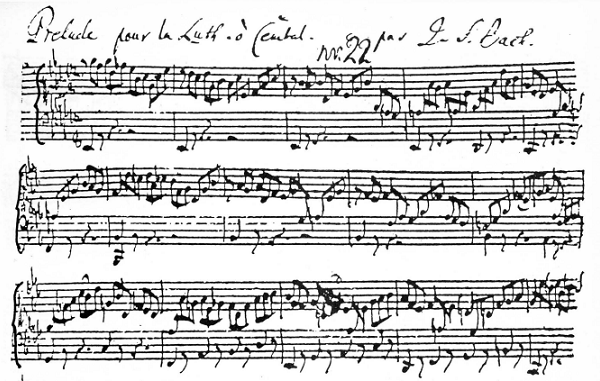
BWV 998 MS image

**

I had the good fortune some decades ago to be invited to attent Dr Homer Swander‘s seminar at the Oregon Shakespeare Festival in Ashland. Dr Swander is notable among Shakespearean scholars for his insistence that the texts we have of the plays are not themselves works of art, but serve the same function with respect to actual performances that an anrchitect’s blueprints serve with respect to a house, or a musical score to the performance of a work of music. Dr Swander dedicated much of his life to Shakespeare‘s plays, so we should not imagine that he thought little of the First Folio — or indeed of the First Quarto of Hamlet with its truncated soliloqy beginning:

To be or not to be, ay there’s the point,
To die, to sleep, is that all? Ay all:

[for the original spelling, see this facsimile ©The British Library]

— it’s simply that he saw them as prelimiaries, not the thing itself. This in turn allowed him to “see” aspects of the plays from a director’s standpoint, with intriguing results:

Swander Caesar
Hugh Macrae Richmond, Shakespeare’s Theatre: A Dictionary of His Stage Context
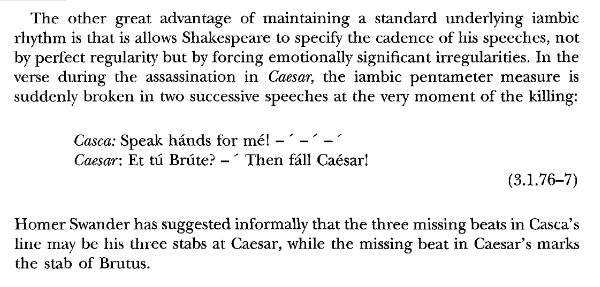
You should have seen Dr Swander stab that point home!

But to return to Johann Sebastian Bach.. Similarly, we may ask ourselves, what’s the manuscript score of a great work of music worth?

**

Christie’s auction house in London has one answer for us in ther case of Bach’s Prelude, Fugue, and Allegro in E-flat major, BWV 998 — $3.3 million:

Valuable Bach manuscript goes under the hammer

The manuscript’s value was originally estimated at between 1.5 and 2.5 million pounds (between 2 and 3.3 million dollars). At the auction on Wednesday (13.07.2016) in London, the final bid came in at the high end of expectations.

Likely written between 1740 and 1745, the Prelude, Fugue and Allegro in E-flat Major (BWV 998) is a favorite among both harpsichords and lutenists. Like many works by Johann Sebastian Bach (1685-1750), it can be played on different instruments, which is expressly indicated on this score in the composer’s handwriting: “Prelude pour la Luth ò Cembal” (for lute or keyboard).

That’s its current cash value as judged by the market.

**

But what’s it worth — to you, to me, to life?

Nicholas Harnoncourt
explains:

**

I am grateful as always to my friend Michael Robinson of Ornamental Peasant for pointing me to the sale at Christie’s — and to this remarkable piece.
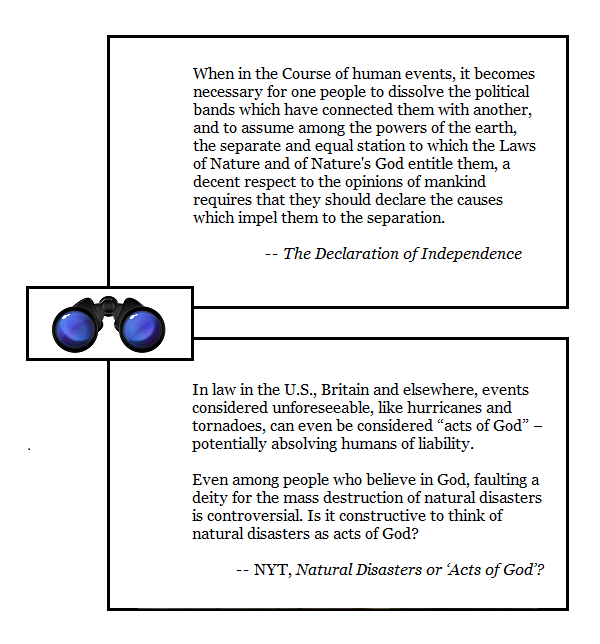
Sunday surprise the second — the Laws of Nature and Nature’s God

Sunday, July 3rd, 2016

[ by Charles Cameron — wishing you all blessings on the Fourth ]
.

My eye was caught today by yet another disaster — which in turn reminded me of tomorrow, the Fourth of July. It’s just one example among many:

— but it brings up again the question of whether we think in terms of “acts of God” or “laws of Nature” or — somehow — both. And that’s where thw roding of the Constitution comes in, with the phrase “the Laws of Nature and of Nature’s God”:

Nature and Nature's God DQ

**

If I used that phrasing — “the Laws of Nature and of Nature’s God” — today, I might well be attempting to please or at least placate readers who variously:

  • believe in a God separate from and superior to Nature, and author of Nature’s laws
  • believe in a God essentially indistinguishable from Nature, wholly immanent, &
  • disbelieve in any kind of God, but recognize Nature as a catchall term for the Whole System.
  • I don’t suppose that would necessarily be the case in 1776, though, and wonder whether the phrase should be read as:

    the Laws — of Nature and of Nature’s God

    or:

    the Laws of Nature — and of Nature’s God

    and if the second, whether the and marks a distinction between Nature and nature’s God, or also covers the possibility of their being one and the same.

    And once we’ve cleared that up, and bearing in mind that John Donne could write “At the round earth’s imagin’d corners” — thus conflating the old, imaginative, square earth with the new, scientific, spherical one — how feasible do you think it is to hold simultaneously the idea that a given earthquake, hurricane, tsunami or volcanic eruption is an act of God and a natural disaster?

    A worldview paradox?

    **
    Sources:

  • July 4, 1776, The unanimous Declaration of the thirteen united States of America
  • November 18, 2013, Room for Debate: Natural Disasters or ‘Acts of God’?
  • Sunday surprise the first — neat tweets from KarlreMarks

    Sunday, July 3rd, 2016

    [ by Charles Cameron — Brexit, graphical thinking, serpents — there’s never a dull moment with Karl Sharro on Twitter! ]
    .

    Karl Sharro is reMarkable and indeed reTweetable:

    **

    An hour or so before I saw that tweet from Sharro, I’d tweeted a quote from Suzanne Langer:

    I was quoting Langer’s Philosophy in a New Key — hat-tip: Steven H. Cullinane:

    Visual forms— lines, colors, proportions, etc.— are just as capable of articulation, i.e. of complex combination, as words. But the laws that govern this sort of articulation are altogether different from the laws of syntax that govern language. The most radical difference is that visual forms are not discursive. They do not present their constituents successively, but simultaneously, so the relations determining a visual structure are grasped in one act of vision.”

    I think that’s generally right, and goes some way to explaining why “reading” a HipBone Game is cognitively different, even when the game is played entirely in verbal moves, from an equivalent reading of the same “move” tests in sequence.

    I noted Sharro’s visual example — worth clicking all the way through to see it full scale — because although it’s a visual representation of a cluster of texts, it follows a timeline from left to right, and is thus simultaneously sequential and synchronic. A neat trick.

    BTW, Sharro is celebrated for an earlier diagram I’ve posted here — with glee, and with his amazing purely textual equivalent!

    **

    OK so now my focal length is just right for KarlreMarks Twitter feed, and I find this beauty — also about Brexit — too:

    What’s so neat here? Well, it appears to be a paradox of self-reference — ourobouros, a serpent biting its own tail if you like — and it’s very nicely done. The “large numbers of people” gathered in London, of course, aren’t the “large numbers of people” they say shouldn’t be heard, and if Sharro had tweeted —

    Large numbers of people gather in London to demand that large numbers of other people shouldn’t be heard”

    — the paradox would have been gone, the serpent biting its own tail morphed into a serpent biting another serpent — a far less interesting spectacle.

    Or would it? At the level of particular crowds, yes, the paradox would vanish, one crowd biting another, but at the level of implied principle, a crowd voicing the denial of the principle that the voices of crowds deserve a hearing would still be self-refuting in just the way Sharro plays on.

    So the paradox would be like Schrodinger’s cat, dead while alive — or even better, the Cheshire Cat, niow here now gone, perhaps?

    **

    Life, she is rich in paradox.

    Sunday surprise: Synchronize watches!

    Sunday, June 26th, 2016

    [ by Charles Cameron — from science and religion, two prime resources for scenario planners ]
    .

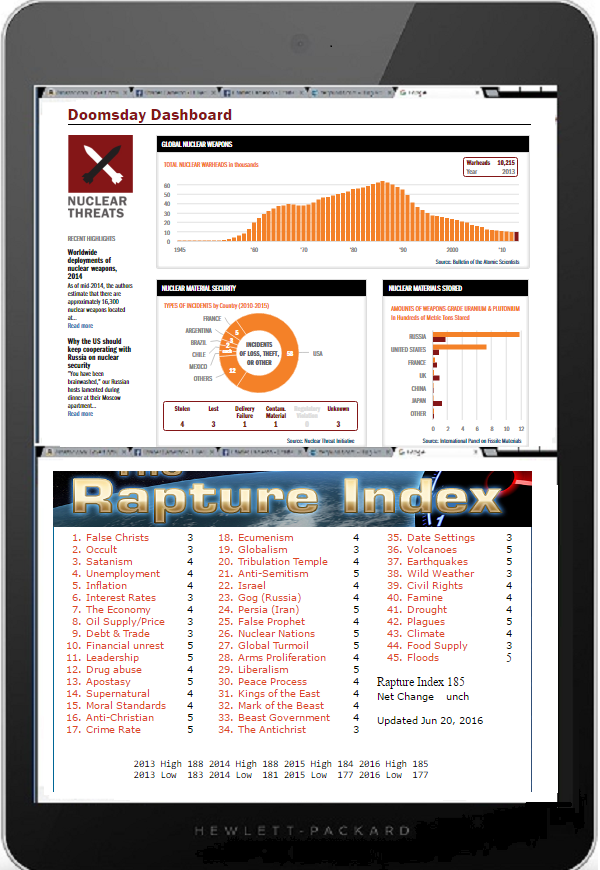
    Here are two versions of how close we may be to The End of Story. In the upper panel, a glimpse of the Bulletin of the Atomic Scientists’ Doomsday Dashboard, representing their version of the scientific view:

    DQ Doomsday Rapture

    In the lower panel, the current state of the Rapture Index, representing the view of a Christian website dedicated to reading the signs and keeping us updated on our proximity to a day that, per scripturam, “knoweth no man, no, not the angels of heaven, but my Father only.”

    **

    Sources:

  • Bulletin of the Atomic Scientists, Doomsday Dashboard
  • The Rapture Index, updated June 20, 2016
  • Matthew 24.36 (KJV), But of that day and hour knoweth no man
  • Subzin movie quotes, Synchronize watches
  • **

    Who you gonna believe?

    As Tim Furnish might say, BREXIT is not the Apocalypse, not even close — it hasn’t even merited an uptick in the Rapture Index.

    Of sundry musicians and their moon walks

    Sunday, June 12th, 2016

    [ by Charles Cameron — a jeu d’esprit, really, because i already have my sunday surprise for this week lined up, and this was too much fun to miss ]
    .

    I ran across this tweet this morning from Husain Haqqani, former ambassador of Pakistan to the United States and author of Pakistan: Between Mosque and Military and Magnificent Delusions: Pakistan, the United States, and an Epic History of Misunderstanding, currently with the Hudson Institute:

    Neil Armstrong? Heard the Islamic Call to Prayer? On the moon?

    **

    Poets love the moon, almost by definition — the Chinese poet Li Po supposedly drowned while attempting (under the influence) to kiss her face in the Yellow River — so this alleged, though dubious, story was definitely too rich in possibilities for me to ignored. And the Islamic Call to Prayer? According to Nicholas Kristof in the NYT:

    Mr. Obama described the call to prayer as “one of the prettiest sounds on Earth at sunset.”

    You may or may not agree, but if you want to hear the Call and judge for yourself, you could try listening to one of these videos:

  • https://www.youtube.com/watch?v=mUHDYlJHaOQ
  • https://www.youtube.com/watch?v=otdgbR3yso0
  • https://www.youtube.com/watch?v=T8o6WKTQpMc
  • **

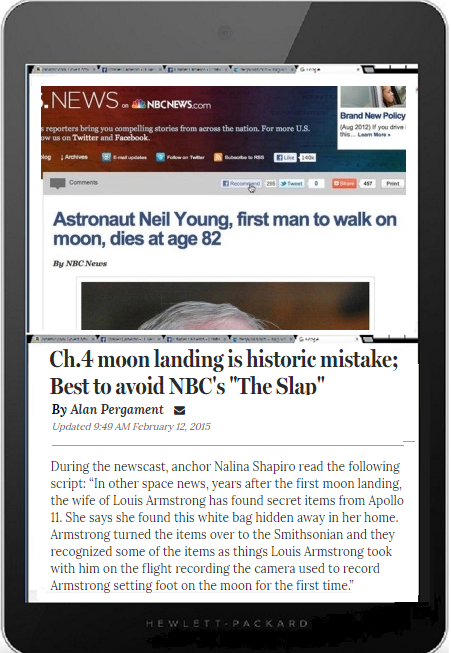
    That’s what led me to my second discovery –one which might be excused by blaming autocorrect, twice, for suggesting that Neil Young — he of the voice, upper panel below — and Louis Arnmstrong — he of the trumpet, lower panel — were each the first man to land on the moon, per (in both cases) NBC.

    Tablet DQ 600 at 75 blank Musicians on Moon

    In all fairness, it’s worth noting that other candidates for moon walks include Buzz Lightyear, Lance Armstrong, and Michael Jackson.

    **

    Sources:

  • Mix 104.1, Twitter Confuses Neil Armstrong With Lance and Louis
  • Buffalo News, Ch.4 moon landing is historic mistake; Best to avoid NBC’s “The Slap”
  • **

    None of these mistakes are critical, however, if you believe the late Srila Prabhupada, who introduced Krishna Consciousness to the United States. As someone fascinated by different cosmologies and theologies, I remember reading of Prabhupada’s claim that the moon landing was faked in a California film studio in his magazine some time in the 1970s. No longer having access to the magazine, and looking for confirmation of that memory, I found this page, Srila Prabhupadas statements about the moon landing, of considerable interest:

    Srila Prabhuapda himself said different things at different times. Sometimes he directly said they didn’t go and it was some kind of hoax. And at other times he said they didn’t go to the moon because they didn’t experience the higher dimensional nature of the moon planet, which is a rational way to harmonize the Vedic perspective with the idea of three dimensional space travel. At other times he just said the whole idea was foolish and a waste of money. He saw material space travel as a foolish attempt to reach higher dimensions which can only be reached by yogic practice.

    Bear in mind too that both Joseph Smith and L Ron Hubbard also taught their followers about significant planets that do not form part of the standard astronomical account of deep space — or the heavens, in other words.

    And Charles Williams — the brilliant Dante scholar, Arthurian poet, novelist, theologian of Romantic Love, and friend of JRR Tolkien and CS Lewis — offers a striking near-contemporary Christian example of the genre in the opening paragraph of his book, The Descent of the Dove: A Short History of the Holy Spirit in the Church.

    The beginning of Christendom, is, strictly, at a point out of time. A metphysical trigonometry finds it among the spiritual Secrets, at the meeting of two heavenward lines, one drawn from Bethany along the Ascent of the Messias, the other from Jerusalem against the Descent of the Paraclete. That measurement, the measurement of eternity in operation, of the bright cloud and the rushing wind, is, in effect, theology.

    See also my post, A metaphysical trigonometry.


    Switch to our mobile site