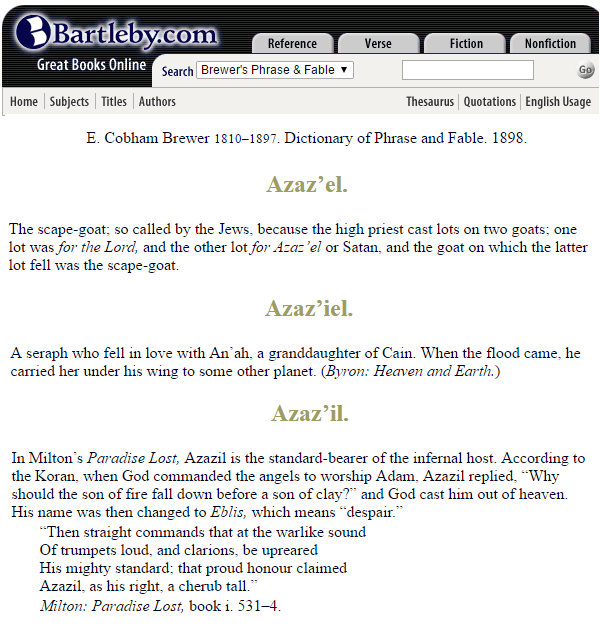
[ by Charles Cameron — on the angelic and poetical differences between Azaz’el, Azaz’iel and Azaz’il ]
.
Beginning ignorant, and with failing memory besides, I find it difficult to keep these distinctions straight in my unaided mind. Grateful thanks, therefore, to Bartelby and Brewer, who provide me with these assists:
Now that the matter has been clarified, my own affectionate preference goes to Azaz’iel, to be sure.
[ by Charles Cameron — a quick note about putting the mind through hoops, aka connecting dots ]
.
For the record, the mind is not a phalanx but a swarm — IOW it gets creative when the links are leaps, not serried ranks.
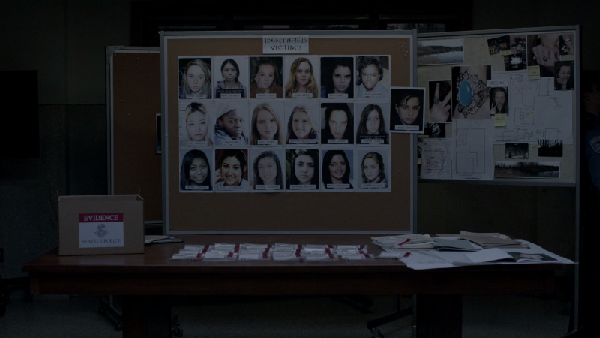
So when your evidence board, memory jolt, graphical display looks like this (and it’s not the unavoidable dimness of the screen-grab I’m talking about):
the mind won’t see as many possibilities as when it’s more like this:
**
Randomize. Create uneven spaces between items. Shift items around. The idea here is to create fresh possibilities, not to look tidy.
I had a friend once who was an artist. His studio and his life were both disasters — and in his studio, in the middle of that life, he created dazzling, gorgeously colored and delicately graduated geometric patterns — as though he was a disorder organizer, and the more disorderly his input, the greater the precision of his output.
[ by Charles Cameron — Tarkovsky, Nostalghia, Vivaldi, Mingardo ]
.
I trust you are in no hurry. Watching a film by Tarkovsky invites a certain stillness, permeated with wonder. It is in that stillness that the birds..
…in this case, Nostalghia, are born from the Madonna.
I was reading my daily quota of Three Quarks Daily and found Leanne Ogasawara‘s Dreaming of the Madonna — interesting, indeed beautiful — but when it closed with that video clip I was — transported, transfixed. Such luminous beauty.
The woman painted, the woman carried, and the woman walking.
**
And then to recall another woman walking, in a clip no less beautiful: the exquisite Sara Mingardo, who has been holding back, listening to and absorbing conductor Rinaldo Alessandrini and Concerto Ialiano performing Vivaldi‘s Gloria from the start of Philippe Béziat‘s movie of that great work, and moves slowly forward to join them to sing her agonized opening notes, “Domine Deaus, Agnus Dei” — “Lord God, Lamb of God”:
**
It is entirely possible to be lifted from this world into another world — without the necessity of leaving this one.
[ by Charles Cameron — as a poet, i love the term “triple canopy” — okay? ]
.
I was watching The Big Lebowski — a great film that’s all the better because it features a cameo of my old buddy Jimmie Dale Gilmore — and was caught off-guard when I saw this particular segment:
Once again, the arts — my side of the house, you might say — are bringing me intelligence of strategy — the main course here at Zenpundit, which creativity a close second — and I was pretty sure I’d read much the same thing somewhere in the last few days..
A quick query on FaceBook revealed that I wasn’t making things up out of whole cloth. Stephanie Chenault and Laura Walker had seen it, too.
And then Mark brought the whole thing back home, with this FaceBook post of his:
Very likely, that’s what we all saw..
**
It’s still Sunday here, and I’ve been pleasantly surprised — so this can still be the Sunday surprise I meant it to be, even though you likely won’t see it till Monday.
And mebbe in future we should simply refer to The Big Safranski as The Dude.
[ by Charles Cameron — what carves memory? blood is spilled, song carries grief and anger across centuries ]
,
One hundred years ago, Irish blood was spilled in the Easter Uprising of 1916, as Sinéad O’Connor & The Chieftains call us to remember in The Foggy Dew:
As down the glen one Easter morn to a city fair rode I
There armed lines of marching men in squadrons passed me by
No pipe did hum no battle drum did sound it’s loud tattoo
But the Angelus bell o’er the Liffey swell rang out through the foggy dew
The bravest fell, and the Requiem bell rang mournfully and clear
For those who died that Easter-tide in the spring of the year
While the world did gaze in deep amaze at those fearless men but few
Who bore the fight that freedom’s light might shine through the foggy dew
While some may see in the Uprising a merely political fight, in song the religious element — Easter morn, the Angelus bell, the Requiem bell — add Catholic poignancy to memory.
**
One hundred years.
Memory can linger long past a hundred years, as we in our rush to be the first into the future may forget. Let the Chieftains again remind us, with O’Sullivan’s March:
Donal Cam O’Sullivan Beare marched in 1602 — as Shakespeare was penning All’s Well That Ends Well and Othello?
A doff of the cap is due here to blog-friend Pundita , who pointed me in the direction of this post with her own Don’t ask me why, because..:
**
Ah, but Pundita also deerves a bow for her most recent post, Can the griots lead us home? — wherein she pointed me to a music of great joy, that of Oumou Sangaré:
If you watch enough videos of Oumou singing (there must be a zillion of them posted to YouTube) you’ll see that in many of her performances she has a highly conversational way of singing. You feel as if she’s talking directly to you. Sometimes it’s as if she’s talking to you in the manner of a defense attorney making an argument to a judge; others as if she’s chatting about something over lunch with you.
Here is a hunting song:
Pundita notes:
I think the ability to set up a very personal communication through song is the mark of a real griot, although after watching about 50 of her videos I think Oumou represents a tradition that I suspect goes back much earlier even than the griot clans — to a time when certain people in a tribe were interlocutors between humans and natural forces and helped settle disputes between members of tribes, and did so through the power of their voices to project a wide range of emotions.
Mali, at a time of violent upheaval — yet such joy in dance and song:
**
We have statistics for which nations suffer the most losses in war and terror, which export the most weapons, which nations invade, and which are invaded — but what of joy?
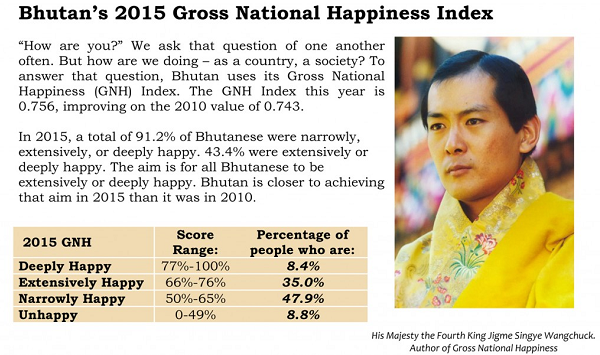
Years ago, in a book that sank like a stone, I suggested the concept of a Subtle National Product. King Jigme Singye Wangchuck of Bhutan apparently beat me to it, when he declared in the 1970s:
Gross National Happiness is more important than Gross National Product.
His Majesty came up with the idea first, I now see and gladly admit — but I still prefer my own pohrasing!
Joy, it seems to me, isn;t easily quantified, although Bhutan does have an Index:
Here are some conparative stats across nations, ethnicities and faiths I’d be interested in:
deaths in warfare, civilian, irregular, and military
numbers of children pressed into war
numbers of those maimed, displaced and or grossly mentally disturbed by war
depth of grief, as meaaured in forms of keening and ululation
degree of exuberance, as found in music and dance, popular and professional
ritual solemnity and grandeur, on religious and state occasions
quantity of written poetry bought or borrowed from libraries
size of audiences for spoken poetry readings
number of poets (in particular) imprisoned for their writings
Qualitative equivalents of these values would also be of interest, though even harder to obtain and verify in any objective manner..
Zenpundit is a blog dedicated to exploring the intersections of foreign policy, history, military theory, national security,strategic thinking, futurism, cognition and a number of other esoteric pursuits.