zenpundit.com » sunday surprise

Archive for the ‘sunday surprise’ Category

Sunday surprise, my ashes when the time comes

Monday, August 14th, 2017

[ by Charles Cameron — the poem as guided tour ]
.

So, my son Emlyn asked me where I would like my ashes scattered when I’m gone, offering to do me that service, and the ensuing discussion made it clear I had an opportunity not only to send him to some places I’ve loved where he’d be likely to find adventure, but also to provide him with reading (or listening) along the way — again, close to my mind and heart and potentially revelatory for his.

^^

I was tossing this around in my mind a day or two ago, and this poem announced itself:

Paradise or Pasadena, since you asked

I should like my ashes scattered in the upper atmosphere,
in Bach to be precise,
in deep feeling, in the St Anne Prelude and Fugue,
in “not of this world” in other words,
believing that if met by JSB
at the General Resurrection, I was most choicely planted.

Bach, seriously, is the mountain range I have assiduously
climbed since early youth,
and the St Anne not the most obvious,
but among the most glorious works therein,
though I am also vastly taken by Contrapunctus IX
and the Dorian Toccata was my first love.

More practically, fold me between pages of Yeats or Rilke,
and leave me on a bench in the Huntington Gardens.

That’s by no means my final response to Emlyn’s question, I look forward to many more hours of pondering and reminiscing. But it’s a thought..

**

Here, for your delight and enrichment, are the musical offerings the poem mentions:

The St Anne Prelude and Fugue, played here by Peter Hurford:

Contrapunctus IX from The Art of Fugue, played by Glenn Gould on piano, his usual instrument:

and, in a rare instance for Gould, on organ:

— and the Dorian Toccata and Fugue, my first Bach love, which I bought, treasured, and binge-listened to back in the late 50s (?) on a 45 rpm disc:

**

Noteworthy, the second of two images of Ton Koopman accompanying that last recording — which shows the fierce nature of Koopman when he was young — fading in right at the end of the Toccata:

Ton Koopman

I would love to have known him back when..

**

And place — the Huntington Gardens in Pasadena, which include a garden of flowers named in Shakespeare’s works, a Japanese garde, rose garden, and — my absolute favorite –the Desert Garden, containing 5,000 varieties of cactus and other xerophytes across 10 acres..

I suspect that losing oneself in those 10 acres is the closest thing to visiting an alien planet to be found on this one…
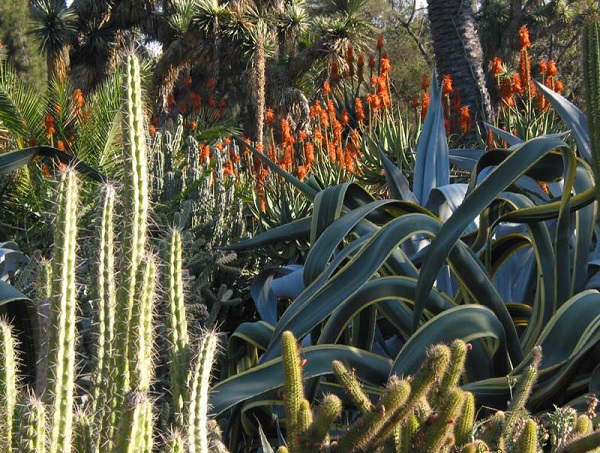
Once you’re in the garden and have escaped the lure of the cacti, the cool of the Huntington Library is nearby — with some stunning William Blake illuminations perhaps, and both a First Folio Shakespeare and the remarkable “bad” First Quarto of Hamlet which preceded it.

How has the mighty soliloquy been truncated:
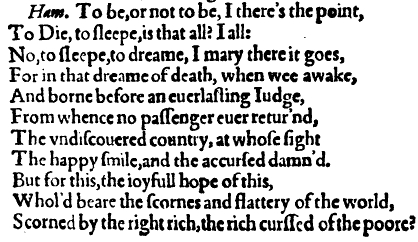
To Die, to sleepe, is that all?

**

Cacti, roses, Folio, scholars, tea rooms — heaven, in its earthly approximation…
Sunday surprise, Kaushiki Chakrabarty

Monday, July 31st, 2017

[ by Charles Cameron — lend me 18 minutes, thank me later! ]
.

I had no idea: a raga from the superb Kaushiki Chakrabarty. I have no idea why it took me seventy-plus years to know I shared the earth with such a voice — and such a beauty! — there is hope for us yet:

With profound thanks to 3 Quarks Daily for the pointer.

Sunday surprise — Go on

Sunday, July 23rd, 2017

[ by Charles Cameron — zen mind, beginner’s mind, math mind, game mind ]
.

Pi:

A Beautiful Mind:

Sunday surprise — Hopkins’ words like unto Clapton’s guitar

Sunday, July 16th, 2017

[ by Charles Cameron — what fire can spark forth when a great actor reads a great poet ]
.

First, Clapton performing Dylan:

It’s the speeding beauty (grace, flight, blues brutality) of Clapton’s guitar riffs that I’d draw your attention to — how can the human voice, in language hope to compare?

It’s a question that has driven me any times to despair, listening to Clapton.

**

And then there’s this poem. Let me give you the words first, so you can follow them. Gerard Manley Hopkins is the poet:

The Leaden Echo and The Golden Echo
(Maidens’ song from St. Winefred’s Well)_

THE LEADEN ECHO

How to keep — is there any any, is there none such, nowhere known some, bow or brooch or braid or brace, lace, latch or catch or key to keep
Back beauty, keep it, beauty, beauty, beauty…. from vanishing away?
O is there no frowning of these wrinkles, ranked wrinkles deep,
Down? no waving off of these most mournful messengers, still messengers, sad and stealing messengers of grey?
No there’s none, there’s none, O no there’s none,
Nor can you long be, what you now are, called fair,
Do what you may do, what, do what you may,
And wisdom is early to despair:
Be beginning; since, no, nothing can be done
To keep at bay
Age and age’s evils, hoar hair,
Ruck and wrinkle, drooping, dying, death’s worst, winding sheets, tombs and worms and tumbling to decay;
So be beginning, be beginning to despair.
O there’s none; no no no there’s none:
Be beginning to despair, to despair,
Despair, despair, despair, despair.

THE GOLDEN ECHO

Spare!
There is one, yes I have one (Hush there!);
Only not within seeing of the sun,
Not within the singeing of the strong sun,
Tall sun’s tingeing, or treacherous the tainting of the earth’s air.
Somewhere elsewhere there is ah well where! one,
One. Yes I can tell such a key, I do know such a place,
Where whatever’s prized and passes of us, everything that’s fresh and fast flying of us, seems to us sweet of us and swiftly away with, done away with, undone,
Undone, done with, soon done with, and yet dearly and dangerously sweet
Of us, the wimpled-water-dimpled, not-by-morning-matched face,
The flower of beauty, fleece of beauty, too too apt to, ah! to fleet,
Never fleets more, fastened with the tenderest truth
To its own best being and its loveliness of youth: it is an ever-lastingness of, O it is an all youth!
Come then, your ways and airs and looks, locks, maiden gear, gallantry and gaiety and grace,
Winning ways, airs innocent, maiden manners, sweet looks, loose locks, long locks, lovelocks, gaygear, going gallant, girlgrace —
Resign them, sign them, seal them, send them, motion them with breath,
And with sighs soaring, soaring sighs deliver
Them; beauty-in-the-ghost, deliver it, early now, long before death
Give beauty back, beauty, beauty, beauty, back to God, beauty’s self and beauty’s giver.
See; not a hair is, not an eyelash, not the least lash lost; every hair
Is, hair of the head, numbered.
Nay, what we had lighthanded left in surly the mere mould
Will have waked and have waxed and have walked with the wind what while we slept,
This side, that side hurling a heavyheaded hundredfold
What while we, while we slumbered.
O then, weary then why should we tread? O why are we so haggard at the heart, so care-coiled, care-killed, so fagged, so fashed, so cogged, so cumbered,
When the thing we freely forfeit is kept with fonder a care,
Fonder a care kept than we could have kept it, kept
Far with fonder a care (and we, we should have lost it) finer, fonder
A care kept. Where kept? Do but tell us where kept, where. —
Yonder. — What high as that! We follow, now we follow. —
Yonder, yes yonder, yonder,
Yonder.

Richard Burton, unbelievably, recites this poem:

Burton performing Hopkins.

Let that wash over you once. Or twice — or as they say, binge-listen.

One of the commentators on the Clapton video calls it “a guitar tutorial on what it means to truly master the art of music” — ditto say I for Burton performing Hopkins.

we could get into the magnificent rage of Clapton & Dylan later (from a quasi-pacifist position over here).

Sunday subsidiary — typewriters, poetry, guns, roses, and art

Monday, July 3rd, 2017

[ by Charles Cameron — one-time typewriter poet & artist ]
.

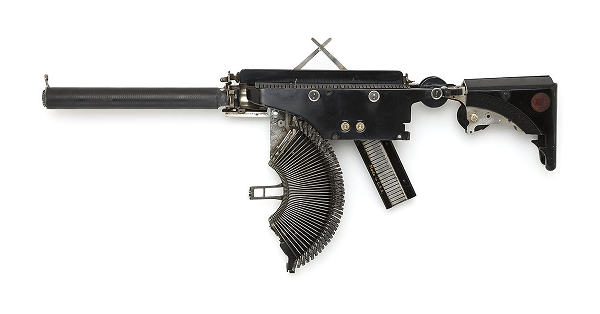
From This Artist Recycles Typewriters into Guns:

Typewriters revolutionized the way we write and guns changed the wars we fight, yet it can’t be denied that both are artifacts of tremendous cultural impact, despite the dramatic differences in function. This notion helps illuminate the peculiar Typewriter Guns of Québécois artist Eric Nado, a sculptural series of typewriters transformed to look like guns.

Thankfully non-functional, Nado’s guns seem like strange weaponry from the future, due to their brilliantly vibrant hues and the protruding typewriter parts that seem like alien steampunk appendages in this technological recontextualization. This may be partially an aesthetic choice, but it also relates to the artist’s desire to fully recycle the typewriters. In his project statement, Nado iterates that every piece of the typewriters were re-incorporated into the guns, an almost eerie vein of sustainability given how convincingly dangerous these sculptures look.

**

Reminds me of Ernst Jandl‘s sound poem schtzngrmm, based on taking the letters of the word “trench” — “Schützengraben” in German literally, letter by letter, so as to evoke (some of) the sound of trench warfare:

schtzngrmm
schtzngrmm
t-t-t-t
t-t-t-t
grrrmmmmm
t-t-t-t
s———c———h
tzngrmm
tzngrmm
tzngrmm
grrrmmmmm
schtzn
schtzn
t-t-t-t
t-t-t-t
schtzngrmm
schtzngrmm
tssssssssssssss
grrt
grrrrrt
grrrrrrrrrt
scht
scht
t-t-t-t-t-t-t-t-t-t
scht
tzngrmm
tzngrmm
t-t-t-t-t-t-t-t-t-t
scht
scht
scht
scht
scht
grrrrrrrrrrrrrrrrrrrrrrrrrrrr
t-tt

But I’ll let Jandl read it himself and comment on that final “t-tt” and its aural cognate, “tod” — death:

**

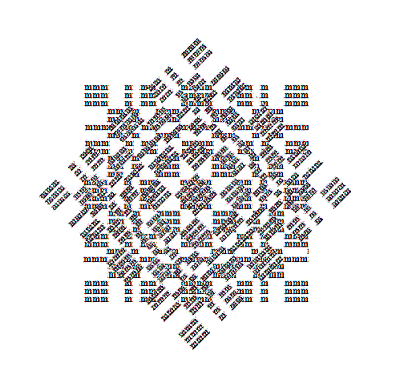
Back in the day, I was a “visual poet” as Jandl was a “sound poet” — the two experiments observed poetry as it approached art and music, respectively — and here’s one of mine, now enshrined in Marvin & Ruth Sackner‘s definitive The Art of Typewriting:

That’s no gun — it’s a rose, and I presented it to Elizabeth Taylor, no less, when she was supporting Basil Bunting for the Oxford Poetry Professorship, and we met in a pub by the river..


Switch to our mobile site