zenpundit.com

DoubleTweeting Islam, yesterday

July 17th, 2015

[ by Charles Cameron — a quick, trick question ]
.

It is still too early to say what specific kind of inspiration, guidance or affiliation (IS? AQ? other?) the Chattanooga shooter may have had, but two tweets yesterday speak volumes about individuals and large bodies of believers. Question:

Is any religion with over a billion members monolithic?

**

and:

**

Hey, that was a trick question. The Christian Church can reasonably claim to be monolithic, having been founded, as Matthew 16.18 puts it, on a Rock:

And I say also unto thee, That thou art Peter, and upon this rock I will build my church; and the gates of hell shall not prevail against it.

Nevertheless, even Christians come in many shapes and sizes, isn’t it?

The Boston IS and Apocalyptic Conference

July 16th, 2015

[ by Charles Cameron — I was (unexpectedly) almost totally deaf at the time, so the videos of the conference allowed me a second go-around, for which I’m profoundly grateful ]
.
CMS Landes 602
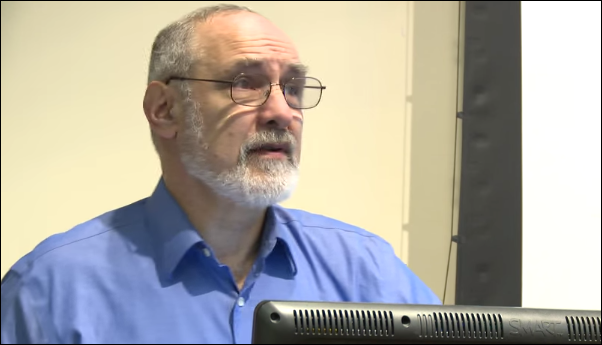
Richard Landes, opening the Boston conference

**

With what I hope will turn out to be the wisdom of a fool, I am going to propose the importance of (a) Richard Landes‘ now defunct Center for Millennial Studies at Boston University, and (b) its recent resurgence as a single and singular conference on Apocalyptic Hopes, Millennial Dreams and Global Jihad.

Bear with me, I’m an enthusiast.

**

Gregory Bateson died thirty-five years ago July 4th, the day I started writing this post — a fact I only know because I’m inclined to associate the Boston Conference as one of the great cross-disciplinary and initially underestimated conferences alongside the early Macy conferences on Cybernetics, in which Gregory Bateson was so significant a partner — or the seminal Eranos Conferences attended by the friends of CG Jung.

The Macy conferences ushered in the computer age, the Eranos conferences celebrated the highest level of cross-cultural and cross-disciplinary exchanges between psychologists, philosophers, religious scholars and physicists — while the Millennial Studies conferences focused on a studiously ignored area of knowledge that has swung into heightened significance via the arrival on scene of Al-Qaida and the Islamic State.

**

Participants, Macy and Eranos:

The Macy Cybernetics Conferences included such participants as William Ross Ashby, William Grey Walter, Kurt Lewin, J. C. R. Licklider, Warren S. McCulloch, Margaret Mead, Oskar Morgenstern, F. S. C. Northrop, Walter Pitts, I. A. Richards, Claude Shannon, Heinz von Foerster, John von Neumann, and Norbert Wiener.

The Eranos Conferences included presentations by Carl Gustav Jung, Rudolf Otto, Mircea Eliade, Wolfgang Pauli, Karl Kerényi, Erich Neumann, Henry Corbin, G van der Leeuw, Louis Massignon, Gilles Quispel, Hellmut Wilhelm, Hugo Rahner, Erwin Schrödinger, Gershom Scholem, Heinrich Zimmer and Martin Buber.

In each case, the ideation was intensely and deliberately cross-disciplinary, and the importance of the series of conferences only widely apparent at a later date.

**

Participants, Center for Millennial Studies:

In the case of the Boston conference on Apocalyptic Hopes, Millennial Dreams and Global Jihad, the series in whicb it partakes is that of the new defunct Center for Millennial Studies, an extraordinary organization which studied millennial movements from the Dead Sea Scrolls via the Taiping Rebellion (20-30 million dead), and the Siege of Mecca (1979 CE), to Aum Shinrikyo, Waco and Y2K — with implications for future events at least as far as the 2000th anniversary of the crucifixion in the 2030s and the start of the next Islamic century in the 2070s.

Among the attendees at this year’s conference were Richard Landes, William McCants, Graeme Wood, Timothy Furnish, Cole Bunzel, Jeffrey M. Bale, myself, David Cook, JM Berger, Itamar Marcus, David Redles, Paul Berman, Charles Strozier, Brenda Brasher, Mia Bloom and Charles Jacobs. Husain Haqqani was expected to attend and intended to speak about the Ghazwa e-Hind but couldn’t make it, and Ayaan Hirsi Ali cancelled her appearance for security reasons as a result of the Garland, TX, shooting the day before.

Speakers at previous CMS conferences included, in additiopn to some of the above, Steven O’Leary, Michael Barkun, Albert Baumgarten, Chip Berlet, Bruce Lincoln, Moshe Idel, Michael Tolkin, Gershom Gorenberg, Damian Thompson and Robert Jay Lifton.

**

You can see the entire series of CMS 2015 Conference videos

  • here
  • In particular and given my own special interests, I recommend the talks by

  • Will McCants (on IS eschatology)
  • Cole Bunzel (on the 1979 Mahdist assault on Mecca), and
  • David Cook (on Islamic apocalyptic and Boko Haram)
  • You can follow those up with such friends and worthies as Tim Furnish, JM Berger, and (on Palestinian messaging) Itamar Marcus — Itamar’s brilliant presentation shifted my thinking on the Israeli-Palestinian question by about ten degrees.

    My own contribution is

  • here
  • **

    My recent discombobulations (see previous post) and an over-busy writing schedule have prevented me from posting separately on each of the talks at the conference, which I had hoped to do — but McCant’s forthcoming book will soon be with us, and this brief introduction (and my three reading lists) will hopefully provide background while we await it.

    The book I brought with me, for (heh!) light reading, was A. Azfar Moin‘s The Millennial Sovereign: Sacred Kingship and Sainthood in Islam. Path-breaking, scholarly, intelligent, unfailingly curious, written with grace — a true delight!

    Forgiveness and Mercy: more recent words..

    July 16th, 2015

    [ by Charles Cameron — adding angles to an existing series of posts on a crucial (pun fully intended) topic ]
    .

    I’m doing some catch-up on uncompleted posts here, and today I’d like to add two comments I ran across a while back to the two posts I’ve already written on forgiveness:

  • Some recent words from the Forgiveness Chronicles
  • More recent words from the Forgiveness Chronicles
  • Given time, I’d probably edit these down a bit, but (a) I got unceremoniously dumped from my abode less than a week ago, with two hours to move my library and my life, courtesy of the landlord’s violation of safety codes — or perhaps courtesy of someone’s opportunity to make a bundle in real estate by closing down two hotels, who knows? — and (b) I therefore no longer have my library to hand, and am backed up in terms of my writings, so..

    **

    Without further ado and with little or no editing, here are the voices of:

  • Anthea Butler, The decision to forgive is rooted in faith. The desire to forget is rooted in racism:

    or many people, the forgiveness offered to Dylann Roof, the man charged with killing of nine black members of Emmanuel AME Church in Charleston, South Carolina, at his arraignment by the families of his victims is impossible to understand – and worthy of veneration. “I forgive you” said Nadine Gardner, daughter of slain church member Ethel Lance. “I will never ever hold her again. But I forgive you, and may God have mercy on your soul”.

    But how could someone forgive such a heinous crime so quickly, so easily? The answer lies in part with Christian interpretation of the New Testament, a history of racialized violence and the civil rights movement.

    Black churches taught us to forgive white people. We learned to shame ourselves

    Forgiveness is a spiritual practice and biblical mandate from the New Testament that many American Christians engage in as a part of their faith. Familiar scriptures (such as Jesus forgiving the Romans while hanging on a cross, or saying that forgiveness should be given 70 times seven) are staples of Christian teaching and theology. Forgiveness is enshrined in the Lord’s prayer – forgive us our debts as we forgive our debtors. These scriptures point to the power of forgiveness not only as a way to absolve transgressions, but to ensure that the person extending forgiveness will be forgiven of theirs. For many Christians, these teachings form the foundation of their Christian faith, even when that forgiveness can be difficult to give.

    Historically, narratives of forgiveness were part of both the anti-slavery movement and the civil rights movement in America. Uncle Tom’s Cabin, for instance, was based loosely on the life of the Rev Josiah Henson, who forgave his master that wanted to sell him and beat him after Henson begged him not to.

    I fell down and clung to his knees in entreaties. Sometimes when too closely pressed, he would curse and strike me. May God forgive him!

    These slave narratives in the 19th century were designed to put forth messages of Christian love and mercy, even in the face of the masters’ violence and cruelty. For many slaves and subsequent free black people, forgiveness was also a way to protect themselves from continued racial violence. A well placed “I forgive you” served as protection for vulnerable African Americans in a violent racist environment by calling out to oppressor and oppressed’s shared religious faith.

    In the 20th Century, the non-violent “soul force” that Martin Luther King Jr taught was a combination of Hinduism and Christianity. Forgiveness became a big part of the civil rights movement, juxtaposed against the violence of protesters and law enforcement. King described forgiveness in one of his early sermons as a pardon, a process of life and the Christian weapon of social redemption. In MLK’s words, “forgiveness is not an occasional act, it is a constant attitude”

    History and scripture are just the foundations for the stunning words of forgiveness from the families of those murdered at Emmanuel AME, expressions apparently driven by sincerity and theChristian witness of the surviving family members. However, forgiveness deployed in the context of American race relations become part of the ritual of what I call racial forgiveness.

    Racial forgiveness is different than a theological premise; it is a cultural ritual in America which functions to atone for the past racism (as with the apologies from various denominations, such as Southern Baptists, in the 1990s) or in an attempt to provide African Americans a way to move forward and acknowledge historic and recent racial pain. These public acts of racial forgiveness are important, but they can also bring about ritual forgetting when co-opted by individuals or groups with little interest in atonement.

    This ritual forgiveness and forgetting is one of the reasons America’s conversation on race is stilted, disingenuous, and dangerous. In a culture of ritual forgiveness and forgetfulness, no one is called to account for historic deeds done against others, and history is viewed as a malleable story to support the forgetting. That is why the conversation about the Confederate Flag and its meaning are simply swept away as a “cultural matter” or history, when the reality is that the flag was a symbol of resistance to the Union and, later, used as a way to continue the culture of the Confederacy and terrorize Africans Americans.

    Forgiveness unfortunately, can birth forgetting: by the time the arraignment ended, the ritual forgetfulness had already begun. Politicians like Jeb Bush claimed not to understand why the shooter would want to kill black people and conservatives claimed that the shooting “was an attack against Christians”.

    How long will forgiveness and the subsequent forgetting be a means to derail sustained efforts to confront racism in America? For black people, there is no forgetting of the history of American racism, or the complicity of Christians in that history. When a white man walks into a black church, sits for an hour, and then allegedly shoots nine black people dead, no amount of forgiveness given for his murderous act by the families of the dead can absolve America of its violent history of racism, no matter how much those complicit in that racism might hope for it.

    And:

  • Buzzfeed, Here Is What Dzhokhar Tsarnaev Said To His Victims In Court:

    “I’d like to now apologize to the victims and the survivors,” Tsarnaev said.
    “If there is any lingering doubt, I did it along with my brother.”
    As he spoke in courtroom, he began to cry.
    “I am sorry for the lives that I have taken, the suffering that i have caused you, the damage that I’ve done.”
    “Immediately after the bombing, of which I am guilty of, there is little doubt about that. I learned their faces, their names.”
    Tsarnaev also thanked the jury and his attorneys.
    “Made my life the last two years easy. I cherish their companionship,” Tsarnaev said about his defense team.
    He concluded his speech by asking for mercy for himself and his brother.
    “I am Muslim. My religion is Islam,” Tsarnaev said.
    “I ask allah to have mercy on me my brother and my family. I ask Allah to have mercy on the Umah. Thank you.”

    **

    If there’s anything in particular here to take note of — and I’m not sure we should generalize from such a tiny sample — it’s Butler’s use of forgivess terminology and Tsarnaev’s corresponding use of mercy.

    Forgivness is taught in the Christian Lord’s Prayer, while The Merciful in Islam is one of the great and beautiful Names of God.

  • When one life sprouts inside another

    July 16th, 2015

    [ by Charles Cameron — some ugly comparisons, you have been warned — but it is only the exaggerated ugliness that drives my point home ]
    .

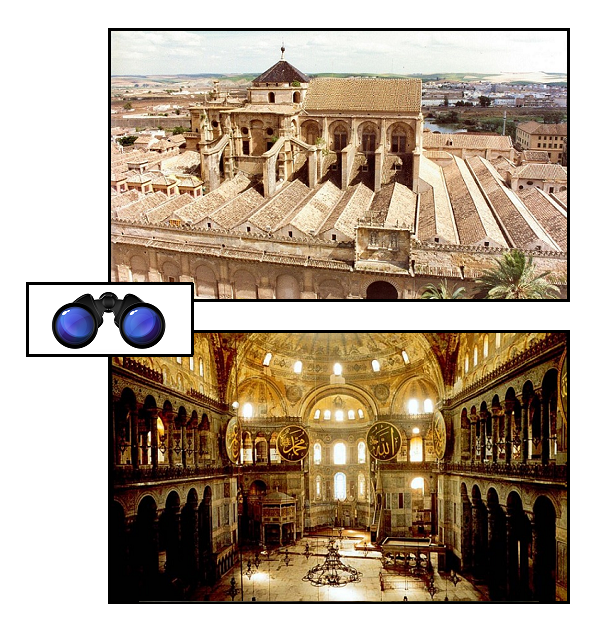
    The first DoubleQuote of three I’m posting here shows two views of sacred sites taken over by conquering religions.

    SPEC DQ cordoba istanbul

    You may have seen this DoubleQuote before — the upper panel shows the Mezqita or Grand Mosque of Cordoba, an extraordinarily beautiful building in the middle of which Spanish Catholics grafted a baroque cathedral, an act of which King Carlos V of Spain said:

    You have built here what you or anyone might have built anywhere else, but you have destroyed what was unique in the world

    The lower panel shows the Hagia Sophia or Basilica of the Holy Spirit in Istanbul, which was turned into a mosque by Muslim conquerors, and subsequently made into a museum

    **

    The question this sort of transformation of sacred places — from one faith to another, often by conquest but also on occasion by commercial transfer or simple generosity — leaves me wondering what it must feel like for those who lose their place of worship, especially in case of conquest. And I should make it clear that my question applies as much to Jews unable to pray on Temple Mount as it does to Christians in Istanbul or Muslims in Cordoba.

    By its visual nature, the Cordoban example sticks in my mind, however — the relatively new cathedral sprouting quiute visibly from the ancient mosque.

    And so it is that my mind, habituated to seeking visual analogues, stumbled on the disgusting — if brilliant — birth of the alien in Ridley Scott‘s The Alien:

    SPEC DQ alien chestbuster birth

    I know: Giger‘s aliens in the movie — and even more so, in the now canonical “chestburster” scene — are hideous, as Ridley Scott himself said, “in the unique manner in which they convey both horror and beauty.”

    **

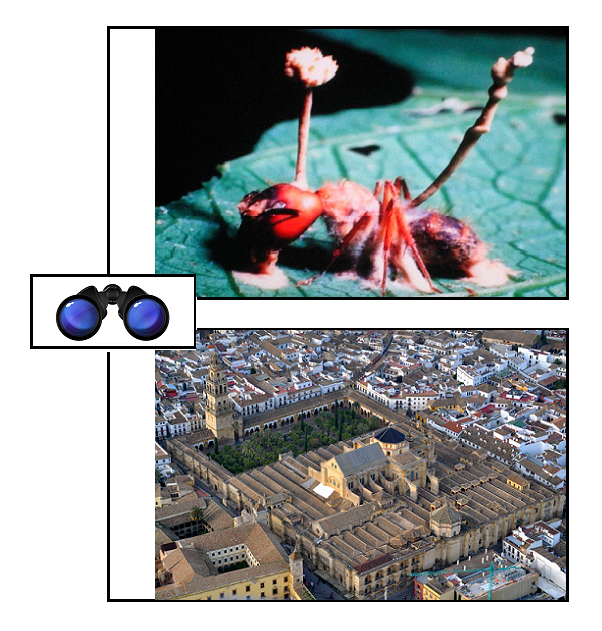
    Granted, these comparisons from “fiction” (above) and “nature” (below) to what is now one of the world’s more interesting architectural oddities seem obscene — we are used to the church-in-a-mosque as a tourist attraction, and in its own way a minjor miracle —

    SPEC Mezquita and Ant

    — my interest here, hiowever, is in looking at it, not through Muslim eyes, but through the eyes of those Muslims for whom building a church inside what was not only a mosque but one of the most beautiful mosques in the world feels like a grievous insult.

    For them, the cathedral in the Mezquita is a blasphemy — the insertion of a polluted form of worship in a place once dedicated to God’s own preferential service. And this is important not so that we can understand the ideation of those who wish to return the cathedal to a mosque and more generally Spain to al-Andalus, but so that we can comprehend the depth and intensity of the associated emotion.

    The passion.

    Which some Christians must surely also feel whewn they enter the museum of Hagia Sophia, once so proud a place of Christian worship and history — or some Jews with respect to the Temple Mount in Jerusalem, where the movement to permit Jewish worship, at present forbidden, is gaining momentum.

    The passion behind (sacred) revanchism.

    Millenarian movements #3: comments and additional book suggestions

    July 16th, 2015

    [ by Charles Cameron — concluding post in 3-part biblio series ]
    .

    I wanted to complete my series of posts, begun before the Boston conference, providing readings of use in understanding new religious movements, and “end times” movements in particular.

  • A dozen or more books on NRMs, apocalyptic, and violence
  • A dozen or so books on Islamic apocalyptic
  • This, the third and last post in that series, contains additions to the first of the two posts above, as recommended by scholars on a relevant mailing list I subscribe to.

    **

    Here are the comments made by three scholars of new religious movements in response to my request:

    Gordon Melton:

    I feel some need to call attention to the vast literature on millennialisms that have no violence connected with them. I have been working for the past few years, for example, on Pentecostalism, an intensely millennial movement that spread globally in its first generation with no hint of violence. In fact the great majority of millennial groups have had no violence connected with them, while the majority of violent nrms have had no particular millennial orientation. In asking why a few millennial groups turned violent, and others had violence inflicted upon them, we must always deal with the issue of why so many, from the Millerites to the modern Catholic Marian groups, have no hint of violent tendencies in spite of vibrant millennial expectations.

    John Hall:

    I want to emphasize again that religious violence is not restricted to apocalyptic/millenarian groups, a point I developed at length in ‘Religion and violence from a sociological perspective,’ [in Jerryson, Juergensmeyer, and Kitts’s 2013 Oxford Handbook of Religion and Violence] which is not focused on religious movements per se, and thus, may have been missed by list members.

    Jean Rosenfeld:

    In How the Millennium Comes Violently, Cathy Wessinger has a chapter on the instructive case of Chen Tao, which I have used in class to demonstrate that even when the authorities are excited by the possibility of a group suicide, informed individuals from the group and outside can reassure everyone that nothing will happen. Even in the case of a very violent apocalyptic group, CSA, the collaboration of an insider (Noble) with the besieging authority (FBI HRT director Coulsen) averted a bloody denouement. In contrast, arguably peaceful groups, the Waco Davidians and the Rua Kenana group in North Island, NZ, were violently confronted by misguided (and frightened) authorities.

    **

    Further readings suggested by a variety of scholars:

    Bromley & Melton, eds, Cults, Religion, and Violence
    John Hall, Gone from the Promised Land: Jonestown in American Cultural History
    Benjamin Zeller, Heaven’s Gate: America’s UFO Religion
    James Lewis, ed, The Order of the Solar Temple: The Temple of Death
    Eileen Barker, forthcoming, The Making is a Moonie: Brainwashing or Choice?

    And some titles with brief comments:

    Peter Webster, Rua and the Maori Millennium
    — incredible early study by anthropologist Webster of an Antipodean “Koresh”
    Paul Clark, Hauhau: the Pai Marire Search for Maori Identity
    — how the wars that founded New Zealand began in response to N.Z.’s most influential prophet movement
    GW Trompf, ed., Cargo Cults and Millenarian Movements: Transoceanic Comparisons of New Religious Movements
    — relevant today, oddly enough, and insightful)
    Jean Rosenfeld, The Island Broken in Two Halves: Land and Renewal Movements Among the Maori of New Zealand
    — 4-5 major nativist millennial/apoc. movements and Land Wars; NZ has some of the richest, most copious data on these subjects
    Sylvia Thrupp. ed., Millennial Dreams in Action: Studies in Revolutionary Religious Movements
    — includes chapters on early N.A. Indian movements, lest we forget


    Switch to our mobile site