I just finished reading Koran, Kalashnikov and Laptop: The Neo-Taliban insurgency in Afghanistan by historian Antonio Giustozzi who has subsequently gone on to write in rapid succession, Decoding the New Taliban: Insights from the Afghan Field and Empires of Mud, which I intend to read as well. Giustozzi is doing something important with his study of the Neo-Taliban insurgency that twenty years ago, a professional historian would have eschewed: applying his his historical expertise and methodology in a disciplinary synthesis to understand a dynamic, emerging, phenomenon at the center of current policy.
At the outset, Giustozzi writes:
This book is written by a historian who is trying to understand contemporary developments making use of not just the historical method, but also drawing from other disciplines such as anthropology, political science and geography. As a result, this book combines an analysis of the development of the insurgency based on available information with my ongoing work, focused on identifying the root causes of the weakness of the Afghan state.
This is a useful investigative methodological approach. “Useful” in the sense that while adhering to scholarly standards, Giustozzi offers readers the benefit of his capacity as a professional historian to evaluate new information about the war with the Neo-Taliban, while orienting it in the appropriate cultural-historical context. Not all of the information dealt with is reliable; Giustozzi candidly explains the disputes around particular unverified claims or accusations before offering his educated guess where the truth may be or the probabilities involved in a fog of war and ethno-tribal animosities.
Koran, Kalashnikov and Laptop is an academic book with a fairly detached tone and heavily endnoted chapters, which Giustozzi divided in the following manner:
1. Sources of the insurgency
2. How and why the Taliban recruited
3. Organization of the Taliban
4. The Taliban’s strategy
5. Military tactics of the insurgency
6. The counter-insurgency effort
The chapters have a wealth of detail, bordering at times on minutia, on Afghanistan’s complex and personalized system of politics which help shed light on why the effort at providing effective governance, a key COIN tenet, is so difficult. One example:
“….Strengthened as it was by powerful connections in Kabul, Sher Mohammed’s ‘power bloc’ proved quite resilient. Some of the Kabul press reported ‘criticism’, by former and current government officials from Helmand, of Daoud, whose attempts to restrain and isolate the rogue militias and police forces of helmand were described in terms of collaborationism with the Taliban. Daoud reacted by accusing the local ‘drug mafia’ of plotting against him and tried to convince President Karzai to leave him in his post, but not even British Prime Minister Tony Blair’s efforts sufficed to save him. Karzai sacked Daoud in the autumn of 2006. His replacement, Asadullah Wafa, was widely seen as a weak figure who for several months even refused to deploy to Lashkargah.”
This example is a typical one for political life in the provinces. Karzai’s counterinsurgency strategy does not have much to do with ours, and is largely antithetical to it. What we call “corruption”, Karzai sees as buying loyalty; what we call good governance, Karzai views as destabilizing his regime. We are not on the same page with Hamid Karzai and perhaps not even in the same playbook.
Giustozzi is exceptionally well-informed about Afghanistan and the political and military nuances of the old Taliban and the Neo-Taliban insurgency and the structure of Koran, Kalashnikov and Laptop is clear and well-organized. Giustozzi is informed about COIN in this context but less so generally (in a minor glitch, he posits Mao as primarily waging guerrilla war against an Imperial Japan – Mao didn’t – which did not have much of a “technological edge” – which Japan certainly did over Chinese forces, Nationalist or Communist, for most of the war) but Giustozzi is not writing to add to COIN theory literature, as he specifically noted. What the reader will get from Giustozzi is a grasp of who the Neo-Taliban are as a fighting force and the convoluted, granular, social complexity of Afghan political life in which the US is attempting to wage a COIN war.
Koran, Kalashnikov and Laptop is strongly recommended.
[….] B. Failure of the American Effort in Afghanistan
Our posters were nearly unanimous that the current American effort in Afghanistan would not succeed, or even have a long-term effect on Afghanistan. That is an expected, but still damning vote of no confidence on the decade-long Bush-Obama non-strategy for Afghanistan. The strongest counter-example was Trent Telenko, who suggested a strategy to secure the country that sounds plausible to me, an non-expert.
Joseph Fouche had my second favorite observation of the Roundtable: “America has the firepower to destroy a large country, the heavy forces to invade a medium country, and the manpower to occupy a small one.” The USA and its military are not configured to do the kind of nation-building the US Government seems to want to do. Thomas P.M. Barnett has long observed that these tasks, if they can be done at all, require lots of people. The USA has a military composed of a small number of highly trained and expensively equipped people. The only way that a country the size of Afghanistan could be pacified is to put lots of boots on the ground. The only countries that have that many boots are China and India. Afghanistan will not be pacified by the USA, using hearts-and-minds methods. It may be pacified by one of the two large Asian powers, using more direct method. Jim Bennett speculated on what it would look like if China moved in, bulldozer fashion. His vision seems highly plausible over the long term.
Fringe provided a thoughtful analysis of the US failure in Afghanistan, which I won’t summarize but I strongly suggest you read. I think it is the single most informative post in the Roundtable. He notes that successful US wars have not had an “exit strategy.” To the contrary, they consisted of a battlefield success followed by an extended occupation. This provides an initial test, before the outset of a war. If it is not worth an occupation, it is not worth invading in the first place. “With few exceptions, if it’s worth a war, there is no exit strategy.”
One intriguing set of predictions was of ongoing, networked non-governmental efforts to provide some relief for the Afghan people. Dr. Madhu predicts ongoing turmoil, with NGOs doing humanitarian work where governments are unwilling or unable to go. David Ronfeldt foresees a “secretive ethicalist netfirm” operating swarms of surveillance UAVs to protect Afghan women. While this seems exotic at first glance, David is probably tapping into what seem to me to be the likely trends.
Radical advancement in technology may make much of our current thinking obsolete by 2050, and probably a lot sooner. Zenpundit noted in a comment that “[t]he DIY movement combined with high tech sectors like desktop manufacturing and nanotechnology are going to permit [individuals] and small groups to have their own capacity for military intervention.” The bad guys will take advantage of this first, since governments will try unsuccessfully to control the process. Once that fails, we will see a massive breakout of self-help as military scale violence becomes accessible and ubiquitous. Once this happens, the nation-state itself will be an over-priced, unusable legacy system that not only fails at providing the core function of providing physical security, but obstructs it. We will have to move to a different arrangement entirely. Goodbye, Westphalia, you won’t be missed very much. The good guys will win but the process will be ugly. This was roughly what I predicted in my initial post, with a posited dissolution of the USA, followed by a networked regrouping of the successor entities
….After January’s earthquake in Haiti, the U.S. military and Coast Guard vessels transported supplies, provided security, and even conducted air traffic control for Toussaint L’Ouverture International Airport. During the ongoing flooding in Pakistan, helicopters from U.S. warships have delivered critical food aid and airlifted thousands to safety. Both disasters presented a side of America that is too rarely seen on the world stage: young American men and women sent to aid beleaguered nations.
However, in both these cases the U.S. flotilla was ad hoc, assembled either by reassigning ships from more traditional duties or, as in the case of the hospital ship U.S.N.S. Comfort, deployed from port only through the Herculean efforts of her crew. There was no dedicated squadron trained and tasked for humanitarian assistance and disaster relief. We should change this.
Anyone who’s read my history-of-America in “Great Powers” knows TR is the pivotal figure in so many ways, not the least of which being the profound influence he had on his cousin–FDR.
If you’re only going to read one, read the first, simply because the ride up is always more interesting than the time at the top. As soon as I read this book, I thought to myself, why isn’t there a big Hollywood movie of such a seminal figure in our history. Scorsese is making a movie of the book, with DiCaprio in the title role. Scorsese makes a lot of sense, because of the NYC connection.
Here we see the distinction between the study of “war” and the study of “warfare”. War remains the same and a general theory may apply, whereas warfare is specific to the time and interaction in question. Each of the theorists I mention above – -including Clausewitz – dealt with both in their analyses, many times quoting Clausewitz or assuming a general theory foundation and then developing their own specific “art of warfare” based on military history/personal experience for their own epochs. It is this art of warfare for the particular epoch which in turn supplies the basis for military doctrine
An unexpected global event occurs. What caused it? The event was produced by an individual, relatively powerless by traditional standards. However, since this is the 21st Century, this individual is able to use unfettered access to a global super-network to leverage and amplify his actions. The event he creates disrupts established global social networks and puts them into turmoil. That turmoil creates the opportunity and sustenance needed to activate dozens of small subnetworks/groups. As these groups interact, a new dynamic is formed.
Here’s an interesting theoretical question: How long will it take for someone in the open source swarm forming around this, to surpass and replace Terry Jones now that a systempunkt has been both identified and proven to work? His fumbling makes it possible for new entrants to run with this. Theseefforts don’t meet the level necessary to surpass/trump the efforts of Jones, but they add to the confusion.
Sean Meade, in addition to being my good friend, is the Web Editor for Aviation Week’s defense and space content and is the former longtime webmaster/editorial assistant/right-hand of Dr. Thomas P.M. Barnett. Sean blogs at ARES for Aviation Week and at his personal blog, Interact:
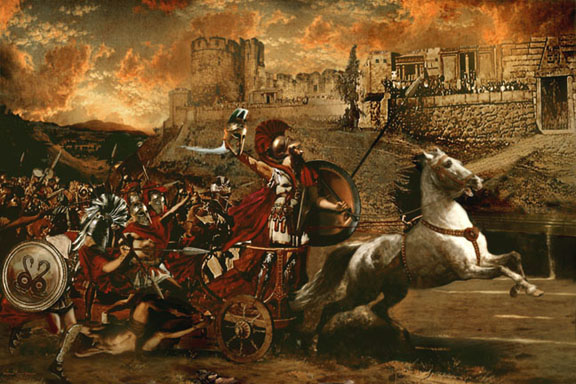
ON THE ILLIAD
by Sean Meade
What makes ‘The Iliad’ a classic? Why is it classic?
I think the primary answer is simple: it’s the characters. If you can hang tough through all of the idiosyncratic flourishes and ornaments and repetitions, the characters are compelling: Achilleus, his anger and character; the comparative nobility of Hektor and Patroklos (both of whom we know are doomed); the vagaries of the gods and their adolescent machinations; the supporting cast of Agamemnon, Menelaos the wronged, two very different men named Aias (Ajax), Diomedes, Aeneas, Odysseus, Nestor, Paris, Helen and Priam. Take these characters and others and mix them with an interesting story and you have a classic that reaches out to us from about the eighth century BC (when it was likely ‘composed’ (with heavy use of previous, oral sources) by Homer), maybe from as far back as the 12th century BC (maybe the original setting of what has come down to us as The Trojan War). ‘The Iliad’ still resonates with us today.
One reason ‘The Iliad’ can still move us is that Homer has done a masterful job of relating the ‘accidents’ of life. ‘Time and chance happen to all men’, and people who lived 3000 year ago couldn’t deceive themselves about their ability to control life the way we ‘modern’ people do. Human experience and emotions are often inscrutable. ‘Love’ (baldly called ‘lust’ by Homer) can easily destroy. When it occurs in the most influential levels of society, it can draw whole nations into its whirling vortex. Even the love between men in ‘The Iliad’ can seem illogical (no matter where you come down on the homosexuality question): why does noble Patroklos honor Achilleus literally to the death?
‘The Iliad’, of course, focuses a lot on war in ways that have become shockingly remote for most of us. Nothing is so susceptible to ‘luck’ as war. One ‘good’ soldier gets hit by stray friendly fire and dies instantly. Another ‘bad’ soldier comes through the whole war unscathed. Consider the hazards of love, life and war in ‘The Iliad’. Consider them in our own experience. It makes more sense than many theories to conclude that arbitrary and capricious gods can powerfully affect us.
My final guess (for the purposes of this mini-review) at why ‘The Iliad’ is a classic is that the poetry is timeless. This is, of course, nearly impossible to take in from one read-through in translation. My friend, Jason, listened to the abridged version and talked about its power. The commentators discuss it quite a bit, from what I can tell. Most of us (who aren’t going to pay the price to really test it) are going to have to take this on faith and rate it as we will. Poetry is a dying art, and poetry appreciation is probably in an even worse state.
I wonder what role foreknowledge plays in ‘The Iliad’. Many of us know the broad outline of the story going in. If we don’t, Homer spills it in short order. Does knowing Achilleus dies shortly after this episode in The Trojan War change our view of him? Do we cut him more slack? How does knowing that Hektor and Patroklos die within the bounds of this story affect us? Or that Odysseus lives? Or that Agamemnon will be murdered in his bath by his wife (he had it coming ;-)?
Something else that stands out about ‘The Iliad’ is the graphic war imagery. Homer’s descriptions almost seem gratuitous when he goes into detail about how one soldier killed another, where the spear penetrated and where it came out, what muscles were severed, what happened to the bowels, teeth or brain. It’s probably distasteful to many of us in the 21st century, but I think we can just chalk that up to cultural differences.
My second big question is: what does ‘The Iliad’ mean? I’m very snobbish about exegesis, especially concerning the Bible (my training, as a former pastor), but including any suitably worthy literature (with concomitant training in British Lit and Analytic Philosophy). Exegesis, in principle, is simple: what was the author trying to communicate to the audience? (So why is good exegesis so hard to find? 😉 If we are to make any meaningful connection to the original work, this is where we have to begin. You can deploy your Reader Response Theory on ‘Twilight’ or some such drivel, but keep it off my Homer (I told you I’m a snob ;-).
We come to ‘The Iliad’ at a loss because Homer’s values are very different from ours. His presuppositions are vastly different from ours. I have touched on some of these already. The gods can show up at any time and throw any wrench in the works for almost any imaginable reason. We have to take the role of the gods seriously to take Homer seriously. What did their role say about the responsibility of people? Humans retain some responsibility, almost paradoxically. Helen isn’t completely off the hook for running away with Paris. Achilleus does not get a complete pass for his anger that causes the deaths of so many Achaean comrades. Agamemnon is not excused for his overbearing pride that contributed to the disagreement with Achilleus. And even noble Hektor faces bouts of inaction and cowardice for which he is not wholly exonerated.
Another value we find hard to understand is the ancient Greek concept of nobility. It’s just born there. If you’re a shepherd who’s not the natural-born son of King Priam and Queen Hekabe, that’s all you’ll ever be: a shepherd. The main characters are noble; many are first-generation half-deities and most (all?) have divinity in their bloodline somewhere. From our standpoint, Achilleus behaves like a monster, especially in his repeated attempted-desecration of Hektor’s body (the gods protect Hektor’s body and Achilleus’ ultimate honor by preserving Hektor’s corpse inviolate in almost the perfect proverbial deus ex machina). He’s sacrificed any claim to nobility as far as we’re concerned. Not so for Homer and the ancient Greeks; Achilleus retains his nobility, though it is clouded by sins. He receives partial pardons and rationalizations. From our perspective, we view him as maybe the original anti-hero. Homer’s view is much less ambivalent, and Achilleus gets away with things for which lesser men would go straight to Tartaros without passing ‘Go’. It’s a far cry from our 21st century Western concept of nobility and our love of ‘rags to riches’ fables. It’s only riches to riches here (though maybe no one knew through the rags that you were really rich).
So what is Homer’s message? The conclusion of my barely-better-than-cursory reading is: Given that nobility and greatness are natural, almost literally gifts of fate (the Fates); and that humans are subject to the whims of the gods; it is best to be brave and seek glory (within reason–with a glance forward to Aristotle’s middle-way ethic). How’s that going to help you with your job or family? Not much. It’s fodder for thinking about societal values and a long way from whether or not to stick it out in your mediocre, going-nowhere job. (It might possibly apply to whether or not you should run away with your neighbor’s spouse.)
For most of us, ‘The Iliad’ is probably a test in proper exegesis more than someplace we should or will go to look for meaning. But maybe that’s just my soap box 😉
Charles Cameron is the regular guest-blogger at Zenpundit, and has also posted at Small Wars Journal, All Things Counterterrorism, for the Chicago Boyz Afghanistan 2050 roundtable and elsewhere. Charles read Theology at Christ Church, Oxford, under AE Harvey, and was at one time a Principal Researcher with Boston University’s Center for Millennial Studies and the Senior Analyst with theArlington Institute:
In a Time of Religious Arousal
by Charles Cameron
We live in times of considerable religious arousal – witness the Manhattan mosque and cultural center controversy, the on-again, off-again Florida Quran burning, last week’s Glenn Beck rally at the Lincoln Memorial,Hindutva violence against Muslims in India, Muslim violence against Christians, the wars ongoing or drawing to an end in Afghanistan and Iraq, the threat of an Israeli or American attack on Iran, the Palestinian-Israeli conflict and peace process… In each of these instances, religious arousal has a role to play.
It would require considerable care, research, and craftsmanship to produce a nuanced and appropriately balanced view of human nature, the current state of the world, American, European and Islamic popular, polite and political opinions, the global admixture of peoples and approaches that characterize Islam, the history of violence, religious and otherwise, the braiding in different times and places of religion with politics, the roots of violence, the roots of peace and its meanings both as a state of cessation of conflict and as a state of contemplative calm…
Such a presentation would require at least a book-length treatment, and cannot be trotted out every time some new spark emerges from the ancient fires… but perhaps I can lay out some of my own considerations about the topic here, in somewhat condensed form.
The teachings of Jesus appear to have been directed towards an audience that included regular folk: fishermen, members of an occupying military force, radical zealots, a tax-collector, a physician, a prostitute, religious scholars… a fair cross-section of human kind…
Every religion of any real “size” will have followers who are intellectuals, fearful followers, angry and reactive followers, contemplative followers – followers who are skilled in the various businesses of crime prevention, defense, contemplation, literature, the sex trade, theft, medicine, art, bargaining, diplomacy, music, architecture, investigativejournalism, yellow journalism, inspirational writing, poetry…
It will of necessity address, and over time retain traces, of all their concerns.
Every religion of any real “size” will also have begun in a particular time, place and cultural setting, and will carry considerable parts of that setting with it, although it may also contain elements of a more profound or elevated spirit…
Every religion and scripture will, I suggest, promise a garden / paradise / city which is both attainable “outside” life, in a “there” which is hard to put into words, and “within” us, a similarly difficult concept to verbalize, in the moment, here. It will also contain what I call “landmines in the garden” – verses or narratives that offer sanction to what we today might regard as abhorrent violence against the innocent “other”.
Thus in Numbers 25 in the Jewish Tanakh and Christian Bible, the Lord offers to Phineas / Pinchas a “covenant of priesthood”, because he recognized that his Lord did not appreciate an Israelite and a woman of the Midianitescopulating, and skewered the pair of them in flagrante through their conjoined parts with his spear — without first seeking the approval of the High Priest.
One of the most radical Christian Identity theorists is Richard Kelly Hoskins, who in 1990 invented the notion of the “Phineas Priest,” built around the concept of the biblical Phinehas, who used a spear to slay an Israelite and a Midianite who had lain together. Phineas Priests believe themselves modern day Phinehases, with a self-appointed mission to strike out in the most violent and ruthless way against race mixers, abortionists, homosexuals, Jews, and other perceived enemies.
It seems highly probable that Byron de la Beckwith, killer of civil rights leader Medgar Evers, considered himself a Phineas Priest, see Reed Massengill, Portrait of a Racist: The Man who Killed Medgar Evers, pp 303-305. Similarly, it appears that Rev. Paul Hill, convicted of abortion clinic murders, was considered by his friends, and may have considered himself, a Phineas Priest. Likewise Yigal Amir, assassin of Yitzak Rabin, seems to have had the Phineas story in mind when deciding, without rabbinic support, to go ahead and kill the Israeli PM.
For an example of a recent meeting of rabbis — in Jerusalem’s Ramada Renaissance hotel– to promote the permissibility under halachic law of the killing of goyim / gentiles, see this article by Max Blumenthal and the accompanying video:
Individuals, small sects or powerful movements will on occasion seize on these “landmine” texts within a religious tradition, and use them to justify acts of violence, large and small.
The Crusades, for instance, did this on behalf of Christianity and against Islam, notwithstanding which St Francis was able to approach Saladdin’s nephew, the Sultan Malik al-Kamil, across the battle lines, coming in peace, discussing matters of devotion, and departing in peace. The Islam of al-Andalus was for centuries, in comparison to the Christendom of its time, a model of scholarship and tolerance – though not without aspects of the pre-eminence of Islam, dhimmi status for People of the Book, the jizya, etc.
Mark Juergensmeyer, author of Terror in the Mind of God and currently our finest analyst of religious terrorism, recently co-edited a book on Buddhist Warfare (obligatory, cautionary note: Juergensmeyer and I are both contributors to Michael W Wilson and Natalie Zimmerman’s book, A Kingdom at Any Cost: Right-wing Visions of Apocalypse in America). The world of Zen has been rattled by controversy regarding the support of leading roshis for the Japanese imperial war effort — and there are apocalyptic references to a future war between Buddhists and the mleccha (presumably Islam) in the text ofwhat the Dalai Lama has termed an “initiation for world peace” — the Kalachakra tantra.
Alexander Berzin, who has translated for the Dalai Lama on numerous occasions when this teaching was given, comments:
A careful examination of the Buddhist texts, however, particularlyThe Kalachakra Tantraliterature, reveals both external and internal levels of battle that could easily be called “holy wars.” An unbiased study of Islam reveals the same. In both religions, leaders may exploit the external dimensions of holy war for political, economic, or personal gain, by using it to rouse their troops to battle. Historical examples regarding Islam are well known; but one must not be rosy-eyed about Buddhism and think that it has been immune to this phenomenon. Nevertheless, in both religions, the main emphasis is on the internal spiritual battle against one’s own ignorance and destructive ways.
Any and all religions can be used to justify internal struggle, external violence, external peace-making and inner peace: the question is how these various threads are interwoven in individual cultures and histories, and in our own times.
That is, I’d suggest, a matter for legitimate dispute – but not one with an easy one sentence or even single paragraph answer.
In my view, the most powerful response to the current global “jihadist” movement will come not from advocates of democracy (whether backed up or not by military force or threat of force) who will naturally appear to be interfering in affairs between the soul and its God that do not concern them – but from people within the jihadists’ own religious tradition.
Noman Benotman, one-time leader of the Libyan Islamic Fighting Group and colleague of bin Laden and Zawahiri, wrote an open letter to bin Laden dated 10 September 2010 / 1 Shawwal 1431 AH, which the Quilliam Foundation just released under the title “Al-Qaeda: Your Armed Struggle is Over“.
Benotman’s letter opens with an invocationfrom Qur’an57:16:
Is it not time for believers to humble their hearts to the remembrance of God and the Truth that has been revealed.
The text of Benotman’s message is only four pages long, and I recommend reading the whole of it – but have selected this single passage as representative of his critique:
What has the 11th September brought to the world except mass killings, occupations, destruction, hatred of Muslims, humiliation of Islam, and a tighter grip on the lives of ordinary Muslims by the authoritarian regimes that control Arab and Muslim states? I warned you then, in summer 2000, of how your actions would bring US forces into the Middle East and into Afghanistan, leading to mass unrest and loss of life. You believed I was wrong. Time has proved me right
Benotman closes:
In urging you to halt your violence and re-consider your aims and strategy, I believe I am merely expressing the views of the vast majority of Muslims who wish to see their religion regain the respect it has lost and who long to carry the name of “Muslim” with pride.
For those who are concerned at the influence of Anwar al-Awlaki on English-speaking youth, there’s a detailed 130-page critique of his approach to global jihad from a strict Salafist perspective available on the web:
On the topic of suicide bombing / martyrdom operations viewed from an Islamic perspective, I’d suggest reading the Ihsanic Intelligence “Hijacked Caravan“:
To me religious belief in Islam is, as Sufi Muslims put it, “love of God,” not a political ideology of hatred. … In my heart, therefore, I am a Sufi, but in my mind I subscribe to ‘aql/”reason”, and in this I follow the Islamic rationalism of Ibn Rushd/Averroes. Moreover, I read Islamic scripture, as any other, in the light of history, a practice I learned from the work of the great Islamic philosopher of history IbnKhaldun. The Islamic source most pertinent to the intellectual framework of this book is the ideal of al-madina al-fadila/”the perfect state”, as outlined in the great thought of the Islamic political philosopher al-Farabi.
A former clandestine officer of the CIA who operated overseas without benefit of diplomatic cover, “Ishmael Jones” has painted one of the most damning insider accounts of a puportedly self-serving and risk-averse CIA’s management culture that has ever been written. Jones’ description of a mendacious and incompetent CIA headquarters bureaucracy has less in common with critical documents like the 9/11 Commission Report or the legendary Church Committee hearings than it does with the literature produced by Soviet dissidents and defectors during the Cold War.
Jones, who quotes from the iconic 1990’s film Glengarry Glen Ross, yearned to be in an aggressive covert intelligence service whose case officers would “Always Be Closing” . Instead, he finds a Central Intelligence Agency topheavy with career managers averse to approving operational approaches to potential sources, eager to recall effective and productive officers permanently home on the slightest pretexts, comfortable with padding their incomes through familial nepotism and not above lying to Congress or political superiors in the Executive Branch. Jones navigates successfully through three consecutive overseas assignments via a strategy of keeping HQ in the dark about his activities, never becoming known as an “administrative problem” to HQ paper-shufflers and advancing operational costs from his own pocket, with the CIA eventually in arrears to Jones to the tune of $ 200,000.
CIA management in The Human Factor resembles nothing so much as the Soviet nomenklatura crossbred with the Department of Motor Vehicles. Even if we were to allow for exaggeration for humorous effect, or frankly discount 50 % of Jones’ examples outright, the remainder is still a horrifying picture of Langley as an insular bureaucracy that excels far more at Beltway intrigue than at foreign espionage or covert operations. Jones also discusses the tenure of CIA directors George Tenetand Porter Goss, the Valerie Plamestory and the post-9/11 intelligence “reforms” that aggravated the CIA management culture’s worst tendencies. Jones concludes by stating flatly that the CIA cannot be fixed and should be abolished, with its useful operational personnel transferred to the Departments of State and Defense.
ADDENDUM:
An excellent – and more detailed – review of The Human Factor by by fellow Chicago Boyzblogger, James McCormick:
….Other reviews of this book have proclaimed Human Factor a rather boring recollection of examples of institutional ineptitude and better as a guidebook for potential employees than a useful description of the CIA but I feel this is in fact the most useful book on the CIA’s clandestine service since:
which covered clandestine case officer activities, first person, in Vietnam and Latin America.
Like these two aforementioned titles, Human Factor focuses on the day-to-day challenges of being a covert case officer … the “teeth” in any intelligence organization. It is noteworthy that the Director of Central Intelligence has rarely, if ever, been one of those covert (non-State Department) officers. It’s as if your dentist was being overseen by experts in small-engine mechanics.
Ishmael recounts the minutiae of what reports he needed to write, the porous e-mail systems he had to manipulate, and the permissions he needed to gain. The timing and delays of decisions from Langley … the phrasing and terminology that was necessary to get anyone back in the US to allow any activity whatsoever. As a former stock broker, Jones was entirely comfortable with the challenges of “cold-calling” and dealing with “No” over and over again. But this wasn’t the case for his fellow trainees or for any of his superiors. At every turn, he was able to contrast his experience in the Marines (and military culture), and with Wall Street’s “make the call” ethos, with what he was experiencing as one of the most at-risk members of the Agency
Zenpundit is a blog dedicated to exploring the intersections of foreign policy, history, military theory, national security,strategic thinking, futurism, cognition and a number of other esoteric pursuits.

result, this book combines an analysis of the development of the insurgency based on available information with my ongoing work, focused on identifying the root causes of the weakness of the Afghan state.


 by
by  , Simon & Schuster, 1990, 294 pp.
  , Atheneum, 1977, 309 pp.

