“A Muslim Yugoslavia” and More Afghanistan 2050 Roundtable Posts
Tuesday, August 17th, 2010First, an excerpt of my contribution to the Afghanistan 2050 Roundtable, then from the RT in it’s entirety, so far:
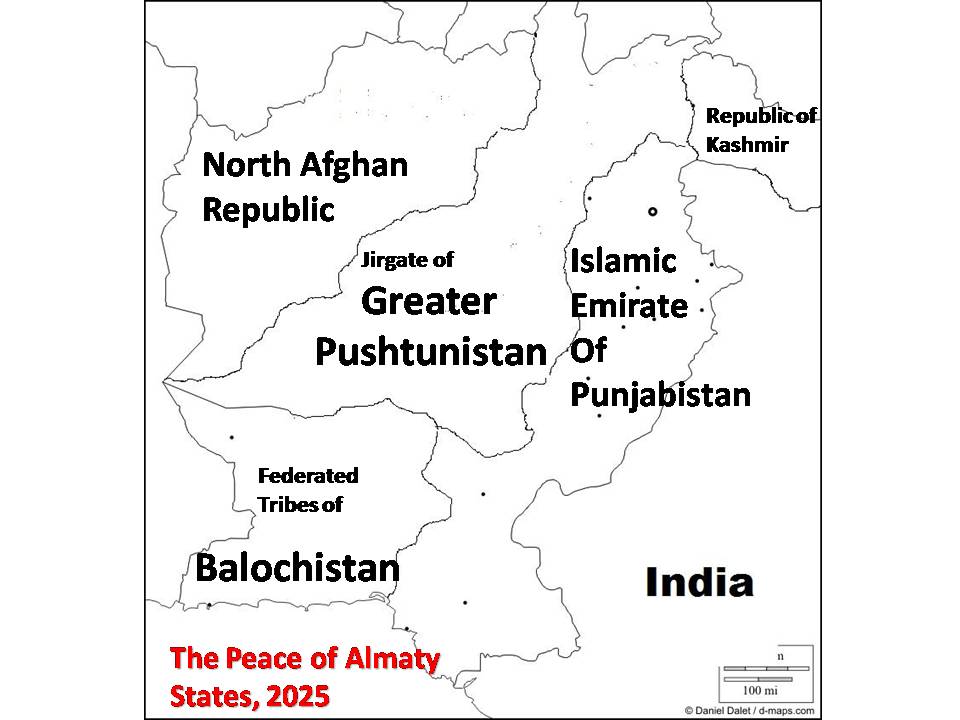
“We snatched anarchy from the jaws of defeat”
– Henry KissingerHistorians tracing the origins of the short but terrible Indo-Punjabistani nuclear exchange of 2024 over the issue of Kashmiri independence generally look to the rapid disintegration of Pakistan into secession, civil war and democide a decade earlier during the conclusion of the “American war” in Afghanistan.
Pakistan had officially been touted as a steadfast ally of the United States during nine years of an American-led campaign against the Taliban insurgency and its al Qaida partners in Afghanistan and Pakistan’s tribal territories, with successive administrations overlooking strong evidence of Pakistani collusion with Taliban leaders. This changed in 2012 when mounting war-weariness at home and an impending presidential election forced President Barack Obama to take more aggressive action to bring the war in Afghanistan to something resembling a “victory”. On September 1st, US forces in Afghanistan under General David Petraeus launched “Operation Iron Emir”, a devastating combined arms “raid” into Pakistan’s tribal territories that routed the Taliban rear areas, effectively annihilated the Haqqani Network, incuding its commander, Sirajuddin Haqqani, along with Hizb-i-Islami, and its notoriously cruel leader, Gulbuddin Hekmetyar, pictures of whose head, decapitated in a 500 lb bomb blast, were splashed across the front page of The New York Times….
Now for the rest:
seydlitz89 – Afghanistan 2050: A Political Watershed
. . . Thus ends our discussion of the military aspects of the Afghan campaign. The political roots of the campaign and how they developed – everyone obviously has their own individual story as to how their own family was affected by the momentous events this war helped to set in motion – are not so easily discernible today. President Bush’s decision to invade the country and overthrow the Taliban government in 2001 seemed a logical response to the events of 11 September, but was in reality predetermined by decades of ideological and political confusion which only came to its inevitable end with the withdrawal of Successor States forces in 2018. In effect American policy makers fancied themselves metaphysicians capable of driving human historical events/the development of political cultures through the use of military power. While the tendency among Bush Studies academics is to argue that Bush represents a unique model followed by his three successors, this puts too much influence on the man and not the times, nor the history which made those times what they were…
selil – Afghanistan 2050: A distributed solution to the distributed problem
Afghanistan history over the last 50 years is a study in the contexts of land locked populations struggling between radical theocracy and criminal ambition. Over the last 50 years we have seen a remarkable set of changes in the political influence and the social impacts of a world changing from petro economy to lithium and thorium as primary energy trade goods. Introducing these topics the following essay describes in detail the radical changes in the world economy and the effects on Afghanistan leading to today in the year 2050….
Trent Telenko – Afghanistan 2050 – Two Sucessful Campaigns in a Wider War
What was determinative in America’s victorious 2001 and 2008 – 2013 Afghanistan military campaigns was the will of the American people to keep the Afghanistan from becoming a terrorist base again. Unlike Vietnam, but like the Second World War, this war was started by a surprise attack on the American people at home. Thus the America people’s definition of “victory” was security at home, whatever games America’s ruling elite of the time were doing to either make the goal more or less than that definition.
Shane – Afghanistan 2050: Kaleidoscope of History
….It is ironic that the colonial powers of the west thought they could tame Afghanistan. The first memories of my youth were of my brave brothers and uncles taking arms against the Soviet tanks that sought to prop up the urban elites of Babrak Karmal and his fellow kleptocrats. And as a young man, I watched the ignorant Taliban Kandaharis try to impose their misguided interpretation of Shari’a on our peoples – only to be quickly ousted by the Americans and their corrupt puppet Hamid Karzai. And in my middle age I witnessed the ebb and flow of various outsiders – from Europeans to Pakistanis to Chinese – try to impose their centralized governances on us. At least until the development of sub-Saharan Africa gave them all a new sandbox to attempt to shape in their own image, leaving us to our own “archaic” ways….
T. Greer – Afghansistan 2050: Futures That Will Not Be
….Consider the stakes the United States has in Central Asia. For the past twenty years America’s policy for the region has been fairly straight forward: lend support to would-be democratic revolutionaries, contain the Russians, and do everything possible to increase America’s political influence and military presence in region. As the vanguard of the color revolutions begin to show their true autocratic colors it has become clear that this policy was a mistake. The Sino-Soviet split was one of the greatest strategic coups of the Cold War; today’s active intervention in Central Asia threatens to reverse what the diplomats of a generation past worked so hard to achieve. The interests of the United States could in few ways be better served than if China and Russia were jostling for strategic influence in Central Asia. The American presence in the region assures that this will never happen. Instead of competing in a new great game the two are drawn together to kick the imperial outsider out of their mutual backyard.
Lexington Green – Afghanistan: 40 years is a long time
This poster is meant to be funny, but it is tragic.
These pictures tell a thousand word tale of utter destruction.
Dr. David Ronfeldt – Afghanistan 2050: Tribes vs. Networks
“Because of the way U.S. forces pulled back in the Teens and wars ensued in the 20s and 30s, debates continue as to whether we won or lost over there. Yet, what matters more for this quadriform theory of social evolution is the following: The persistent grip of the tribal form of organization – and thus local resistance to allowing the institutional (statist) and market forms to take hold properly – explains what unfolded in the region and why so little could be changed. At least we finally stemmed the jihadis efforts to spread their monoform religious tribalism elsewhere. But we’ve done less well at our deeper challenge here at home and abroad: adapting to the wrenching rise of the newest of the four forms – the information-age network form
Matthew Borton – Afghanistan 2050: Effects of the US Conflict
American forces withdrew at the end of 2015, leaving only a token force for training oversight. A short bloody civil war ensued with a faction of the Islamic extremists affiliated with the original Taliban quickly retaking the government. They consolidated their power over the next five years, bringing isolated tribal groups under control with an extreme interpretation of sharì’a law. Afghans see this turn of events not as a return to a life of repression, or even a triumph for Islam, but as a victory over another in a series of invading states and the triumph of nationalists over subjugation to a foreign nation under the regime of a puppet government
Fringe – Frustration, Apathy, and Futility
Are the real reasons that great powers quit Afghanistan.
This is an especially hard, but important lesson to learn. Like many lessons of military history, it is best learned vicariously.
The current US situation in Afghanistan sheds a bright light on the Soviet experience, and transforms a different narrative from implausible to obvious.
Dr. Steven Metz – “…America’s Afghanistan strategy, with its flawed assumptions, is badly out of balance.”
I’m currently reading Andrew Bacevich’s new book Washington Rules: America’s Path to Permanent War
. He contends that at the end of Vietnam, there was a moment when the United States could have veered away from the “Washington rules” which had developed since the 1940s-militarism, the definition of instability anywhere as a threat to American security, a poor understanding of non-Western cultures, and so forth. But it didn’t.
I truly believe that Afghanistan, coming on the heels of Iraq, will provide another such moment. And I hope we take it.
James C. Bennet- Afghanistan 2050: A Travel Guide
….Arrival in storied Kabul was exciting, but, on walkabout, the first impression of the city was a bit of a letdown. So much of it has been rebuilt since the Times of Troubles that it now for the most part resembles any other Chinese city, and the crowds on the busy streets generally have the faces you would see in Shanghai, Beijing, or Lhasa. Indeed, if you are looking for the famous veiled faces or turban-clad national minorities, you must go to the Minorities Quarter, where several blocks have been restored in the traditional minority style – even a mosque! (Although the call to prayer was merely an automatic sound file played by a helpful policeman-guide.) Ironically, you will see more Tibetans on the streets than Pashtuns, since many Tibetans have taken advantage of the lower altitudes and cheap housing available in Kabul these days. It is easier to get good Tibetan momo dumplings now in Kabul than the traditional lamb and rice dishes associated with the area…
Cheryl Rofer – Afghanistan 2050: The Game-Changer
The Afghanistan War, 2001 – 2011
The Pakistan floods of August 2010 were the turning point. Very quietly, South Africa’s Ambassador Abdul S. Minty detached himself from an International Atomic Energy Agency delegation visiting Israel to deliver a letter from Nelson Mandela to Prime Minister Binyamin Netanyahu (Appendix XIX; reproduced at the end of this post). The letter urged Netanyahu to lead an effort to bring aid to Pakistan. The stated purpose was to improve Israel’s image in the world and its relations with Turkey in particular, but Mandela’s intention also was to distract Netanyahu and Israel more generally from its fixation on Iran’s nuclear program.
Joseph Fouche – Afghanistan 2050: The Future’s Just Not That Into You
EEvn beefoor thu 80 Yeerz ‘ Woor ended, selfkonfidenz fyuuld bii FIL luld 3 Reepublik intuu unuthr rownd uv intrvenshnz, thoo theez reemaand dwoorft bii thu intrvenshnz uv thu preeceedng rownd. Startng with Grenaadu (BR43), this finl rownd inkluuded intrventshnz in thu fyuuchr KPS (SAU (BR46-BR37), Gron Kooloombeeu (BR37), Ispanyoolu (BR32)) az wel az owtsiid it (EEtheeoopeeu (BR35-BR34, BR25-BR15), Srveeu (BR31-BR14), Midl EEzt (BR43-BR44, BR36-BR15), sentrl Wrld IIland (BR25-BR14)). Az 2 Reepublikz‘ fiinl intrvenshnz ended aftr 2 Korekshn, 3 Reepublikz‘ fiinl intrvenshnz ended aftr 3 Korekshn. Thu xpeereeunz uv theez intrvenshnz, howevr, led tuu frthr deevelopmentz in popuulaashn kontrool and roobotikz.
– Birth and Deth uv 3 Republiks, R21
[Legacy encoding: Even before the Eighty Years’ War ended, self-confidence fueled by FIL lulled the Third Republic into another round of interventions, though these remained dwarfed by the interventions of the preceding round. Starting with Grenada (BR43), this final round included interventions in the future CPZ (CAU (BR46-BR37, Gran Colombia (BR37), Hispaniola (BR32)) as well as outside it (Ethiopia (BR35-BR34 and BR25-BR15), Servia (BR31-BR14), the Middle East (BR43-BR44, BR36-BR15), central World Island (BR25-BR14)). As the Second Republic’s final interventions ended after the Second Correction, the Third Republic’s final interventions ended after the Third Correction. The experience of these interventions, however, led to further developments in population control and robotics.
– Birth and Death of Three Republics, R21]
Dr. Daniel Abbott –Afghanistan in 2050: The Long Type of Time
The American victory in Afghanistan would be short lived, owing to the efforts of the progressives. The stable, secure, and democratic Afghanistan inaugurated by President Obama was soon undermined by activists to his left. The Karzai government was unable to acquire the weapon systems that it needed to defend itself, and was soon swept away in all but name. To this day, the Afghanistan War is a lesson of the hollowness of military victory when the enemy has already infiltrated the nation’s capital.
The Story of the United States, 1776-2026, Beck Academic Books.
American imperialism ran aground in Afghanistan, like it ran aground in Vietnam two generations before. Attempts by the globo-capitalists in the Obama Administration to subjugate the Afghan people quickly backfired, as popular movements swept across the countryside. Of course, given Afghanistan’s unique history, many of these movements garbed themselves in the robe of the religion that is native to the region. The enormous might of the military-industrial complex was once again unable to overcome the will of the people- both American and Afghani – for peace.
The American People: Triumphs and Tragedies, the Yearly Kos Press.
Fringe – The Exit Strategy Fantasy
The principle cause of the failed US strategy in Afghanistan was the contemporary fascination with a fantasy called ‘exit strategy’. Wars arise from conflicts of interest so substantial that nations are willing to resort to force of arms to impose their will and achieve their strategic objectives. Once victory has been attained on the battlefield, ongoing threat of military force is usually necessary to prevent eruption of more hostilities. For the majority of US history, its political and military leaders understood that victory in war would allow the US to impose its strategic will on the conquered, and would require occupation for as long as the casus belli remained relevant.
Lexington Green – America in Afghanistan: Looking Back From 2050
… It is impossible to ever know the total number of lives lost, but world population certainly fell by over two billion by 2029. … The stereoimage of the first Chinese Pope, John Paul IV, embracing Zeng Hongzhang, Chairman of the New Righteousness United Evangelical Churches of China, both barefoot and clad in a plain brown robes, at the convening of the Pilgrimage Out of Darkness in New Beijing (November 2029), is the popular symbol of the beginning of the New Sanity Era. …
… With the universal re-accession of all American States, Territories, Free Zones, Free Cities and New Hansa Zones to the Restored Old Constitution, all are now signatories to the Anglosphere Network Commonwealth Heritage Association Pact of 2041. ANCHA brought an end to the unpopular legal prohibition of all positive depiction of the American military. The roaring public demand for TI (total immersion) products based on US military history continues unabated … .
There will be an update later today of Afghanistan-Pakistan related posts from bloggers and academics not participating in the RT but who are raising interesting or germane POV.

 calls “Masters” – as they rise in rank, they acquire ever greater expertise over a narrower and more refined and esoteric body of professional knowledge. This tendency toward insularity and specialization, analysis and reductionism is the norm in a 20th century, modern, hierarchical institutional culture of which the US military is but one example.

