zenpundit.com » 2011

Archive for 2011

Book

Sunday, November 20th, 2011

Thinking in Time by Richard Neustadt and Ernest May

Picked up this classic work on metacognition, history and strategic decision making for the astronomical price of…..$ 4. Including shipping.

The diminuition of the teaching of history in elite universities after the 1960’s, when the old undergraduate canon was chucked in deference to demands by student and faculty radicals for an a la carte system (to replace the old core with politicized race-gender-crit rubbish), has contributed to the decline in American strategic thinking.

Striking Iran: game vs game

Saturday, November 19th, 2011

[ by Charles Cameron — game and counter-game, FPS, Iranian nuclear attack ]

.

spec-iran-games1.png

Following up on two earlier posts [i & ii] on gaming a strike on Iran — from the FPS leagues…

The upper image shows “the designer of the first Iranian made Nuclear Energy computer game”, according to the tag-line in the Sydney Morning Herald game review, Iranian game promotes sacrifice and martyrdom — the image credit is AP.

According to the review:

In “Rescue the Nuke Scientist,” U.S. troops capture a husband-and-wife team of nuclear engineers during a pilgrimage to Karbala, a holy site for Shiite Muslims, in central Iraq.

Game players take on the role of Iranian security forces carrying out a mission code-named “The Special Operation,” which involves penetrating fortified locations to free the nuclear scientists, who are moved from Iraq to Israel.

To complete the game successfully, players have to enter Israel to rescue the nuclear scientists, kill U.S. and Israeli troops and seize their laptops containing secret information.

But there’s more: the game itself is a “tit for tat” move in an overarching game of games:

The “Rescue the Nuke Scientist” video game, designed by the Union of Students Islamic Association, was described by its creators as a response to a U.S.-based company’s “Assault on Iran” game, which depicts an American attack on an Iranian nuclear facility.

That would be the US designed Kuma\War game, Mission 58: Assault on Iran, described in the lower of my two frames.

As a Special Forces soldier in this playable mission, you will infiltrate Iran’s nuclear facility at Natanz, located 150 miles south of Iran’s capital of Teheran. But breaching the security cordon around the hardened target won’t be easy. Your team’s mission: Infiltrate the base, secure evidence of illegal uranium enrichment, rescue your man on the inside, and destroy the centrifuges that promise to take Iran into the nuclear age. Never before has so much hung in the balance… millions of lives, and the very future of democracy could be at stake.

Seems like it’s hanging in the balance still — the Kuma\War game was released in 2005, the Iranian response in 2007.

Hen’s Teeth and Presidential Strategists

Friday, November 18th, 2011


Dr. Bernard Finel, after a hiatus, has returned to blogging:

Uzbeki-beki-beki-stan-stan

….Now, I am not really making an original argument here, but there is some truth here. In a very significant sense, a president (and, by the way, I hate the way he uses “Commander-in-Chief” rather than “President” in describing his role as a foreign policy decision-maker), any president, is not really a “strategist.” When Libya began to blow up, no one went to Obama and said, “Mr. President, what should we do?” Instead, ultimately, Obama was presented with a series of courses of action developed and proposed by his staff and various other agencies and departments, and the president was asked to select from a relatively constrained set of choices.

Now, obviously,  a president is not wholly constrained. He or she could strike out in a new direction, or demand more options, or whatever. But there is, ultimately, a lot of truth to the notion that the president is ultimately more of a traffic cop than a “policy maker” per se.

….And look, this is not a Cain/Perry problem alone. I mean, Obama was tremendously thoughtful and eloquent on the campaign trail, and in the end allowed himself to be borne along with the tide on the Afghanistan surge decision. The only case I can think of where this was not the case was Nixon who, essentially, spent much of his administration waging war on his own executive departments. I’m not sure that is a better model.

Richard Nixon was a genuinely gifted geopolitical strategist, albeit one who came with serious psychological baggage, the effects of which H.R. Haldeman and Dr. Arnold A. Hutschnecker, Nixon’s sometime psychotherapist, strove to mitigate. Henry Kissinger, so valuable to Nixon as a diplomatic tactician, aggravated Nixon’s darker instincts as frequently as he calmed them (and in turn, Nixon deliberately stoked Kissinger’s anxieties to the point where Kissinger having a nervous breakdown seemed a possibility to WH staffers). I agree with Finel that presidential strategists are quite rare, but while there are more than just Nixon, they too had their share of problems.

Abraham Lincoln, who evolved into America’s greatest strategic leader by dint of circumstance, intelligence and latent talent suffered from bouts of major depression. Dwight Eisenhower, whose discernment recognized the value of strategic restraint in statecraft, had an explosively bad temper that spared neither aides nor grandchildren nor himself, contributing to Ike’s heart attacks. Even by the standards of politics, Franklin Roosevelt was unusually manipulative, deceptive and egocentric, lying with such frequency to his closest advisers that it is sometimes difficult to understand what FDR had really intended on certain issues, particularly in his last years when the weight of the war led FDR to procrastinate on making decisions.

Does strategic thinking come easier to those with psychological flaws?

The Peace Officers and the Practitioner

Thursday, November 17th, 2011

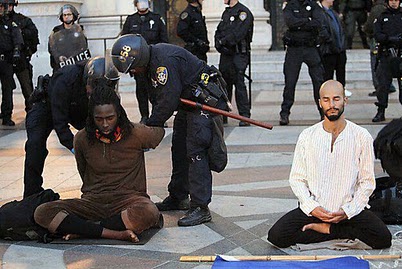
[ by Charles Cameron — disturbing and keeping the peace, OWS Oakland, paradox ]

.

disturbing-the-peace.jpg

Paradox.

It’s a bit like the koan where a zen monk is asked “is it the flag or the wind that moves?” — is peace what the meditator is dipping into, or is peace what the occupier / meditator is disturbing while the peace officers are maintaining it for the rest of us?

Here’s a photo taken a few moments / minutes later:

meditator-arrest.png

And in fact, the whole incident does seem to have passed off pretty peacefully (in both senses of the word): as the Chronicle’s SFGate blog put it in a caption:

Police peacefully detain Occupy Oakland protester, “Pancho” Ramos Stierle who was meditating while police cleared out the Occupy Oakland camp early in the morning on Monday, November 14, 2011.

*

And the zen master said, “Neither and both: it’s the mind that moves.”

Introducing SPECS: All dressed up

Thursday, November 17th, 2011

[ by Charles Cameron — analytic and esthetic game boards, HipBone Games, bishops in procession, Darth Vader, police,  OWS, clowns ]

.

spec-format-sm.png

I’ve been frustrated for a while now by the size limitations of my DoubleQuotes format, with which regular ZP readers may well be familiar, and never more so than when trying to juxtapose images — which often have to be reduced to near invisibility to fit…

Today I had a pair of photos I wanted to juxtapose for you, and came up with a new format that allows me to do a better job with images: the Specs. That’s Brit for “the spectacles, you know, ie glasses, and thus by extension “binocular vision” — but it also references “spectacle” in the dramatic sense, and (again, by extension) “specification” in the sense of offering a minimal set of requirements for grasping the essence of a situation…

Here, then, is my first pair of spectacles:

spec-01-processional.png

The top image is from a Lutheran church function in Iceland [video and further details], the lower one is from the Occupy movement…  the hi-fashion specs in miniature in the middle are by Tom Ford

And it seems to me they’re all dressed up for their respective occasions…


Switch to our mobile site