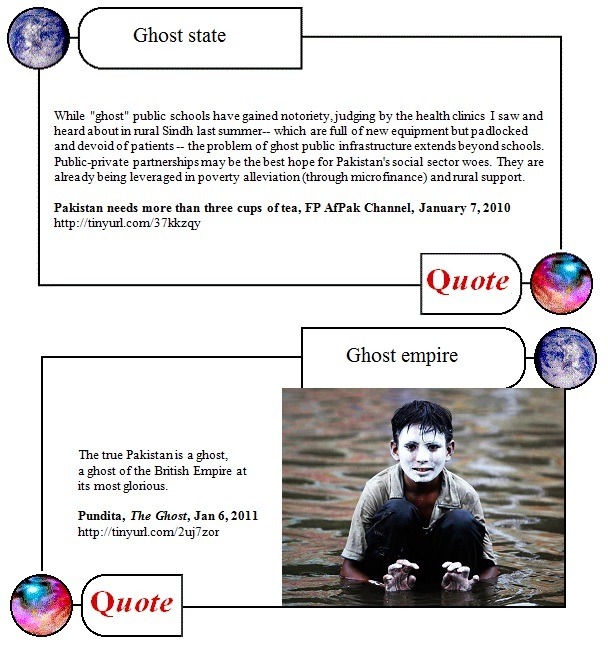
Ah yes, the entomology of war
Tuesday, January 11th, 2011[ by Charles Cameron — in playful response to M. Fouche’s recent post on ChicagoBoyz, Butterfly Effect ]
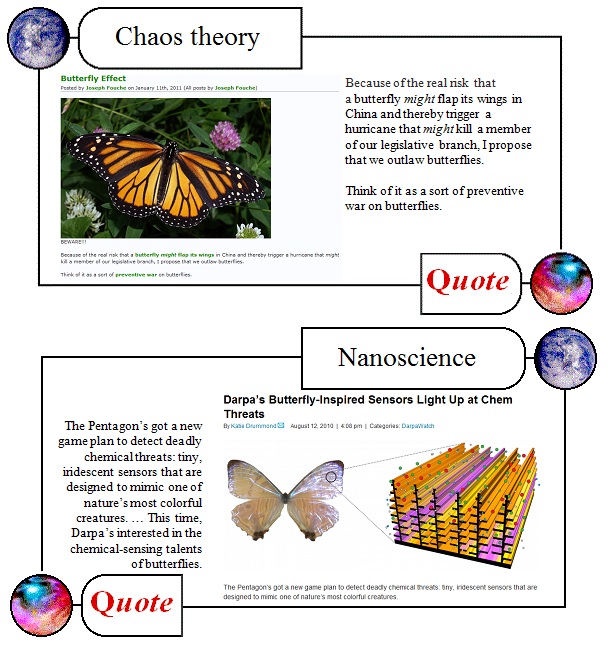
Links: Chaos theory – Nanoscience
[ by Charles Cameron — in playful response to M. Fouche’s recent post on ChicagoBoyz, Butterfly Effect ]
Links: Chaos theory – Nanoscience
A popular and respected Democratic member of Congress is shot by a lunatic and her partisan colleagues honor her by proposing to restrict political speech, give themselves special privileges at airports and to give all members of Congress and, apparently, the Federal judiciary, the statutory status of the President if the United States.
“We’ve had some incidents where TSA authorities think that congresspeople should be treated like everybody else,” he [ Rep. Clyburn] said. “Well, the fact of the matter is, we are held to a higher standard in so many other areas, and I think we need to take a hard look at exactly how the TSA interact with members of Congress.”
The indignity of it all! A Congressman, treated as if he was under the same laws as his fellow citizens. An outrage. Maybe with that “harder look” Representative Clyburn can take a little time for how his fellow Americans are being treated by TSA as well.
Perhaps granting the Democratic House minority leadership and their children a few hereditary titles of nobility and some estates on Federal lands would cut to the chase for what these people are really after. At a minimum that would be as relevant a response to the shooting of Rep. Giffords as empowering the FCC to censor FOXnews and force Rush Limbaugh off of the airwaves – and it would do our constitutional order a whole lot less harm. I am perfectly content to refer to Rep. Clyburn as Viscout, Prince-bishop or Archduke if he in turn agreed to, say, read the Bill of Rights. Better late than never, I say.
Incidentally, making credible death threats against anyone is already a crime in most jurisdictions I am aware of, albeit one insufficiently prosecuted by DA’s. Threatening USG officials is a Federal offense.
Top Billing!COMMAND POST Clint Van Winkle – The Guilt
Powerful. Poignant.
Van Winkle is the author of Soft Spots: A Marine’s Memoir of Combat and Post Traumatic Stress Disorder
The film focuses on my friend SSgt David Paxson. In 2003, Paxson and I fought at Nasiriyah together-one of the earliest and bloodiest battles of Iraq-and making the film forced us to relive those memories. It was a difficult shoot and took all of us months to recover. Talking about war isn’t easy either.
Paxson and I were 25 when we went to Iraq. One week we were in combat, trying to survive insurgent attacks and the next week we were at home, trying to survive panic attacks. After Iraq, we didn’t see each other much. We spoke, but rarely about our experiences. We didn’t talk about the smell of death, the killing, the loss of friends. Day-to-day life was a struggle, but we pretended like we were okay.
We thought we had experienced the worst life had to offer, but Paxson still had another round of pain coming his way….
The Economist – Our global oligarchs ( hat tip Jessica Margolin)
The problem is that too many of the people who allegedly claim to understand capitalism best, working in the world of high finance are in reality, too frequently, short-term time horizon, zero-sum oriented, assholes with contempt for the idea that markets, to be free, also need to be free of illicit collusion, regulatory capture and rentier self-dealing.
Pennlive.com – Dick Winters, of ‘Band of Brothers’ fame, dies ( Hat tip to Starbuck)
Dick Winters, the former World War II commander whose war story was told in the book and miniseries “Band of Brothers,” has died.
Dick Winters led a quiet life on his Fredericksburg farm and in his Hershey home until the book and miniseries “Band of
Brothers” threw him into the international spotlight. Since then, the former World War II commander of Easy Company had received hundreds of requests for interviews and appearances all over the world.He stood at the podium with President George W. Bush in Hershey during the presidential campaign in 2007. He accepted the “Four Freedoms” award from Tom Brokaw on behalf of the Army. He was on familiar terms with Tom Hanks and Steven Spielberg, producers of the HBO mini-series, the most expensive television series ever produced.
Winters was always gracious about his new-found celebrity, but never really comfortable with it. He never claimed to be a hero and said that he had nothing to do with the national effort to get him the Medal of Honor, the nation’s highest military honor. When people asked him if he was a hero, he liked to answer the way his World War II buddy, Mike Ranney, did.
“No,” Ranney said. “But I served in a company of heroes.”
Zero Intelligence Agents –Swallowing the Academic “Red Pill”
….Part of the problem for academics is the mythology of their career is not celebrated to an even reasonably comparable degree as that of the professional athlete. On my first day of graduate school one of my professors said, “Congratulations on being accepted to the program. While most people will not understand it, you have one of the greatest jobs one the planet. People are going to pay you to think, and I think that is pretty cool.”
I think it is pretty cool too, and while at face value that statement no better reflects the reality of graduate school anymore than Summer Catch reflects the realities of the Minor League baseball system, it is an important to remember what an academic career is really about: to be one of the world’s best thinkers, period. The original article attacking academia never considers this point, and rather places doctoral research as any other kind of on-the-job training. The fact is, there are very few people who will successfully navigate their graduate program and be hired as a tenure-track faculty, and even fewer who will go on to be successful academics. It is an environment where a very specific set of goals blended with unique intellectual, interpersonal and labor skills are needed to flourish, not unlike many other highly specialized careers.
Pundita –The ghost
….The true Pakistan is a ghost, a ghost of the British Empire at its most glorious.Westerners can understand, I think, what the most informed Indians already know: that without the help of the ruling families who supported the British enterprise in India the British couldn’t have lasted there as long as they did. The ruling families were the British Raj. So it was a symbiotic relationship, not a parent-child one, a relationship that created a lifestyle of timeless order.
The order was an illusion, just as an unsinkable ship is an illusion, but that was seen only when the British could no longer afford to maintain the illusion. Yet the illusion was so powerful that Pakistan’s rulers didn’t see Partition as abandoning the motherland: they would go on ruling, as they had always done, and the mighty British Empire would continue to remain their protector. The second great European war was a blip, as the first great European war had been; the British would bounce back and everything would continue as before.
When the illusion vanished Pakistan’s ruling families were left with the outward forms, the mannerisms of Pax Britannica: cricket matches, marching bands, a patronizing contempt for Hindus, high tea. That’s what they gave up the motherland for and they know it. That’s why it could take Pakistan’s ruling families another generation before they’re able to let go of a past that is more real to them than anything around them today.
That’s it.
[ by Charles Cameron — cross-posted from the DIME/PMESII boards at LinkedIn ]
I’ve been hammering away at the importance of a nuanced understanding of religious drivers in successful modeling of our world, and today I ran across some paragraphs from a book by Gary Sick that explain, forcefully and briefly, just why this seems like a big deal to me.
1
Sick, who was the National Security Council’s point man on Iran at the time of the Ayatollah Khomeini‘s Iranian Revolution, recounts how totally unprepared we were for the sudden emergence of a theocracy in his book, All Fall Down:
Vision is influenced by expectations, and perceptions — especially in politics — are colored by the models and analogies all of us carry in our heads. Unfortunately, there were no relevant models in Western political tradition to explain what we were seeing in Iran during the revolution. This contradiction between expectation and reality was so profound and so persistent that it interfered fundamentally with the normal processes of observation and analysis on which all of us instinctively rely.
On one level, it helps to explain why the early-warning functions of all existing intelligence systems — from SAVAK to Mossad to the CIA — failed so utterly in the Iranian case. Certainly, US intelligence capability to track the shah’s domestic opposition had been allowed to deteriorate almost to the vanishing point. But even if it had not, it would probably have looked in the wrong place. Only in retrospect is it obvious that a good intelligence organization should have focused its attention on the religious schools, the mosques and the recorded sermons of an aged religious leader who had been living in exile for fourteen years. As one State Department official remarked in some exasperation after the revolution, “Whoever took religion seriously?”
Even after it became clear that the revolution was gaining momentum and that the movement was being organized through the mosques in the name of Khomeini, observers of all stripes assumed that the purely religious forces were merely a means to the end of ousting the shah and that their political role would be severely limited in the political environment following the shah’s departure, The mosque, it was believed, would serve as the transmission belt of the revolution, but its political importance would quickly wane once its initial objectives had been achieved.
2
The blissful ignorance didn’t end back there in 1979. Right at the end of 2006, reporter Jeff Stein asked Rep. Silvestre Reyes (Dem, TX), the incoming head of the House Intelligence Committee (which has oversight of the entire US Intelligence Community) whether Al-Qaida was Sunni or Shiite – noting in two asides, “Members of the Intelligence Committee, mind you, are paid $165,200 a year to know more than basic facts about our foes in the Middle East” and “To me, it’s like asking about Catholics and Protestants in Northern Ireland: Who’s on what side?”
Reyes guessed wrong – not good – and so did a lot of other senior people in the FBI, Congress and so forth. Understandable perhaps, but still, not good.
The popular media keep many of the rest of us confused, too. Glenn Beck has been misinformed by the Christian thriller writer Joel Rosenberg, and refers to the “Twelvers” when he means the “Anjoman-e Hojjatieh” -which, to extend Stein’s point, is the equivalent of saying “Catholic Church” when you mean “Legionnaires of Christ”.
3
Okay, we know that religion has something to do with all this Iran – and Afghanistan and Pakistan and Iraq, and Yemen, and Somalia, and Nigeria — and maybe even homegrown — mess. And I agree, other people’s religions really aren’t our business normally, and it’s not surprising if we don’t know much about them.
Except, I’d say, when religions take up the sword, or have significant power to influence decisions about the use of nuclear weapons — at which point it’s appropriate to get up to speed…

Zenpundit is a blog dedicated to exploring the intersections of foreign policy, history, military theory, national security,strategic thinking, futurism, cognition and a number of other esoteric pursuits.
Customized Web Site & Blog Design