Rationality: Saw this on Facebook
Thursday, March 17th, 2011Hat Tip to Dan F.

If only…..
Hat Tip to Dan F.
If only…..
I was involved in a discussion elsewhere regarding the excellent and thought provoking article at SWJ by General Huba Wass de Czege on operation art, design and thinking:
Operational Art is Not a Level of War
Strongly recommend you read the article first. My remarks follow, slightly revised:
I have only read a few pieces by General Wass de Czege, those published at SWJ but the caliber of the general’s self-reflective, professional, thinking is something we should strive to emulate.
Here is what seems to be the crtical point in his article, after which I have a comment:
“We doctrine writers of the 1980’s inserted operational art as a mid-level of war between tactics and strategy – making it the art of translating the governing strategy into the implementing tactics of the “tactical echelons.” And thus, making operational art the province of “campaigning” generals. Because of the way I was conditioned to think then, that strategy was the business of the upper echelons and tactics the business of the lower ones, I miss-translated an idea borrowed from Soviet doctrine about the mediation between strategy and tactics. I was then a product of indoctrination in the US Army’s War and Command and Staff Colleges. These institutions, and the business schools of the time, taught based on the industrial age organizational model of the head (where strategic decisions are made) and the rest of the body (where tactical decisions implement the strategy). I now believe that, without violating the historical meaning of the terms strategy and tactics, this is a much more useful and natural way to think of the relationship between tactics, strategy and operational art.
In fact, this allows one to close the conceptual gap between our bifurcated way of thinking about warfare between nation states and that between states and armed movements of any kind. It also helps do the same for the two tactical operating modes that have recently surfaced in new Army concepts – “combined arms maneuver” and “wide area security.”
Campaigning, another word for operational art, can occur at any scale, and in any milieu, as a close look at what our best company, battalion, and brigade commanders have been doing in Iraq and Afghanistan. “
I think maybe this should be qualified – re; operational art is not a “level”. It is a level of war and it is not at the same time.
The difference between the two I think is *how* we are employing the term: “Operational art” as a historical, taxonomic, description of how a military-political command structure has behaved/behaves as a warfighting institutional culture vs. methodologically how they *could* and *should* think about warfare and in turn behave at any “level”.
It is not surprising to me, thinking in terms of history, that Wass de Czege, where he wrote that he was in error, was drawing from Soviet examples. If we think about “operational art” as a “level of war” we are led to military powers where powerful ideological constraints systemically interfered with the “natural” clausewitzian connection between Policy and Strategy.
The USSR’s Red Army, from the early days of Commissar-Commander relationships in battle, through the Stalinist era to the more modern and restrained (i.e. non-murderous) controls of the Army’s Political Department and vetting security checks for promotion carried out jointly by the military, State Security and Party organs, created an atmosphere where deferral of political implications caused a) a segregation of an officer’s intellectual initiative to organizational and technical military questions and b) constructing military strategy and operational campaigns to at least nominally reflect Marxist-Leninist dogma and the Party line as a matter of necessity, and for a period, in an effort to try and avoid being physically liquidated.
Most of the Soviet Union’s most gifted military strategists and tacticians were unsuccessful in this regard and perished (ex. Svechin, Tukhachevskii, Blyukher). Arguably that left an institutional legacy in it’s wake that narrowed the conceptual framework with which Soviet Marshals and generals approached planning for war, including nuclear war.
Germany is another example, with the policy-strategy split favoring a professional military focus on operational art emerging as early as 1870 in tensions between Bismarck and Moltke over the war with France, growing worse during the Great War until during the Third Reich, a state of enforced paralysis occurs after 1942 on the Eastern Front. In theory, Hitler, who was his own war minister and commander-in-chief of the Army in addition to being the Supreme Commander, Fuhrer and Reich Chancellor, could (like Stalin) have resolved any contradictions or discordance between Policy and Strategy. Hitler deliberately chose not to do so and his paranoia led him to eventually limit even his field commander’s tactical flexibility (some generals, like Rommel, resisted this more effectively than others).
The US military, in my view, suffers a similar fixation. The reasons are very different – proper constitutional deference to civil authority coupled with a limited or absent capacity of most civilian political authorities to think in a complementary strategic fashion that would allow them to best guide their military commanders in jointly constructing a seamless bridge between policy-strategy-operational campaign. Another reason, though I do not want to go into it here, is a cultural reaction to the experience of the Vietnam War that became embedded in the officer corps during the shift to the AVF starting with the Nixon administration.
Tom Ricks had a very interesting post at Best Defense while back on the Hew Strachan article in which Ricks argued against the existence of an operational level of war, but as we are not discussing platonic forms, militaries are at whatever “level” of war for which their culture institutionally encourages officers to think about and plan. So in that sense, Wass de Czege is absolutely correct – they can and should be thinking across the whole range and not in “slots”. However, if they don’t do what he suggests and if they do predominantly focus on one “level” as most of their thinking and planning, be it tactics, operations, strategy. Then that level “exists”, it leaves a bureaucratic “trail”, grows a structure to execute it and will be put into practice during a war – at least initially until events force a change of practice from below (the field) or above ( political leaders).
[ by Charles Cameron — cross-posted from SmartMobs ]
*
An Easter Egg, according to one online definition, is an “undocumented function hidden in software that may or may not be sanctioned by management”. All sorts of media can in fact have Easter Eggs hidden in them, and the same definition goes on to mention occurrences in “video games, movies, TV commercials, DVDs, CDs, CD-ROMs and every so often in hardware.”
Well, okay. As of now, they can also be found on Fox News. Someone just sneaked the name of a Japanese rock club into the list of Japanese nuclear power plants:

The definition of Easter Egg is from Your Dictionary.
The Fox News screen-grab is from Business Insider.
The image of the young rocker is from the Shibuya Eggman club website.
The song the young man is singing is undoubtedly I am the Walrus.
The hat-tip goes to Daveed Gartenstein-Ross, @DaveedGR, who pointed me to another Faux-pas, this one involving Pakistan and padded bras.
The divine comedy is that we can still find humor in the teeth of tragedy.
The triple tragedy is that Japan is reeling from quake, tsunami and nuclear plant failure.
One of the key chapters in my friend Howard Rheingold‘s book, SmartMobs, is titled Shibuya Epiphany. And that’s my epiphany for today.
[ by Charles Cameron ]
*
Two stories — continents, centuries and cultures apart — yet as remarkable for their similarities as for their differences. The first concerns a US military defense attorney’s first meeting with a defendant at Gitmo, the second a zen monk…
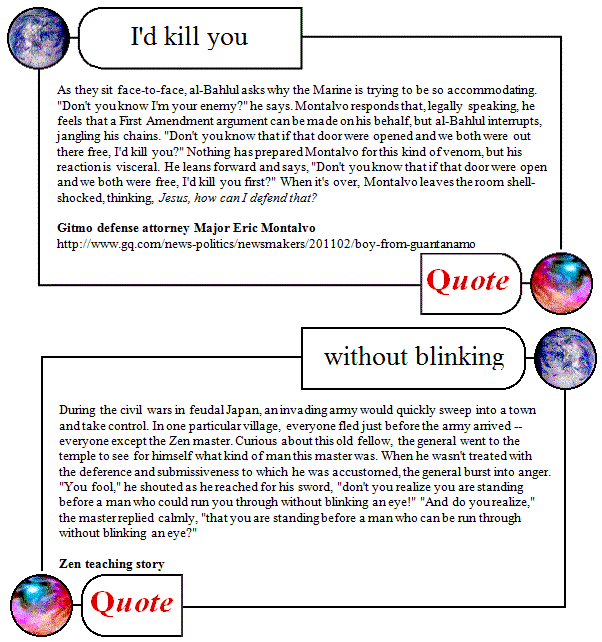
I already knew the zen story, so the Gitmo version positively flew off the page at me.
I suppose some people will prefer one story, some will prefer the other: for me it’s the almost stereophonic effect of knowing the pair of them that I find more interesting than knowing either one of them separately.
Either one is impressive — together, they dance.

Top Billing! Sic Semper Tyrannis-#Libya – De Opresso Liber
What to Do:
I’m certain there are SFODAs (SF Operational Detachment Alpha) that have planned and trained for employment in Libya to support guerilla operations. But given our decade long preoccupation with Iraq and Afghanistan, those teams may not be immediately available or not immediately ready to move into Libya. On the other hand, I’m sure there are teams with Arabic and desert training ready to go in the 3rd, 5th or 10th Groups. The headquarters for the operation would probably be in Stuttgart, Germany where EUCOM, AFRICOM and, conveniently enough, 1st Battalion, 10th SFGA are located. An assessment/ command team should be immediately inserted into Benghazi to make contact with the Libyan resistance. In a previous post I alluded to the difficulty and criticality of this initial contact. How this team will be received is unknown. However, I am getting the impression that the resistance forces initial euphoria is being tempered by the realization that they have a difficult struggle ahead of them. This assessment team will serve as liaison to the resistance leadership and a command element to the SFODAs to follow. The assessment team will determine the size, abilities and needs of the resistance fighting forces and relay this information to Stuttgart so the SFODAs can properly prepare for their insertion. The ODAs will be in isolation intensively preparing for their insertion and mission execution. ….
Great Satan’s Girlfriend –Arab League To The Rescue?
‘Aqoul –The Full Q. Rebound, & Support
Austin Bay –Blunting Gadhafi’s Air Power Advantage
The Arabist –Libya dispatch: Momentum
Abu Muqawama – For Intervention in Libya: Two Views and The Rebels Love Us, Right?
Thomas P.M. Barnett –WPR’s The New Rules: Obama Abdicating U.S. Leadership in Libya
SWJ Blog (Frank Hoffman) – Wrong War, Wrong Policy, or Wrong Tactics?
…The Long War against extremism has spawned an explosion in books on global terrorism and America’s interventions in Iraq and Afghanistan. While Operation Enduring Freedom was the first counter-blow, following quickly on the heels of 9/11, it has not garnered as much attention as the larger Iraqi conflict. In contrast, the protracted contest in Mesopotamia generated George Packer’s Assassin’s Gate, Tom Ricks’ superlative Fiasco and The Gamble, and Linda Robinson’s Tell Me How This Ends among others.
Afghanistan has produced some notable exceptions. Sean Naylor’s Not a Good Day to Die topped the field until Sebastian Junger’s War was issued last year. The former was an operational history of the ferocious fight against Al Qaeda in the Shahikot Valley during Operation Anaconda in March 2002. Junger’s micro-epic focused more narrowly on a small unit over a longer period of time in 2008 in the Korengal Valley.
The imbalance in our bookshelves is starting to become rectified, and Bing West’s latest book tops the list. Mr. West, a former Marine, Pentagon policy official and noted author, brings much insight and no small amount of prior experience to this particular subject. During the Vietnam War, he had the opportunity to closely examine creative approaches and political complications of modern conflict. His first book, the renowned The Village, captured the complexity of American efforts to provide local security assistance to a foreign population beleaguered by a fierce conflict.
Swedish Meatballs Confidential(NSFW) –More On The Boundary Break
A little IO milestone.
Recommended Viewing – Again:

Zenpundit is a blog dedicated to exploring the intersections of foreign policy, history, military theory, national security,strategic thinking, futurism, cognition and a number of other esoteric pursuits.
Customized Web Site & Blog Design

