zenpundit.com » 2012

Archive for 2012

Form is Insight: the project

Monday, October 22nd, 2012

[ by Charles Cameron — about the (not yet titled) book (or post-book project) i seem to be writing, which offers a grand slam intro to an array of box-free contemplative and artistic approaches to creative thinking, and hence opens fresh angles on intelligence ]
.

One thing I can promise: whatever this project turns out to be, it won’t be predictable.

credit for this incredible image: Roger Dean

.

This project won’t take you over familiar territory, congratulating you on holding the same opinions as the author and adding in enough choice details to keep you interested. I’m not aiming to teach you the same thing you already know, only better, more interestingly, more precisely, or in greater detail. I’m aiming to question you, challenge you, and give you a whole new range of optics through which to view the world.

**

So, here we go.

I think I am finally at the point where the book (or whatever it is) I’ve been gathering inside me all these years is ready to be written. Some of it has already emerged in earlier posts here on Zenpundit — you don’t known and couldn’t count how many thanks, Mark — and this is certainly where I’ve been developing the style of integrated visuals and verbals that gives the project its flavor — so I’d also like to use my posts here to discuss the thing with you as I go along.

The project is about intelligence in the widest sense, including heart and mind, and with particular focus on creativity. I’m addressing this from two standpoints that mesh together well, and I’m addressing it to two audiences that I believe also mesh together well.

The standpoints are (i) meditation and (ii) the arts, and the audiences are (i) the “intelligence community” and (ii) bright people in general.

I believe that meditation cultivates a spacious mind-set in which we can hold multiple concerns in mind at the same time – the opposing needs of different people, stakeholders, sections of society, the environment, etc – thus seeing things from multiple angles and in balancing & thus balanced ways. And I think the arts serve as the primary means for expressing these balances with all their nuances and shadings, and that techniques from within the arts such as polyphony, chiaroscuro, formal constraint and pattern can teach us to shape multi-faceted insights like these into rich and complex understandings – complex patterns that respond to complex situations. I’ll go into all this in detail as we move along, with examples.

I also believe that this kind of creatively patterned insight — embodying artistic methodology in the context of complex problems with a “fresh” and open mind – will be of interest beyond the intelligence agencies and policy-makers, to business people, artists, and also — importantly — the bright general public, which I take to be a far larger subset of the population than we commonly think, and always eager for reading that doesn’t talk down to them but appreciates their own intelligence and good will.

For now let me just say that I’m very excited, because this seems (at last) to be a project that ties together my game-work with Sembl, the think-tank side of me which has been monitoring religious violence, jihad and terror and working towards nuance, understanding and peace these last dozen years — and my sense of creativity as a writer and poet.

Ripeness is all: I suspect the time for this venture has arrived.

**

Here’s the single page overview I’ve written, with a working title:

Intelligence is Zen: understanding our complex world with koans in mind

Just a few days ago, the Director of National Intelligence, James Clapper, referenced Pirsig‘s book, Zen and the Art of Motorcycle Maintenance, as key to the Intelligence Community’s work in understanding and adapting to the many, varied, intersecting problems we face in the world today. As I noted, Clapper was focused a bit more on the biker wisdom than the Zen to be found in Pirsig’s book, but he does raise a question I’ve been addressing for some years now:

What does the contemplative mind have to offer in terms of understanding a complex world?

To my mind, the creativity which is all the buzz of the business world, aimed at solving what are called “wicked problems” — problems that feature multiple stakeholders with multiple aims and objectives, aims and objectives which themselves shift over time so the problems are “never the same river twice” – requires a major mental and emotional shift. Reverie and meditation free us up to make the shift: the shift itself is poorly understood.

Our present, mostly linear way of thinking favors either/or side-taking, dubious cause-and-effect expectations which fail to take complex feedback loops into account, followed all too often by a rush to judgment. We need a whole new – old, even ancient – way of thinking.

Our problems are complex because they overlap, they ripple through one another. In Buddhist terms, they are “interdependently arising.” Not surprisingly, the way of thinking that is required to gain a deeper insight into “interdependently arising” problems can be found in explicit form in such contemplative traditions as Madhyamika & Zen, Taoism, Sufism, and their Abrahamic contemplative analogs. At the heart of these systems is fresh thinking – thought refreshed by quiet.

Furthermore, the shaping of insights in an open field of thought is something the world’s artistic traditions have long dealt with, and there are schools of insight not just available but recorded in exquisite detail in the world’s traditions of poetry, music, painting, theater, film… in patterns that are found in nature, in culture, and in the very turbulence we now must learn to flow with.

The project therefore takes a meditation-influenced approach to intelligence, both in the sense in which Clapper would use the word, relating to the intelligence analysis which develops and influences our decision-makers’ understanding of what’s needed, and in the more general sense of those capable folk with bright minds, keen insights, sharp instincts, warm hearts.

I’ll propose a series of ways of looking differently – with application for anyone, whether artist, intel analyst, businessman, policy-maker, or lover – that cut to the essence of creativity: lateral, analogical, holistic thinking, witnessing pattern beneath the surface of things. My examples will be mainly drawn from terrorism, which I have been monitoring for a dozen years: my style is that of a poet and an eccentric Englishman.

My subtext, my subliminal message, will be contemplation and artistry as profound common sense.

Some interesting pre-debate readings, left and right

Monday, October 22nd, 2012

[ by Charles Cameron — first, the humor, then the serious stuff — including insider and outsider claims as to who belongs with what religious grouping ]
.

Two items from my inbox on this day of the Presidential Foreign Policy debate play humorously with the, for want of a better term, issue of Muslims and Mormons:

On the top, Tim Furnish, author of the book Holiest Wars and an expert on Mahdism, heads up a brief post on his MadhiWatch blog with an image out of South Park and the caption: The quintessential Mormon v. the original Mahdi! It’s ON! That’s from the right.

From the left, Frank Schaeffer, who “left” the movement his influential “right” father, the evangelical theologian Francis Schaeffer, helped found, and is now an Orthodox Christian of a more sacramental and liberal stripe, plays a rather different game in his Huffington Post piece, posted under their Comedy header, and purportedly describing an “alternative USA somewhere on a planet far away and not so long ago…”

Okay, that’s the fun. The serious part, for me, boils down to these two things:

**

Schaeffer has a point, I think, in mocking the Billy Graham organization’s sudden and opportunistic dropping of Mormonism from the list of cults on their My Answer page.

I support the right of Latter-day Saints to call themselves Christians, since they follow the teachings of Jesus Christ as they understand them.

I support the right of other Christians to view them as non-Christian, should they feel obliged in good conscience to do so, since Mormons consider the revelations of Joseph Smith on a par with the canonical gospels, much as Moslems consider the revelation to Muhammad as a completion of the Towrat and Injil (Jewish and Christian revelations).

And I don’t much like the term “cult” as applied to people whose beliefs differ from one’s own in any case, since it tends to dehumanize those to whom it is applied, as witness the tragedy of the Branch Davidians in Waco not too many years ago.

I am not entirely opposed to the idea of adjusting religion to suit a changing world, but I have to say this move on the part of the Graham organization appears to be a totally inauthentic PR move, made for political and not theological reasons, and wide open to the appearance of hypocrisy. If, on the other hand, it leaves all concerned more willing to respect each other as individuals across theological borders, that’s something I can readily applaud.

As usual, there are nuances within nuances to be considered.

**

And Tim Furnish’s use of an image from South Park (I imagine it’s from their Super Best Friends episode) is pure eye-candy. It’s an attention grabber, all right, and it’s function is to point you to Furnish’s recent piece on History News Network, titled What Would a Mitt Romney Foreign Policy Look Like? We’ll learn more about that tonight, I imagine, but Furnish’s column makes interesting preparatory reading:

Ironically, rather like Obama, Romney sees the events of the “Arab Spring” and the abortive “Green Revolution” in Iran through neo-Wilsonian lenses, as evidence of Middle Eastern masses yearning to breathe free — a “struggle between liberty and tyranny, justice and oppression, hope and despair.”

Interestingly enough, the question of who can or should not be tagged with a particular label is central to Furnish’s post. Discussing Romney’s use of the term “extremism” seven times in his Virginia Military Institute [VMI] addresss, he writes:

Only once, note, did he preface the term with the adjective “Islamic.” However, by that one example of intellectual honesty, Romney locates himself light-years ahead of the Obama administration, which actively discourages honest discussion of the fact that 61 percent — 31 of 51 — of the foreign terrorist organizations on the State Depatment’s list thereof are Islamic and which, further, sanctions counter-terrorist trainers who dare to utter words such as “jihad.” One wishes he would simply call an Islamic extremist spade a spade — but Romney is allowing himself to be constrained by his stable of advisors, as well as, perhaps, the pro-Islamic tendencies inherent in the Church of Jesus Christ of Latter Day Saints. Someone needs to tell the Governor that naming Islamic extremism in the defense of Western civilization is no vice.

FWIW, I am in favor of recognizing that jihadists are influenced by their own versions of Islamic doctrine, within widely varying degrees of flexibility, so the phrase “Islamist extremists” makes some sense to me. And I am equally in favor of allowing those Muslims who see the jihadist’s theology as alien and contrary to their own Muslim tradition to make it clear that in their understanding of Islam, the “jihadists” represent an aberration from the faith. Nuance again, nuance.

Okay, that reference above to the “pro-Islamic tendencies inherent in the Church of Jesus Christ of Latter Day Saints” is linked to another of Furnish’s pieces for HNN, in which he asks Has Mitt Romney’s Mormonism Influenced His Views on Islam? — in which Furnish quotes Romney thus:

I spoke about three major threats America faces on a long term basis. Jihadism is one of them, and that is not Islam. If you want my views on Islam, it’s quite straightforward. Islam is one of the world’s great religions and the great majority of people in Islam want peace for themselves and peace with their maker. They want to raise families and have a bright future. There is, however, a movement in the world known as jihadism. They call themselves jihadists and I use the same term. And this jihadist movement is intent on causing the collapse of moderate Muslim states and the assassination of moderate Muslim leaders. It is also intent on causing collapse of other nations in the world. It’s by no means a branch of Islam. It is instead an entirely different entity. In no way do I suggest it is a part of Islam [emphasis added].

Here’s where the delicate balance is required.

On the one hand, we need to be clear — especially on the analytic and policy-making levels — on the ways in which Islam can be and is being interpreted as providing divine sanction for sustained campaigns of terroristic violence.

And on the other, we should in no way encourage — particularly at the level of popular public opinion — the idea that we are “at war with Islam”, an idea which leads to such things as the dehumanizing and killing of American (not necessarily even Muslims) citizens within our own shores, and an increasing sense that America is in fact at war with Islam in the minds of some few Muslims here and many more abroad — who then become prey for further radicalization, as rage on each extreme fuels the other in the multiple echo-chambers and feedback loops of YouTube and the net.

**

And for what it’s worth, Tim F and Frank S — you should both talk to your editors about proof-reading. Tim, the Mormon church is the Church of Jesus Christ of Latter-day Saints if I’m not mistaken, with a hyphen and lower-case “d” in “Latter-day” — strictly FTR. And Frank — you get Dinesh D’Souza‘s first name right on two occasions — why spell it Dnish and Dinish on two others?

Oh well, we all make mistakes. I tried to type the word “to” the other day. You might think that’s simple enough, but I spelled it “typo”. Oops!

Feel free, y’all, to let me know what I’ve mis-spelled, misunderstood, or just plain missed, okay?

A Handy intro to Networks

Monday, October 22nd, 2012

Blogfriend Rob Paterson has two concise posts up on understanding networks and network theory. If this is a subject you want to know more about, they are must-reads.

My Network Revealed – Now what can you learn about yours?


….Here is my social network as created by the Mapping tool on Linkedin. It’s not the 100% true picture but it looks like 90% to me. You can use their mapping tool by going here.

If I am right and we are moving to an economy that depends on our networks, then it is essential that we learn what each of our networks means and what we can do to make them healthier. So, with that in mind, let’s look at mine and I will share some lessons with you.

Next week, I will post a podcast that I recorded yesterday with the Master of Networks, Valdis Krebs. Anything I know is because of him. He will go much deeper than I – so this is an introduction.

Diversity – In nature diversity is a good thing – so it is with our social networks. You can see that I am connected to a series of worlds. PEI , Public Media, Network Thinkers, Family and I have 2 outside nets of New Military Thinkers and my legacy Corporate connections.

I think that this does not look too bad – I have good links into many fields. How does your world look? 

Our networks are like gardens, we can always make them better. We can always add and remove. We can always pay attention. ….

Read the rest here.

Human Networks – A masterclass by the Master Valdis Krebs – Podcast #networks

This is Valdis Krebs – The Galileo of human Social Networks – ie the person who shows us what they look like, when before they were invisible, and who shows us the simple rules that drive them. 

The few nations that were early into navigation and exploration in the 16th century, did very well. As we ourselves move into a world where all the advantages will accrue to those that understand Networks, I think it is vital that we understand how to navigate in the Network world. 

The problem that many of us have is that when we hear the work “Network” we think of TV networks or Telephone networks that are driven by the old rules of engineering. What Valdis talks about mainly are Natural Networks, of which human social networks are a part. These are driven by the rules of Emergence and Nature and NOT by the rules of the CEO.

The good news is that the Rules of Nature in this regard are simple to understand and to operate. 

Network copy
This is the “Map” that we are now going to explore.

Read the rest here.

Valdis Krebs is indeed the master of network-mapping and leveraging social networks


Recommended Reading

Monday, October 22nd, 2012

Top Billing! Inkspots (Jason Fritz) – Antony Beevor’s “The Second World War”: Strategic analysis and myth-busting

In the acknowledgements to his latest history, TheSecond World War, Antony Beevor says that he wrote this comprehensive tome on one of the biggest events in human history because he wanted to fill in the gaps to his own knowledge of the topic. But, he says, “above all it is an attempt to understand how the whole complex jigsaw fits together, with the direct and indirect effects of actions and decisions taking place in very different theatres of war.” In this, Beevor succeeds where no other historian I have read has. Weighing in at 833 pages (with notes), Beevor deftly describes and analyzes the political and military strategic events, people, and decisions that started, fought, and ended World War II. Potentially more importantly, he debunks one myth after another surrounding this war.
Geographically and politically, the European and Pacific Theaters were fairly cordoned off from each other, outside of the involvement of the United States and the British, but not entirely. Beevor pulls the thread to examine how the Soviet victory at Khalkhin Gol in eastern Mongolia in the summer of 1939 ensured that the Soviets stayed out of the eastern war (Beevor is not, of course, the only historian to make this important point) and how that affected both theaters. As he pulls the thread further, the interactions of east and west, Axis and Allies, become more acute. Nazi Germany and Imperial Japan have almost no strategic interaction (there are a handful of exceptions), but their actions on three or four fronts each create a strategic graph theory problem of biblical proportions for the Allies. As a big-picture example, the United States did not just face a Pacific versus Europe resource competition. The United States faced resource competition between Stillwell’s command supporting the Chinese Nationalists, MacArthur’s forces, Halsey’s forces, the preparation for an invasion of western France, operations in North Africa and then Italy, strategic bombing campaigns on both sides, and Lend-Lease to many a slew of locations. To compound this, American leaders needed to maintain support for the war at home and keep the Alliance together while trying to shape the post-war world through a political minefield of communists, socialists, fascists, colonialists, revolutionaries, and democratists. All while trying to actually win the war. If you consider the number of facets and decisions required in this complex world, multiply these considerations by the same problems with which all of the other Allies (and enemies) were forced to contend. The result is an exponentially large equation to determine the outcomes of a world in flux moving at the speed of a tank. Beevor is at his best in this work when he examines these interdependencies of these fronts, the Allies’ force structure to address them, and the inter- and intra-national political considerations.  For students of strategy, this alone makes The Second World War worth reading.

Fast Transients –What hath Boyd wrought? 

Or “wrote.” Written.

Boyd is sometime criticized for not having sat down and written Patterns and his other briefings into nice books. They claim that his ideas are hard to fathom just from his briefings.

But Boyd’s framework, although deep and complex, is not esoteric. In addition to “Destruction and Creation,” Boyd produced a continuous stream of writings from August 1976 until January of the year before his death:

Item Date Pages Words W/P
D&C 9/1976 3,900
PoC  12/1986  185  21,000  113.5
OD  5/1987  37  3,400  92
SG  6/1987  59  4,700  80
CS  8/1992  38  2,900  76
EOWL  1/1996  4  350  87.5
TOTAL (x. D&C)  323  32,350  100
TOTAL  36,250

“Destruction and Creation” is a special case. Set in 12 pt. Arial and double-spaced, it runs about 15 pages or slightly over 250 words/page. Applying that ratio to the body of Boyd’s post-retirement work equates to a book of some 145 pages.  Which is not long, but not insubstantial, either, about the same length of Cleary’s The Japanese Art of War or the Griffith edition of Sun Tzu, both including the commentaries but without appendices. By comparison, the Sun Tzu text itself typically runs 8,000 – 10,000 words depending on the translator.

Given how long it takes to write a manuscript, not to mention finding a publisher who will promote it, it’s hard to see where Boyd would have found the time. Publishers typically want manuscripts of 80-100,000 words, which produces a 400 page book that can be priced in the $25-30 range (today’s prices). Check out Tom Barnett’s books, for example. Obviously, established authors can get different deals, but Boyd would have been a risk. And it would have been a big risk for Boyd because only a tiny fraction of manuscripts by unknown authors ever get published….

Campaign Reboot – Decision making and Failing at mental modelling 

Ribbonfarm –Economies of Scale, Economies of Scope 

Dart Throwing Chimp – A Chimp’s-Eye View of a Forecasting Experiment and When Is a Forecast Wrong?

Steven Pressfield Online – (Callie Oettinger) Outreach, Part I: The Introduction and (Shawn Coyne) Why It Takes So Long to Publish a Book

Slouching Toward Columbia – Kindly Seeking Mastery?

Dr. Tdaxp – The Rise of the Communists and the Fall of the KMT  

Michigan War Studies Review – Fighting Elites: A History of U.S. Special Forces and The War and Its Shadow: Spain’s Civil War in Europe’s Long Twentieth Century 

That’s it.

Report: Boyd & Beyond 2012

Friday, October 19th, 2012

I wanted to offer my thoughts about Boyd & Beyond 2012, now that the dust has settled and the participants are recovering from two days of intense intellectual engagement by day and partying at night.

First, thanks are in order to those who made Boyd & Beyond 2012 a reality:

To the United States Marine Corps, for use of their facilities at the Command and Staff College, the Expeditionary Warfare School and the Al Gray Research Center.

To Colonel Stan Coerr, USMC – the  principal organizer of the Boyd & Beyond Conferences.  It is Colonel Coerr’s hard work during the year that makes these events possible.

To Major Marcus Mainz, USMC – whose dynamic style helped facilitate a very tight schedule of speakers and kept everyone well fed at lunch.

To J. Scott Shipman – my co-blogger, friend and the official host (with his lovely wife Kristen) of the annual Boyd & Beyond Party, where the conversation continued into the night ( they were also my most hospitable hosts as well).

To the archivists and staff of the Al Gray Research Center who made our examination of Colonel John Boyd’s private papers, briefs and personal library enjoyable and informative.

To the folks from Adaptive Leader, who provided the coffee, water and snacks, of which I had too much 🙂

And finally to Gahlord Dewald for creating a much  better home for the conference’s twitter archive.

Now on to the conference itself……

Everyone had their favorite presenters and the number of questions often exceeded the time available, but we could loosely group featured individuals into clusters based on their role at the conference:

THEORISTS:  Dr. Chet Richards, Dr. Venkat Rao, Dr. Terry Barnhart, Michael Moore, Matt Lungren

WARRIORS: Brigadier General Stacy Clardy, USMC, Captain Paul Tremblay, Gunnery Sergeant Nick Galvan and Damien O’Connell ( my apologies to Nick and Damien as I entered the case study after it had already begun and did not catch the intros, Nick might be a Master Gunnery Sergeant and I do not know Damien’s rank at all)

SCHOLARS:  Dr. Katya Drozdova, Adam Elkus, Mike Miller

PRACTITIONERS: Greg Wilcox, Marshall Wallace, Pete Turner, Mike Grice, Gahlord Dewald, Chris Cox, Tom Hayden, William McNulty, Jonathan Brown

MASTERS of CEREMONIES: Colonel Stan Coerr, Major Marcus Mainz, Colonel G.I. Wilson

SPECIAL GUEST: Mary Ellen Boyd, daughter of Colonel John Boyd 

Some of the highlights from my perspective:

Chet Richards was in the keynote speaker role, as befitting his status as the authorized briefer of Colonel Boyd’s work. Chet spoke for an hour on the intellectual evolution of John Boyd’s ideas, based on this paper ” John Boyd, the Conceptual Spiral and the Meaning of Life available for download at Fast Transients.  I also recommend Chet’s essay “ The Origins of John Boyd’s A Discourse on Winning and Losing”  in this slim volume and perusing the DNI archive at DNIPOGO.

I took the most notes on Chet’s lecture of any of the talks and was highly intrigued by what he termed “Boyd’s wonderful trinity”, the relationship of “Insight, Imagination and Initiative”, partly because it relates directly to a major research project I am currently undertaking at work; also, the application of Boyd’s “Theme for Vitality and Growth” being intended to scale from individuals to grand strategy and beyond (literally, the “theme” overarches grand strategy as a particularly attractive distillation of the civilizational narrative, at least as I interpret Boyd).

Dr. Venkatesh Rao, who has the excellent blog Ribbonfarm and the even better book Tempo, spoke on mental models, stating that “mental models are like addictions” and that situations or arguments that validated our mental models was akin to “an addict getting a hit”. Venkat shared lessons learned regarding common mental models, advising “training opponents using their unconscious model”; that the best strategy was not “faster [tempo] vs. getting inside [their Loop], but both” that we should get inside and then accelerate our tempo; that we should strive for “low tempo with richer moves that are natural to the system” which will beat a high tempo of artificial moves.

In both instances of Chet Richards and Venkat Rao, I felt the stringent ban on powerpoint maintained by Boyd & Beyond was something of a handicap to their excellent talks. While I fully understand and sympathize with the reluctance of military personnel who are bombarded daily with endless streams of junk powerpoint garbage to see more shape and arrow slideware at a conference, it would have been very helpful for the audience to have seen, for example, the figures from Boyd’s Conceptual Spiral that Chet was analyzing.

While I am familiar with Boyd’s briefs, 1) I don’t have them memorized and I can only imagine that  2) the first time participants would have benefited from the visual to an even greater degree.  Likewise, Venkat could have used a slide for his mental models and lessons rather than the too small whiteboard on a tripod. Some moderation and common sense in enforcing “no powerpoint” should be considered in light of the nature of the presentation (particularly since John Boyd became well known from….well….briefing….with slides!).

  

In the “Rise of the Marines” section, Brigadier General Clardy gave a forceful brief on his COIN operations in Anbar during the start of the “Anbar Awakening” that was covered by AOL Defense News:

QUANTICO, Va: Even though the administration’s strategic guidance swears off “large-scale, prolonged stability operations” while emphasizing air and naval forces, the lessons that ground troops learned in Afghanistan and Iraq will remain vitally relevant, both because we will still do stability operations in the future and because those skills apply to other kinds of conflicts as well, declared a senior advisor to the Marine Corps Commandant.

“We’re going to do more of this in the future, not necessarily less,” said Brig. Gen. H. Stacy Clardy, the Marines’ operations director. After 10 years of war, he said, “we’ve changed what we consider to be our core competencies.” Alongside the traditional Marine skills in attack, defense, and amphibious operations, “we’ve included now, as [has] the Army, stability operations.”

“It’d be nice to be able to say we’re going to go in, do the job, and get out,” said Clardy. “In reality, it may not work out that way.”

Even when future Marines can achieve their objective quickly — for example, a “non-combatant evacuation” (NEO) to get US diplomats and tourists out of a danger zone — they will still benefit from an appreciation of foreign cultures and the ability to interact with non-US civilians, officials, and security forces. So, said Clardy, the Marine Corps must give its troops “the tools to engage with populations, even if only for a limited period of time.”

Clardy was speaking at a conference at Marine Corps University, the hub of the service’s professional military education system, centered on the teachings of the late Col. John Boyd. Boyd was an Air Force fighter pilot whose research into Korean War dogfights led him to deemphasize high technology as a decisive factor. Instead Boyd ascribed fundamental importance to the human factors of how opposing combatants struggle to out-think each other, with victory going neither to the strong nor to the swift but to the most mentally agile. A fiery and confrontational prophet little honored in his own service, “Genghis John” had a lasting influence on the Marine Corps, and lately a Boyd-like fascination with human factors is rising also in the Army.

“Without what John Boyd proposed and what the Marine Corps absorbed,” said Clardy, “I’m not convinced we would have been successful in Iraq at all.”

Clardy and other attendees at the conference argued that Boyd’s emphasis on human factors — mind over matter, people over technology, skillful maneuver over raw power — holds true not just in a “hearts and minds” counterinsurgency campaign but even in no-holds-barred combat. After all, said Clardy, for a Marine or Army squad in Afghanistan that must defend its base, patrol, and react to ambushes, “the world for you on a daily basis looks a lot like any conventional op.”…..

In response to a question from me, General Clardy stated that a polycentric, decentralized, insurgency like the one in Iraq was tactically easier but a more difficult problem on a strategic level. The general was followed by Captain Paul Tremblay whose talk ended in his riveting account of how he and Bravo Company turned a feared Taliban ambush site into a shooting gallery for the Marines by using blitzkrieg tactics, killing 41 armed Taliban, routing the insurgents and pacifying the area.

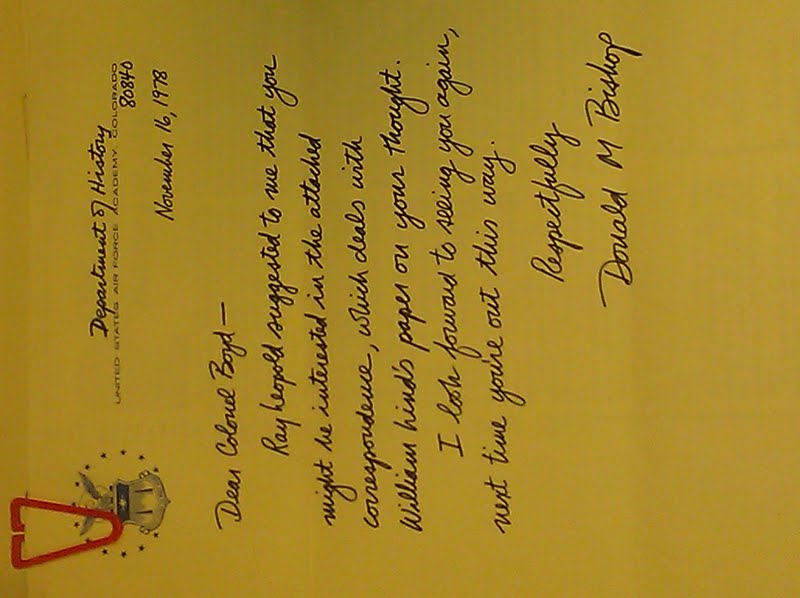
A special mention should be made of the trip to the Al Gray Research Center which houses the papers and books of Col. John Boyd. Earlier, Colonel GI Wilson, had entertained us with the backstory of how the USMC, under the aegis of Lt. General Paul Van Riper, really acquired the Boyd collection for Quantico, with the added bonus of sticking it to the US Air Force. Mary Ellen Boyd also spoke movingly of that time, when her father was dying of cancer, when the Marines arrived at her parents small condo and carefully photographed and removed years of research, notes, briefing papers and books.

The archivist discussed the transfer, organization and presentation of the collection, John Boyd’s exhaustive marginalia and notations ( Boyd’s heavily marked up copy of On War was on display, which I picked up and perused) and the contents of the briefing files and papers. We dug in to all of these. The Al Gray Center, it must be said, is much larger than the Boyd archive and is a first rate facility with a professional staff ready to assist scholars and students in their research of military history. It is a must see if you visit Quantico.
The practitioners and scholars also gave some stimulating talks:

Marshall Wallace, a Quaker humanitarian NGO activist and Director of the Do No Harm Project. While a pacifist is seemingly an odd choice at a conference devoted to a military strategist, Marshall’s themes and ideas regarding decision dynamics in conflict zones were very warmly received by the audience and recognized as being strongly congruent as he illustrated how aid and aid workers, blindly inserted, can aggravate or extend conflicts ( an idea partly explored in The Five Percent: Finding Solutions to Seemingly Impossible Conflicts).

Wiliam McNulty, the co-founder of Team Rubicon gave a very inspiring talk about reintegrating veterans through “first-in” humanitarian missions to remote areas of current conflict zones, getting there long before the less nimble but heavyweight NGO’s can take over.

Pete Turner, a co-author of 29 Articles with 75 months of deployment in the field in Iraq and Afghanistan, in various capacities for the DoD and USG, gave a rapid-fire talk on transition operations being a different breed of animal from COIN. stressing “cultural acuity” and aggressively building up the role of the host nation partner. “Wasta is for the host nation [official]” Turner stated ” If you can’t talk transition, you can’t do COIN”. Turner dismissed our current efforts at cultural awareness and language programs as “Disneyland training” – a point that was strongly seconded (if not more robustly) by a later speaker, former intelligence officer and CORDS program official Tom Hayden, who compared American COIN efforts in Vietnam and Afghanistan.

Dr. Katya Drozdova: The former Hoover Institution Fellow gave a provocative talk about partitioning Afghanistan along ethnosectarian lines – or at least moving from a strong central government to a looser federation with autonomy for major Afghan demographic groups.

Gahlord Dewald, a social media expert and strategist, spoke on the theme of “dreadful efficiency” :

….Dreadful efficiency occurs whenever the path of energy or interest or attention is so straight and so clear that there is no room for the survival of anything else. It’s like the difference between a city water main and a stream. The water main may pass thousands of gallons of water for years before any significant life takes hold in the pipes. The stream would be supporting life within days.

Chris Cox, a British political consultant did an excellent analysis of strategic political dynamics – including recent American political history – something that I think rattled some of the audience members, much to my amusement. If I was ever running for political office, I’d hire Chris in a heartbeat.

Adam Elkus gave one of the best talks of the conference, on par with Chet Richards and Venkat Rao’s in terms of depth, speaking on “OODA and Robotic Weapons“. Leading with “The metaphor is not Terminator but Starcraft”, Elkus held the audience’s rapt attention as he dismantled a great deal of popular rubbish regarding drones and pointed to the larger, strategic implications of the deployment of autonomous systems within the larger operational context. I first met Adam at the Boyd Conference in 2007 and it has been a pleasure watching him mature into a first rate scholar and thinker on defense issues.

Afterwards, we closed Boyd & Beyond 2012 by enjoying great food and adult beverages at Scott Shipman’s. A wonderful time being had by all.

See you in 2013!



Switch to our mobile site